
Fire Risk Prioritisation: How to Rank Hazards by Urgency
Discover how to identify, evaluate and prioritise workplace fire hazards using practical risk assessment methods, severity indicators and effective control strategies.

Fire safety is not simply about identifying hazards. Organisations must also understand which hazards require immediate attention, which risks need planned corrective action and which existing controls must be maintained. When several fire hazards are identified during a workplace inspection, treating every issue with the same level of urgency can lead to inefficient decisions and potentially serious safety consequences.
Fire risk prioritisation provides a structured approach to deciding which fire hazards should be addressed first. It helps employers, facilities managers, fire safety officers and responsible persons evaluate the likelihood of a fire, the potential consequences, the people exposed and the effectiveness of existing precautions.
For example, a blocked emergency exit, a damaged electrical installation and poorly stored combustible materials may all represent fire safety concerns. However, their urgency depends on the circumstances, including occupancy, escape arrangements, ignition potential and the possibility of rapid fire spread.
Effective prioritisation ensures that immediate life-safety concerns are not overlooked while organisations develop a realistic programme for addressing other deficiencies. It also helps management teams allocate resources, assign responsibilities and monitor improvements.
What is fire risk prioritisation?
Fire risk prioritisation is the systematic process of ranking identified fire hazards according to their likelihood of causing a fire, potential severity, exposure of people, effectiveness of existing controls and urgency of corrective action. It enables organisations to address the most serious risks first while maintaining a documented programme for managing remaining hazards.
This guide explains how to rank workplace fire hazards by urgency, use a fire risk matrix, develop an effective action plan and understand relevant UK fire safety responsibilities.
What Is Fire Risk Prioritisation and Why Does It Matter?
Fire risk prioritisation is a decision-making process used to determine the order in which identified fire hazards and safety deficiencies should be controlled. Rather than relying on a general list of observations, organisations evaluate the level of danger associated with each finding and decide what action is necessary, who should take responsibility and how quickly the issue must be resolved.
The process forms an important part of effective fire risk management. A fire risk assessment identifies hazards and evaluates risks, while prioritisation helps translate the assessment findings into an organised programme of corrective action.
The difference between fire hazard identification and risk prioritisation
Hazard identification involves recognising conditions or activities that could contribute to a fire or increase its consequences. Risk assessment examines the likelihood of an incident and the potential harm it could cause. Prioritisation then determines the relative urgency of addressing the findings.
| Activity | Main purpose | Workplace example |
|---|---|---|
| Hazard identification | Recognise potential sources of danger. | Finding damaged electrical equipment. |
| Risk assessment | Evaluate likelihood and consequences. | Assessing the possibility of ignition and exposure. |
| Risk prioritisation | Determine which findings require earlier action. | Escalating a serious electrical hazard for immediate control. |
| Risk control | Remove or reduce the identified danger. | Isolating unsafe equipment and arranging competent repair. |
| Monitoring and review | Confirm that controls remain effective. | Inspecting equipment and reviewing the assessment. |
Why prioritising fire hazards is important
Organisations can identify multiple deficiencies during one inspection. Without a consistent prioritisation system, managers may focus on minor housekeeping issues while more serious problems remain unresolved.
Protection of human life
Prioritisation highlights hazards that could threaten occupants, visitors, contractors and people who may need additional assistance during evacuation.
Better resource allocation
Management can direct maintenance teams, specialist contractors and available budgets towards the most urgent corrective actions.
Improved legal management
Documented decisions help responsible persons demonstrate how assessment findings are being managed and reviewed.
Business continuity
Effective controls can reduce the potential for fire-related disruption, asset damage and interruption to essential operations.
How prioritisation supports a proactive safety culture
Fire risk prioritisation encourages organisations to move beyond reacting to incidents. Regular inspections, staff reporting, equipment maintenance and management reviews help identify developing problems before they result in emergencies.
It also creates clearer communication between departments. A facilities manager can communicate the urgency of a blocked fire exit, while a maintenance manager can organise the technical response to a defective electrical installation. Senior management can then monitor progress and provide appropriate resources.
Organisations seeking to strengthen their understanding of workplace assessment methods can explore the ICTQual AB Level 3 Award in Fire Safety Risk Assessment and Control.
Understanding the Key Factors in Fire Risk Prioritisation
Effective fire risk prioritisation requires more than identifying whether a hazard is present. Each finding must be considered in relation to the conditions of the premises, the people exposed and the effectiveness of existing fire precautions.
Five important factors can help organisations develop a consistent approach.
Likelihood of fire occurring
Likelihood refers to how probable it is that a fire could start under the conditions observed. This involves considering ignition sources, combustible materials, workplace activities, equipment condition and existing preventive measures.
For example, a workplace with regularly inspected electrical equipment, suitable maintenance procedures and good housekeeping may have a different ignition risk from an area containing damaged electrical connections, overloaded equipment and combustible waste.
Factors to consider include:
- Condition and maintenance of electrical installations and appliances.
- Presence of uncontrolled heat sources or naked flames.
- Hot work activities, welding, cutting and grinding.
- Storage and handling of flammable liquids and gases.
- Smoking arrangements and potential sources of deliberate ignition.
- Accumulation of combustible waste, dust and packaging.
Potential severity of consequences
Severity considers what could happen if a fire develops. A relatively small ignition event may have serious consequences where people are exposed, escape routes are inadequate or fire and smoke can spread rapidly.
Assessors should consider potential injuries, fatalities, smoke exposure, structural damage and the effect on adjoining areas. The assessment should not focus only on the size of the initial hazard.
Number and vulnerability of people exposed
The potential consequences of fire depend significantly on who occupies the premises and whether everyone can respond and evacuate safely.
Particular attention should be given to:
- Children, older people and individuals with disabilities.
- People with mobility, hearing or visual impairments.
- Employees working alone or in isolated areas.
- Visitors and contractors unfamiliar with the premises.
- Temporary workers who may not understand emergency arrangements.
- People sleeping on the premises or working during night shifts.
The responsible person should consider suitable arrangements for people who may need assistance. An evacuation strategy must reflect the actual building, occupancy and individual requirements.
Effectiveness of existing fire precautions
A hazard may present a different level of risk depending on the controls already in place. Assessors should examine whether preventive and protective measures are suitable, available and properly maintained.
Important precautions include fire detection and alarm systems, emergency lighting, escape routes, fire doors, compartmentation, appropriate equipment and staff training.
The presence of a fire alarm does not automatically make every fire hazard acceptable. Existing controls must be evaluated for their suitability and effectiveness.
Urgency and potential for deterioration
Some hazards require immediate action because their consequences could become serious without warning. Other findings may be managed through planned maintenance, provided interim controls are suitable and the delay does not create an unacceptable risk.
For example, a fire exit that is obstructed during working hours needs prompt clearance. A damaged fire door that compromises a protected escape route may require urgent assessment and repair. A minor documentation deficiency may be addressed through a controlled administrative action, provided the necessary safety arrangements are already effective.
Important principle: Prioritisation should reflect the actual danger to people. A numerical score must never override a clear need for immediate action, and legal requirements cannot be postponed simply because a hazard receives a lower numerical rating.

How to Identify and Assess Workplace Fire Hazards
Accurate prioritisation begins with reliable hazard identification. If an assessment overlooks an important ignition source, combustible material or escape-route deficiency, the resulting priority ranking may not reflect the actual workplace risk.
Inspect the workplace systematically
Organisations should inspect all relevant areas rather than concentrating only on obvious operational spaces. The inspection should reflect the building layout, activities, occupancy and potential fire development pathways.
Areas to examine may include:
- Offices, meeting rooms and reception areas.
- Production floors and industrial processing areas.
- Warehouses and storage facilities.
- Kitchens, staff rooms and catering areas.
- Electrical rooms, plant rooms and service cupboards.
- Loading bays, workshops and maintenance areas.
- Temporary workplaces, construction areas and external storage locations.
- Corridors, stairways, protected routes and final exits.
Identify ignition sources
Ignition sources are conditions or equipment capable of starting a fire. Their significance depends on their condition, use and proximity to combustible materials.
Examples include electrical faults, heating equipment, cooking appliances, hot work, smoking materials and machinery that generates heat.
Identify combustible materials and fuel sources
Fuel includes materials that can burn and contribute to fire development. Common workplace examples include paper, cardboard, textiles, packaging, wood, certain chemicals and flammable liquids.
Assessors should examine storage arrangements, quantities, separation from ignition sources and the potential for fire to spread between materials or areas.
Examine oxygen and ventilation conditions
Oxygen supports combustion. Normal atmospheric oxygen is present in most workplaces, but additional oxygen supplies and unusual ventilation conditions may influence fire behaviour.
Special attention may be required in premises where oxygen cylinders, industrial gases or specialist processes are used. These arrangements should be assessed by competent personnel who understand the relevant hazards.
Assess fire detection and escape arrangements
Hazard identification should also consider whether existing arrangements would provide adequate warning and allow people to escape safely.
Inspect fire alarm arrangements, emergency lighting, exit signage, escape-route availability, door operation and the condition of fire doors. Check whether evacuation arrangements are appropriate for all relevant occupants.
Record findings with supporting evidence
Each identified finding should be recorded clearly. A useful record includes the location, nature of the hazard, people potentially affected, existing controls, assessment findings and recommended corrective action.
Photographs, inspection records, maintenance documents and staff observations can provide supporting evidence. However, photographs should not replace a proper assessment of the surrounding conditions.
For a broader understanding of workplace hazards, see our guide to workplace fire hazards and common causes of fire.
How to Rank Fire Hazards by Urgency and Severity
Once hazards have been identified, organisations need a consistent method for deciding which findings require the earliest attention. A practical approach is to combine a severity assessment with an evaluation of likelihood, exposure and the reliability of existing controls.
Establish clear priority categories
Organisations can use a four-level action classification to communicate urgency. These categories are an illustrative management framework, not statutory ratings prescribed by UK fire safety legislation.
| Priority | Description | Expected management response |
|---|---|---|
| Critical | Immediate or potentially imminent danger to life, or a major failure of essential fire precautions. | Take immediate protective action, escalate and arrange urgent competent intervention. |
| High | Serious deficiency that could significantly increase fire likelihood or consequences. | Arrange prompt corrective action and effective interim controls. |
| Medium | Identified deficiency requiring planned action and monitoring. | Assign an owner, target date and suitable control measures. |
| Low | Lower-priority improvement or minor deficiency where existing precautions remain effective. | Include in routine improvement and review arrangements. |
Consider the relationship between likelihood and severity
A hazard with a relatively low likelihood may still require a high priority if the potential consequences are catastrophic. Similarly, a recurring hazard may require attention even where individual incidents have historically caused little harm.
Consider two examples:
Example one: A damaged electrical cable is being used close to combustible packaging. The condition creates a credible ignition concern, and the surrounding fuel could contribute to fire development. The equipment should be taken out of use where unsafe, and competent inspection and corrective action should be arranged.
Example two: A minor defect in a non-critical administrative record is identified. If the actual safety measures are effective, this may be managed through a planned documentation improvement. The finding must still be addressed appropriately.
Account for exposure and existing safeguards
Risk ranking should consider whether people are present near the hazard, how many could be affected and whether escape arrangements would remain effective during an emergency.
For example, a fire hazard near a single-access escape route may deserve greater attention than a comparable hazard in an area with different exposure conditions. The assessor must examine the full circumstances rather than relying on the physical size of the hazard alone.
Set realistic action deadlines
Action deadlines should be based on the assessed risk, legal requirements and the time needed to implement an effective control. A target date is not permission to leave an unacceptable hazard uncontrolled until that date.
Where permanent corrective work cannot be completed immediately, suitable interim arrangements should be introduced and monitored. If adequate safety cannot be maintained, the affected activity or area may need to be stopped or restricted until the danger is controlled.
A Step-by-Step Process for Effective Fire Risk Prioritisation
A consistent process helps organisations convert inspection findings into practical decisions. The following method can be incorporated into routine workplace fire safety management and action-plan reviews.
-
Complete a suitable fire risk assessment.
Examine the premises, activities, ignition sources, combustible materials, people at risk and existing fire precautions. Make sure the assessment reflects the actual conditions of the workplace.
-
Record all identified hazards and deficiencies.
Document the location, nature of the problem, supporting observations and potential consequences. Avoid vague descriptions that make corrective action difficult to understand.
-
Evaluate likelihood and potential harm.
Consider how a fire could start, how it could develop, who may be affected and whether existing precautions are adequate. Identify circumstances that could increase the severity of an incident.
-
Assign an appropriate priority.
Classify findings using a consistent organisational system. Escalate immediate dangers and essential fire safety failures without waiting for routine management approval cycles.
-
Determine appropriate corrective measures.
Decide whether the hazard can be eliminated, isolated, reduced or controlled through engineering, maintenance, operational or organisational measures.
-
Allocate responsibility and resources.
Identify the person responsible for completing the action, the specialist support required and any funding or equipment necessary.
-
Set deadlines and introduce interim controls.
Specify completion dates according to urgency. Where a permanent solution requires time, establish appropriate temporary controls and monitor them.
-
Verify that corrective actions are effective.
Inspect completed work, obtain relevant maintenance records and confirm that the original risk has been adequately controlled.
-
Review and update the assessment.
Update records when significant changes occur, following an incident or near miss, or when the effectiveness of existing controls needs reassessment.
Developing a practical fire risk action plan
A fire risk action plan should connect each finding to a clear decision and an accountable person. It should be specific enough for management teams and contractors to understand exactly what needs to happen.
| Action-plan field | Information to record |
|---|---|
| Reference number | Unique identifier for each finding. |
| Location | Exact area, floor, room or workplace section. |
| Hazard description | Clear explanation of the identified deficiency. |
| Risk priority | Critical, high, medium or low according to the assessment framework. |
| Recommended action | Specific corrective or preventive measure. |
| Responsible person | Named role or accountable individual. |
| Target date | Deadline reflecting urgency and applicable requirements. |
| Completion evidence | Inspection record, work order, certificate or other suitable evidence. |
| Review status | Open, in progress, completed or subject to further verification. |
Management should review outstanding critical and high-priority actions regularly. Overdue findings should be escalated, and the reasons for delay should be recorded alongside any additional controls required.
How to Use a Fire Risk Matrix to Prioritise Hazards
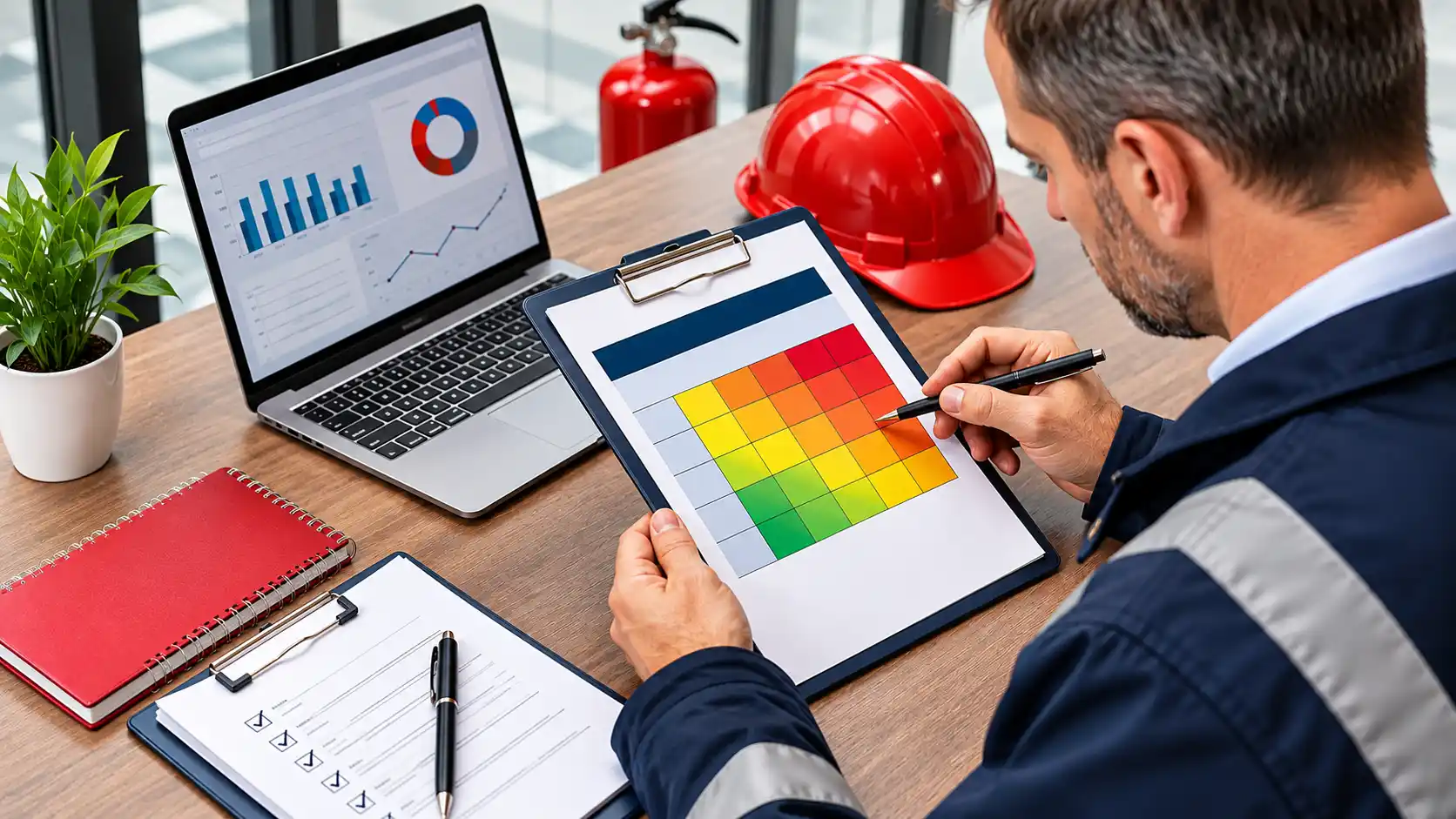
A fire risk matrix is a visual decision-support tool that helps organisations compare the likelihood of an incident with its potential consequences. It can make assessment findings easier to communicate and help management teams identify which issues deserve greater attention.
A matrix should support professional judgement rather than replace it. Its scoring method must be suitable for the workplace and must not be treated as a substitute for legal duties, technical assessment or competent advice.
Understand likelihood ratings
An organisation may use a five-level likelihood scale. The descriptions should be adapted to the premises and available evidence.
| Rating | Likelihood category | Illustrative interpretation |
|---|---|---|
| 1 | Rare | Unusual circumstances would be required for the event to occur. |
| 2 | Unlikely | The event is not expected under normal conditions, but remains possible. |
| 3 | Possible | The event could occur under foreseeable workplace conditions. |
| 4 | Likely | Conditions indicate a substantial possibility of occurrence. |
| 5 | Very likely | Current conditions make the event highly probable or recurring. |
Understand severity ratings
Severity describes the potential consequences if the event occurs. It should consider the people affected, the nature of possible injuries and the wider impact of the incident.
| Rating | Severity category | Illustrative interpretation |
|---|---|---|
| 1 | Insignificant | Minimal consequences with no significant harm anticipated. |
| 2 | Minor | Limited harm or disruption requiring relatively minor intervention. |
| 3 | Moderate | Potential for injury, significant disruption or localised damage. |
| 4 | Major | Potential for serious injury, substantial damage or major disruption. |
| 5 | Catastrophic | Potential for fatalities, multiple serious injuries or extensive destruction. |
Calculate an illustrative risk score
A simple scoring method multiplies the likelihood rating by the severity rating:
Risk score = Likelihood × Severity
For example, a likelihood rating of 4 and a severity rating of 5 produces an illustrative score of 20 out of 25.
The following example demonstrates how an organisation might interpret the resulting scores. These thresholds are illustrative and are not official UK statutory classifications.
| Score | Illustrative band | Management approach |
|---|---|---|
| 1–4 | Low | Monitor and maintain appropriate controls. |
| 5–9 | Moderate | Plan corrective action and monitor progress. |
| 10–16 | High | Arrange prompt corrective action and escalation. |
| 17–25 | Very High | Immediate management attention and suitable protective action. |
Illustrative 5 × 5 fire risk matrix
| Severity ↓ / Likelihood → | 1 Rare | 2 Unlikely | 3 Possible | 4 Likely | 5 Very likely |
|---|---|---|---|---|---|
| 5 Catastrophic | 5 | 10 | 15 | 20 | 25 |
| 4 Major | 4 | 8 | 12 | 16 | 20 |
| 3 Moderate | 3 | 6 | 9 | 12 | 15 |
| 2 Minor | 2 | 4 | 6 | 8 | 10 |
| 1 Insignificant | 1 | 2 | 3 | 4 | 5 |
Understand the limitations of numerical scoring
A risk score is not a complete description of fire risk. Two hazards can receive the same numerical score but require different control measures. A blocked escape route, for example, may create an immediate life-safety concern that cannot be adequately represented by a simple multiplication formula.
Scores can also create false confidence when assessors use inconsistent definitions or insufficient evidence. A matrix should therefore be supported by clear assessment criteria, documented professional judgement and a process for escalating serious findings.
Where a serious deficiency in fire precautions is identified, organisations should take the necessary protective action regardless of its calculated score.
Common Workplace Fire Hazards That Require Immediate Attention
Some workplace conditions require particularly careful assessment because they can increase the likelihood of ignition, contribute to rapid fire development or compromise people’s ability to escape.
Blocked or obstructed emergency exits
Emergency exits and escape routes must remain suitable and available for the intended evacuation strategy. Materials, equipment, deliveries and waste should not obstruct routes or prevent doors from operating correctly.
Where an escape route is obstructed, the organisation should take prompt action to restore safe access. If the affected route is essential and adequate alternative arrangements cannot be maintained, the area or activity may need to be restricted until the problem is resolved.
Damaged electrical equipment and unsafe installations
Damaged cables, defective electrical appliances, unsuitable connections and overheating equipment can create ignition risks. Electrical concerns should be assessed and addressed by appropriately competent personnel.
Unsafe equipment should not remain in use while an organisation waits for routine maintenance arrangements.
Improper storage of flammable substances
Flammable liquids, gases and other dangerous substances require suitable storage, handling and control arrangements. Their quantities, compatibility, ventilation, separation and proximity to ignition sources should be assessed.
Where dangerous substances are present, additional assessment considerations may apply under the relevant legislation.
Accumulation of combustible waste
Cardboard, packaging, paper, textile waste and combustible dust can increase the amount of fuel available during a fire. Poor housekeeping may also obstruct escape routes and make access to fire safety equipment more difficult.
Organisations should establish suitable waste removal schedules, storage arrangements and inspection procedures.
Hot work without adequate precautions
Welding, grinding, cutting and other hot work activities can introduce sparks, hot surfaces and ignition sources. The surrounding environment should be assessed before work begins.
Where appropriate, organisations should implement permit-to-work arrangements, combustible-material controls, suitable fire watches and post-work checks. The precise precautions should reflect the task and risk assessment.
Defective fire doors and compartmentation
Fire doors and compartmentation arrangements help restrict the spread of fire and smoke. Damaged doors, missing seals, defective closers, inappropriate alterations and unsealed service penetrations can compromise their effectiveness.
Significant deficiencies should be assessed promptly, particularly where they affect protected escape routes or the separation of higher-risk areas.
Failure of fire detection and alarm arrangements
Faulty alarm systems, unavailable detectors or poor maintenance can delay warning and evacuation. Defects should be reported and assessed according to their effect on the building’s fire strategy.
Suitable temporary arrangements may be necessary while repairs are completed. Where adequate safety cannot be maintained, restrictions or alternative protective measures may be required.
Read our related guide to fire risk assessment and workplace fire safety management for further guidance on identifying and evaluating these hazards.
Best Practices for Improving Fire Risk Prioritisation
Effective fire risk prioritisation should become part of an organisation’s normal management arrangements. It should not be treated as a one-time exercise completed only when an assessment is prepared.
Use consistent assessment criteria
Develop clear descriptions for likelihood, severity and priority categories. Ensure assessors understand how to apply these definitions and when findings must be escalated.
Consistency makes it easier to compare findings between departments, buildings and assessment periods.
Give life safety appropriate importance
Management decisions should place the protection of people at the centre of fire risk management. Property damage, insurance considerations and operational disruption are relevant, but they should never displace essential life-safety precautions.
Give particular attention to people who may face difficulties recognising an alarm, understanding instructions or evacuating independently.
Involve competent people
Fire risk assessment requires suitable knowledge, training and experience in relation to the complexity and risks of the premises. Organisations should use competent assistance where their internal knowledge is insufficient.
Technical concerns involving electrical installations, fire alarm systems, structural fire protection or specialist industrial processes may require suitably qualified specialists.
Integrate prioritisation with maintenance systems
Link fire risk assessment findings to maintenance work orders, inspection schedules and contractor management procedures. This helps ensure that corrective actions are tracked and completed rather than remaining in an assessment document.
Monitor outstanding actions
Management should review open actions, overdue deadlines, repeat deficiencies and failures of temporary controls. Repeated findings may indicate a deeper problem with supervision, maintenance or organisational procedures.
Review risks following significant changes
Changes in building layout, occupancy, processes, equipment, storage quantities or work activities can affect the original assessment. A review should be undertaken when changes may significantly affect fire risks or the effectiveness of existing precautions.
Incidents, near misses, fire alarm activations and inspection findings should also be considered when deciding whether an assessment needs updating.
Improve staff awareness and reporting
Employees often recognise developing problems before they appear in formal inspection reports. Encourage staff to report damaged equipment, obstructed exits, defective doors and unsafe storage practices.
Ensure employees understand emergency procedures and receive appropriate information and instruction. Temporary workers and contractors should also be included in relevant workplace arrangements.
Manage temporary workplaces and mobile worksites
Construction projects, temporary workspaces and mobile worksites can present changing fire hazards. Fuel storage, temporary electrical supplies, hot work, site accommodation and changing escape routes require regular attention.
Priorities should be reviewed as work progresses and site conditions change. The organisation should ensure that responsibility for fire safety remains clear when several contractors operate within the same workplace.
For more detailed guidance, read managing fire risks in temporary workplaces and mobile worksites.

UK Fire Safety Regulations and Legal Responsibilities for Risk Management
Fire risk prioritisation should operate within the applicable fire safety legislation. Organisations must understand which legal framework applies to their premises and ensure that their assessment and control arrangements meet the relevant requirements.
The precise legislation differs across England, Wales, Scotland and Northern Ireland. Organisations operating in more than one UK nation should not assume that a single legislative reference covers every location.
Regulatory Reform (Fire Safety) Order 2005
The Regulatory Reform (Fire Safety) Order 2005 is a principal framework for fire safety in non-domestic premises in England and Wales. It places duties on the responsible person to take appropriate general fire precautions and undertake a suitable and sufficient assessment of risks to relevant persons.
Article 8 addresses general fire precautions, while Article 9 establishes the risk assessment duty. The assessment must be reviewed regularly and kept up to date, including when relevant changes or other circumstances make review necessary.
Article 11 also addresses fire safety arrangements. Organisations should maintain appropriate procedures for planning, organising, controlling, monitoring and reviewing preventive and protective measures.
Read the Regulatory Reform (Fire Safety) Order 2005 on the official legislation website.
Fire Safety Act 2021
The Fire Safety Act 2021 clarified the application of the Fire Safety Order to certain features of multi-occupied residential buildings, including structure, external walls and flat entrance doors. These matters can be relevant when responsible persons assess fire risks in buildings containing multiple domestic premises.
Organisations responsible for such buildings should consider the relevant scope of the legislation and the associated government guidance.
Official reference: Fire Safety Act 2021.
Fire Safety (England) Regulations 2022
The Fire Safety (England) Regulations 2022 introduced additional requirements for responsible persons in certain residential buildings in England. Requirements vary according to building characteristics and include specific arrangements relating to information, fire doors and firefighting equipment.
Responsible persons should establish which requirements apply to their buildings and incorporate relevant findings into their fire safety management arrangements.
Official reference: Fire Safety (England) Regulations 2022.
Building Safety Act 2022
The Building Safety Act 2022 introduced wider changes to building safety regulation in England and Wales. Its provisions are particularly relevant to the management and regulation of higher-risk residential buildings and the wider building safety framework.
Responsible persons should understand the interaction between applicable building safety duties and fire safety management requirements.
Official reference: Building Safety Act 2022.
Fire safety legislation in Scotland
Scotland has its own fire safety legislative framework. The Fire (Scotland) Act 2005 and the Fire Safety (Scotland) Regulations 2006 are important references for fire safety duties in relevant non-domestic premises.
Employers and other duty holders should consult Scottish government and Scottish Fire and Rescue Service guidance to understand the requirements applicable to their premises.
Official reference: Fire (Scotland) Act 2005.
Fire safety legislation in Northern Ireland
Northern Ireland operates a separate framework that includes the Fire and Rescue Services (Northern Ireland) Order 2006 and the Fire Safety Regulations (Northern Ireland) 2010.
Businesses and other organisations should consult Northern Ireland Fire and Rescue Service guidance to establish their responsibilities and applicable fire safety requirements.
Official resource: Northern Ireland Fire & Rescue Service – Business Fire Safety.
Who is responsible for workplace fire safety?
In premises covered by the Fire Safety Order, the responsible person is generally the employer, owner, landlord, occupier or another person with control of the premises, depending on the circumstances.
Where more than one responsible person has duties in relation to the same premises, they must cooperate and coordinate as required. The extent of responsibility depends on the control each person exercises.
The responsible person must ensure that appropriate risk assessment, preventive and protective measures, emergency planning, information and training arrangements are in place.
Official guidance: Fire safety in the workplace – Who’s responsible.
Government guidance for fire risk assessment
The Home Office’s five-step fire safety risk assessment checklist for England provides a useful structure for identifying hazards, identifying people at risk, evaluating and acting, recording and planning, and reviewing the assessment.
Its action-planning guidance reinforces the importance of identifying what needs to be done and by when. Organisations can use this as a starting point, while selecting the premises-specific guidance and technical support appropriate to their circumstances.
Read the official fire safety risk assessment checklist.
Legal note: This article provides general information, not legal advice. Fire safety duties depend on the premises, jurisdiction, activities and people affected. A risk matrix or internal priority category does not replace statutory requirements or professional assessment. Organisations should consult the relevant legislation, official guidance and competent fire safety professionals.
Practical Examples of Fire Risk Prioritisation in Workplace Safety
Practical examples demonstrate why fire hazards must be assessed in context. The same type of hazard can require different management responses depending on the surrounding conditions, people exposed and existing precautions.
Example one: Blocked emergency exit in an office
Identified hazard: Boxes and office equipment are stored in front of an emergency exit.
Risk considerations: Employees and visitors may be unable to use the exit quickly during an emergency. The impact may be particularly serious where the exit forms part of the intended evacuation strategy.
Priority decision: High or critical, depending on the building’s escape arrangements and available alternative routes.
Corrective action: Remove the obstruction immediately, prevent further storage in the area and introduce regular escape-route inspections. If safe evacuation cannot be maintained, restrict use of the affected area until suitable arrangements are restored.
Example two: Damaged electrical equipment in a warehouse
Identified hazard: A damaged electrical cable is being used near cardboard packaging.
Risk considerations: The damaged equipment could create an ignition source, while the nearby packaging provides combustible fuel.
Priority decision: High, potentially critical depending on the condition of the equipment and surrounding conditions.
Corrective action: Stop using the unsafe equipment, isolate it where appropriate and arrange competent inspection and repair or replacement. Review storage arrangements and check similar equipment.
Example three: Poor storage of flammable liquids in a workshop
Identified hazard: Flammable liquids are stored close to a hot work area without adequate controls.
Risk considerations: Sparks and heat may ignite vapours or combustible materials. The consequences depend on the substances, quantities, storage arrangements and surrounding workplace activities.
Priority decision: High or critical depending on the substances and exposure conditions.
Corrective action: Stop or control the conflicting activities, establish appropriate separation and storage arrangements, and review the relevant dangerous-substance and hot-work procedures. Obtain competent specialist advice where necessary.
Example four: Defective fire door in a commercial building
Identified hazard: A fire door does not close correctly and has damaged components.
Risk considerations: The door may not provide the intended protection against the spread of fire and smoke. The seriousness depends on its location and role in the building’s fire strategy.
Priority decision: High where the door protects a critical escape route or compartmentation boundary.
Corrective action: Arrange appropriate inspection and repair by competent personnel, assess interim arrangements and verify that the door performs as intended after completion.
Example five: Accumulated combustible waste in a production area
Identified hazard: Combustible packaging and production waste have accumulated near equipment.
Risk considerations: The amount of available fuel has increased, and waste may obstruct access to equipment or escape routes.
Priority decision: Medium to high depending on the ignition sources, quantities and proximity to people.
Corrective action: Remove waste safely, introduce suitable disposal arrangements, improve housekeeping supervision and establish routine inspections.
Example six: Temporary construction workplace
Identified hazard: Temporary electrical supplies, hot work activities and combustible materials are present in a changing work environment.
Risk considerations: Work activities and site arrangements may change frequently. Contractors may use different areas, and escape routes can be affected by ongoing construction.
Priority decision: Determined by the actual conditions and potential consequences, with urgent escalation for unsafe hot work, uncontrolled ignition sources or compromised escape arrangements.
Corrective action: Coordinate contractor activities, implement suitable permit-to-work arrangements where necessary, inspect temporary supplies, control combustible storage and review the fire risk assessment as the project changes.
Comparison of practical prioritisation decisions
These examples are illustrative rather than fixed priority ratings. The final decision must be based on the actual premises, risk assessment findings, applicable requirements and professional judgement.
Conclusion: Making Fire Risk Prioritisation Part of Workplace Safety Management
Fire risk prioritisation is an essential part of an effective workplace fire safety management system. It helps organisations understand which hazards demand immediate attention, which deficiencies require planned corrective action and how existing controls should be monitored.
A reliable approach begins with a suitable and sufficient fire risk assessment. Organisations must identify ignition sources, combustible materials, people at risk and weaknesses in existing precautions. They should then evaluate likelihood, potential severity, exposure and the urgency of corrective measures.
Fire risk matrices and priority categories can support consistent decision-making, but they should never replace competent judgement or statutory responsibilities. Immediate life-safety concerns must be addressed promptly, and interim controls should be established whenever permanent corrective work cannot be completed straight away.
Most importantly, prioritisation should be an ongoing management activity. Regular inspections, employee reporting, maintenance, action tracking and periodic reviews help organisations respond to changing conditions and maintain effective fire precautions.
By adopting a structured and evidence-based approach, businesses can improve workplace fire safety, support responsible decision-making and develop a stronger culture of fire prevention and risk control.
Develop Your Fire Safety and Risk Assessment Knowledge
Professional knowledge of fire hazard identification, risk assessment, prioritisation and control can support individuals involved in workplace safety and fire prevention. Explore the following learning opportunities to develop your understanding of fire safety management.
ICTQual AB Level 3 Award in Fire Safety Risk Assessment and Control
Explore the principles of hazard identification, risk evaluation and workplace fire safety control.
View course detailsProQual Level 4 Award in Advanced Fire Risk Assessment
Explore advanced fire risk assessment learning and professional development opportunities.
View course detailsICTQual Level 3 Diploma in Industrial Fire Safety Management
Develop knowledge relevant to fire safety management in industrial workplace environments.
View course detailsICTQual Level 3 Award in Fire Safety
Build an understanding of workplace fire safety principles, prevention and emergency arrangements.
View course detailsFrequently Asked Questions About Fire Risk Prioritisation
What is fire risk prioritisation?
Fire risk prioritisation is the process of ranking identified workplace fire hazards according to their likelihood, potential severity, exposure of people, existing precautions and urgency. It helps organisations decide which corrective actions should be addressed first.
How do you rank fire hazards by urgency?
Identify each hazard, assess the likelihood of fire and potential consequences, consider people exposed and evaluate existing controls. Assign a suitable priority category, establish corrective measures and set deadlines that reflect the actual risk. Immediate dangers require immediate protective action.
What factors influence fire risk prioritisation?
Important factors include ignition likelihood, combustible materials, potential fire spread, severity of harm, occupancy, vulnerable people, escape arrangements, fire protection measures and the urgency of corrective action.
What is a fire risk matrix?
A fire risk matrix is a decision-support tool that compares likelihood and severity ratings to help assess and communicate risk levels. It can support workplace prioritisation when used with consistent criteria and professional judgement.
What is the difference between fire risk assessment and prioritisation?
Fire risk assessment identifies hazards, people at risk and the potential consequences of fire. Prioritisation uses the assessment findings to decide the relative urgency of corrective actions and allocate resources appropriately.
Which workplace fire hazards should be addressed first?
Hazards creating immediate danger to people or compromising essential fire precautions require urgent attention. Examples may include obstructed escape routes, unsafe electrical equipment, uncontrolled ignition sources and serious failures of fire protection arrangements. The actual priority depends on the circumstances.
Can a low-probability fire hazard still be high priority?
Yes. A hazard with a relatively low likelihood may still require urgent attention where the potential consequences are catastrophic, people are particularly vulnerable or essential protective measures are compromised.
How often should fire risk prioritisation be reviewed?
It should be reviewed as part of regular fire safety management and whenever relevant changes, incidents, near misses or new information could affect the assessment. The responsible person must ensure that the fire risk assessment is reviewed regularly and kept up to date under the applicable legislation.
Who is responsible for prioritising workplace fire risks?
The responsible person has the relevant fire safety duties under the applicable legislation. Managers, facilities teams, competent fire risk assessors and other appointed personnel may support the process according to their responsibilities and competence.
Why is documentation important in fire risk prioritisation?
Documentation records identified hazards, assessment decisions, assigned responsibilities, corrective measures and completion evidence. It helps organisations monitor outstanding actions, communicate safety concerns and demonstrate how fire risks are being managed.
Does a fire risk matrix guarantee legal compliance?
No. A matrix is only a decision-support tool. It does not replace a suitable and sufficient fire risk assessment, applicable legal duties, appropriate control measures or competent professional advice.
Strengthen Your Fire Safety Knowledge
Explore professional fire safety and risk assessment learning opportunities designed to develop knowledge of workplace hazards, fire prevention, risk control and effective safety management.
Explore Fire Safety QualificationsEditorial note: This guide is for general educational purposes and should be read alongside current legislation and official fire safety guidance. Organisations should obtain competent advice where the complexity or level of risk requires it.
| Workplace finding | Potential concern | Suggested management focus |
|---|---|---|
| Blocked emergency exit | Delayed evacuation. | Immediate clearance and verification. |
| Damaged electrical cable | Potential ignition. | Stop unsafe use and obtain competent repair. |
| Uncontrolled flammable storage | Fire development and spread. | Control substances and ignition sources. |
| Defective fire door | Compromised fire and smoke separation. | Urgent inspection and appropriate repair. |
| Accumulated packaging | Increased combustible load. | Remove waste and improve housekeeping. |
| Temporary site hazards | Changing risk conditions. | Coordinate activities and reassess regularly. |