
Fire Risk Assessment: Step-by-Step Guide for UK Workplaces
Understand how to identify fire hazards, protect employees and visitors, evaluate existing precautions, prepare an effective action plan and maintain workplace fire safety through regular reviews.

Fire safety is an essential responsibility for every organisation that operates a workplace, commercial building or other non-domestic premises. A fire can develop rapidly, threaten lives, damage property, interrupt business operations and create serious legal and financial consequences. Employers and those responsible for managing premises therefore need effective arrangements to prevent fires and protect people if an emergency occurs.
A fire risk assessment provides the foundation for these arrangements. It is a structured examination of a building, its activities, potential fire hazards, the people who may be affected and the precautions needed to reduce risks. It helps organisations understand whether their current fire safety arrangements are suitable and identify where improvements are necessary.
However, completing an assessment involves more than walking through a building and checking whether fire extinguishers are present. A suitable assessment considers ignition sources, combustible materials, escape routes, fire detection, warning systems, emergency lighting, fire doors, evacuation procedures, staff training and the needs of people who may require additional assistance.
This guide explains how to carry out a fire risk assessment at work, the five main assessment stages, the responsibilities of the responsible person, documentation requirements and the circumstances that should trigger a review. It is designed to help UK workplace managers and safety professionals understand the process and make more informed decisions.
- Identify fire hazards.
- Identify people at risk.
- Evaluate, remove or reduce risks and protect people.
- Record findings, prepare an emergency plan and provide information, instruction and training.
- Review the assessment and update it when necessary.
What Is a Fire Risk Assessment?
A fire risk assessment is a systematic examination of premises, activities and working arrangements to identify fire hazards, evaluate the risks to people and determine the precautions required to prevent fires and minimise harm.
It examines both the likelihood of a fire occurring and the potential consequences if one develops. The purpose is not simply to identify dangerous equipment. It is to establish whether the organisation has appropriate prevention, detection, warning, escape, firefighting and emergency management arrangements.
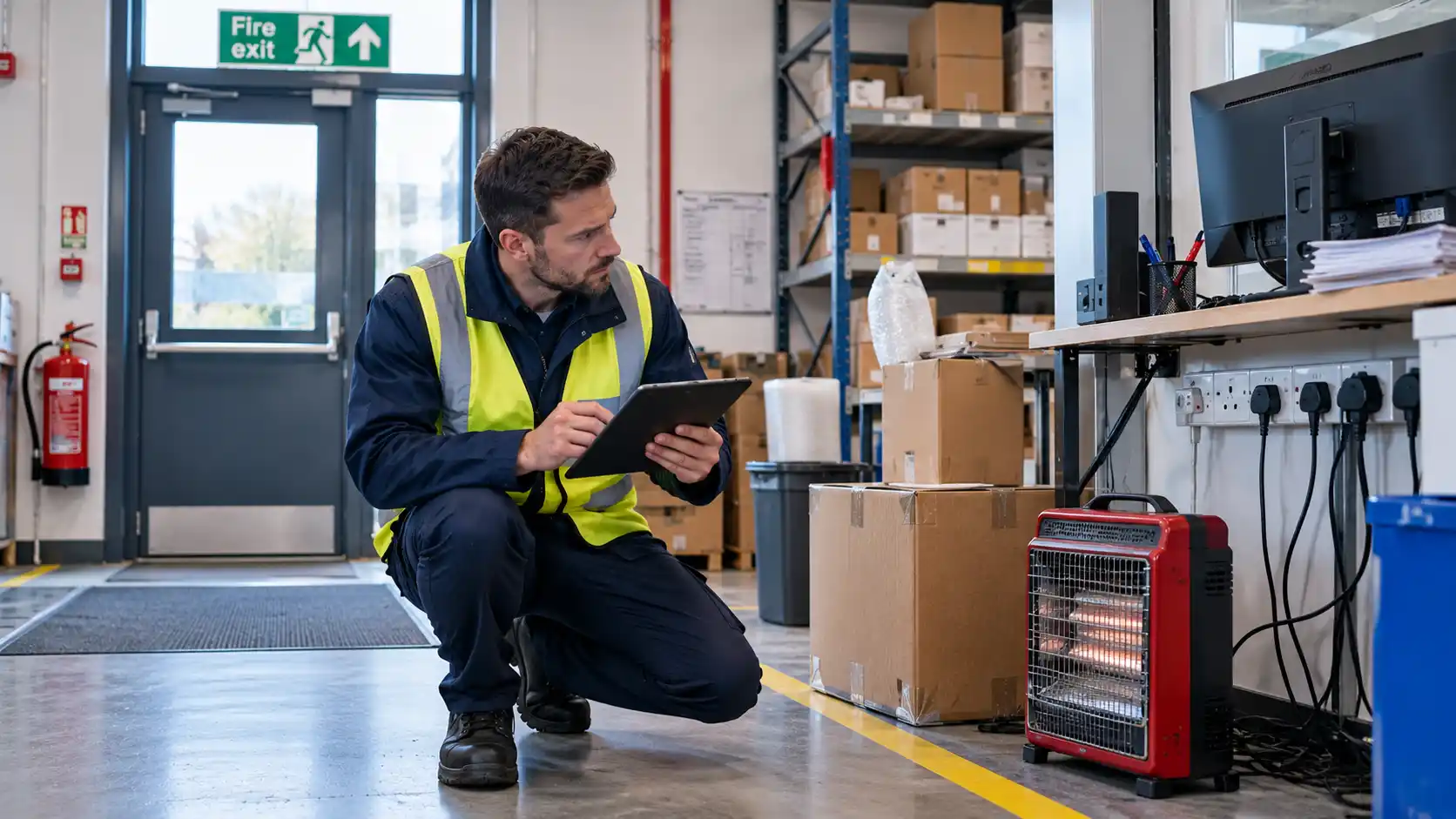
For example, an office assessment may identify overloaded electrical sockets, portable heaters positioned near paper storage, obstructed escape routes or fire doors that do not close properly. A manufacturing facility may present additional hazards associated with machinery, welding, flammable liquids, combustible dust and industrial processes.
Every workplace has its own risk profile. A small office, warehouse, restaurant, school, care facility and construction site cannot automatically use identical fire safety arrangements. The assessment must reflect the actual building, its occupancy, activities and foreseeable emergency conditions.
What Does an Assessment Examine?
A comprehensive workplace assessment normally considers the following areas:
- Fire prevention: Measures that reduce the likelihood of ignition and prevent combustible materials from coming into contact with ignition sources.
- Fire detection: Whether suitable systems are available to identify a fire at an appropriate stage.
- Warning arrangements: Whether occupants can receive a clear and effective warning.
- Escape routes: Whether people can leave the premises safely and reach a suitable place of safety.
- Emergency lighting: Whether escape routes can be identified if normal lighting fails.
- Fire doors and compartmentation: Whether measures designed to restrict fire and smoke spread are maintained.
- Firefighting equipment: Whether appropriate equipment is provided, maintained and suitable for the identified risks.
- Emergency procedures: Whether employees understand what to do when an alarm sounds.
- Management arrangements: Whether inspections, maintenance, training and reviews are organised effectively.
The outcome should be a clear understanding of the risks and a practical plan for controlling them.
UK Fire Risk Assessment: Legal Requirements and Responsibilities
Fire safety requirements depend on where a workplace is located. Organisations must identify the legislation and guidance applicable to their premises rather than assuming that one set of rules applies throughout the United Kingdom.
England and Wales
For most non-domestic premises in England and Wales, the principal legislation is the Regulatory Reform (Fire Safety) Order 2005. It establishes duties for the responsible person, including carrying out a suitable and sufficient fire risk assessment, implementing appropriate fire precautions and maintaining arrangements to protect relevant persons.
The legislation covers workplaces, commercial premises, premises accessible to the public and relevant common areas of multi-occupied residential buildings.
The assessment must be suitable and sufficient for the premises. This means that its scope and detail should reflect the actual hazards, building arrangements, activities and people who may be affected.
Recording Requirements
An important legal development is Section 156 of the Building Safety Act 2022, which amended the Fire Safety Order. From 1 October 2023, responsible persons must record their completed fire risk assessment in full, including its findings, and record their fire safety arrangements. The previous limitations based on employing five or more people no longer determine whether the assessment must be recorded.
Where an external fire risk assessor is appointed, the responsible person should also record the assessor’s name and, where applicable, their organisation.
These requirements make documentation an essential part of workplace fire safety management. Organisations should retain their assessment, supporting records, action plans and review history in an accessible form.
Scotland and Northern Ireland
Scotland operates under its own fire safety legislation, including the Fire (Scotland) Act 2005 and associated Fire Safety (Scotland) Regulations 2006. The Scottish Fire and Rescue Service provides guidance on identifying hazards, evaluating risks and maintaining suitable precautions.
Northern Ireland also has a separate legislative framework, including the Fire and Rescue Services (Northern Ireland) Order 2006 and the Fire Safety Regulations (Northern Ireland) 2010. Businesses should consult the Northern Ireland Fire and Rescue Service and relevant government guidance.
For further information, read our related guide: UK Fire Safety Law Explained.
Who Is Responsible for a Fire Risk Assessment?
The responsible person is the individual or organisation with legal responsibility for fire safety in relevant premises. Depending on the workplace and its management arrangements, this may be an employer, building owner, landlord, occupier or another person who has control over the premises.
In some buildings, several people may have responsibilities. For example, a commercial building may contain multiple tenants, a facilities management company, a landlord and contractors responsible for different services. Their responsibilities should be clearly understood and coordinated.
Main Responsibilities of the Responsible Person
- Ensure that a suitable and sufficient fire risk assessment is completed.
- Identify fire hazards and people who may be affected.
- Implement and maintain appropriate fire precautions.
- Provide suitable emergency procedures and evacuation arrangements.
- Ensure employees receive relevant fire safety information, instruction and training.
- Arrange maintenance and testing of relevant fire safety systems and equipment.
- Coordinate arrangements with other responsible persons where premises are shared.
- Keep the assessment and associated fire safety arrangements properly recorded.
- Review the assessment when circumstances change and at appropriate intervals.
Can an Employer Appoint an External Assessor?
Yes. An organisation can appoint a competent external fire risk assessor to complete or support its assessment. This can be particularly valuable where premises are complex, contain specialist hazards or require a level of technical knowledge that the organisation does not have internally.
However, appointing a consultant does not automatically transfer the responsible person’s legal duties. The responsible person remains accountable for ensuring that suitable fire safety arrangements are implemented and maintained.
Managers should therefore understand the assessor’s findings, agree priorities, allocate responsibilities and monitor the completion of corrective actions.
How to Carry Out a Fire Risk Assessment at Work: The Five Main Steps
The five-step approach provides a practical structure for examining a workplace and determining what improvements are required. Each stage should be completed carefully, with findings recorded and linked to appropriate actions.

Identify Fire Hazards
The first step is to identify anything that could start a fire or contribute to its development and spread. A practical assessment should consider three essential elements: ignition sources, fuel sources and oxygen sources.
Sources of Ignition
Ignition sources generate enough heat or energy to start a fire when they come into contact with suitable combustible material. Examples include:
- Damaged electrical cables, faulty equipment and defective appliances.
- Overloaded electrical sockets and unsuitable extension leads.
- Portable heaters and heating systems.
- Cooking equipment and hot surfaces.
- Welding, grinding and other hot work activities.
- Smoking materials, matches and naked flames.
- Machinery that produces heat, friction or sparks.
Sources of Fuel
Fuel is any material capable of burning. Common workplace examples include cardboard, paper, packaging, timber, textiles, furniture, plastics, waste materials, flammable liquids and certain gases.
Look for unnecessary combustible storage, waste accumulating near equipment, inappropriate chemical storage and materials placed close to heaters or electrical installations.
Sources of Oxygen
Oxygen is normally available through the surrounding air. Some workplaces also use oxygen cylinders or other oxygen-enriched processes. These conditions can increase the severity of a fire if not properly controlled.
Fire doors, compartmentation and suitable storage arrangements can help restrict the movement of fire and smoke, but they must be appropriate for the building and maintained correctly.
Inspect the Entire Workplace
Do not restrict the inspection to offices or areas where employees spend most of their time. Examine kitchens, plant rooms, workshops, storage rooms, corridors, electrical cupboards, external waste areas and any spaces used by contractors.
Ask employees about recurring problems, faulty equipment, unsafe storage and activities that may not be obvious during a short inspection.
Identify People at Risk
The second step is to identify everyone who could be affected by a fire, including people who work in the building and those who visit or enter it temporarily.
Consider employees, supervisors, contractors, cleaners, maintenance staff, customers, visitors, delivery drivers and members of the public. Depending on the building, people in neighbouring premises may also be affected by a fire.
People Who May Need Additional Assistance
Some individuals may experience additional difficulties hearing an alarm, recognising an emergency or evacuating quickly. Examples include:
- People with mobility impairments.
- People with visual or hearing impairments.
- Older people and people with reduced physical capability.
- Young workers and children where relevant.
- People who are unfamiliar with the premises.
- Lone workers and night-shift employees.
- Temporary workers and contractors.
- People working in isolated or restricted areas.
The assessment should examine whether suitable arrangements are available for people who may need assistance. This may include accessible alarm arrangements, personal emergency evacuation plans where appropriate, trained assistance and suitable evacuation equipment.
Consider when different groups are present. A building occupied during the day may have a very different risk profile during evening operations, cleaning periods or weekend working.
Evaluate, Remove or Reduce Risks and Protect People
After identifying hazards and people at risk, assess whether the existing fire precautions are adequate. Consider both the likelihood of a fire occurring and the possible consequences for people if it does.
There is no single control measure that is suitable for every workplace. Decisions should be based on the premises, identified hazards, occupancy, building layout and relevant fire safety requirements.
Reduce the Likelihood of Fire
- Remove unnecessary combustible materials.
- Maintain electrical equipment and address reported defects.
- Control hot work through suitable permit and supervision arrangements.
- Provide suitable storage for flammable substances.
- Maintain good housekeeping and remove waste regularly.
- Control smoking and other ignition sources.
- Keep combustible materials away from heat-producing equipment.
Improve Fire Detection and Warning
Consider whether the fire detection and alarm arrangements are appropriate for the building and its occupants. The assessment should consider the type of premises, its size, layout, occupancy and the time available for people to respond.
Alarm systems should be suitable for the identified risks and maintained in accordance with relevant requirements and competent technical advice. Staff should understand the alarm signal and know what action to take.
Check Escape Routes and Exits
Escape routes should allow occupants to reach a place of safety without unacceptable delay or exposure to fire and smoke. Examine exit locations, travel distances, stairways, corridors, final exits and any areas that could become obstructed.
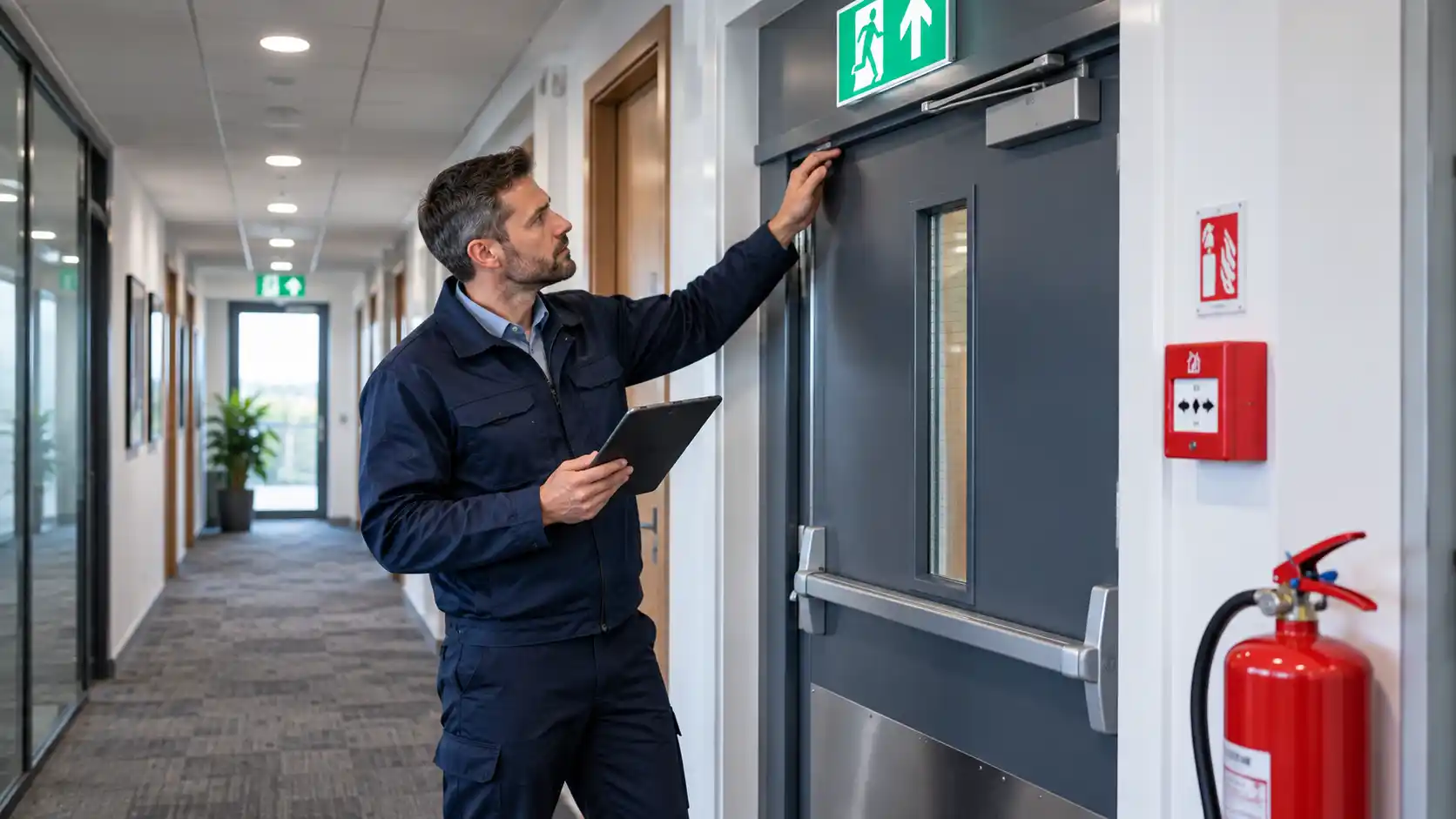
Check that doors can be opened as intended, routes are not blocked by stock or equipment, and emergency exit signs remain visible. Security arrangements must not prevent safe escape.
Inspect Fire Doors and Compartmentation
Fire doors form part of a building’s passive fire protection arrangements. Inspect their general condition, closing action, seals, glazing and hardware as appropriate. Check for damage, unauthorised alterations, missing components or obstructions that prevent proper closing.
Do not wedge fire doors open or make assumptions about their performance based only on appearance. Defects should be assessed and addressed by competent people.
Provide Suitable Firefighting Equipment
Determine whether firefighting equipment is required and whether the equipment provided is appropriate for the identified hazards. Its location, accessibility, maintenance and suitability should be considered.
Employees should not be expected to tackle a fire unless appropriate arrangements, equipment and training are in place. Evacuation and personal safety must remain the priority.
Prepare for Safe Evacuation
Develop emergency procedures that explain how occupants will be alerted, who will coordinate the response, how evacuation will take place and where people should assemble. Arrangements should also cover visitors, contractors and people who need additional assistance.
Record Findings, Prepare an Emergency Plan and Provide Training
A fire risk assessment must be supported by suitable documentation. Recording the findings makes it possible to communicate hazards, allocate corrective actions and demonstrate how fire safety is managed.
For premises covered by the Fire Safety Order in England and Wales, responsible persons must record the completed assessment in full, including its findings, together with their fire safety arrangements.
What Should the Assessment Record Include?
- Premises name, address and relevant building information.
- Details of the responsible person or organisation.
- Name and organisation of the assessor, where applicable.
- Date of the assessment and the areas inspected.
- Identified ignition sources, fuel sources and other hazards.
- People who may be affected and any additional vulnerabilities.
- Existing fire precautions and their condition.
- Identified shortcomings and risk-control measures.
- Emergency procedures and evacuation arrangements.
- Action owners, target dates and completion evidence.
- Review dates and records of subsequent updates.
Develop a Practical Action Plan
Identifying a problem is only the beginning. The organisation must decide how it will be corrected, who is responsible and when the work should be completed.
Actions should be prioritised according to their significance and the level of risk. Immediate serious issues should not be left in a routine maintenance queue. Temporary control measures may be necessary while permanent improvements are arranged.
Provide Fire Safety Training
Employees should receive appropriate information and instruction about workplace fire risks and emergency procedures. Training should explain how to recognise an alarm, raise the alarm, evacuate, follow designated routes and report relevant fire safety concerns.
New employees, temporary staff, contractors and people changing roles should receive information relevant to their responsibilities. Refresher training and evacuation exercises should be arranged as appropriate to the workplace and its risks.
Review and Update the Fire Risk Assessment
A fire risk assessment is a working safety document, not a one-time administrative exercise. It must remain relevant as the building, activities, workforce and fire safety arrangements change.
Review whether the original findings are still accurate, whether the control measures remain effective and whether outstanding actions have been completed.
A review should also consider incidents, near misses, maintenance findings, changes in occupancy and feedback from employees or contractors. Where the assessment is no longer suitable and sufficient, it should be revised.
Common Workplace Fire Hazards That Should Not Be Overlooked
Some workplace fire hazards are easy to identify, while others develop gradually through poor housekeeping, equipment deterioration or changes in working practices. A thorough inspection should consider routine activities and less obvious situations.
| Fire hazard | Potential concern | Practical control consideration |
|---|---|---|
| Electrical equipment | Overheating, damaged cables or faulty appliances. | Inspect equipment, address defects and maintain suitable electrical safety arrangements. |
| Portable heaters | Heat sources close to combustible materials. | Use suitable equipment and maintain safe separation from combustible items. |
| Workplace kitchens | Cooking heat, grease accumulation and unattended appliances. | Maintain equipment, extraction arrangements and suitable cleaning procedures. |
| Waste storage | Combustible waste accumulating near ignition sources. | Use appropriate waste containers and remove waste regularly. |
| Flammable substances | Ignition, vapour release and rapid fire development. | Control quantities, storage and handling according to the substance and applicable requirements. |
| Hot work | Sparks and heat igniting nearby materials. | Use suitable controls, supervision and hot-work procedures. |
| Blocked escape routes | Delayed or prevented evacuation. | Maintain clear escape routes and check them regularly. |
| Defective fire doors | Increased fire and smoke spread. | Inspect, maintain and repair doors using competent personnel. |
Fire Risks in Offices
Offices commonly contain computers, printers, chargers, electrical distribution equipment, paper records, furniture and packaging. These items should be considered together rather than examined individually.
Particular attention should be given to electrical equipment, storage areas, kitchen facilities, waste disposal, portable heaters and escape routes. A tidy reception area does not necessarily indicate that the entire building is being managed safely.
Fire Risks in Warehouses
Warehouses can contain substantial quantities of combustible packaging, pallets, stored products and machinery. Storage arrangements can affect access to exits, fire detection and the performance of installed protection systems.
Assessors should consider stock levels, storage heights, charging facilities, vehicle movements, hot work and access for emergency responders where relevant.
Fire Risks in Workplace Kitchens
Commercial kitchens and staff canteens introduce cooking equipment, hot surfaces, electrical appliances, grease and combustible waste. Cleaning, maintenance and supervision arrangements should be assessed carefully.
Organisations should examine how cooking equipment is operated, how faults are reported, how extraction systems are maintained and whether staff understand emergency procedures.
Fire Risks in Storage Rooms and Archives
Document storage areas may contain large quantities of paper and cardboard. Poor housekeeping, unsuitable electrical equipment, restricted access and inappropriate storage practices can increase fire risks.
Storage arrangements should maintain suitable separation from ignition sources and must not compromise fire doors, escape routes or fire protection systems.
How to Identify People at Risk in a Workplace
Identifying people at risk is an essential part of the assessment because fire precautions must protect individuals, not simply the building itself.
Start by examining who uses the premises, when they are present and where they normally work. Consider the number of occupants, their familiarity with the building, their ability to recognise warnings and their ability to evacuate.
Employees and Temporary Workers
Employees may understand the building layout but still need clear emergency procedures and training. Temporary workers and agency staff may be unfamiliar with the alarm system, exits and assembly arrangements.
Visitors and Customers
Visitors may not know the location of emergency exits or understand the workplace alarm signal. Reception staff and other designated employees should know how visitors will be directed during an evacuation.
Disabled People and Those Requiring Assistance
Evacuation arrangements should take account of individual needs. Where appropriate, organisations should develop personal emergency evacuation plans and ensure that suitable assistance is available.
Plans should be discussed with the individuals concerned rather than based on assumptions about their capabilities. Changes in health, mobility, working location or building layout may require arrangements to be reviewed.
Lone Workers and Night Staff
People working outside normal operating hours may have fewer colleagues available to assist them. Consider how alarms will be communicated, whether routes remain available and how help can be summoned.
Fire Risk Assessment Checklist for UK Workplaces
The following checklist can help managers organise an initial workplace inspection and identify areas that require further examination. It is a practical support tool, not a substitute for a suitable and sufficient assessment.
Workplace Fire Safety Inspection Checklist
Fire Hazards
- Potential ignition sources have been identified.
- Combustible materials are stored appropriately.
- Electrical equipment and visible cables are checked for defects.
- Heating and cooking equipment are considered.
- Smoking and hot-work activities are controlled.
- Waste is removed and housekeeping arrangements are suitable.
- Flammable substances are appropriately controlled.
People at Risk
- Employees and contractors have been considered.
- Visitors and members of the public have been considered.
- Lone workers and night staff have been identified.
- People who may require additional evacuation assistance have been considered.
Fire Protection and Evacuation
- Fire detection and alarm arrangements have been assessed.
- Escape routes and final exits are suitable and unobstructed.
- Emergency lighting arrangements have been considered.
- Fire doors and relevant compartmentation have been inspected.
- Fire safety signs are appropriate and visible.
- Firefighting equipment is suitable and maintained.
- Emergency arrangements are understood by relevant personnel.
Documentation and Management
- The fire risk assessment is recorded.
- Fire safety arrangements are documented.
- Deficiencies have been included in an action plan.
- Responsible persons have been allocated for actions.
- Employees receive appropriate information and instruction.
- Maintenance and inspection arrangements are in place.
- Review arrangements are documented.
Where a checklist identifies a deficiency, the organisation should investigate it, determine its significance and agree suitable corrective action. A completed checklist alone does not demonstrate that every fire risk has been adequately assessed.
Recording Fire Risk Assessment Findings and Preparing an Action Plan
Good documentation allows an organisation to understand what was assessed, what was identified and how improvements are being managed. It also supports communication between managers, employees, facilities teams, contractors and external specialists.
What Makes a Good Fire Risk Assessment Record?
A useful record should be clear, specific and relevant to the premises. Avoid vague statements such as “fire doors need attention” without identifying the location, nature of the problem and required response.
For example, a more useful finding might identify a damaged self-closing device on a specified fire door, explain why the defect requires attention and identify the person responsible for arranging inspection and repair.
Example Workplace Fire Risk Assessment Action Plan
| Finding | Required action | Responsible person | Priority |
|---|---|---|---|
| Escape route partially obstructed by stored boxes. | Remove obstructions and introduce routine route inspections. | Facilities Manager | Immediate |
| Fire door does not close correctly. | Arrange competent inspection and necessary repair. | Building Manager | Urgent |
| Staff unfamiliar with evacuation arrangements. | Provide suitable instruction and training. | Department Manager | High |
| Electrical equipment reported as damaged. | Remove from use where appropriate and arrange competent inspection. | Maintenance Team | Urgent |
| Assessment no longer reflects current building layout. | Review and update the assessment. | Responsible Person | High |
These examples are illustrative. Actual priorities must be based on the circumstances and seriousness of each finding. Where a serious immediate danger is identified, appropriate protective action should not be delayed while an administrative action plan is prepared.
Monitor Actions Until Completion
Creating an action plan is not enough. Managers should monitor progress, confirm that corrective work has been completed and retain suitable evidence.
Evidence may include maintenance reports, inspection records, photographs, training records, invoices, test certificates and revised procedures where appropriate.
Uncompleted actions should be reviewed regularly. If an action cannot be completed by its original target date, the responsible person should reassess the risk and consider whether additional temporary controls are necessary.
Who Can Carry Out a Fire Risk Assessment?
A fire risk assessment can be carried out by the responsible person if they have the necessary competence to assess the premises and understand the fire precautions required. Alternatively, the organisation can appoint an employee or an external specialist.
Competence is not determined by a job title alone. It involves having appropriate knowledge, training, experience and understanding of the relevant fire safety issues.
What Should a Competent Fire Risk Assessor Understand?
- Fire behaviour and common workplace fire hazards.
- Relevant fire safety legislation and guidance.
- Fire prevention and risk evaluation principles.
- Fire detection, alarm and warning arrangements.
- Escape routes, evacuation and human behaviour.
- Fire doors, compartmentation and passive protection.
- Fire safety management and maintenance.
- Assessment documentation and action planning.
- The limitations of their own knowledge and when specialist advice is necessary.
How to Select an External Fire Risk Assessor
Before appointing a professional, organisations should consider their experience with similar premises, relevant training, professional registration or third-party certification where applicable, insurance arrangements and the quality of their proposed assessment process.
Ask the assessor how they will inspect the premises, what information they require, how findings will be documented and whether they can explain the technical basis of their recommendations.
For complex buildings, specialist industrial processes or unusual fire protection systems, additional technical expertise may be necessary.
When Should a Fire Risk Assessment Be Reviewed?
A fire risk assessment should be reviewed regularly and whenever there is reason to believe that it may no longer be valid or suitable. There is no single universal review interval that is appropriate for every workplace.
The review frequency should reflect the nature of the premises, the complexity of operations, the level of risk and the likelihood of changes affecting fire safety.
Important Review Triggers
- Building alterations: Extensions, refurbishment, new partitions or changes to building layout.
- Changes in occupancy: Increased employee numbers, new tenants or changes in public access.
- New activities: Introducing machinery, cooking, hot work or other processes that create different fire hazards.
- Changes in storage: Increased quantities of combustible materials or the introduction of hazardous substances.
- Fire incidents: A fire, near miss or significant overheating event.
- Defective equipment: Problems involving alarms, emergency lighting, fire doors or other safety provisions.
- Changes in vulnerable occupants: New requirements for people who need additional evacuation assistance.
- Outstanding actions: Evidence that previously identified deficiencies have not been corrected effectively.
- Changes in relevant requirements: New or amended legal obligations or applicable guidance.
What Should a Review Include?
Start by examining the previous assessment and identifying changes since it was completed. Walk through the premises, speak to relevant personnel, check maintenance information and confirm whether existing controls remain effective.
Review outstanding actions and determine whether the building, activities or workforce now present different risks. Record the review date, who completed it and what changes were made.
If substantial changes have occurred, a more extensive reassessment may be necessary rather than a simple administrative update.
Common Fire Risk Assessment Mistakes to Avoid
Even organisations that have completed an assessment can experience weaknesses in their fire safety arrangements. The following mistakes are particularly important to avoid.
Treating the Assessment as a One-Time Exercise
Workplaces change over time. A report that accurately described the building several years ago may no longer reflect its current layout, activities or occupancy. Establish a review process and respond to significant changes.
Using a Generic Template Without Inspecting the Premises
Templates can help structure an assessment, but they cannot replace an actual examination of the building. The assessor must understand the hazards and circumstances of the specific workplace.
Ignoring People Who Need Additional Assistance
Evacuation arrangements should consider individual needs. Assuming that everyone can hear an alarm, use stairs or evacuate at the same speed can result in inadequate protection.
Failing to Address Identified Deficiencies
An assessment that identifies problems but does not lead to corrective action provides limited practical protection. Assign responsibilities, set appropriate target dates and monitor completion.
Overlooking Fire Doors and Escape Routes
Blocked exits, damaged doors and poorly maintained escape arrangements can undermine an otherwise well-managed workplace. Include these elements in routine inspections.
Providing Insufficient Staff Information
Employees need to understand what to do in an emergency. A fire alarm is not effective if people do not recognise it or understand the evacuation procedure.
Failing to Coordinate Shared Premises
Where multiple organisations occupy one building, fire safety responsibilities and emergency arrangements must be coordinated. Conflicting evacuation instructions or unclear responsibilities can create unnecessary risks.
Developing Professional Skills in Fire Risk Assessment
Workplace fire risk assessment requires more than the ability to identify visible hazards. Professionals need to understand fire safety principles, relevant legislation, building arrangements, evacuation requirements, control measures and effective reporting.
Individuals who are responsible for fire safety, manage premises or want to develop a career in fire safety management may benefit from structured professional education and relevant qualifications.
Who May Benefit from Fire Risk Assessment Training?
- Health and safety officers.
- Facilities and building managers.
- Fire safety coordinators.
- Workplace supervisors.
- Property and estate managers.
- Fire safety consultants.
- Individuals seeking professional development in fire risk assessment.
Choosing an Appropriate Qualification
Training should be selected according to the learner’s existing knowledge, responsibilities and professional objectives. Introductory learning may be suitable for employees who support workplace fire safety, while more advanced qualifications may be relevant to individuals developing specialist assessment and management capabilities.
Explore the following professional learning opportunities:
Explore Professional Fire Risk Assessment Qualifications
Develop your knowledge of workplace fire safety, risk assessment principles, control measures and professional assessment practices through structured learning.
ProQual Level 5 Award ProQual Level 4 Award ICTQual AB Level 1 AwardProQual Level 5 Award in Fire Risk Assessment
The ProQual Level 5 Award in Fire Risk Assessment is a qualification to explore if you are looking to develop your professional knowledge in this specialist area. Review its published qualification requirements, assessment arrangements and intended learner profile before deciding whether it matches your objectives.
ProQual Level 4 Award in Advanced Fire Risk Assessment
The ProQual Level 4 Award in Advanced Fire Risk Assessment is another option for learners interested in developing their understanding of more advanced fire risk assessment topics. Check the awarding organisation’s qualification specification and entry requirements for accurate details.
ICTQual AB Level 1 Award in Fire Safety Risk Assessment and Control
The ICTQual AB Level 1 Award in Fire Safety Risk Assessment and Control may be worth exploring for individuals seeking introductory knowledge of workplace fire safety and risk control. Review the qualification information to determine whether its level and content are appropriate.
Professional qualifications can support learning and career development, but completing a course alone does not automatically establish competence to assess every type of premises. Competence must also reflect relevant practical experience, knowledge and the complexity of the assessment being undertaken.
How Fire Risk Assessment Supports Effective Workplace Safety Management
A well-managed fire risk assessment contributes to a broader workplace safety system. It helps organisations identify weaknesses before an incident occurs and provides a structured basis for improving prevention and emergency arrangements.
Protecting Employees and Visitors
The main objective is to reduce the likelihood of fire and protect people from harm. Identifying hazards and maintaining effective evacuation arrangements can improve the organisation’s ability to respond to an emergency.
Supporting Business Continuity
A fire can interrupt operations, damage equipment, destroy records and affect customer confidence. Effective prevention and emergency planning help organisations understand these risks and prepare appropriate responses.
Improving Management Accountability
Clear documentation helps managers understand responsibilities, identify outstanding work and monitor improvements. It also supports communication between departments and external service providers.
Encouraging a Positive Safety Culture
Employees who understand workplace fire hazards are more likely to report unsafe conditions and follow established procedures. Managers should encourage reporting, investigate concerns and communicate lessons learned.
Integrating Fire Safety with Other Risk Assessments
Fire safety should be considered alongside wider workplace health and safety arrangements. For example, electrical safety, chemical handling, hot work, housekeeping and contractor management can all affect the likelihood or consequences of fire.
Organisations should ensure that their different safety procedures support one another rather than create conflicting requirements.
Frequently Asked Questions About Fire Risk Assessment
What is a fire risk assessment?
A fire risk assessment is a systematic examination of workplace fire hazards, people at risk and existing safety precautions. It determines what actions are required to prevent fires and protect people if a fire occurs.
What are the five steps of a fire risk assessment?
The five steps are identifying fire hazards, identifying people at risk, evaluating and controlling risks, recording findings and preparing emergency arrangements, and reviewing the assessment when necessary.
Is a fire risk assessment a legal requirement in the UK?
Fire risk assessment duties apply to relevant premises under the applicable fire safety legislation. In England and Wales, the Regulatory Reform (Fire Safety) Order 2005 establishes the main requirements for responsible persons. Scotland and Northern Ireland have separate legislative frameworks.
Who is responsible for completing a fire risk assessment?
The responsible person is accountable for ensuring that a suitable and sufficient assessment is completed. Depending on the premises, this may be an employer, owner, landlord, occupier or another person with control over the building.
Can I complete my own workplace fire risk assessment?
Yes, if you have the necessary competence and knowledge to assess the premises and its fire risks. Where the assessment is complex or specialist knowledge is needed, appointing a competent professional may be appropriate.
Do small businesses need a fire risk assessment?
Relevant small businesses must meet the fire safety requirements applicable to their premises. A smaller building is not automatically exempt from fire safety duties. The assessment should be proportionate to the actual hazards and circumstances.
Does a fire risk assessment have to be written down?
In England and Wales, responsible persons must record the completed fire risk assessment in full, including its findings, under the amended Fire Safety Order. Scotland and Northern Ireland have their own recording requirements, so the applicable local legislation should be checked.
How often should a fire risk assessment be reviewed?
It should be reviewed regularly and whenever significant changes occur that could affect fire safety. Examples include building alterations, changes in occupancy, new activities, fire incidents and changes to fire protection arrangements.
What should a workplace fire risk assessment include?
It should consider fire hazards, people at risk, existing precautions, escape routes, fire detection and warning, emergency arrangements, training, identified deficiencies and the actions needed to control risks.
What is the difference between a fire hazard and a fire risk?
A fire hazard is something with the potential to cause or contribute to a fire. Fire risk considers the likelihood of a fire occurring and the potential consequences for people. For example, a damaged electrical cable is a hazard, while the possibility of it igniting nearby combustible material and injuring occupants forms part of the risk.
What qualifications does a fire risk assessor need?
There is no single qualification that automatically establishes competence for every premises. An assessor needs appropriate knowledge, training, experience and understanding of the relevant fire safety requirements. The competence needed depends on the complexity and risks of the premises.
Can a fire risk assessment be completed using a checklist?
A checklist can help organise an inspection and remind the assessor about important areas. However, it cannot replace a premises-specific assessment, professional judgement or the investigation of identified hazards.
What happens if a workplace does not meet fire safety requirements?
The relevant enforcing authority may investigate and take enforcement action where legal requirements are not met. Depending on the circumstances, this may include formal notices, restrictions and prosecution. Responsible persons should address deficiencies promptly and obtain competent advice where necessary.
Why is employee fire safety training important?
Training helps employees recognise alarms, understand evacuation procedures, identify hazards and respond appropriately during an emergency. It also helps ensure that temporary workers and other relevant people understand the arrangements that apply to the workplace.
Fire Risk Assessment for Different Types of UK Workplaces
Although the five-step assessment process provides a consistent structure, the hazards and precautions required can vary considerably between workplaces. A suitable assessment must reflect the activities, building design, occupancy and fire protection arrangements of each premises.
Offices and Commercial Buildings
Office assessments should examine electrical equipment, printers, server rooms, kitchen facilities, combustible document storage and portable heating appliances. Particular attention should be given to escape routes, fire doors, emergency lighting and the arrangements for visitors who may be unfamiliar with the building.
Warehouses and Distribution Centres
Warehouses may contain substantial combustible stock, packaging, pallets and industrial equipment. Assessments should examine storage arrangements, charging areas, vehicle operations, ignition sources and access to emergency exits. The organisation should also consider whether its fire detection and protection arrangements remain suitable when stock levels or storage configurations change.
Schools and Educational Facilities
Educational premises require consideration of pupils, employees, visitors and contractors. Evacuation arrangements should reflect the age and capabilities of occupants, the building layout and the activities taking place. Laboratories, kitchens, workshops, storage areas and assembly spaces may introduce additional hazards.
Healthcare and Care Facilities
Healthcare and care environments may contain occupants who cannot evacuate independently or who require assistance during an emergency. Assessment should consider mobility, staffing arrangements, evacuation procedures, equipment and the need for coordination between different departments.
Factories and Industrial Premises
Industrial workplaces may involve hot processes, machinery, flammable substances, combustible dust and specialist equipment. Assessors should understand the processes being undertaken and identify where specialist engineering or technical advice is required.
How to Evaluate Fire Risk and Prioritise Corrective Actions
Evaluating fire risk requires consideration of both the likelihood of a fire and the potential consequences for people. A workplace may contain several hazards, but their significance will depend on the circumstances in which they occur and the effectiveness of existing precautions.
For example, an electrical defect close to combustible packaging may require urgent attention because of the potential for ignition and fire development. A minor housekeeping issue in a controlled area may require a different response. The assessment should explain the reasoning behind its findings.
Consider Likelihood and Consequences
When evaluating risk, consider how frequently a hazard may arise, whether ignition is reasonably foreseeable, how quickly fire and smoke could spread and whether people can evacuate safely.
Also consider the reliability of existing protection systems. A building with an appropriate alarm system may still have significant evacuation weaknesses if exits are obstructed or occupants do not understand the emergency procedure.
Set Clear Action Priorities
Corrective actions should be prioritised according to the seriousness of the deficiency and the level of risk. Serious shortcomings should receive immediate attention, while other improvements should be assigned realistic deadlines and monitored until completion.
Where a permanent solution cannot be implemented immediately, the responsible person should consider suitable interim controls and obtain competent advice where necessary.
Maintaining Fire Safety Records and Inspection Evidence
Effective fire safety management depends on more than retaining the original assessment. Organisations should maintain relevant evidence showing how identified risks are controlled and how fire safety arrangements are monitored.
Depending on the premises and applicable requirements, records may include alarm inspection and maintenance information, emergency lighting checks, fire door inspections, firefighting equipment maintenance, employee training, evacuation exercises and corrective maintenance reports.
Records should be organised so that managers and other authorised individuals can identify the latest assessment, outstanding actions and relevant inspection history.
Digital recordkeeping can help organisations manage multiple premises and assign responsibilities. However, using software does not automatically make an assessment suitable or guarantee compliance. The quality of the inspection, professional judgement and completion of corrective actions remain essential.
Working with Employees to Improve Fire Safety
Employees are an important source of information about workplace fire hazards. They may identify recurring electrical problems, obstructed routes, unsafe storage or operational activities that are not obvious during a management inspection.
Organisations should encourage employees to report concerns promptly and explain how those reports will be investigated. Managers should communicate relevant changes to emergency procedures and make sure employees understand their responsibilities.
Regular communication, suitable training and effective supervision help turn fire safety from an administrative requirement into an active part of everyday workplace management.
Conclusion: Make Fire Risk Assessment an Ongoing Workplace Priority
A fire risk assessment is one of the most important foundations of an effective workplace fire safety management system. It helps organisations identify ignition sources, combustible materials, vulnerable occupants and weaknesses in existing fire precautions.
By following the five assessment stages, responsible persons can develop a clearer understanding of the risks, introduce suitable control measures, prepare emergency procedures and maintain accurate documentation.
However, the process should never end when the assessment report is completed. Fire safety depends on continuous attention, employee awareness, effective maintenance, action-plan monitoring and reviews when workplace circumstances change.
Employers, facilities managers and safety professionals should treat fire risk assessment as an active management responsibility rather than a document prepared only for compliance purposes. A systematic and competent approach can help create safer workplaces and improve the protection of employees, visitors, contractors and everyone else who may be affected by a fire.
Develop Your Knowledge of Fire Risk Assessment
Explore professional fire safety and risk assessment qualifications to build your understanding of workplace fire hazards, assessment principles and effective risk control.
Explore Fire Safety QualificationsFurther Reading and Official Fire Safety Resources
Related Articles and Qualifications
- UK Fire Safety Law Explained – Understand the wider fire safety legal framework.
- How to Report a Fire Hazard at Work – Learn how workplace fire safety concerns should be reported.
- ProQual Level 5 Award in Fire Risk Assessment.
- ProQual Level 4 Award in Advanced Fire Risk Assessment.
- ICTQual AB Level 1 Award in Fire Safety Risk Assessment and Control.
Official External Guidance
Disclaimer: This article is intended for general educational and informational purposes. It does not replace a suitable and sufficient fire risk assessment, professional advice or the applicable legislation and official guidance. The responsible person remains responsible for ensuring that suitable fire safety arrangements are in place.