
Fire Risk Assessment Courses Compared: Awareness, Intermediate and Advanced
Understand the differences between awareness, intermediate and advanced fire risk assessment training. Compare learning routes, professional responsibilities, entry requirements and career development options to identify the course that matches your experience.

Choosing between fire risk assessment courses can be difficult, particularly when training providers offer different course titles, qualification levels and professional development routes. Some programmes introduce learners to fire hazards and basic prevention arrangements, while others develop the technical knowledge, practical assessment skills and professional judgement required for more demanding fire risk assessment activities.
The distinction matters because fire risk assessment is not simply a matter of completing a checklist. A competent assessment requires an understanding of how buildings are used, how fires may start and spread, how people could be affected, and whether existing fire prevention and protection arrangements provide an appropriate level of safety.
A person responsible for workplace fire safety may need awareness training to understand organisational duties. Someone developing a professional assessment role may need a more structured programme. An experienced assessor working with complex premises may require advanced learning and demonstrable competence beyond introductory training.
Why Does Choosing the Right Fire Risk Assessment Course Matter?
Fire risk assessment training should reflect the responsibilities a learner is expected to undertake. A course that provides useful awareness for an office supervisor may not develop the knowledge required to independently assess a complex healthcare building, industrial facility or large residential development.
The right learning route helps individuals understand the boundaries of their responsibilities, recognise when additional technical advice is needed and develop the ability to make proportionate fire safety recommendations.
Fire safety responsibilities require appropriate knowledge
In England and Wales, the Regulatory Reform (Fire Safety) Order 2005 places duties on the Responsible Person to ensure that a suitable and sufficient fire risk assessment is undertaken for relevant premises. The assessment must identify risks to relevant persons and help determine the general fire precautions required.
The Responsible Person may be an employer, building owner, occupier or another person with control of relevant premises, depending on the circumstances. The legal responsibility does not disappear simply because an external consultant or fire risk assessor has been appointed.
This is why training is relevant to more than people who intend to become professional fire risk assessors. Facilities managers, health and safety officers, supervisors, property managers and business owners also need an appropriate understanding of fire safety.
Official guidance is available through the UK Government’s workplace fire safety responsibilities guidance. Learners should also understand which legislation and guidance apply to the jurisdiction and premises concerned.
Course selection influences professional development
Selecting an appropriate course can help a learner develop knowledge progressively rather than attempting to undertake responsibilities beyond their current experience.
A structured learning route can develop understanding of fire behaviour, ignition sources, means of escape, fire detection, emergency lighting, compartmentation, fire safety management and assessment reporting. The depth of each subject should increase as the learner progresses towards more demanding assessment responsibilities.
Professional development should also include workplace exposure, supervised experience where appropriate, reflective practice and continuing professional development. A certificate is evidence of completing a learning or assessment programme; it should not be treated as automatic permission to assess every building type.
Awareness Training vs Professional Fire Risk Assessor Training
One of the most important distinctions is the difference between understanding fire safety and developing the competence to carry out fire risk assessments. Awareness courses primarily develop recognition and understanding. Professional assessor programmes require a deeper examination of hazards, risks, existing precautions and appropriate recommendations.
What is fire safety awareness training?
Fire safety awareness training introduces learners to the fundamental principles of preventing fires and protecting people. It explains common fire hazards, the importance of housekeeping, emergency procedures, evacuation arrangements and the purpose of workplace fire protection measures.
Awareness training is particularly useful for employees, supervisors, administrative staff, facilities personnel and managers who need to understand how everyday activities influence fire safety.
Typical learning topics include:
- Common causes of workplace fires, including electrical faults, overheating and unsafe storage.
- Recognising combustible materials and potential ignition sources.
- Understanding the purpose of fire alarms and emergency warning systems.
- Keeping escape routes, stairways and exits clear.
- Understanding evacuation procedures and assembly arrangements.
- Recognising the importance of fire doors and compartmentation.
- Reporting fire hazards and unsafe conditions.
- Understanding individual responsibilities during an emergency.
Awareness training can improve workplace behaviour and help employees contribute to fire prevention. However, it does not necessarily provide the technical knowledge or practical assessment experience required to act as an independent fire risk assessor.
What is professional fire risk assessment training?
Professional fire risk assessment training goes beyond recognising hazards. It develops the ability to examine a building systematically, identify relevant fire hazards, consider people who may be affected, evaluate existing precautions and determine whether additional control measures are needed.
Depending on the programme, learners may study:
- Fire risk assessment principles, processes and methodologies.
- Relevant fire safety legislation, standards and guidance.
- Fire development, smoke movement and fire spread.
- Building layout, construction and occupancy characteristics.
- Means of escape and the needs of vulnerable occupants.
- Active and passive fire protection systems.
- Fire safety management and emergency arrangements.
- Risk evaluation, prioritisation and proportionate recommendations.
- Assessment documentation and professional reporting.
The practical expectations depend on the qualification and its assessment requirements. A programme may include knowledge assessments, case studies, simulations, workplace evidence, completed reports or professional discussions.
Intermediate and Advanced Fire Risk Assessment Courses
Intermediate and advanced learning routes are designed to develop increasingly demanding levels of professional capability. The distinction is not simply the numerical level printed on a certificate. It concerns the knowledge, skills, experience and professional judgement needed to assess premises with different characteristics and levels of complexity.
Intermediate fire risk assessment training
Intermediate training is generally aimed at individuals who have developed foundational fire safety knowledge and are progressing towards more structured assessment responsibilities.
Learners may examine how to conduct systematic inspections, identify deficiencies in existing precautions, evaluate fire hazards and assess whether arrangements are suitable for the premises being considered.
Relevant learning areas may include:
- Planning and preparing for a fire risk assessment.
- Identifying significant fire hazards and people at risk.
- Assessing the adequacy of escape routes and evacuation procedures.
- Reviewing fire detection and alarm arrangements.
- Examining emergency lighting and fire safety signage.
- Understanding fire doors, compartmentation and passive protection.
- Evaluating fire safety management procedures.
- Recording findings and preparing clear assessment reports.
- Identifying when specialist advice or further investigation is required.
Intermediate learning is particularly relevant to practitioners who already have some fire safety responsibilities and need to develop a more systematic approach to assessment. Entry requirements may include previous learning, occupational experience or access to appropriate assessment opportunities.
Advanced fire risk assessment training
Advanced training is intended for experienced professionals who need to develop or demonstrate the ability to assess more complex fire safety situations. The nature of the premises, building construction, occupancy, fire hazards and existing protection arrangements can significantly influence the assessment.
Advanced learning may address:
- Complex building configurations and fire safety challenges.
- Higher-risk premises and complex occupancy arrangements.
- Fire spread, smoke movement and compartmentation performance.
- Building construction and the implications of material selection.
- Active and passive fire protection performance.
- Complex means-of-escape considerations.
- Fire safety management across large or multi-occupied buildings.
- Evaluating technical information and identifying limitations.
- Developing proportionate, evidence-based recommendations.
- Professional judgement, reporting and communication with dutyholders.
An advanced assessor must recognise the limits of their own expertise. Some matters, such as complex structural fire engineering, intrusive investigations or specialist external wall assessments, may require appropriately qualified specialists.
Advanced training should therefore develop the ability to recognise complex issues, evaluate available evidence and determine when specialist support is necessary. It should not create the impression that one certificate provides unrestricted technical competence across every aspect of fire engineering.
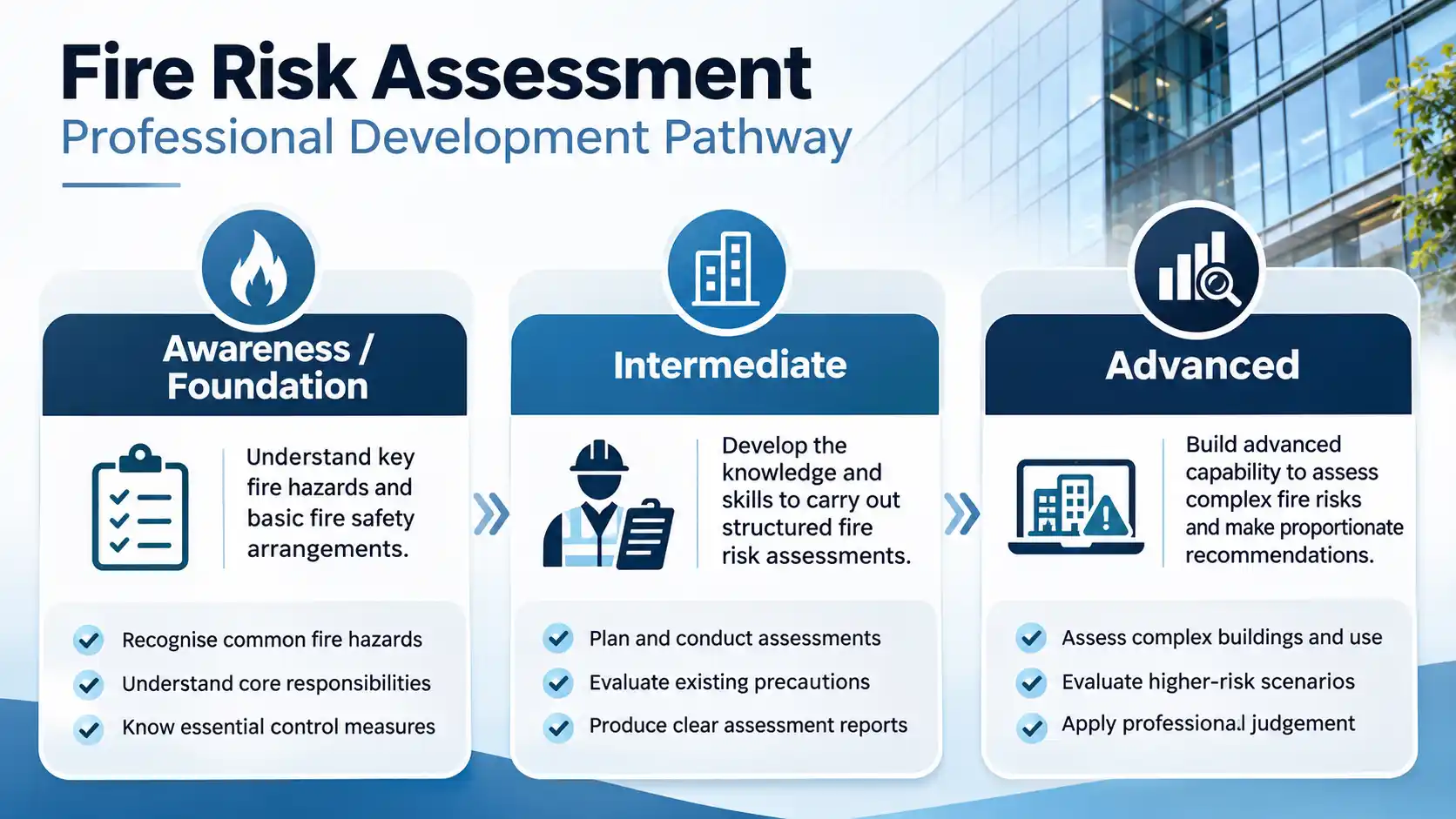
The three learning stages represent increasing depth of knowledge and professional development, rather than automatic permission to undertake every category of assessment.
Compare Fire Risk Assessment Course Levels and Learning Focus
The following comparison provides a general framework for understanding the differences between awareness, foundation, intermediate and advanced learning. Actual course content and entry requirements must always be checked against the awarding body’s current specification.
| Comparison area | Awareness / Foundation | Intermediate | Advanced |
|---|---|---|---|
| Primary purpose | Understand basic fire safety principles. | Develop structured assessment knowledge and skills. | Develop capability for complex assessment situations. |
| Typical audience | Employees, supervisors and new entrants. | Developing fire safety practitioners and assessors. | Experienced assessors and senior fire safety professionals. |
| Fire hazard knowledge | Recognise common hazards. | Identify and evaluate relevant hazards. | Analyse complex and interacting fire hazards. |
| Risk assessment | Understand the basic process. | Apply structured assessment methods. | Evaluate complex conditions and assessment limitations. |
| Fire protection | Understand basic system purposes. | Review relevant protective arrangements. | Evaluate complex protection and building-related issues. |
| Reporting | Understand hazard reporting. | Develop structured assessment documentation. | Produce detailed, evidence-based reports. |
| Practical experience | Awareness and introductory exercises. | Relevant practical or simulated assessment evidence. | Substantial relevant professional experience and evidence, as required. |
| Professional judgement | Recognise when to report concerns. | Evaluate common assessment findings. | Manage complex findings and recognise specialist boundaries. |
Level 3 vs Level 4 fire risk assessment
Learners comparing Level 3 and Level 4 fire risk assessment programmes should examine the actual qualification specifications rather than assuming that every awarding body uses identical titles or assessment structures.
A Level 3 foundation programme may develop the knowledge required to understand assessment principles, fire development, common hazards and fire safety management. A Level 4 programme may require more detailed application, practical evidence and the ability to produce or evaluate assessment reports.
For example, the ProQual Level 3 Award in Fire Risk Assessment and the ProQual Level 4 Certificate in Fire Risk Assessment are presented as different stages in the ProQual development pathway. Entry requirements, total qualification time and assessment expectations should be confirmed using the latest official specifications.
The distinction is especially important for learners moving from general workplace fire safety responsibilities into a professional assessment role.
Level 4 vs Level 5 fire risk assessment
The comparison between Level 4 and Level 5 is particularly relevant to experienced practitioners considering advanced development. Level 4 programmes may support intermediate or advanced learning depending on the qualification title and framework, while Level 5 programmes can be designed for more demanding professional assessment responsibilities.
However, the words Foundation, Intermediate and Advanced should not be assigned to an RQF level without checking the relevant qualification specification. Different awarding bodies may use different qualification titles and structures.
In the developing FireQual pathway announced by the Fire Industry Association in September 2026, Level 4 is identified as Intermediate and Level 5 as Advanced. This is a specific framework and should not be used to relabel unrelated qualifications.
Examples of Fire Risk Assessment Courses Available to Learners
Different awarding organisations provide fire risk assessment programmes for learners with different levels of experience. The following examples illustrate how course selection can be aligned with learning needs. They should be reviewed against the current published specifications before enrolment.
ICTQual AB Level 3 Certificate in Fire Safety Risk Assessment and Control
The ICTQual AB Level 3 Certificate in Fire Safety Risk Assessment and Control is designed for learners seeking structured knowledge of fire hazards, risk assessment principles, fire prevention and control measures.
Its subject areas include hazard identification, risk evaluation, active and passive fire protection, emergency preparedness, fire safety policies and monitoring arrangements. These topics are relevant to safety personnel, supervisors, facilities teams and individuals involved in workplace fire safety management.
The course can be considered by learners seeking to develop their understanding of fire risk assessment and control. However, its title should not be interpreted as proof of professional competence to independently assess every type of building.
Learners should also distinguish its awarding framework from Ofqual-regulated qualifications. The ICTQual AB course page identifies this particular certification as non-Ofqual-regulated.
Explore the ICTQual AB Level 3 Certificate in Fire Safety Risk Assessment and Control →ProQual Level 4 Award in Advanced Fire Risk Assessment
The ProQual Level 4 Award in Advanced Fire Risk Assessment is presented on the course page as a programme for fire safety professionals seeking to develop knowledge and practical skills in advanced fire risk assessment.
Its stated learning focus includes fire hazard identification, risk evaluation, building characteristics, fire prevention and protection measures, evacuation planning and assessment reporting.
The programme is relevant to professionals developing their ability to evaluate fire safety conditions and produce evidence-based recommendations. Learners should review its official specification to confirm the intended assessment scope, entry requirements and regulated status.
Explore the ProQual Level 4 Award in Advanced Fire Risk Assessment →ProQual Level 5 Award in Fire Risk Assessment
The ProQual Level 5 Award in Fire Risk Assessment provides a structured learning route for professionals developing advanced knowledge of fire risk assessment and management.
The published course information identifies learning areas including fire risk assessment principles, hazard identification, risk evaluation, fire prevention and protection, emergency arrangements, assessment reporting and professional practice.
The programme is particularly relevant to learners seeking more advanced understanding of fire risks in complex or higher-risk built environments. The specific unit selected, assessment requirements and professional experience should be considered before enrolment.
Explore the ProQual Level 5 Award in Fire Risk Assessment →Why should learners compare awarding body specifications?
A course title may sound similar to another programme while the learning outcomes, assessment methods and intended occupational roles differ considerably.
Before choosing a programme, learners should review the awarding body’s specification and verify:
- The official qualification title and level.
- Whether the qualification is regulated and by which regulator.
- The qualification number, where applicable.
- The mandatory and optional units.
- The total qualification time and guided learning hours.
- Whether workplace evidence or practical assessment is required.
- The experience expected before starting the programme.
- The intended scope of assessment practice.
Entry Requirements to Check Before Enrolling
Entry requirements vary between fire risk assessment courses. Awareness training may have few formal prerequisites, whereas intermediate and advanced programmes may expect relevant occupational experience, previous learning or access to suitable premises for practical evidence.
Previous fire safety knowledge
Learners should consider whether they understand basic fire safety principles, common hazards, fire protection systems and emergency arrangements. Previous training may provide a useful foundation for more technical programmes.
However, previous attendance on a short awareness course should not automatically be considered equivalent to the experience or prior certification required by an advanced programme.
Relevant occupational experience
Some courses are designed for people already working in fire safety, health and safety, building management or related professional roles. Experience may help learners understand how fire safety arrangements operate in real premises.
Advanced programmes may require evidence that candidates have previously undertaken relevant assessments or have experience dealing with the types of premises covered by the course.
Access to workplace evidence
Practical assessment programmes may require candidates to submit evidence from their workplace or professional activities. This can include completed fire risk assessment reports, inspection records, case studies, photographs, reflective accounts or other documentation specified by the awarding organisation.
Evidence must be authentic, relevant and appropriately redacted to protect confidential business information and personal data.
Assessment and study commitments
Learners should understand how a course is assessed before registering. Some programmes use written assignments and knowledge assessments, while others require portfolios, simulated exercises, professional discussions or practical demonstrations.
The time needed to complete a course depends on its structure, the learner’s previous knowledge, the evidence available and the assessment requirements.
| Requirement | Questions to consider |
|---|---|
| Previous certification | Is an earlier course or qualification required? |
| Work experience | Does the programme require relevant occupational experience? |
| Practical evidence | Can suitable workplace evidence be accessed? |
| Assessment method | Are assignments, reports, simulations or interviews required? |
| Study time | Can the learner meet the expected study and assessment schedule? |
| Professional scope | Does the programme match the premises and activities involved in the learner’s role? |
Understanding BS 8674:2025 and Fire Risk Assessor Competence
Professional competence is an important consideration when comparing fire risk assessment courses. BS 8674:2025 provides a framework for the competence of individual fire risk assessors in the built environment. It is relevant to the development of consistent expectations concerning the knowledge, skills and professional behaviours required for fire risk assessment work.
The framework is important because fire risk assessors may encounter premises with very different characteristics. An assessment of a relatively straightforward workplace is not necessarily comparable to an assessment involving complex building construction, unusual occupancy arrangements or significant fire protection challenges.
What does competence involve?
Competence involves more than possessing theoretical knowledge. It requires an individual to apply appropriate skills and experience, make informed decisions and recognise the limitations of their professional capabilities.
The following areas are particularly important:
- Knowledge: Understanding fire safety principles, hazards, relevant requirements and protection systems.
- Skills: Conducting inspections, evaluating risks, reviewing precautions and preparing reports.
- Experience: Applying knowledge in appropriate workplace and building contexts.
- Professional behaviour: Acting responsibly, communicating clearly and maintaining professional integrity.
These elements should be considered together. A learner may understand fire safety theory but still require supervised practical experience before undertaking assessments independently.
Why is professional scope important?
Every fire risk assessor should understand the boundaries of their competence. Building height, construction, occupancy, the vulnerability of occupants, the nature of activities and the complexity of fire protection arrangements may affect the expertise needed.
Where an assessment identifies issues outside an individual’s competence, appropriate specialist advice should be obtained. This may involve fire engineers, structural specialists, fire protection system specialists or other relevant professionals.
Learners can consult the British Standards Institution for information about applicable standards and their current editions. The exact requirements of BS 8674:2025 should be checked through an authorised copy of the standard.
Developments in the UK fire risk assessor profession
The UK Government published a consultation on the future of the fire risk assessor profession on 26 March 2026. The consultation considered proposals concerning professional competency, certification, regulatory powers and the development of clearer career pathways. Its stated geographical scope was England.
The consultation reflects increasing attention to how fire risk assessor competence is demonstrated and maintained. It also highlights the distinction between obtaining a qualification and independently verifying that an individual is competent for a particular scope of work.
The consultation is not itself a new law or proof that all proposed regulatory arrangements have already been implemented. Learners and employers should check the latest government position before relying on any proposed changes.
Read the Government consultation on the fire risk assessor profession for further information.
FireQual’s Foundation, Intermediate and Advanced pathway
In September 2026, the Fire Industry Association announced a new suite of FireQual regulated qualifications covering Foundation, Intermediate and Advanced Fire Risk Assessment.
The announced structure includes a Level 3 Certificate in Foundation Fire Risk Assessment, a Level 4 Certificate in Intermediate Fire Risk Assessment and a Level 5 Certificate in Advanced Fire Risk Assessment.
The FIA announcement stated that the Level 4 Intermediate qualification was available through an assessment-only route for suitably experienced practitioners. The Foundation Level 3 qualification was expected in early 2027, with the advanced route to follow.
This development illustrates why learners should check current availability, entry requirements and awarding arrangements rather than relying on older course comparisons.
Further details are available in the Fire Industry Association announcement.
How to Choose the Right Fire Risk Assessment Course for Your Role
The most suitable course depends on current responsibilities, previous experience and the level of competence required for future work. Rather than selecting a programme simply because it carries a higher number, learners should identify what they need to be able to do after completing it.
Choose awareness training if the priority is workplace understanding
Awareness training is a suitable consideration for employees, supervisors and managers who need to recognise common hazards, understand emergency arrangements and contribute to workplace fire prevention.
It may also be useful for people who are beginning to explore fire safety as a professional subject but have not yet developed the experience needed for formal assessor training.
Choose a foundation or Level 3 route if developing assessment knowledge
A foundation programme may be appropriate for learners seeking a more structured understanding of fire risk assessment. It can provide a starting point for learning about fire development, hazards, people at risk, fire precautions and the assessment process.
Before selecting a Level 3 programme, check whether it is intended for awareness, foundation assessor development or a broader fire safety management role. The title alone may not provide enough information.
Choose intermediate training if developing practical assessment capability
Intermediate programmes may suit practitioners who already understand fire safety principles and need to strengthen their ability to inspect premises, evaluate risks and produce structured reports.
This route is particularly relevant when occupational responsibilities are moving beyond basic hazard reporting towards more systematic assessment work.
Choose advanced training if already working at a demanding professional level
Advanced programmes should be considered by experienced professionals whose work involves more complex buildings, hazards and fire safety arrangements.
Learners should carefully review the entry requirements and evidence expectations. An advanced programme may not be appropriate for someone who has only completed introductory awareness training.
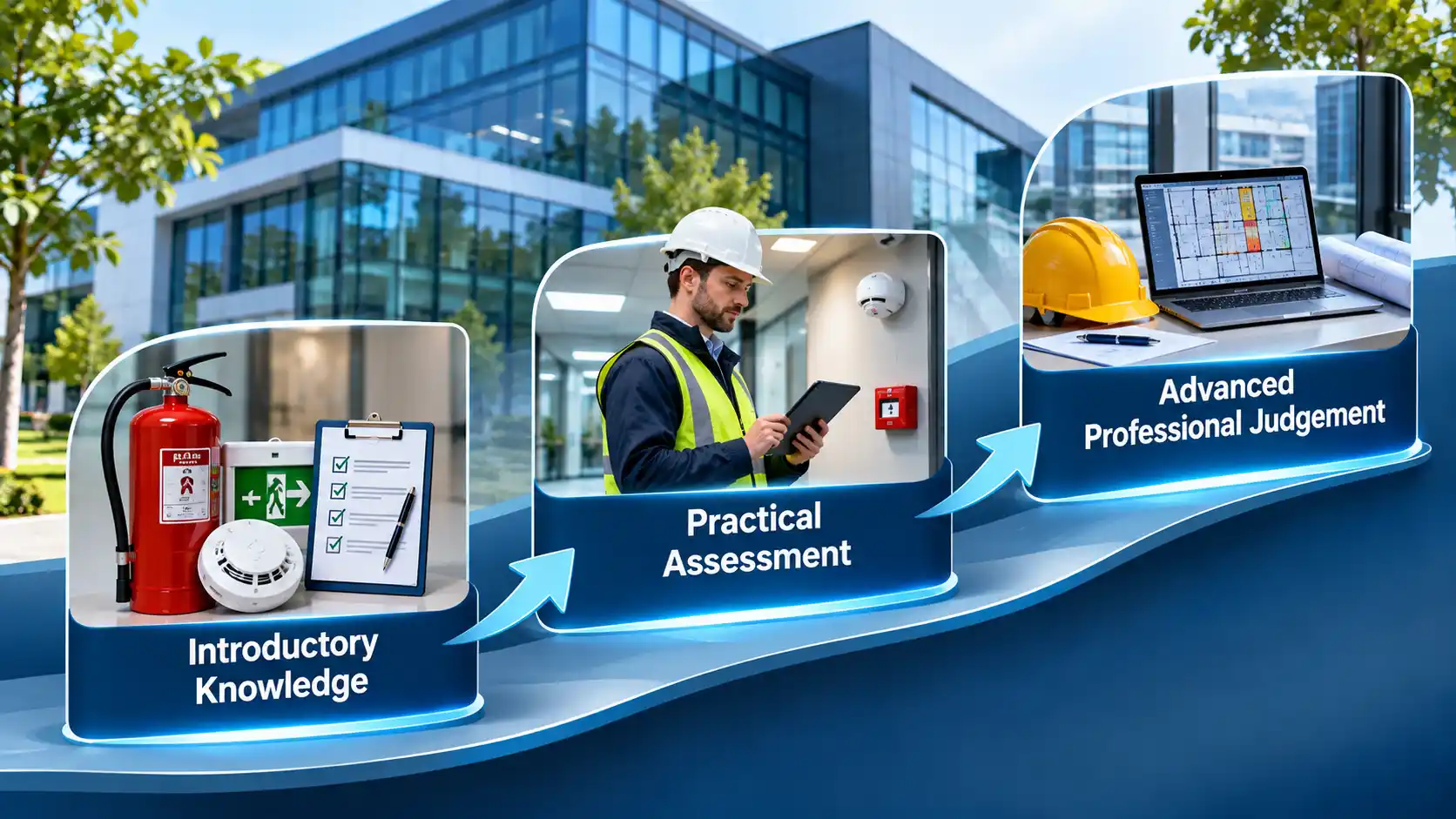
A learning pathway should reflect existing knowledge, practical experience and the level of responsibility required.
Questions to Ask Before Enrolling on a Fire Risk Assessment Course
Course selection should involve more than comparing prices or study durations. Learners should obtain clear information about the awarding body, assessment structure, recognition and intended occupational outcomes.
- Who awards the certification? Confirm the awarding organisation and verify the exact qualification title.
- Is the qualification regulated? Check whether it is Ofqual-regulated or delivered under another awarding framework. Do not assume that all certificates are regulated simply because they use a recognised level in their title.
- What knowledge and skills will be developed? Review the learning outcomes, assessment criteria and course specification.
- What experience is required? Confirm whether the programme expects previous certification, occupational experience or practical assessment opportunities.
- How will competence be assessed? Ask whether the assessment involves written assignments, portfolios, case studies, simulations, workplace evidence or professional discussions.
- What premises are covered? Check whether the programme addresses the types of buildings and assessment activities relevant to the intended role.
- Does the programme support professional progression? Understand what additional learning, experience or assessment may be needed after completion.
- What support is available? Confirm tutor support, assessment feedback, resubmission arrangements and access to course resources.
Check the official qualification specification
A course webpage is useful for an overview, but the awarding body’s specification should be the main reference for formal qualification requirements. It provides more reliable information about unit structures, assessment criteria and learning outcomes.
Where a course provider describes a qualification as regulated, learners should independently verify its status using the relevant official register. For England, Ofqual provides an online Register of Regulated Qualifications.
A learner should also ask whether the programme is suitable for their intended occupational role. Completing a course does not remove the need to work within professional competence.
Common Mistakes When Comparing Fire Risk Assessment Courses
Course selection can become confusing when learners focus on qualification titles without examining what the programmes actually involve. Several common mistakes can result in unsuitable training choices.
Assuming a higher qualification number always means the right course
A higher RQF level can indicate greater complexity in learning outcomes, but it does not automatically establish suitability for a particular professional activity. The course content, practical requirements and intended scope must also be considered.
Confusing awareness training with assessor certification
General fire safety awareness can improve workplace knowledge, but it is not automatically equivalent to a professional fire risk assessment programme. Learners should identify the difference before paying for a course.
Ignoring practical experience
Fire risk assessment involves applying knowledge to real premises. A learner may understand assessment principles but still need relevant workplace experience to evaluate building characteristics, fire precautions and occupant needs effectively.
Assuming every building can be assessed after completing one course
Different buildings present different risks and technical challenges. Complex premises may require additional expertise, specialist investigation or professional input beyond the scope of a general fire risk assessment programme.
Failing to check awarding body recognition
Course providers may use similar terminology while offering programmes under different awarding arrangements. Learners should verify the exact awarding organisation, regulation status and certificate details rather than relying on promotional descriptions.
Choosing a course based only on cost
Price is a practical consideration, but it should not be the only factor. The quality of assessment, tutor support, course resources, awarding arrangements and relevance to professional responsibilities are equally important.
Further Reading: Develop Fire Risk Assessment Knowledge
Learners considering professional development can benefit from understanding both the fire risk assessment process and the responsibilities associated with the assessor role.
The following resources provide additional information:
- How to Become a Fire Risk Assessor in the UK – Explore the professional development route, experience considerations and important factors involved in becoming a fire risk assessor.
- Fire Risk Assessment Guide – Understand the purpose of a fire risk assessment, the main assessment stages and the importance of identifying and controlling fire hazards.
- Managing Fire Risk in Buildings with Multiple Occupiers – Learn how shared responsibilities, common areas, building management and emergency arrangements influence fire safety.
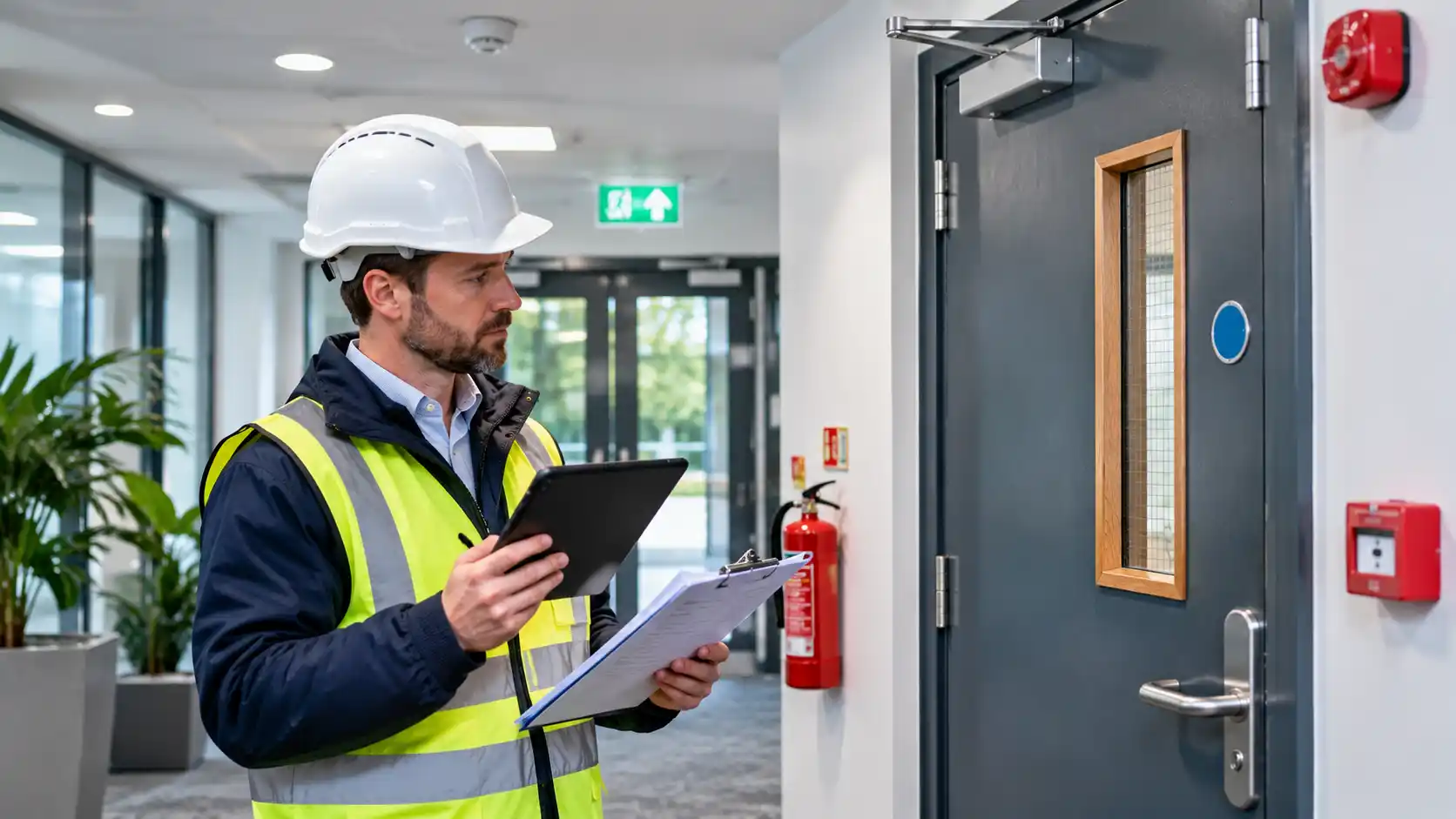
Practical understanding of building conditions is an important part of professional fire risk assessment development.
Frequently Asked Questions About Fire Risk Assessment Courses
1. Which fire risk assessment course should I take?
The appropriate course depends on current knowledge, experience and job responsibilities. Awareness training is suitable for understanding basic fire safety principles. Foundation programmes introduce structured assessment knowledge, intermediate courses develop more detailed assessment capabilities, and advanced programmes are intended for experienced professionals dealing with complex fire risks. Always check the specific course requirements.
2. What is the difference between awareness and fire risk assessor training?
Awareness training develops an understanding of fire hazards, prevention and emergency procedures. Fire risk assessor training develops more detailed knowledge of assessment methods, risk evaluation, building precautions and reporting. Awareness training alone does not establish professional assessor competence.
3. What is the difference between Level 3 and Level 4 fire risk assessment?
The distinction depends on the awarding body’s qualification specification. Generally, Level 3 programmes may develop foundation knowledge, while Level 4 programmes may involve more detailed application, practical evidence and assessment responsibilities. The intended competency stage should be confirmed against the relevant framework and qualification specification.
4. Is Level 4 or Level 5 better for fire risk assessment?
Neither is automatically better for every learner. The appropriate level depends on experience, course content and the intended professional scope. Level 5 programmes may address more advanced learning outcomes, but learners should confirm the exact qualification structure and entry requirements before enrolling.
5. Can a beginner become a fire risk assessor?
A beginner can start developing the necessary knowledge through appropriate foundation training. However, becoming competent to undertake professional assessments requires more than attending an introductory course. Relevant learning, practical experience, appropriate assessment and professional development are important.
6. Is a fire risk assessment qualification legally required in the UK?
The Fire Safety Order in England and Wales requires the Responsible Person to ensure that a suitable and sufficient fire risk assessment is carried out. The legislation does not simply make one named course a universal prerequisite for every assessment. However, anyone appointed to assist with an assessment must have appropriate competence for the work undertaken. Requirements and guidance differ across UK jurisdictions.
7. Does completing a fire risk assessment course make someone competent?
Completing a course can demonstrate learning or achievement against specified assessment requirements. Professional competence also involves applying knowledge and skills, gaining relevant experience, exercising sound judgement and working within the appropriate scope of practice.
8. What is BS 8674:2025?
BS 8674:2025 is a British Standard providing a framework for the competence of individual fire risk assessors in the built environment. It addresses the professional capabilities expected of assessors and supports the development of more consistent approaches to demonstrating competence.
9. What should an advanced fire risk assessment course cover?
Advanced programmes may cover complex building characteristics, fire hazards, fire protection systems, evacuation considerations, assessment methodology, technical evaluation, professional reporting and the recognition of specialist issues. The exact coverage depends on the qualification specification.
10. Can someone move directly to an advanced course?
Some programmes allow experienced practitioners to enter through an appropriate assessment or experienced-worker route, subject to their requirements. Other programmes require previous qualifications or documented experience. Candidates should obtain confirmation from the awarding organisation or approved training provider before applying.
11. What evidence may be required for a fire risk assessment course?
Depending on the programme, candidates may need written assignments, workplace assessment reports, case studies, practical exercises, reflective accounts, professional discussions or other portfolio evidence. The exact requirements should be checked before enrolment.
12. Are online fire risk assessment courses suitable for professional development?
Online learning can be suitable for developing theoretical knowledge and completing certain forms of assessment. However, professional competence may also require practical experience, workplace evidence or supervised assessment activities. Learners should check that the delivery and assessment arrangements match the requirements of their chosen programme.
13. Do fire risk assessment course levels have the same meaning across all awarding bodies?
No. Qualification titles, frameworks and intended learning outcomes can differ. Learners should compare official specifications and verify the regulated status and professional purpose of each course rather than assuming that similarly numbered qualifications are equivalent.
14. How can an experienced fire risk assessor demonstrate competence?
Depending on the applicable framework and professional requirements, competence may be demonstrated through relevant qualifications, practical experience, assessment reports, workplace evidence, professional assessment, continuing professional development and appropriate certification or registration arrangements.
Conclusion: Select a Fire Risk Assessment Course That Matches Professional Responsibilities
Choosing between fire risk assessment courses requires a clear understanding of the differences between awareness, foundation, intermediate and advanced learning. Each route serves a different development purpose, and the most suitable option depends on the knowledge, experience and professional responsibilities involved.
Awareness training helps individuals recognise fire hazards and understand workplace precautions. Foundation programmes provide a more structured introduction to assessment principles. Intermediate learning develops more detailed assessment knowledge and practical capability, while advanced programmes address complex fire safety conditions and higher levels of professional judgement.
Learners should compare awarding bodies, course specifications, assessment methods, entry requirements and professional scope before making a decision. They should also recognise that a certificate is one part of professional development, not an unrestricted guarantee of competence.
As the UK fire safety sector continues to place greater emphasis on professional competence and consistent assessment standards, selecting appropriate training is an important step towards responsible and effective fire risk management.
Explore Fire Risk Assessment Learning Opportunities
Discover fire safety and risk assessment programmes designed to develop knowledge of fire hazards, risk evaluation, prevention measures and professional fire safety management.
Review the available course specifications, compare entry requirements and select a learning route that matches existing experience and professional development objectives.
References and Further Information
The following authoritative and industry resources can help readers verify current requirements, professional developments and qualification information.
- GOV.UK – Workplace Fire Safety: Your Responsibilities
- Ministry of Housing, Communities and Local Government – Fire Risk Assessors Profession Consultation (2026)
- Fire Industry Association – New Fire Risk Assessment Qualification Suite (2026)
- ProQual Awarding Body – Qualification Specifications
- Ofqual – Register of Regulated Qualifications
- British Standards Institution – Standards Information
Editorial note: This article provides general educational information about fire risk assessment training and professional development in the UK. It is not legal advice or a substitute for the current official qualification specification, applicable legislation or competent specialist advice. Legislation and regulatory arrangements differ between England, Wales, Scotland and Northern Ireland. Always verify the current requirements relevant to the premises and jurisdiction.