
How to Become a Fire Risk Assessor in the UK: Skills, Training and Career Route
Discover the qualifications, practical experience, professional skills and career development opportunities needed to become a competent fire risk assessor in the UK. Explore the different training routes and understand how to build a career in fire safety and risk assessment.

Becoming a fire risk assessor in the UK offers an opportunity to develop a professional career in an important area of building safety, workplace protection and risk management. Fire risk assessors help protect people by identifying potential fire hazards, evaluating existing precautions and recommending improvements that reduce the likelihood and consequences of fire.
The role has become increasingly important as organisations, property owners, employers and building managers recognise the need for effective fire safety management. Commercial buildings, educational establishments, healthcare facilities, residential common areas, industrial premises and public venues all require appropriate attention to fire risks.
However, entering the profession involves more than completing a short training course. A capable assessor needs relevant technical knowledge, an understanding of legislation, practical assessment experience, professional judgement and the ability to communicate findings clearly.
For individuals considering a fire risk assessment career, understanding the available qualifications and the relationship between training and practical competence is an essential starting point. This guide explains the main responsibilities, skills, qualifications, experience requirements and development opportunities involved in becoming a fire risk assessor in the UK.
In This Guide
- What Does a Fire Risk Assessor Do?
- Understanding the Legal Framework
- Essential Skills and Knowledge
- Qualifications and Training Options
- Practical Experience and Professional Competence
- Step-by-Step Fire Risk Assessor Career Path
- Typical Work Settings
- Salary and Career Opportunities
- Career Development and Professional Recognition
- Common Mistakes to Avoid
- Frequently Asked Questions
- Conclusion
1. What Does a Fire Risk Assessor Do?
A fire risk assessor is a professional who examines premises to identify fire hazards, evaluate the people who may be affected, assess existing fire precautions and recommend measures to control identified risks. The assessor provides information that helps the Responsible Person understand the fire safety condition of the premises and decide what improvements may be necessary.
The work involves examining both physical building conditions and the management arrangements that influence fire safety. An assessment should consider how a fire could start, how it might spread, whether occupants could escape safely and whether suitable precautions are maintained.
Identifying Fire Hazards
One of the first responsibilities is identifying potential sources of ignition, combustible materials and circumstances that could contribute to a fire. These may include damaged electrical equipment, unsafe cooking arrangements, poorly controlled hot work, combustible waste, inappropriate storage and inadequate maintenance.
The assessor also considers how different hazards interact. For example, combustible materials stored close to electrical distribution equipment may create a different risk profile from either condition considered independently.
Identifying People at Risk
Fire risk assessment must consider everyone who may be affected by a fire. This includes employees, customers, visitors, contractors, residents and people who may require additional assistance during an evacuation.
Particular attention may be necessary in care environments, healthcare facilities, residential accommodation and buildings used by people who are unfamiliar with the premises.
Evaluating Existing Fire Safety Precautions
Assessors examine the precautions intended to prevent fires, detect developing incidents, warn occupants, restrict fire and smoke spread and support evacuation.
Depending on the building and the assessment scope, these may include:
- Fire detection and alarm arrangements.
- Emergency lighting and escape signage.
- Fire doors and compartmentation.
- Escape routes, corridors and final exits.
- Portable firefighting equipment.
- Emergency procedures and evacuation arrangements.
- Fire safety training and management responsibilities.
- Inspection, testing and maintenance records.
Preparing Fire Risk Assessment Reports
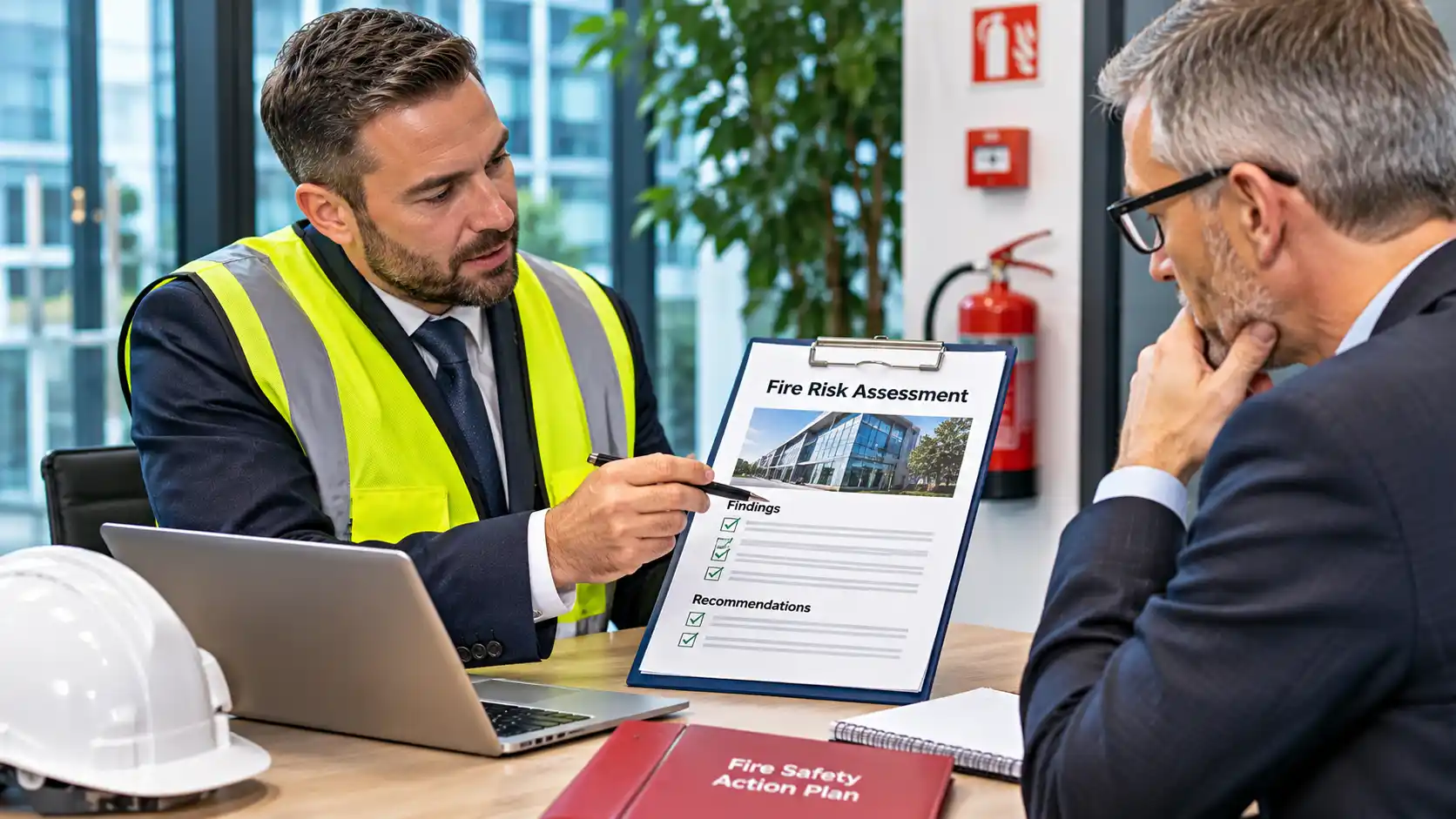
A fire risk assessment report communicates the findings of an inspection and explains the improvements that may be required. It should be sufficiently clear and detailed to allow the Responsible Person to understand the identified issues and take appropriate action.
A professional report generally records the premises information, assessment scope, hazards, people at risk, existing precautions, significant findings, recommendations and relevant limitations.
Recommendations should be proportionate to the identified risks. They should explain the issue, the reason for concern and the action required without making unsupported assumptions about the building.
For a more detailed explanation of the assessment process, read our complete guide to fire risk assessment.
Advising Organisations and Building Managers
Assessors also communicate with employers, property managers, facilities teams, landlords and other responsible individuals. Their recommendations may influence maintenance programmes, fire safety procedures, staff training and building improvement plans.
The role therefore combines technical inspection with professional communication and practical risk management.
2. Understanding the Legal Framework for Fire Risk Assessment in the UK
A fire risk assessor must understand the legal requirements relevant to the premises being assessed. Legislation establishes responsibilities for fire safety, while supporting guidance and standards help organisations understand appropriate precautions and professional practice.
The legal framework differs across the UK, so an assessor must identify the jurisdiction before applying legislation or guidance.
Regulatory Reform (Fire Safety) Order 2005
In England and Wales, the Regulatory Reform (Fire Safety) Order 2005 is a central part of the fire safety framework for relevant non-domestic premises. It includes workplaces and the common parts of multi-occupied residential buildings within its scope.
Article 9 requires the Responsible Person to make a suitable and sufficient assessment of the risks to which relevant persons are exposed. The purpose is to identify the general fire precautions needed to comply with the Order.
The Responsible Person may appoint a competent person to assist with the assessment. However, appointing an external assessor does not automatically transfer the Responsible Person’s legal duties.
Read the official wording of Article 9 of the Fire Safety Order.
Other Important Fire Safety Legislation
A professional assessor should understand how different legal requirements relate to the premises, the people using them and the work being undertaken.
- Fire Safety Act 2021: Clarifies the application of the Fire Safety Order to the structure, external walls and flat entrance doors of relevant multi-occupied residential buildings in England and Wales.
- Fire Safety (England) Regulations 2022: Introduces additional fire safety duties for responsible persons in specified multi-occupied residential buildings in England.
- Building Safety Act 2022: Establishes an important framework for building safety, including the higher-risk building regime and wider competence-related reforms.
- Dangerous Substances and Explosive Atmospheres Regulations 2002: Relevant where dangerous substances may create fire or explosion risks.
- Health and Safety at Work etc. Act 1974: Provides the wider occupational health and safety framework.
Fire Safety Legislation Across Different UK Nations
The legal position must be checked against the location of the building. The legislation applying in England and Wales should not automatically be treated as the complete legal framework for Scotland or Northern Ireland.
| UK jurisdiction | Key fire safety legislation | Important consideration |
|---|---|---|
| England | Regulatory Reform (Fire Safety) Order 2005, as amended | Additional requirements include the Fire Safety Act 2021 and Fire Safety (England) Regulations 2022. |
| Wales | Regulatory Reform (Fire Safety) Order 2005, as amended | Consider Welsh legislation and guidance alongside the Fire Safety Order. |
| Scotland | Fire (Scotland) Act 2005 and Fire Safety (Scotland) Regulations 2006 | Apply the Scottish fire safety framework and relevant guidance. |
| Northern Ireland | Fire and Rescue Services (Northern Ireland) Order 2006 | Consider the relevant Northern Ireland fire safety legislation and supporting requirements. |
Understanding these differences is particularly important for assessors working across several regions or providing services to organisations with premises in different parts of the UK.
Professional Standards and Competence
Professional standards provide additional guidance on the knowledge, skills and behaviours expected from people undertaking fire risk assessments.
BS 8674:2025 is an important development because it provides a framework for assessing the competence of individual fire risk assessors. It introduces a structured approach to considering professional competence at different levels of practice.
Assessors should understand the relationship between the relevant standard, the complexity of the premises, their own experience and the responsibilities they accept.
3. Essential Skills and Knowledge Required to Become a Fire Risk Assessor
A competent fire risk assessor requires a combination of technical understanding, analytical ability, inspection skills and professional communication. These capabilities enable the assessor to recognise hazards, evaluate precautions and produce useful recommendations.
Technical Fire Safety Knowledge
Knowledge of fire behaviour is essential. Assessors should understand how fires start, develop and spread, including the influence of heat, smoke, ventilation, combustible materials and building construction.
They should also understand the purpose and limitations of active and passive fire protection measures. This includes fire alarms, emergency lighting, sprinklers, fire doors, fire-resisting walls and compartmentation.
Analytical and Risk Evaluation Skills
Assessors must evaluate information rather than simply record observations. They should be able to distinguish between hazards, existing controls, deficiencies and the potential consequences of an incident.
For example, identifying combustible storage is only the beginning. The assessor must consider its location, quantity, proximity to ignition sources, possible impact on escape routes and effectiveness of existing controls.
Building Inspection Skills
A fire risk assessor needs the ability to conduct systematic inspections and recognise conditions that could compromise fire safety.
This may involve examining escape routes, doors, visible fire-resisting construction, electrical arrangements, housekeeping, signage, fire protection equipment and management records.
Assessors must also understand the limits of visual inspections. A standard fire risk assessment does not automatically include intrusive investigations, structural surveys or specialist engineering examinations.
Communication and Report-Writing Skills
A fire risk assessment is useful only when its findings can be understood and acted upon. Assessors must explain technical issues in clear language and present recommendations in a logical order.
Good communication includes discussing findings with relevant representatives, explaining the significance of deficiencies and making clear which matters require specialist investigation.
Professional Judgement and Attention to Detail
Professional judgement helps an assessor evaluate the significance of different conditions and identify proportionate improvements. Attention to detail is particularly important when reviewing building layouts, fire protection features, escape arrangements and supporting records.
Digital and Organisational Skills
Modern assessment work frequently involves digital reporting systems, photographic records, document management and electronic communication.
An assessor should be comfortable using relevant software, maintaining organised records and managing site visits, deadlines and outstanding recommendations.

4. Qualifications and Training Options for Fire Risk Assessors
Professional training is an important part of becoming a fire risk assessor. It helps develop an understanding of fire safety principles, relevant legislation, assessment methodology and the responsibilities involved in evaluating risks.
However, there is no single universal course that automatically establishes competence for every type of fire risk assessment. The appropriate learning route depends on previous experience, existing knowledge, intended responsibilities and the complexity of the buildings involved.
Foundation-Level Fire Risk Assessment Training
Foundation-level learning is generally appropriate for individuals beginning their development in fire safety. It can introduce fire hazards, ignition sources, combustible materials, fire prevention, emergency procedures and the basic principles of risk assessment.
A suitable starting point may include the ICTQual Level 3 Certificate in Fire Risk Assessor.
This option can help learners develop an initial understanding of fire risk assessment terminology, responsibilities and assessment principles.
Level 3 Fire Risk Assessment Qualifications
Level 3 training can provide a structured foundation for people developing their knowledge of professional fire risk assessment. Depending on the specific course, the learning may cover fire safety legislation, fire hazards, assessment processes, building precautions and the preparation of reports.
For learners seeking a broader programme, the ICTQual Level 3 Diploma in Fire Risk Assessor provides another training option to consider.
When selecting a programme, learners should examine the actual learning outcomes, assessment methods, entry requirements and relevance to their intended professional responsibilities.
Level 4 Fire Risk Assessment Qualifications
Level 4 programmes can support more developed professional learning and, depending on the specific certification, may involve practical assessment evidence and more advanced application of fire risk assessment principles.
The ProQual Level 4 Certificate in Fire Risk Assessment is a relevant option for individuals exploring further professional development.
Before enrolling, learners should review the specific entry criteria and assessment requirements. A higher-level course should be selected because it matches the learner’s existing experience and development needs, rather than simply because it carries a higher level designation.
Level 5 Professional Development
Level 5 learning may be appropriate for individuals who have developed a stronger foundation in fire risk assessment and are seeking more advanced knowledge.
The ProQual Level 5 Award in Fire Risk Assessment is another option to explore when considering advanced professional development.
Learners should confirm the programme’s specific scope, entry requirements and assessment outcomes before making a decision.
Comparison of Training and Development Options
| Development stage | Main learning focus | Potential progression objective |
|---|---|---|
| Foundation | Basic fire safety principles, hazards and legal awareness. | Develop initial technical knowledge. |
| Level 3 | Structured fire risk assessment knowledge and methodology. | Build a foundation for supervised practical experience. |
| Level 4 | More developed assessment knowledge and relevant practical evidence, where required by the programme. | Develop broader assessment capability. |
| Level 5 | Advanced professional learning within the programme’s defined scope. | Extend knowledge and support further professional development. |
How to Choose the Right Fire Risk Assessor Course
Choosing a suitable fire risk assessor course requires more than comparing course titles. The programme should be relevant to the learner’s intended role and provide meaningful knowledge that can be applied in professional practice.
Before selecting training, consider the following:
- Does the course cover relevant UK fire safety legislation?
- Are the learning outcomes relevant to fire risk assessment?
- Does the programme explain building fire protection measures?
- Are assessment methods appropriate for the intended level?
- Are entry requirements clearly explained?
- Is the awarding organisation and certification status verifiable?
- Does the course support the learner’s intended professional development pathway?
- Will additional supervised practical experience be available?
For a wider overview of professional learning, read our fire safety training guide.
5. Practical Experience and Professional Competence
Practical experience is one of the most important elements of professional development. A person may understand fire safety theory but still need substantial practical exposure before accepting responsibility for assessments independently.
Experience helps assessors understand how fire safety arrangements operate in real buildings, how different risks interact and how to communicate appropriate recommendations.
Why Supervised Experience Matters
Working alongside an experienced fire risk assessor allows developing professionals to observe inspection techniques, discuss assessment decisions and understand how findings are translated into practical recommendations.
Supervision also helps identify knowledge gaps and limitations before the individual accepts work beyond their current competence.
Building a Portfolio of Practical Evidence
A structured evidence portfolio can help demonstrate professional development and practical capability. Its contents should reflect the requirements of the relevant training programme, employer or professional competence scheme.
Examples of useful evidence may include:
- Records of supervised site inspections.
- Completed fire risk assessment reports, appropriately anonymised.
- Examples of identified hazards and risk-control recommendations.
- Photographic evidence where authorised and appropriate.
- Professional discussions and feedback from supervisors.
- Records of continuing professional development.
- Evidence of experience across relevant building types.
Understanding the Limits of Professional Competence
Competence is not unlimited. An assessor should understand which buildings, activities and assessment tasks fall within their knowledge and experience.
For example, an assessor experienced in straightforward office premises may not automatically have the specialist knowledge needed to evaluate complex healthcare facilities, high-rise residential buildings, industrial processes or unusual fire engineering arrangements.
Some issues may require additional expertise, intrusive investigation or specialist fire engineering advice. Recognising when to obtain that support is an important professional responsibility.
Understanding BS 8674:2025
BS 8674:2025 provides a framework for assessing individual fire risk assessor competence. It is particularly relevant when considering how knowledge, skills, experience and professional behaviours relate to the scope of assessment work.
The framework distinguishes foundation, intermediate and advanced competence levels. These distinctions support the development of a structured professional pathway.
Individuals and employers should consider the standard alongside the relevant qualification requirements, professional guidance and actual experience of the assessor.
6. Step-by-Step Fire Risk Assessor Career Path
There is no single career route followed by every fire risk assessor. Some professionals enter from health and safety, facilities management or building services, while others develop their experience through fire safety roles or specialist training.
The following pathway provides a practical development model for individuals who want to establish themselves in this profession.
- Develop a foundation in fire safety Begin by understanding fire behaviour, common hazards, fire prevention, emergency arrangements and relevant legislation. Previous experience in health and safety, property management, construction or facilities management may provide useful transferable knowledge.
- Choose suitable fire risk assessment training Select an appropriate course based on existing knowledge and intended responsibilities. Foundation and Level 3 programmes can provide structured introductory learning, while higher-level programmes may support more developed professional objectives.
- Gain supervised workplace experience Seek opportunities to observe assessments, participate in inspections and learn how experienced professionals evaluate risks. Exposure to different types of premises can help build a broader understanding of assessment practice.
- Develop assessment and report-writing skills Practise recording hazards, identifying people at risk, evaluating existing controls and preparing clear recommendations. Develop the ability to explain findings in a way that building managers and Responsible Persons can understand.
- Build evidence of professional competence Maintain appropriate assessment records, feedback, training evidence and professional development documentation. Demonstrate the ability to carry out work within an agreed scope.
- Progress to more advanced learning where appropriate Consider Level 4 or Level 5 professional development when existing experience, entry requirements and career responsibilities justify progression.
- Maintain professional development and recognition Keep up to date with legislation, technical guidance, professional standards and relevant developments. Explore appropriate professional membership and registration routes.
Moving from Employment into Independent Practice
Some assessors eventually establish independent consultancy services. However, self-employment requires more than technical knowledge.
Independent practitioners need appropriate professional indemnity and public liability insurance, clear engagement agreements, reliable reporting procedures, secure record management and suitable arrangements for obtaining specialist support.
They must also ensure that the services offered match their competence and that clients understand the scope and limitations of the assessment.

7. Typical Work Settings for Fire Risk Assessors
Fire risk assessors work across a wide range of sectors. The premises they assess may differ significantly in their construction, occupancy, activities and fire protection arrangements.
Commercial Buildings and Offices
Office environments require attention to electrical equipment, storage, escape routes, fire detection, emergency lighting and employee evacuation arrangements.
Changes in office layouts, occupancy levels and business operations may also influence the fire risk profile.
Residential Buildings
Residential common areas, apartment buildings and other housing developments may involve complex management arrangements. Assessors may need to consider common escape routes, fire doors, compartmentation, alarm arrangements and the relationship between individual dwellings and shared areas.
Assessments must be consistent with the relevant building design, legal duties and applicable fire strategy. Different residential buildings may have different evacuation arrangements.
Healthcare and Care Environments
Hospitals, care homes and similar premises may contain occupants who require assistance during evacuation. The assessor must understand the building’s occupancy characteristics, emergency arrangements and management procedures.
These environments may require specialist experience because the consequences of ineffective evacuation arrangements can be particularly serious.
Industrial and Manufacturing Premises
Industrial premises can involve machinery, combustible materials, dangerous substances, hot work, storage systems and specialist production processes.
The assessor needs to understand the interaction between operational activities and fire safety arrangements. Some assessments may require additional specialist input.
Educational and Public Buildings
Schools, colleges, universities, entertainment venues and public buildings often involve changing occupancy levels, visitors and people who may be unfamiliar with the premises.
The assessment should consider evacuation procedures, fire safety information, management responsibilities and the needs of the people using the building.
8. Fire Risk Assessor Salary and Career Opportunities in the UK
Fire risk assessor earnings vary according to experience, responsibilities, location, employer and specialist knowledge. Employment opportunities may be available within fire safety consultancies, housing organisations, facilities management companies, local authorities and larger organisations with internal fire safety teams.
According to the Prospects UK occupational profile, indicative salary ranges include approximately £28,500–£32,500 for entry-level roles and £40,000–£65,000 for experienced professionals. These figures are guidance rather than guaranteed earnings, and actual remuneration may differ.
See the Prospects fire risk assessor career profile for further occupational information.
Employment Opportunities
Potential employment settings include:
- Fire safety consultancy organisations.
- Property and building management companies.
- Facilities management providers.
- Housing associations and residential management organisations.
- Industrial and commercial organisations.
- Fire protection and building safety companies.
- Public sector organisations.
Self-Employment and Consultancy Opportunities
Experienced professionals may consider independent consultancy work. This can provide flexibility and opportunities to work with different clients and premises.
However, independent practice also involves business development, client management, professional insurance, quality assurance, legal awareness and ongoing competence management.
Factors That Influence Career Progression
Career progression is influenced by more than the number of years spent in the industry. Relevant experience, technical capability, report quality, professional judgement and the complexity of work undertaken can all affect opportunities.
Developing specialist knowledge in particular building types or fire safety subjects may also support professional development.
9. Career Development and Professional Recognition
A fire risk assessor’s professional development should continue throughout their career. Fire safety legislation, technical standards, building practices and professional expectations evolve over time.
Continuing professional development helps assessors maintain relevant knowledge and identify areas where additional training or specialist support may be necessary.
Continuing Professional Development
CPD activities may include:
- Attending relevant fire safety seminars and professional events.
- Completing technical training and refresher courses.
- Reviewing updated legislation and government guidance.
- Studying relevant professional standards.
- Participating in technical discussions and peer learning.
- Reviewing assessment reports and professional feedback.
- Developing knowledge of new fire protection technologies.
Professional Membership and Registration
Professional membership and third-party certification can help demonstrate professional commitment and provide structured routes for assessing competence.
Depending on the individual’s background and work scope, relevant organisations and schemes may include:
- Institution of Fire Engineers (IFE).
- Institute of Fire Safety Managers (IFSM).
- BAFE, including its relevant third-party certification scheme for fire risk assessment organisations.
The eligibility criteria, assessment processes and scope of recognition differ between organisations. Membership of a professional body should not automatically be interpreted as certification for every type of fire risk assessment.
Government Proposals for the Future of the Profession
The development of the fire risk assessor profession is receiving increased attention in the UK.
In March 2026, the Ministry of Housing, Communities and Local Government published a consultation on the future regulation of fire risk assessors in England. The consultation closed on 18 June 2026 and considered proposals relating to mandatory competence requirements, professional oversight, certification and career pathways.
The Government stated that it intended to use consultation responses to inform further development and seek legislation when parliamentary time allows. Therefore, proposed reforms should be distinguished from requirements already in force.
For the latest official position, consult the Government consultation on the fire risk assessors profession.
10. Common Mistakes to Avoid When Starting a Fire Risk Assessment Career
Entering a professional fire safety role requires careful preparation. Some common mistakes can limit development or create problems when accepting assessment responsibilities.
Assuming One Qualification Is Enough
Completing a course is an important achievement, but professional competence also involves experience, judgement and the ability to apply knowledge in real premises.
A developing assessor should understand the limits of the completed training and obtain appropriate supervised experience.
Accepting Work Beyond Personal Competence
Assessors should not accept assignments simply because a client requests them or because the premises appear familiar. Building complexity, occupancy characteristics and specialist fire protection arrangements may require additional knowledge.
Where necessary, the assessor should decline the work, narrow the scope or obtain appropriate specialist assistance.
Ignoring Legislation and Regulatory Updates
Fire safety requirements can change. Relying entirely on previously completed training without reviewing current legal and technical developments can result in outdated advice.
Producing Vague Recommendations
Recommendations should clearly explain the identified issue and the required improvement. General statements without supporting observations can make it difficult for the Responsible Person to determine what action is necessary.
Neglecting Continuing Professional Development
Professional competence requires ongoing attention. CPD helps assessors maintain their knowledge, learn from experience and respond to changes in fire safety practice.
Choosing Training Without Checking Its Scope
Course titles can be similar while their learning outcomes and assessment methods differ. Learners should verify the awarding organisation, programme requirements, certification details and relevance to their career objectives before enrolling.
11. Frequently Asked Questions About Becoming a Fire Risk Assessor
1. What qualifications do you need to become a fire risk assessor in the UK?
Relevant fire safety and fire risk assessment training is an important starting point. The appropriate level depends on previous knowledge, experience, intended responsibilities and building complexity. Professional competence also requires practical experience, sound judgement and the ability to undertake assessments within an appropriate scope.
2. Can you become a fire risk assessor without previous experience?
Individuals can begin developing the knowledge required for this career without previous direct fire risk assessment experience. However, independent professional assessment work requires appropriate competence. Beginners should seek supervised experience and build practical evidence before accepting responsibilities beyond their capabilities.
3. Is a Level 3 qualification enough to become a fire risk assessor?
A Level 3 programme can provide a foundation in fire risk assessment, but completing it does not automatically establish competence for every building or assessment task. The learner must consider the course outcomes, practical experience, relevant competence framework and intended work scope.
4. Can someone progress directly to Level 4?
Progression depends on the specific programme’s entry requirements and the learner’s existing knowledge and experience. Some individuals may be suitable for a higher-level programme without completing every lower-level course, provided they meet the relevant requirements.
5. How long does it take to become a fire risk assessor?
There is no universal timeframe. Training duration, previous experience, access to supervised assessments and the complexity of intended work all influence development. A learner may complete a course relatively quickly but still require additional practical experience before undertaking independent work.
6. How much does a fire risk assessor earn in the UK?
Earnings depend on experience, location, employer and responsibilities. Prospects provides indicative figures of approximately £28,500–£32,500 for entry-level roles and £40,000–£65,000 for experienced professionals. Actual salaries and consultancy earnings can vary.
7. Do fire risk assessors need professional registration?
The legal and regulatory position should be checked against current requirements. The Government’s 2026 consultation proposed reforms to professional competence and oversight in England, but proposals should not be presented as already implemented mandatory registration. Professional membership and certification schemes have their own eligibility criteria.
8. Can a fire risk assessor work independently?
Yes, independent consultancy can be a career option for appropriately competent professionals. Independent assessors should have suitable insurance, reporting arrangements, client agreements and professional procedures. They must also work within their competence and obtain specialist support where required.
9. What skills are most important for a fire risk assessor?
Important skills include fire safety knowledge, building inspection, analytical thinking, risk evaluation, report writing, communication, attention to detail and professional judgement. The ability to recognise personal limitations is equally important.
10. Is fire risk assessment a good career in the UK?
It can be a rewarding career for people interested in building safety, technical inspection, risk management and protecting people. Opportunities exist in consultancy, facilities management, property management and organisational fire safety teams. Career development depends on building relevant competence and experience.
11. What is the difference between a fire safety qualification and professional competence?
A qualification demonstrates achievement against specified learning and assessment outcomes. Professional competence is broader and includes relevant knowledge, practical experience, professional judgement, communication and the ability to perform the particular work safely and effectively.
12. Can a fire risk assessor assess every type of building?
No. Assessment competence depends on the building, its complexity, the nature of the risks and the assessor’s experience. Specialist premises or complex fire safety issues may require additional professional expertise.
12. Conclusion: Building a Successful Fire Risk Assessor Career
Becoming a fire risk assessor in the UK requires a combination of structured learning, practical experience and professional development. It is a career that involves much more than identifying fire hazards or completing assessment forms. Assessors must understand building conditions, evaluate fire precautions, recognise people at risk and communicate recommendations that support effective fire safety management.
For beginners, a suitable foundation course can provide an important starting point. Further Level 3, Level 4 and Level 5 learning may support progression according to individual experience and professional objectives. However, qualifications should always be considered alongside practical competence and the complexity of the intended assessment work.
The continuing development of professional standards and proposed regulatory reforms also makes it important for assessors to remain informed about the changing expectations of the sector.
For anyone considering this career, the most effective approach is to build knowledge progressively, gain supervised experience, develop strong reporting skills and demonstrate the ability to work within an appropriate professional scope.
Start Developing Professional Fire Risk Assessment Knowledge
Explore relevant fire risk assessment courses and professional development programmes designed to help learners build knowledge of fire safety, risk assessment principles and workplace fire safety responsibilities.
Explore Level 3 Diploma Explore Level 4 CertificateReferences and Further Reading
The following official and professional resources provide additional information about fire safety legislation, professional responsibilities and career development.
- Regulatory Reform (Fire Safety) Order 2005 – Article 9
- GOV.UK – Fire Risk Assessors Profession Consultation
- Prospects – Fire Risk Assessor Career Profile
- GOV.UK – Workplace Fire Safety Responsibilities
- Institution of Fire Engineers
- Institute of Fire Safety Managers
- BAFE – Fire Safety Certification
Editorial note: This article provides general career and professional development information. It is not legal advice, a substitute for specialist technical guidance or confirmation that an individual is competent to undertake a particular fire risk assessment.