
Fire Safety Performance Indicators: Measuring More Than Compliance
Discover how organisations can use fire safety performance indicators to evaluate prevention measures, monitor control effectiveness, identify emerging risks and make informed decisions that strengthen workplace fire safety beyond basic regulatory compliance.

Fire safety is often evaluated through completed inspections, maintenance certificates, staff training records and documented risk assessments. These records are important because they help organisations demonstrate that fire safety arrangements have been established and that relevant responsibilities are being addressed. However, completed paperwork does not automatically demonstrate that a workplace is adequately protected from fire.
An organisation may have an inspection schedule, but repeated defects could remain unresolved. Employees may complete fire awareness training without understanding the correct evacuation arrangements. A fire alarm system may have a maintenance certificate while operational faults continue to affect its reliability. These situations demonstrate why measuring activities alone can provide an incomplete picture of fire safety performance.
Fire safety performance indicators provide a structured way to evaluate whether an organisation’s fire prevention arrangements, protective systems, emergency procedures and management activities are delivering their intended results. They help responsible persons and management teams understand what is working, where weaknesses exist and which improvements require attention.
The purpose is not simply to demonstrate compliance with applicable fire safety requirements. It is to develop a more reliable understanding of how effectively fire risks are being controlled in everyday operations.
1. Understanding Fire Safety Performance Indicators and Their Importance in the Workplace
Fire safety performance indicators are measurable criteria used to assess how effectively an organisation manages fire hazards, maintains protective arrangements and implements preventive procedures. They translate broad fire safety objectives into observable information that managers can review and use when making operational decisions.
An indicator might measure the proportion of scheduled fire alarm tests completed, the number of overdue corrective actions, the percentage of employees receiving role-specific training or the frequency of repeated fire door defects. Each measure provides information about a different aspect of the organisation’s fire safety arrangements.
Why should organisations measure fire safety performance?
Fire risk management involves more than identifying hazards during an assessment. Controls must be implemented, maintained, checked and reviewed as buildings, equipment, occupancy and workplace activities change. Performance indicators help organisations determine whether these arrangements continue to function as intended.
The most important benefits include:
- Improved risk visibility: Performance data highlights recurring hazards, control failures and areas where management attention is required.
- Better accountability: Clearly defined indicators help establish who is responsible for inspections, maintenance, training and corrective actions.
- More informed decisions: Managers can prioritise resources according to the seriousness and persistence of identified fire risks.
- Early identification of weaknesses: Monitoring preventive activities can reveal deterioration before an incident occurs.
- Continuous improvement: Historical information helps organisations evaluate whether corrective measures have produced lasting improvements.
- Stronger management oversight: Structured reporting gives senior management a clearer understanding of operational fire safety conditions.
Compliance measurement versus performance measurement
Compliance measurement examines whether applicable legal duties, organisational requirements and established procedures have been addressed. Performance measurement goes further by evaluating the quality, reliability and practical effectiveness of those arrangements.
For example, recording that employees have attended fire safety training demonstrates participation. It does not necessarily prove that employees can recognise the alarm, follow evacuation instructions or understand arrangements for assisting people who require additional support.
Similarly, recording a completed fire door inspection is not enough if significant defects remain unreported or repairs are repeatedly delayed. Effective measurement therefore considers inspection quality, defect severity, remedial action and subsequent verification.
| Compliance-focused question | Performance-focused question |
|---|---|
| Was the inspection completed? | Were defects identified, prioritised and resolved effectively? |
| Was staff training delivered? | Can employees demonstrate the knowledge and actions required? |
| Was equipment maintenance recorded? | Are protective systems reliable and available for their intended purpose? |
| Was an emergency drill conducted? | Did the drill reveal weaknesses that were corrected and verified? |
| Was a fire risk assessment completed? | Were its findings translated into effective and monitored controls? |
The distinction is important because a workplace can appear organised on paper while operational weaknesses remain. A useful performance framework connects documented activity with evidence of practical effectiveness.
Organisations can strengthen their understanding of the assessment process by exploring our fire risk assessment resources .
2. Leading and Lagging Indicators for Effective Fire Risk Management
A balanced fire safety performance framework should include leading and lagging indicators. These two categories provide different types of information. Leading indicators focus on preventive activity and the condition of risk controls, while lagging indicators examine events, failures and outcomes that have already occurred.
What are leading fire safety performance indicators?
Leading indicators are measures designed to provide information about preventive processes and the activities that support effective fire risk management. They help managers identify weaknesses in controls before those weaknesses contribute to an unwanted event.
Examples include:
- Percentage of scheduled fire safety inspections completed.
- Percentage of fire safety defects corrected within their agreed risk-based timescales.
- Number of overdue fire risk assessment actions.
- Percentage of relevant employees completing role-specific training.
- Completion of scheduled fire alarm and emergency lighting tests.
- Percentage of fire door defects receiving documented follow-up.
- Number of reported fire hazards investigated within the required timeframe.
- Percentage of emergency evacuation drill recommendations closed and verified.
Leading indicators are useful because they give managers an opportunity to intervene before a serious incident develops. However, an organisation should not assume that a high completion rate automatically demonstrates effective risk control. The quality and relevance of the activity must also be examined.
What are lagging fire safety performance indicators?
Lagging indicators measure events or outcomes that have already occurred. They help organisations understand the consequences of existing weaknesses and identify patterns that may require further investigation.
Examples include:
- Number of workplace fire incidents during a reporting period.
- Number of fire-related injuries or cases of smoke exposure.
- Number of fire-related business interruptions.
- Frequency of recurring fire alarm or detection system failures.
- Number of repeated fire safety non-conformities.
- Number of evacuation difficulties identified during actual emergencies or drills.
- Extent of property damage associated with fire incidents.
- Number of repeat findings following previous corrective actions.
Lagging indicators provide important evidence, but they have a limitation: serious fire incidents are relatively infrequent in many workplaces. A low incident count may reflect effective precautions, but it may also mean that an organisation has not experienced a significant event during the measurement period.
Therefore, incident frequency should never be treated as the only measure of fire safety effectiveness.
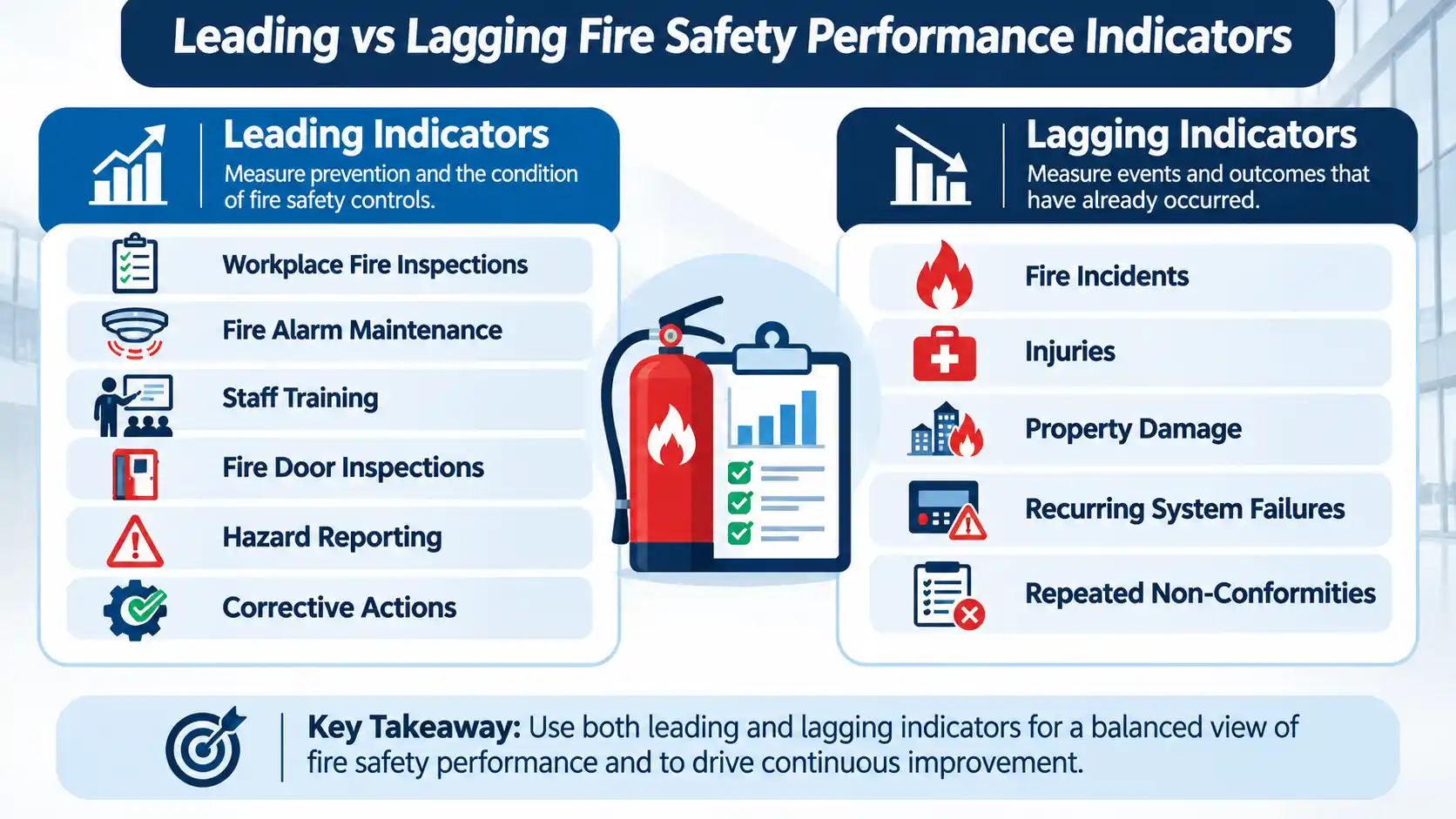
Leading versus lagging indicators: Understanding the difference
| Comparison | Leading indicators | Lagging indicators |
|---|---|---|
| Main focus | Prevention and control activities | Events and outcomes |
| Measurement purpose | Identify weaknesses early | Understand what has happened |
| Typical information | Inspections, training, maintenance and action closure | Fires, injuries, damage and recurring failures |
| Management value | Supports preventive intervention | Supports investigation and evaluation |
| Main limitation | Activity completion does not prove effectiveness | May reveal weaknesses only after an event |
Why both indicator types should be used together
Leading and lagging indicators are most valuable when they are interpreted together. Consider a warehouse that reports 100% completion of scheduled inspections but continues to experience repeated obstruction of fire exits.
The inspection completion figure appears positive, but the recurring obstruction indicates that the underlying management arrangements may be ineffective. The organisation should investigate why the problem continues, whether storage procedures are suitable and whether corrective actions are being verified.
Conversely, a workplace may report no fires during a reporting period while its inspection programme is incomplete and several fire protection defects remain outstanding. The absence of incidents should not be interpreted as proof that its controls are effective.
This balanced approach reflects the broader systemic view of fire safety performance discussed by Santos-Reyes and Beard in their research on technical and human factors. Read the research on systemic fire safety performance measurement.
3. Key Performance Metrics for Measuring Workplace Fire Safety
Effective fire safety KPIs should reflect the actual hazards, protective arrangements and operational conditions of the premises. A manufacturing facility, office building, warehouse, healthcare facility and multi-occupied commercial property will not necessarily require identical indicators.
The most useful metrics are those that help managers understand whether significant fire risks are being controlled. They should provide actionable information rather than simply generate a large collection of figures.
1. Fire risk assessment action completion
This indicator measures the progress made in addressing actions identified through fire risk assessments, inspections and management reviews. It can help management determine whether identified weaknesses are receiving appropriate attention.
Action completion rate = (Actions completed ÷ Actions due) × 100For example, if 18 of 20 actions due during a reporting period have been completed, the completion rate is 90%. However, the remaining two actions must still be examined. If one concerns a critical fire protection defect, the organisation should not treat the overall figure as evidence of satisfactory performance.
2. Fire protection system testing and maintenance
Fire detection, warning, emergency lighting and other relevant protective systems must be managed according to their design, applicable requirements, manufacturer instructions and appropriate technical guidance.
Performance indicators may examine:
- Scheduled testing completed against the applicable programme.
- Number and severity of system faults identified.
- Time taken to investigate and resolve reported faults.
- Number of recurring faults following maintenance.
- Availability of documented inspection and service records.
- Evidence that defects have been corrected and the system retested where necessary.
A maintenance completion figure should be supported by evidence that work was performed by appropriately competent personnel and that identified faults were not simply carried forward without suitable risk controls.
3. Fire door and compartmentation inspection results
Fire doors and compartmentation arrangements help restrict the spread of fire and smoke. Their effectiveness can be affected by damaged seals, unsuitable alterations, poor installation, defective hardware, unapproved penetrations and inadequate maintenance.
Useful indicators include the number of defects identified, the percentage of high-priority defects addressed within the agreed timescale, the frequency of repeated defects and the results of follow-up inspections.
4. Fire safety training and competency
Training performance should be assessed through more than attendance records. Managers should consider whether employees understand their responsibilities, recognise alarm signals, know escape routes and can follow the arrangements relevant to their roles.
For example, fire wardens may require additional instruction appropriate to their duties. New employees, contractors and temporary workers should also receive information relevant to the premises and their activities.
The ICTQual AB Level 2 Award in Fire Safety Awareness can be explored as a relevant learning option for individuals developing foundational fire safety awareness.
5. Emergency evacuation performance
Emergency drills and exercises can provide evidence about how well employees understand emergency procedures. They can also reveal weaknesses in communication, alarm recognition, route accessibility, coordination and arrangements for people who may require assistance.
Relevant indicators include participation, observed procedural weaknesses, recommendations raised, completion of improvement actions and verification that identified problems have been addressed.
Evacuation time may be recorded where it is meaningful and appropriate, but it should not be used as a universal pass-or-fail measure. Building design, occupancy, evacuation strategy and individual assistance requirements all affect the interpretation of results.
6. Fire hazard reporting and corrective action
The number of fire hazards reported can provide insight into the visibility of workplace risks and the willingness of employees to raise concerns. However, a rising number of reports does not automatically mean that fire safety performance is deteriorating.
It may indicate improved reporting awareness or a more open safety culture. Managers should therefore examine the nature, severity, location and recurrence of reported hazards, together with the quality and timeliness of corrective actions.
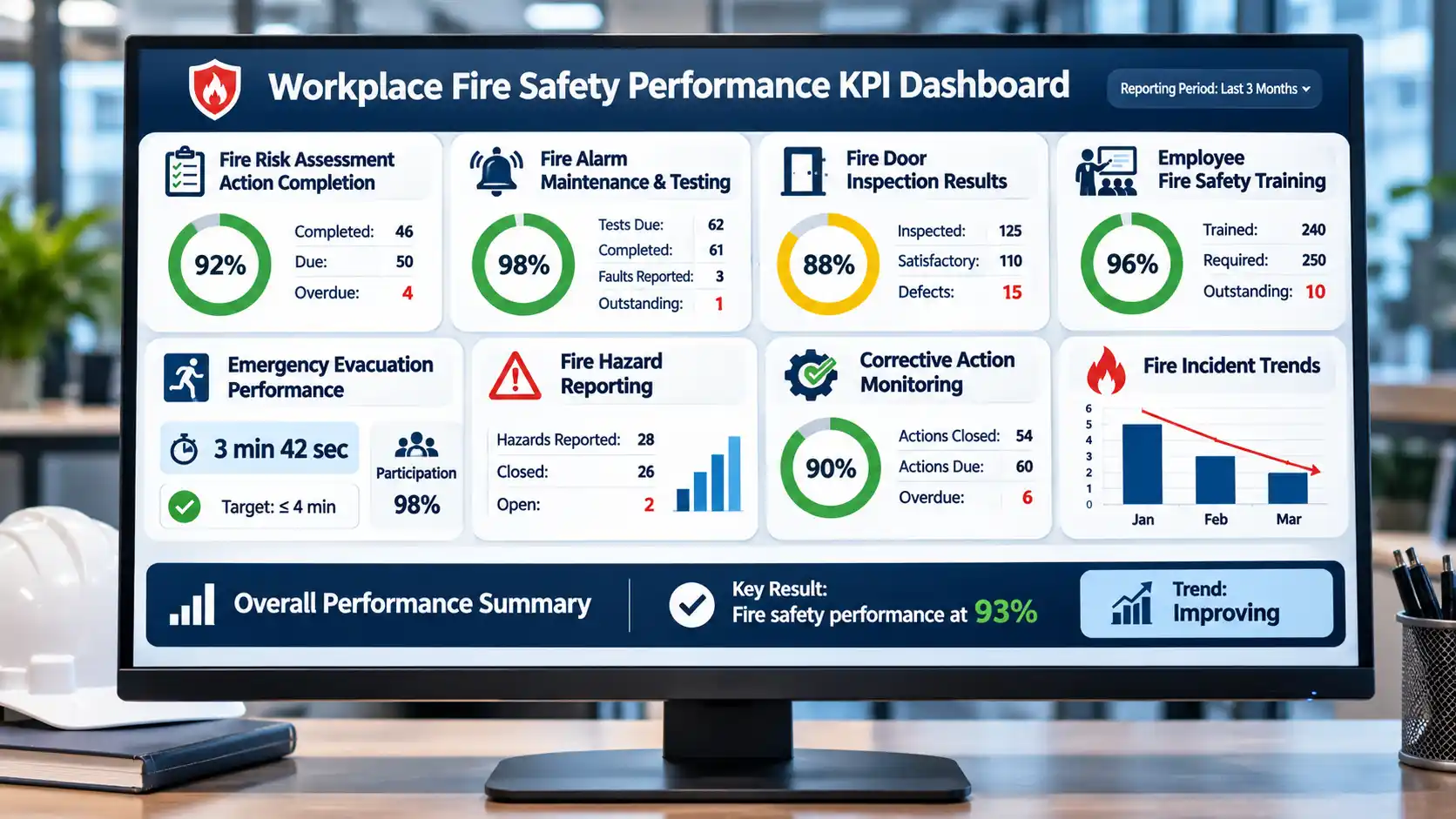
Practical fire safety performance indicator framework
The following table provides an example framework that organisations can adapt to their premises. The measures and review intervals are illustrative management choices, not universal statutory targets. Actual requirements and frequencies should be established from applicable legislation, risk assessments, system specifications and competent technical advice.
| Performance area | Example KPI | Evidence source | Management purpose |
|---|---|---|---|
| Risk assessment | Percentage of due actions completed | Risk assessment action register | Monitor risk reduction measures |
| Fire alarm systems | Scheduled tests completed and faults resolved | Test and maintenance records | Monitor system reliability |
| Fire doors | Priority defects resolved and verified | Inspection records | Monitor passive protection |
| Training | Role-specific training and competency checks completed | Training and assessment records | Evaluate workforce preparedness |
| Housekeeping | Recurring combustible waste and obstruction findings | Workplace inspection reports | Strengthen ignition and fuel controls |
| Emergency arrangements | Drill recommendations closed and verified | Exercise and evacuation reports | Improve emergency readiness |
| Incident management | Fire incidents, near misses and repeat events | Incident reporting system | Identify recurring risk patterns |
| Management oversight | Overdue high-priority actions and escalation status | Management review records | Improve accountability |
How should organisations calculate and interpret KPIs?
A performance indicator should have a clearly defined calculation, reporting period, data source and responsible owner. Without these elements, different departments may measure the same activity inconsistently, making comparisons unreliable.
For example, a training completion rate should identify the employees who are required to receive the relevant training, rather than simply dividing attendance records by the total workforce without considering job roles and training applicability.
Similarly, a maintenance completion measure should distinguish between planned tasks, completed tasks, tasks that were missed and tasks that were completed but resulted in outstanding defects.
Every KPI should therefore be accompanied by a clear definition and an explanation of what the result does and does not demonstrate.
4. Evaluating Fire Prevention Measures Beyond Regulatory Compliance
Fire prevention involves controlling the conditions that could allow a fire to start and develop. These conditions include ignition sources, combustible materials, unsafe work practices, equipment defects and inadequate housekeeping.
Measuring fire prevention performance requires organisations to evaluate whether these hazards are being identified and controlled consistently. A procedure may exist, but its actual implementation needs to be examined.
Evaluate the effectiveness of ignition source controls
Electrical equipment, heating appliances, cooking activities, smoking, hot work and maintenance operations can introduce ignition risks. The relevant controls depend on the workplace, the equipment in use and the nature of the activities being performed.
Useful performance measures may include:
- Number of electrical safety defects identified during inspections.
- Percentage of relevant hot work activities supported by suitable authorisation and controls.
- Number of repeated ignition source hazards.
- Completion of relevant equipment inspections and maintenance.
- Number of unsafe work practices reported and investigated.
Managers should not rely solely on the number of permits issued or inspections recorded. They should also verify whether required precautions were actually implemented and maintained during the work activity.
Monitor combustible materials and housekeeping
Poor housekeeping can increase fire loading, obstruct escape routes and create opportunities for ignition sources to come into contact with combustible materials. This is particularly important in warehouses, manufacturing facilities, commercial kitchens and maintenance areas.
Relevant indicators may include recurring combustible waste findings, storage non-conformities, blocked escape routes, inadequate separation of materials and the completion of housekeeping corrective actions.
Organisations can strengthen this area by reviewing our guidance on fire safety for cleaning teams, chemical storage and ignition risks .
Measure contractor and maintenance fire safety controls
Contractors can introduce temporary hazards through welding, cutting, electrical work, equipment installation and other maintenance activities. Their work may affect fire protection systems, compartmentation and normal evacuation arrangements.
Useful measures include contractor induction completion, review of relevant risk assessments and method statements, monitoring of hot work controls, inspection of work areas and verification that temporary impairments have been managed appropriately.
Where maintenance work affects fire safety arrangements, organisations should monitor temporary controls and confirm that normal protection is restored before the work area returns to routine operation. Further practical information is available in How to Manage Fire Risks During Building Maintenance Work .
Review non-conformities and recurring fire safety defects
A non-conformity is a failure to meet an applicable requirement, established procedure or defined organisational standard. Repeated non-conformities may indicate that the original corrective action did not address the underlying cause.
Performance monitoring should consider the severity of each finding, the time taken to address it, the effectiveness of the remedy and whether the same problem occurs again.
For a more detailed approach, see our article on fire safety non-conformities, classification and corrective action .
Use risk-based priorities rather than treating every finding equally
Not every defect presents the same level of risk. A minor administrative issue and a defect affecting a critical escape route should not receive identical management attention.
Organisations should classify findings using an appropriate risk-based approach that considers potential consequences, the people who could be affected, the condition of existing controls and the urgency of intervention.
5. Using Fire Safety Data to Identify Risks and Improve Decision-Making
Collecting fire safety information is only the first stage of performance management. Its real value comes from analysing the information, recognising patterns and translating findings into practical decisions.
Inspection reports, maintenance records, incident reports, training information and corrective action registers can provide a useful picture of the condition of workplace fire safety arrangements. However, information from different departments must be organised consistently before meaningful conclusions can be drawn.
Identify recurring trends rather than reviewing isolated figures
A single inspection finding may indicate an isolated problem. Repeated findings across different reporting periods may suggest a wider weakness in management arrangements.
For example, if several inspections identify combustible materials being stored near electrical equipment, managers should investigate whether storage procedures, supervision, employee awareness or workplace layout are contributing to the problem.
Trend analysis can help identify:
- Locations where fire hazards are repeatedly reported.
- Equipment or systems experiencing recurring faults.
- Departments with consistently overdue corrective actions.
- Repeated weaknesses in employee understanding of emergency procedures.
- Contractor activities associated with frequent fire safety findings.
- Changes in the severity or frequency of non-conformities.
Develop a fire safety performance dashboard
A dashboard can bring together important indicators in a format that supports operational monitoring and management review. It should present information clearly, show changes over time and highlight issues requiring action.
A practical dashboard may include:
- Current fire risk assessment actions and overdue priorities.
- Fire protection system testing and outstanding faults.
- Fire door inspection findings and remedial work.
- Employee training and role-specific competency information.
- Emergency drill findings and improvement actions.
- Fire incident and near-miss trends.
- Recurring housekeeping and contractor-related findings.
- Management review decisions and action ownership.
Dashboard information should be updated at an interval appropriate to the risk and operational needs of the organisation. High-priority defects may require immediate escalation rather than waiting for a monthly management report.
Use evidence to prioritise resources
Fire safety budgets and resources are not unlimited. Performance information can help managers identify where intervention is most important and whether existing resources are being directed towards the most significant risks.
For instance, recurring defects in a critical fire protection system may justify additional technical investigation, maintenance resources or specialist support. A repeated housekeeping issue may require changes to storage arrangements, supervision or operational responsibilities.
Decisions should be based on risk significance and reliable evidence, not simply on which department has the lowest KPI score.
Understand the limitations of performance data
Data can be misleading when its definitions are inconsistent, records are incomplete or reporting behaviour changes. A low number of recorded hazards may indicate a well-controlled workplace, but it may also indicate that employees are reluctant to report problems.
Similarly, a high number of completed inspections may reflect administrative activity rather than meaningful examination of fire safety conditions.
Managers should therefore validate data, review the quality of supporting evidence and compare indicators with direct observations. Interviews, workplace inspections and technical verification can help confirm whether reported performance reflects actual conditions.
Example: Turning a performance finding into an improvement decision
Consider a commercial premises where the management dashboard identifies repeated fire door defects across several floors. The initial inspection completion rate is high, but the number of repeat findings remains unchanged.
Rather than setting another inspection target, management investigates the underlying issue. The review identifies that door damage is associated with unsuitable movement of materials and inadequate reporting of minor defects.
The organisation then introduces improved handling arrangements, assigns responsibility for reporting defects, reviews contractor activities and verifies repairs through follow-up inspections.
The next performance review examines not only whether the actions were completed but also whether repeat defects have reduced and the doors remain in suitable condition.
This example demonstrates how performance data can move an organisation from recording problems to understanding causes and improving risk controls.
6. Best Practices for Monitoring and Improving Fire Safety Performance Indicators
An effective monitoring system should be proportionate, consistent and connected to the organisation’s actual fire risks. It should give responsible persons and managers useful information without creating unnecessary administrative work.
1. Start with the fire risk assessment
The fire risk assessment provides the foundation for identifying hazards, people at risk and necessary preventive and protective measures. Indicators should be developed around the significant risks and controls identified through this process.
A warehouse may require close monitoring of combustible storage, ignition sources and fire detection arrangements. An office environment may place greater emphasis on escape routes, electrical equipment, staff awareness and evacuation arrangements.
Indicators should therefore reflect the actual risk profile of the premises rather than being selected simply because they are easy to measure.
2. Establish clear definitions and responsibilities
Every indicator should have a defined purpose, calculation method, reporting period and accountable owner. Managers should understand what information is being collected, where it comes from and who is responsible for reviewing it.
Clear definitions reduce inconsistent reporting and help different departments interpret performance information in the same way.
3. Establish meaningful targets
Targets should be based on legal requirements where applicable, risk assessments, equipment specifications, technical guidance and organisational needs.
For example, a maintenance target should reflect the relevant testing and servicing programme rather than an arbitrary percentage chosen to make a dashboard appear positive.
Avoid adopting generic numerical targets without considering their suitability for the premises. A target is useful only when it encourages the right action and reflects an appropriate standard of control.
4. Combine quantitative and qualitative evidence
Quantitative information provides measurable results, such as completed inspections, reported defects and overdue actions. Qualitative evidence helps explain the circumstances behind those results.
For example, a high training completion rate can be supplemented by observations, staff discussions and practical assessments of emergency procedure understanding.
Combining both forms of evidence gives management a more reliable understanding of fire safety performance.
5. Review high-priority issues promptly
Not every performance issue can wait until the next scheduled management meeting. Defects that could seriously affect fire prevention, warning, escape or protection should be escalated according to their urgency and the arrangements established for the premises.
Organisations should have clear procedures for identifying significant defects, introducing appropriate interim controls where necessary and arranging suitable remedial action.
6. Investigate the reasons behind poor performance
When an indicator falls below its expected standard, management should investigate why. The cause may involve insufficient resources, unclear responsibilities, inadequate training, unsuitable equipment, weak supervision or ineffective procedures.
Simply asking employees to improve their performance may not address a problem caused by the wider management system.
7. Verify corrective actions
Closing an action in a register does not automatically mean that the original risk has been controlled. Verification should confirm that the agreed work was completed, the intended outcome was achieved and any relevant system was checked after intervention.
Where the same issue reappears, management should consider whether the corrective action addressed only the immediate defect rather than its underlying cause.
8. Review the indicators themselves
Performance indicators should not remain unchanged indefinitely. Changes in building use, occupancy, equipment, processes, workforce arrangements and identified hazards may make some measures less useful or introduce new monitoring requirements.
Management should periodically examine whether each indicator remains relevant, whether the information is reliable and whether the measure is influencing the right decisions.
Practical monitoring checklist
- Are indicators linked to significant fire risks?
- Are the calculation methods clearly documented?
- Are data sources reliable and regularly checked?
- Are leading and lagging indicators both included?
- Are serious defects escalated without unnecessary delay?
- Are corrective actions assigned to responsible individuals?
- Is the effectiveness of completed actions verified?
- Are recurring findings investigated?
- Are performance results reviewed by appropriate management personnel?
- Are indicators updated when workplace risks or arrangements change?
7. Building a Proactive Fire Safety Culture Through Continuous Performance Improvement
Fire safety performance is influenced by more than equipment, procedures and inspection schedules. Organisational culture also affects how employees recognise hazards, communicate concerns, follow procedures and respond to identified weaknesses.
A proactive fire safety culture encourages people to take responsibility for safe working practices and report concerns before they develop into more serious problems.
Encourage employee participation and hazard reporting
Employees often have direct knowledge of everyday workplace conditions. They may notice damaged equipment, blocked escape routes, unsuitable storage or unsafe activities that are not immediately visible during formal inspections.
Organisations should provide accessible reporting arrangements and ensure that concerns receive appropriate attention. Employees should also receive feedback about the actions taken so that reporting is recognised as a useful part of risk management.
Strengthen management leadership and accountability
Senior managers influence how fire safety is prioritised, resourced and integrated into operational decisions. Their involvement is important when significant defects require funding, changes to working arrangements or cooperation between different departments.
Managers should regularly review performance findings, challenge recurring weaknesses and ensure that responsibilities are clearly assigned. Fire safety should be treated as an operational responsibility rather than a task that belongs exclusively to a single safety department.
Use continuous improvement to strengthen controls
Continuous improvement involves a structured cycle of planning, implementation, evaluation and refinement. It helps organisations learn from inspection results, incidents, near misses, exercises and changes in operational conditions.
A practical improvement cycle can follow four stages:
- Plan: Identify significant fire risks, establish objectives, select appropriate indicators and assign responsibilities.
- Implement: Introduce preventive measures, maintain protective systems, deliver training and carry out planned activities.
- Evaluate: Review performance data, inspect workplace conditions, investigate incidents and assess the effectiveness of controls.
- Improve: Correct weaknesses, update arrangements, allocate resources and verify the results of improvement actions.

Develop professional knowledge and organisational competence
A reliable performance framework depends on people who understand fire hazards, protective measures, management responsibilities and the interpretation of performance information.
Organisations should identify the knowledge and competence required for different responsibilities. Employees may need general awareness, while managers, fire safety coordinators and specialist personnel may require more advanced understanding of fire risk assessment, prevention and management.
The ICTQual AB Level 3 Certificate in Fire Safety Principles is relevant to individuals seeking to develop knowledge of fundamental fire safety principles.
For professionals interested in broader technical and management knowledge, the ICTQual AB Level 5 International Diploma in Fire Safety and Firefighting Technology provides another relevant learning pathway to explore.
Training should support the responsibilities assigned to individuals. It should not be treated as a substitute for suitable equipment, effective management arrangements or the appointment of appropriately competent specialist support where required.
Ultimately, a proactive fire safety culture develops when employees and management understand that performance measurement is not simply an exercise in producing reports. It is a way of identifying weaknesses, improving controls and protecting people through informed and consistent action.
Conclusion: Measuring Fire Safety Performance Beyond Compliance
Fire safety performance indicators help organisations understand whether their preventive measures, protective systems and management arrangements are working effectively. They provide a structured approach to monitoring fire risks, evaluating organisational performance and identifying opportunities for improvement.
However, meaningful performance measurement requires more than recording completed inspections, training sessions and maintenance activities. Organisations need to examine the quality of those activities, the condition of their controls, the effectiveness of corrective actions and the lessons arising from incidents and near misses.
By combining leading and lagging indicators, reviewing reliable information, establishing clear accountability and involving employees in prevention, responsible persons can develop a more effective approach to workplace fire safety.
The most valuable fire safety performance system is one that supports timely decisions, identifies emerging weaknesses and encourages continuous improvement. Compliance remains essential, but the wider objective is to maintain effective fire precautions and protect everyone who may be affected by a fire.
Frequently Asked Questions (FAQs)
1. What are fire safety performance indicators?
Fire safety performance indicators are measurable criteria used to evaluate how effectively an organisation identifies fire hazards, maintains protective measures, implements preventive procedures and manages fire-related risks. They help responsible persons monitor performance and identify areas requiring improvement.
2. Why are fire safety performance indicators important?
They help organisations monitor the effectiveness of fire prevention measures, identify recurring defects, evaluate training and maintenance activities, prioritise corrective actions and make informed decisions about fire risk management. They also support continuous improvement and management oversight.
3. What is the difference between leading and lagging fire safety indicators?
Leading indicators measure preventive activities and the condition of risk controls, such as inspections, training and corrective action completion. Lagging indicators measure events and outcomes that have already occurred, including fire incidents, injuries, property damage and recurring system failures. Both are necessary for balanced evaluation.
4. What are the most useful KPIs for workplace fire safety?
Useful indicators include risk assessment action completion, fire alarm maintenance and fault resolution, fire door defect management, role-specific training, emergency drill findings, hazard reporting and recurring non-conformities. The exact selection should reflect the premises, activities and identified fire risks.
5. How frequently should fire safety performance be reviewed?
Review frequency should be proportionate to the risk, the nature of the indicator and the operational needs of the premises. Some critical defects require immediate attention, while management dashboards may be reviewed monthly or quarterly. Fire risk assessments must be reviewed regularly and when relevant changes or other reasons indicate that the assessment may no longer be valid.
6. Can an organisation be compliant but still have poor fire safety performance?
Yes. An organisation may maintain documentation and complete scheduled activities while recurring defects, ineffective procedures or inadequate employee understanding remain. This is why performance evaluation should consider the actual condition and effectiveness of fire safety controls rather than documentation alone.
7. How can fire safety performance indicators improve fire prevention?
They help organisations identify recurring hazards, monitor preventive controls, investigate weaknesses and evaluate whether corrective measures are effective. This enables managers to address problems before they contribute to serious fire incidents.
8. Are fire safety performance indicators a legal requirement in the UK?
There is no single universal statutory KPI set that every workplace must use. However, responsible persons have legal duties concerning fire risk assessment, appropriate precautions and the maintenance of fire safety arrangements. Suitable performance indicators can help organisations monitor these arrangements and support effective management.
9. Who should be responsible for monitoring fire safety KPIs?
Responsibility depends on the organisation and the duties assigned to relevant individuals. The responsible person retains the applicable legal responsibilities, while fire safety managers, facilities managers, department managers and competent specialists may undertake monitoring and reporting activities within their roles.
10. How can an organisation improve its fire safety performance?
It can begin by reviewing its fire risk assessment, identifying significant control weaknesses, selecting meaningful indicators, assigning responsibilities, reviewing reliable performance information and verifying corrective actions. Employee participation, suitable training and regular management oversight also contribute to improvement.
Strengthen Professional Fire Safety Knowledge
Effective fire risk management depends on informed decision-making, competent personnel and a clear understanding of fire prevention and protective arrangements. Explore professional fire safety learning opportunities to develop relevant knowledge and support improved workplace safety practices.
Explore our Fire Safety and Risk Assessment Qualifications to discover relevant learning pathways for different professional responsibilities and levels of experience.
References and Further Reading
The following legislation, government guidance and professional research provide further information on fire safety responsibilities, risk assessment and performance measurement.
- The Regulatory Reform (Fire Safety) Order 2005 .
- GOV.UK: Fire Safety in the Workplace – Fire Risk Assessments .
- Home Office: A Guide for Persons with Duties Under Fire Safety Legislation .
- Home Office: Fire Safety (England) Regulations 2022 .
- Health and Safety Executive: Developing Process Safety Indicators (HSG254) .
- Santos-Reyes and Beard: A Systemic Approach to Measuring Fire Safety Performance .
- Astutis: Performance Indicators (KPIs) and Metrics for Health and Safety .
Editorial note: This article provides general information about fire safety performance management. It is not a substitute for a suitable and sufficient fire risk assessment, competent professional advice or the applicable legal requirements for the premises. Fire safety legislation and guidance differ across the UK, so organisations should consult the requirements relevant to their jurisdiction.