
Fire Safety Non-Conformities: Classification, Corrective Action and Follow-Up
A practical guide to identifying fire safety deficiencies, classifying non-conformities, prioritising risks, implementing corrective actions and verifying continued compliance in UK workplaces.

Fire safety compliance is not achieved simply by installing fire alarms, providing extinguishers or preparing an emergency evacuation plan. It requires continuous monitoring, effective maintenance, competent personnel and a structured process for identifying and resolving deficiencies. Even when an organisation has established fire safety arrangements, weaknesses can emerge through routine inspections, maintenance activities, operational changes and workplace incidents.
These weaknesses are commonly identified as fire safety non-conformities. They may include blocked escape routes, defective fire doors, inadequate emergency lighting, missing inspection records, unsuitable storage of combustible materials or failures to maintain fire protection equipment. Some deficiencies can be corrected immediately, while others require detailed investigation, management involvement and longer-term improvements.
The challenge for employers and fire safety professionals is to determine the significance of each finding, understand its potential consequences and implement appropriate corrective measures. Without a consistent approach, organisations may repeatedly identify the same problems without addressing the underlying causes.
A structured fire safety non-conformity management process helps organisations move beyond reactive inspections. It connects hazard identification, risk assessment, corrective action, accountability, monitoring and verification within a continuous improvement framework.
Fire safety non-conformity classification is the process of categorising identified failures, deficiencies or deviations from applicable fire safety requirements according to their significance, potential consequences and urgency. It helps organisations determine which issues require immediate intervention, which need planned corrective action and how completed improvements should be verified.
This guide explains how to classify fire safety non-conformities, assess their associated risks, investigate root causes, develop corrective action plans and establish effective follow-up arrangements in UK workplaces.
1. What Are Fire Safety Non-Conformities?
A fire safety non-conformity is an identified failure to meet an applicable fire safety requirement, organisational procedure, agreed control measure or expected safety standard. It indicates that an existing arrangement, activity, piece of equipment or management process does not adequately meet the requirement against which it has been evaluated.
In practical workplace situations, a non-conformity may be physical, operational or administrative. A damaged fire door represents a physical deficiency, whereas a failure to complete scheduled fire alarm testing represents an operational or maintenance deficiency. Missing fire risk assessment documentation may indicate a weakness in the organisation’s management arrangements.
Understanding the Difference Between a Hazard and a Non-Conformity
A fire hazard is a source or condition with the potential to cause a fire or contribute to its development. A non-conformity is a failure to meet a relevant requirement. Although the two concepts frequently overlap, they are not identical.
For example, combustible materials stored near an ignition source represent a fire hazard. If the organisation’s documented storage controls prohibit that arrangement, the failure to follow those controls may also constitute a non-conformity. The same observation can therefore provide evidence of both an underlying hazard and a failure of an established control.
Examples of Fire Safety Non-Conformities
- Emergency exits obstructed by equipment, stock or waste materials.
- Fire doors damaged, incorrectly adjusted or unable to close properly.
- Emergency lighting not functioning or not adequately maintained.
- Fire alarm faults not investigated or resolved within an appropriate timeframe.
- Fire extinguishers missing, inaccessible or inadequately maintained.
- Fire-stopping damaged by building alterations or service installations.
- Inadequate control of hot work and other ignition-producing activities.
- Missing inspection records and incomplete maintenance documentation.
- Employees not receiving appropriate fire safety instruction or training.
- Fire risk assessments not reviewed following significant changes.
Organisations should record the specific requirement against which each finding is assessed. This may be a legal obligation, a fire risk assessment recommendation, an equipment manufacturer’s instruction or an internal procedure. Identifying the requirement makes the finding easier to investigate and verify.
2. Understanding the Importance of Fire Safety Non-Conformity Management
Effective non-conformity management allows organisations to identify weaknesses before they develop into serious fire safety incidents. It creates a documented process through which deficiencies can be investigated, prioritised, corrected and monitored.
The value of this process extends beyond meeting inspection requirements. It supports better operational control, clearer management accountability and improved protection for employees, visitors, contractors and other relevant persons.
Reducing the Risk of Fire and Harm
Unresolved fire safety deficiencies can weaken several layers of protection simultaneously. A defective fire door may allow smoke to spread, while an obstructed escape route can delay evacuation. If emergency lighting is also defective, occupants may experience additional difficulties during an emergency.
Identifying these issues and implementing suitable corrective actions helps maintain the effectiveness of preventive and protective measures.
Maintaining Legal and Organisational Compliance
Employers and other responsible persons must understand and meet the fire safety duties applicable to their premises. In England and Wales, the Regulatory Reform (Fire Safety) Order 2005 provides the main legal framework for general fire precautions in relevant non-domestic premises.
Article 9 addresses fire risk assessment, Article 11 concerns fire safety arrangements, and Article 17 addresses maintenance of relevant premises, facilities, equipment and devices. These obligations provide important reference points when evaluating fire safety deficiencies.
Improving Accountability and Management Control
A formal non-conformity process identifies who is responsible for investigating an issue, who must authorise the corrective action and who verifies its completion. This prevents important findings from remaining unresolved because responsibilities are unclear.
Supporting Continuous Improvement
Repeated findings can reveal weaknesses in training, maintenance schedules, supervision, procurement or communication. Reviewing these patterns allows management to improve the systems responsible for fire safety rather than repeatedly correcting individual symptoms.
For a broader understanding of this management approach, read our guide to Fire Safety Management Reviews, which explains how management review supports monitoring, accountability and ongoing improvement.
3. Common Types of Fire Safety Non-Conformities in the Workplace
Fire safety non-conformities can occur in almost every part of workplace operations. Understanding their common forms helps inspectors, managers and employees recognise deficiencies and report them accurately.
Fire Detection and Alarm System Deficiencies
Fire detection and alarm systems provide early warning so that occupants can respond appropriately. Faulty detectors, damaged call points, disabled alarm zones and incomplete testing records can compromise the reliability of these arrangements.
Any indication that an alarm system is not operating as intended should be assessed promptly. Where a system or part of it is impaired, appropriate interim arrangements must be determined according to the risk, the building’s fire strategy and competent advice.
Fire Door and Compartmentation Deficiencies
Fire doors and fire-resisting construction help restrict the movement of fire and smoke. Common problems include missing seals, damaged door leaves, defective self-closing devices, unauthorised alterations and unsealed service penetrations.
A door that appears visually acceptable may still fail to perform its intended function. Inspections should therefore consider the complete door assembly and its relevant installation and maintenance requirements.
Organisations should also inspect fire-stopping around service penetrations. Our related guide, Fire Stopping Inspection, provides further information about identifying defects in fire-resisting construction.
Emergency Escape Route Deficiencies
Escape routes must remain suitable and available for occupants to evacuate safely. Common findings include blocked corridors, locked or obstructed exits, damaged exit signage and inadequate emergency lighting.
Escape-route deficiencies require particular attention because they can directly affect the ability of people to leave a building during a fire.
Firefighting Equipment and Maintenance Deficiencies
Fire extinguishers, hose reels and other firefighting equipment must remain suitable for their intended purpose and be maintained appropriately. Findings may include missing equipment, physical damage, inaccessible locations or overdue servicing.
Housekeeping and Fire Prevention Deficiencies
Poor housekeeping can increase fire loading and introduce avoidable ignition risks. Examples include combustible waste accumulating near equipment, inappropriate storage of flammable substances and uncontrolled use of temporary electrical equipment.
Training and Documentation Deficiencies
A workplace may have suitable equipment but inadequate management arrangements. Missing training records, outdated evacuation procedures, incomplete inspection registers and unclear emergency responsibilities can undermine overall fire safety performance.
| Non-conformity area | Example finding | Potential consequence |
|---|---|---|
| Fire alarms | Unresolved alarm fault | Delayed warning |
| Fire doors | Defective self-closing mechanism | Increased smoke and fire spread |
| Escape routes | Blocked emergency exit | Delayed evacuation |
| Emergency lighting | Failed lighting unit | Reduced visibility |
| Housekeeping | Excessive combustible waste | Increased fire loading |
| Documentation | Missing maintenance records | Reduced assurance and accountability |
4. Classification of Fire Safety Non-Conformities by Risk Level
Classification provides a consistent way to communicate the seriousness of an identified deficiency and determine the urgency of corrective action. Organisations can use a risk-based classification framework that reflects the potential consequences, existing controls and likelihood of harm.
A practical four-level framework includes critical, major, minor and observation-level findings. These categories are management tools rather than universal legal definitions. They should be incorporated into an organisation’s documented procedure and applied consistently.
Critical Non-Conformities
Critical non-conformities involve a serious or potentially imminent threat to life safety, or a failure of a fundamental fire safety control that requires immediate intervention.
Examples may include a blocked sole means of escape, a seriously compromised evacuation arrangement, or a significant failure of a critical fire protection system where people are exposed to unacceptable risk.
Required response: Take immediate action to protect people, restrict affected activities or areas where necessary, escalate the issue to the responsible person and obtain competent assistance. Any temporary arrangements must be suitable for the actual circumstances. A critical finding should never remain open simply because a routine action deadline has not expired.
Major Non-Conformities
Major non-conformities involve substantial weaknesses in fire safety controls, maintenance arrangements or management procedures. They may not create an immediate emergency in every situation, but they can significantly increase risk or indicate a systemic failure.
Examples include repeated fire alarm maintenance failures, widespread defects in fire doors, inadequate arrangements for managing hot work or significant deficiencies in fire safety training.
Required response: Introduce appropriate interim controls, conduct a documented investigation, allocate a competent action owner and establish a prioritised completion date based on the risk.
Minor Non-Conformities
Minor non-conformities involve isolated deficiencies that have a relatively limited impact on fire safety arrangements when considered in their actual context. However, their significance must still be assessed.
Examples may include a minor administrative omission in an inspection record or an isolated housekeeping issue that does not compromise an escape route or introduce a significant ignition risk.
Required response: Correct the deficiency, document the finding where required, investigate any underlying cause and monitor for recurrence.
Observations and Opportunities for Improvement
Observations identify conditions that may benefit from improvement but do not necessarily demonstrate an existing breach of a requirement. They may reveal developing weaknesses or opportunities to strengthen fire safety arrangements.
Examples include improving the visibility of inspection instructions, simplifying defect-reporting arrangements or introducing more consistent communication between departments.
Required response: Record relevant observations, assess whether further action is justified and incorporate suitable improvements into routine management reviews.
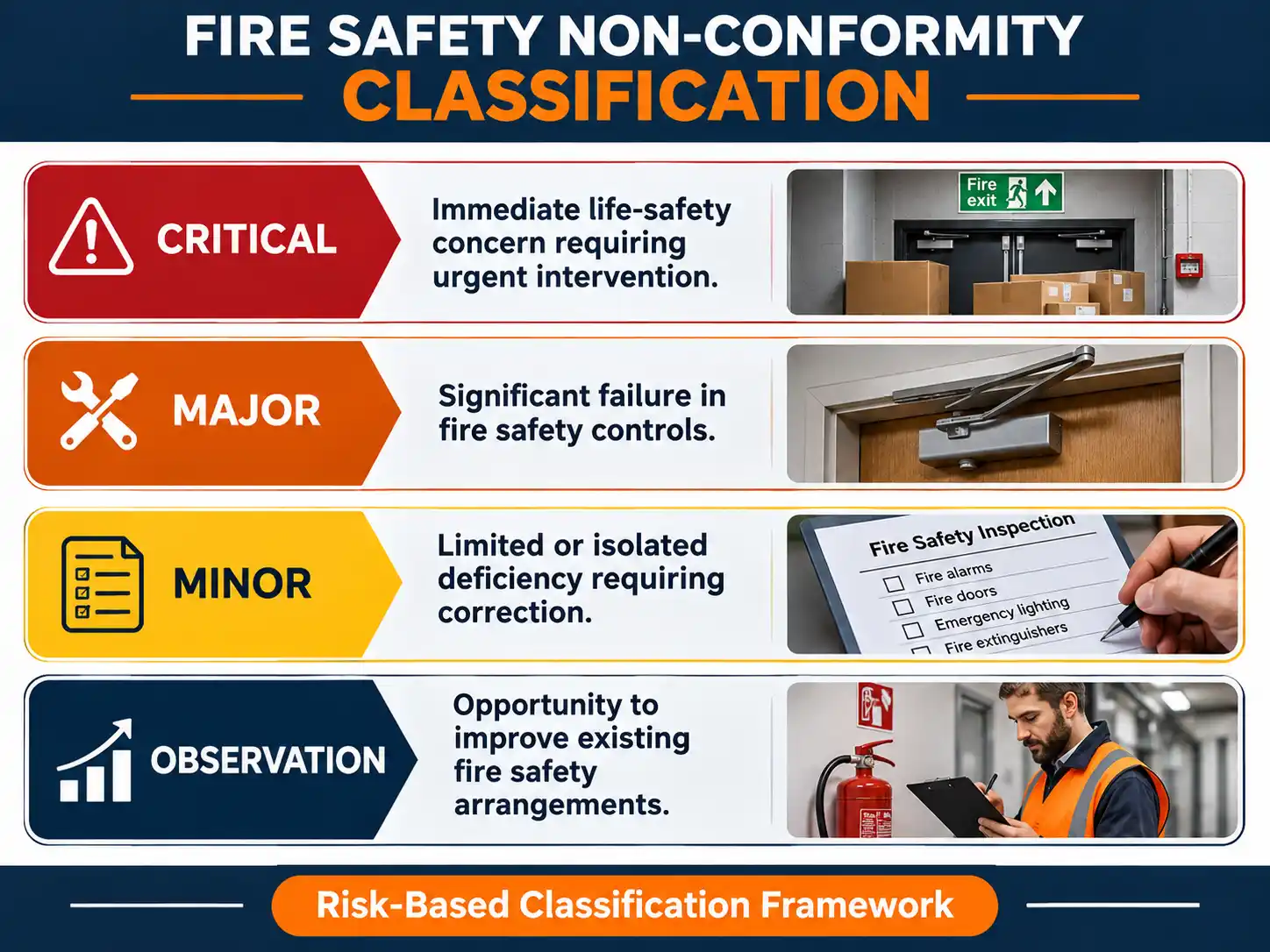
Comparison of Classification Levels
| Classification | Typical significance | Management response |
|---|---|---|
| Critical | Serious or potentially imminent life-safety threat | Immediate protection, escalation and risk control |
| Major | Substantial control failure or systemic weakness | Prompt investigation and prioritised corrective action |
| Minor | Limited, isolated deficiency | Correction, recording and appropriate monitoring |
| Observation | Potential improvement opportunity | Review and proportionate improvement |
5. Common Causes of Fire Safety Non-Conformities
Identifying the immediate defect is only the first stage of effective non-conformity management. Organisations must also understand why the deficiency occurred. Without root-cause investigation, corrective actions may resolve the visible problem while leaving the conditions responsible for its occurrence unchanged.
Inadequate Maintenance and Inspection
Fire protection equipment and building safety features require appropriate inspection and maintenance. Missed servicing, poorly planned maintenance schedules and ineffective contractor oversight can allow defects to remain undetected.
Insufficient Employee Training
Employees may not understand their responsibilities for housekeeping, reporting defects, maintaining escape routes or following hot-work procedures. Training that does not reflect actual workplace risks can create recurring operational weaknesses.
Poor Communication and Supervision
Fire safety information may not reach the people responsible for implementing it. This can occur during shift changes, contractor activities, building alterations or changes in management responsibilities.
Unclear Responsibilities
Where ownership of maintenance, inspections and corrective actions is unclear, defects may remain unresolved. This is particularly relevant in multi-occupancy buildings where different organisations control separate areas or shared systems.
Inadequate Management Resources
Insufficient budgets, staffing shortages, unavailable replacement parts and unrealistic completion schedules can delay corrective actions. Management should consider whether the resources allocated to fire safety are adequate for the identified risks.
Failure to Learn from Previous Findings
Repeated non-conformities often indicate that previous corrective actions addressed symptoms rather than underlying causes. If the same fire door defects or blocked escape routes continue to appear, the organisation should investigate why existing controls are not preventing recurrence.
Uncontrolled Workplace Changes
Changes to building layouts, occupancy levels, equipment, storage arrangements or operational processes may introduce new hazards. Failure to review fire safety arrangements following significant changes can create deficiencies that were not present during the original assessment.
6. How to Identify and Assess Fire Safety Non-Conformities
A structured identification process helps organisations detect deficiencies before they develop into more serious problems. Findings should be supported by objective evidence and evaluated against relevant fire safety requirements.
Routine Workplace Inspections
Routine inspections provide opportunities to examine escape routes, fire doors, emergency exits, housekeeping, firefighting equipment and other relevant precautions. Inspection frequency should reflect the premises, occupancy, hazards and management arrangements.
Fire Risk Assessment Reviews
Reviewing the fire risk assessment helps identify whether existing precautions remain appropriate. Assessors should consider changes in workplace activities, occupancy, building layout, equipment and the needs of people who may require additional assistance.
Equipment Testing and Maintenance Records
Testing and maintenance records can reveal repeated faults, overdue inspections and incomplete servicing. A review of these records should consider whether identified defects have been escalated and whether repairs have been independently verified where appropriate.
Internal and External Audits
Audits assess whether fire safety procedures are implemented effectively and whether organisational arrangements meet established requirements. Findings should identify the evidence reviewed, the applicable requirement and the nature of the deficiency.
Employee and Contractor Reporting
Employees and contractors often identify problems during normal operations. Organisations should provide accessible reporting channels so that damaged equipment, blocked exits, unusual fire hazards and other deficiencies can be communicated promptly.
Documenting the Finding
Every formal non-conformity record should contain sufficient information to support investigation and follow-up.
- Unique reference number and date of identification.
- Location and description of the deficiency.
- Applicable legal, organisational or operational requirement.
- Photographs, inspection findings or other supporting evidence.
- Initial risk assessment and classification.
- Immediate containment or protective measures.
- Responsible person and investigation owner.
- Required corrective action and target completion date.
- Verification evidence and closure approval.
A good non-conformity record should explain what happened, where it happened and why the finding matters. Vague descriptions such as “fire safety issue identified” provide insufficient information for effective corrective action.
7. Fire Risk Assessment and Prioritisation of Non-Conformities
Not every identified deficiency requires the same response. Prioritisation should consider the likelihood of a fire, the potential severity of its consequences, the people who could be affected and the effectiveness of existing protective measures.
Evaluate the Likelihood and Consequences
Likelihood assessment considers how reasonably foreseeable it is that a hazardous event could occur under the existing conditions. Consequence assessment considers the potential harm if the event occurs.
For example, combustible materials stored near a frequently used ignition source may create a different risk profile from an isolated administrative omission. However, the final assessment must consider the complete circumstances rather than relying on one observation alone.
Consider People at Risk
The assessment should consider employees, contractors, visitors, customers and other relevant persons. Particular attention should be given to individuals who may need additional time or assistance during evacuation.
Consider Existing Fire Protection Measures
A deficiency must be considered in relation to other controls. A defect in one protection measure may be especially significant where other measures are also ineffective or unavailable.
Apply a Risk-Based Priority Matrix
A simple likelihood-and-consequence matrix can support consistent decision-making. The following table is an illustrative management tool, not an official UK statutory scoring system.
| Likelihood | Minor consequence | Moderate consequence | Severe consequence |
|---|---|---|---|
| Low | Low priority | Moderate priority | High priority |
| Medium | Moderate priority | High priority | Very high priority |
| High | High priority | Very high priority | Critical priority |
Management should use the assessment to determine the appropriate response, taking account of legal duties and the actual circumstances. Where there is a serious threat to life safety, immediate protective action takes precedence over routine administrative prioritisation.
8. Corrective Actions for Fire Safety Non-Conformities
Corrective action is the process of addressing the underlying cause of an identified non-conformity to prevent its recurrence. It differs from a simple correction, which resolves the immediate deficiency.
Correction and Corrective Action: Understanding the Difference
Consider a workplace where a fire exit is obstructed by stored materials. Removing the materials immediately is a correction because it resolves the visible problem. However, if employees continue to use the exit area for storage, the underlying cause remains.
A corrective action might involve changing the storage arrangement, introducing a clearly designated storage area, improving supervision and implementing routine escape-route inspections.
| Aspect | Correction | Corrective action |
|---|---|---|
| Purpose | Resolve the identified problem | Address the underlying cause |
| Focus | Immediate deficiency | Prevent recurrence |
| Example | Remove materials from an exit | Improve storage controls and supervision |
| Verification | Confirm the exit is clear | Confirm the storage problem does not recur |
Immediate Containment Measures
Where a non-conformity creates an immediate or developing risk, the organisation should first control the situation. Depending on the circumstances, containment may involve restricting access, removing combustible materials, isolating defective equipment or introducing suitable temporary precautions.
Temporary measures must not be treated as permanent solutions. If a critical fire protection system is impaired, the responsible person should obtain competent advice and determine whether the premises or affected activities can continue safely.
Root-Cause Analysis
Root-cause analysis helps establish why a non-conformity occurred. It should examine the processes, responsibilities, equipment and management arrangements that contributed to the deficiency.
The 5 Whys Technique
The 5 Whys method involves repeatedly asking why a problem occurred until the investigation identifies an underlying cause supported by evidence.
For example, repeated obstructions near a fire exit might be investigated as follows:
- Why was the exit obstructed? Employees placed delivery materials in the area.
- Why were materials placed there? The designated storage area was full.
- Why was the storage area full? Delivery quantities exceeded available storage capacity.
- Why was capacity insufficient? Procurement and storage planning were not coordinated.
- Why was coordination ineffective? The organisation lacked a defined process for reviewing storage arrangements against operational demand.
The investigation suggests that the underlying problem may involve planning and management controls rather than simply employee behaviour. The proposed corrective action should therefore address the actual causes.
Fishbone Analysis
A fishbone diagram can help investigation teams explore possible causes across categories such as people, procedures, equipment, materials, environment and management. It is particularly useful when several factors contribute to the same deficiency.
Implementing Permanent Corrective Measures
Permanent corrective measures should be appropriate to the identified cause and proportionate to the actual or potential consequences. They may include engineering improvements, revised maintenance procedures, better supervision, employee training, changes to storage arrangements or stronger contractor controls.
The objective is not simply to close the inspection finding. It is to establish a reliable arrangement that prevents the same deficiency from returning.
9. Developing an Effective Corrective Action Plan
A corrective action plan converts investigation findings into specific activities, responsibilities and measurable completion requirements. It ensures that each non-conformity is assigned to an appropriate person and followed through until the effectiveness of the action has been established.
Essential Elements of an Action Plan
- Finding: A clear description of the identified non-conformity.
- Risk priority: Classification based on the actual risk and urgency.
- Immediate action: Temporary measures required to control the situation.
- Root cause: The underlying factors identified during investigation.
- Corrective measure: The permanent action required to address the cause.
- Action owner: The person accountable for implementation.
- Resources: Personnel, funding, equipment or specialist support.
- Target date: A realistic completion deadline based on risk.
- Verification: Evidence demonstrating that the action is effective.
- Closure approval: Confirmation from an authorised person.
Example of a Fire Safety Corrective Action Plan
The following example demonstrates how a workplace can record a fire door deficiency and manage its resolution.
| Action element | Example |
|---|---|
| Finding | Fire door fails to close completely. |
| Classification | Major, subject to actual risk assessment. |
| Immediate action | Escalate the defect and implement suitable interim protection based on competent advice. |
| Root cause | Inadequate inspection and maintenance arrangements. |
| Corrective action | Arrange competent repair and introduce documented inspection controls. |
| Responsible person | Facilities manager. |
| Target date | Risk-based deadline agreed by management. |
| Verification | Inspect the repaired door and review the updated maintenance record. |
| Closure | Authorised fire safety manager approves closure following satisfactory evidence. |
Action plans should be reviewed regularly, particularly when a deadline is approaching or a significant obstacle develops. If the original completion date cannot be achieved, management should reassess the risk and ensure that temporary controls remain adequate. A revised deadline must not be used to justify leaving an unacceptable risk uncontrolled.
10. Responsibilities of Employers and Fire Safety Managers in Addressing Non-Conformities
Effective non-conformity management requires cooperation between organisational management, responsible persons, fire safety professionals, employees and maintenance contractors. Responsibilities should be clearly documented so that identified deficiencies receive appropriate attention.
Employers and Responsible Persons
Employers and responsible persons must ensure that applicable fire safety duties are fulfilled within the areas and activities for which they have responsibility. This includes maintaining suitable arrangements for identifying risks, implementing precautions and reviewing fire safety performance.
Fire Safety Managers
Fire safety managers coordinate monitoring activities, review inspection findings, support investigations and track corrective actions. They should ensure that significant findings are communicated to management and that overdue actions are escalated appropriately.
Facilities and Maintenance Teams
Facilities and maintenance teams often have direct responsibility for resolving defects in fire doors, emergency lighting, alarms and other building systems. Their work should be carried out by appropriately competent personnel and supported by suitable records.
Employees and Fire Wardens
Employees should follow established fire safety procedures and report hazards or defects promptly. Fire wardens may support routine monitoring, communicate observations and assist with the implementation of workplace fire safety arrangements, according to their assigned responsibilities and competence.
External Contractors
Contractors undertaking inspection, servicing, repair or installation work should understand relevant workplace requirements. Their responsibilities, access arrangements and reporting procedures should be established before work begins.
Coordination in Multi-Occupancy Buildings
In shared premises, several responsible persons may have duties relating to different areas or activities. Under Article 22 of the Fire Safety Order, applicable responsible persons must cooperate and coordinate their fire safety measures. This makes communication and shared defect reporting particularly important.
11. Monitoring and Following Up on Corrective Actions
Monitoring ensures that corrective actions are completed within appropriate timescales and that outstanding deficiencies remain visible to management. Without effective follow-up, organisations may record findings but fail to achieve meaningful improvements.
Maintaining a Non-Conformity Register
A central register provides a consolidated record of identified deficiencies and their current status. It should allow managers to distinguish between newly reported issues, actions in progress, overdue findings and completed actions awaiting verification.
Useful register fields include the reference number, location, classification, description, action owner, target date, current status, verification evidence and closure approval.
Conducting Follow-Up Inspections
Follow-up inspections should confirm whether the agreed action has been implemented. For example, after a fire exit obstruction has been addressed, the responsible person should check that the route remains available and that storage controls are working.
Escalating Overdue Actions
Overdue actions should be escalated according to their risk and organisational reporting arrangements. A delayed critical action requires immediate management attention, whereas a lower-risk administrative improvement may be handled through the normal compliance review process.
Reviewing Trends and Recurring Findings
Management should analyse the register to identify recurring defects, departments with repeated problems and actions that frequently miss their deadlines. These trends can indicate weaknesses in supervision, maintenance planning or organisational controls.
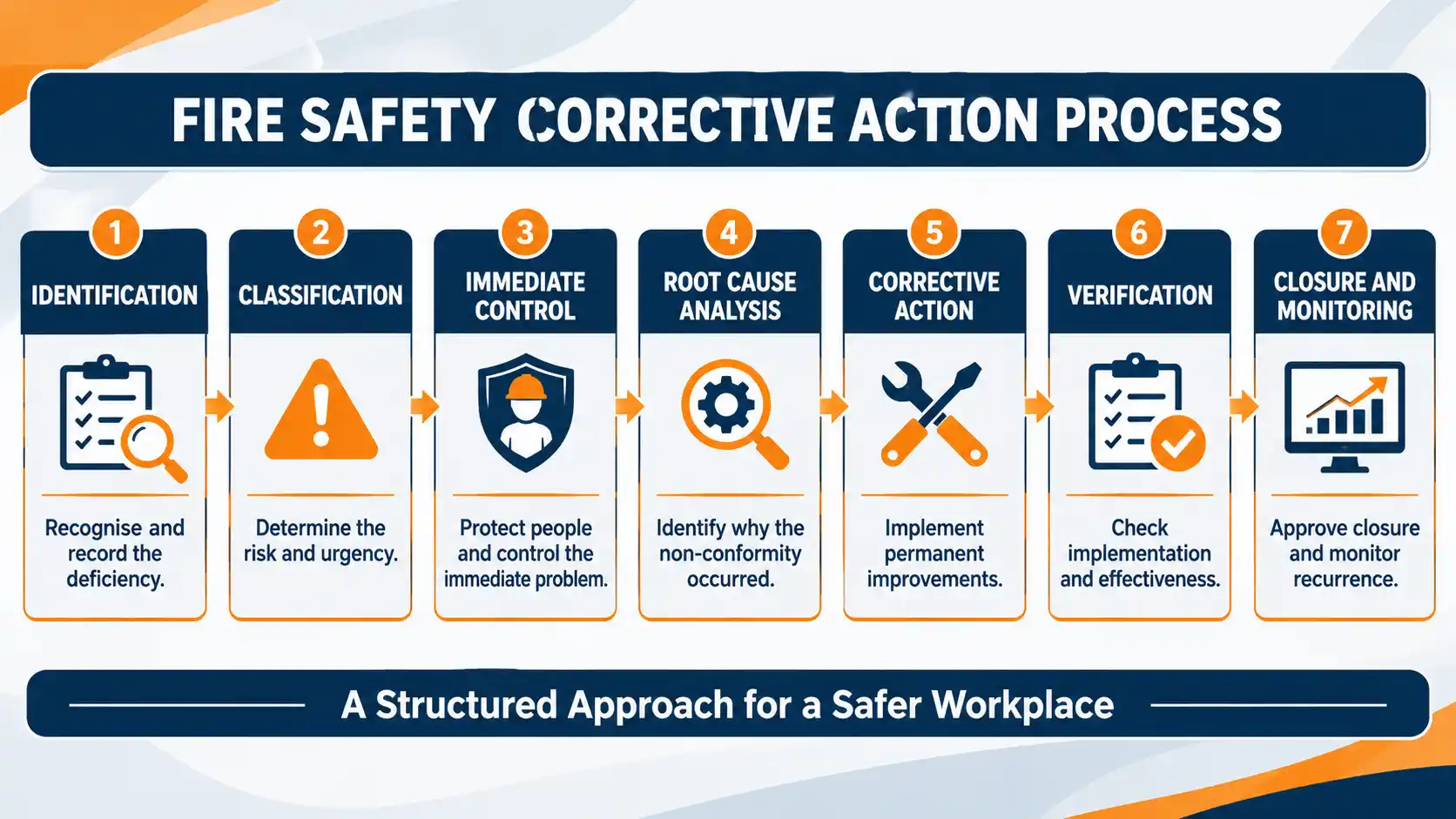
12. Verification and Closure of Fire Safety Non-Conformities
A non-conformity should not be closed merely because someone reports that the corrective work has been completed. Closure requires appropriate evidence that the deficiency has been resolved and that the agreed action has achieved its intended purpose.
Confirming Completion of the Corrective Action
The first stage involves confirming that the planned work has been carried out. This may include reviewing maintenance certificates, repair reports, inspection records, photographs or updated procedures.
Checking Technical Effectiveness
Where a technical defect has been corrected, appropriate inspection or testing should confirm that the relevant equipment or building feature performs as intended. A repaired fire door, for example, should be checked against its intended function and relevant installation requirements.
Assessing Whether the Root Cause Has Been Addressed
Verification should also consider whether the underlying management or operational weakness has been resolved. If a maintenance procedure was revised, management should confirm that it is being followed and that inspection responsibilities are understood.
Monitoring for Recurrence
Some corrective actions require monitoring over an appropriate period. This is especially relevant where the original finding involved repeated housekeeping failures, inconsistent employee behaviour or ineffective supervision.
Formal Closure and Documentation
Once sufficient evidence is available, an authorised person should approve closure. The record should contain the verification findings, supporting documents, date of approval and any outstanding monitoring requirements.
If verification identifies that the action was ineffective, the finding should remain open or be reopened as appropriate. Further investigation and revised corrective measures may be necessary.
13. Best Practices for Preventing Recurring Fire Safety Non-Conformities
Preventing recurring non-conformities requires organisations to move from isolated corrections towards stronger operational controls. The following practices can improve the reliability of fire safety arrangements.
Establish Clear Inspection Procedures
Inspection procedures should identify what must be checked, who is responsible, how findings are recorded and how defects are escalated. Standardised inspection arrangements make it easier to identify changes and compare findings over time.
Provide Appropriate Fire Safety Training
Training should reflect workplace hazards, employee responsibilities and the requirements of emergency procedures. Refresher instruction should be provided where appropriate, particularly following significant operational changes or identified weaknesses.
Strengthen Maintenance Management
Organisations should maintain planned inspection and maintenance schedules for relevant fire protection equipment and building features. Maintenance providers should be appropriately competent, and outstanding defects should be tracked until resolution.
Improve Communication
Employees, managers, contractors and relevant occupiers should have clear methods for reporting fire safety problems. Important findings should be communicated to the people responsible for implementing and monitoring corrective measures.
Introduce Management Review
Management should periodically review outstanding findings, recurring deficiencies, maintenance performance and the effectiveness of previous corrective actions. This helps identify systemic problems and ensures that resources are directed towards important risks.
Apply Effective Change Management
Significant changes to premises, occupancy, processes or equipment should trigger appropriate consideration of fire safety implications. Reviewing arrangements before and after changes can prevent new non-conformities from developing.
14. Common Challenges in Managing Fire Safety Non-Conformities
Even organisations with established fire safety procedures can experience difficulties managing identified deficiencies. Understanding these challenges helps management develop more reliable corrective action arrangements.
Unclear Classification Criteria
Different inspectors may classify similar findings differently if the organisation has not established consistent criteria. This can lead to inconsistent priorities and confusion over the required response.
A documented classification procedure should provide clear definitions, examples and escalation requirements. Staff should receive suitable instruction in applying the framework.
Delayed Corrective Action
Actions may be delayed because of insufficient resources, unavailable contractors, procurement difficulties or competing operational priorities. Management should ensure that delays are escalated and that appropriate interim controls remain in place.
Weak Root-Cause Investigation
Investigations sometimes focus on individual mistakes without examining the management conditions that contributed to the problem. This can produce superficial corrective actions that fail to prevent recurrence.
Insufficient Documentation
Incomplete records make it difficult to establish what was identified, who was responsible and whether the action was effective. Standardised reporting templates and centralised registers can improve traceability.
Lack of Management Commitment
If senior management does not review outstanding deficiencies or allocate adequate resources, corrective actions may lose priority. Effective fire safety management requires visible leadership and clear accountability.
Inadequate Verification
Closing findings without checking their effectiveness can create a false impression of compliance. Verification should be based on evidence rather than assumptions or informal verbal confirmation.
15. How to Improve Fire Safety Compliance Through Continuous Monitoring
Continuous monitoring provides ongoing information about the effectiveness of fire safety arrangements. Rather than relying exclusively on periodic audits, organisations should combine routine inspections, maintenance reviews, employee reporting and management oversight.
Use Meaningful Fire Safety Performance Indicators
Performance indicators can help managers understand whether corrective actions are being implemented effectively. Useful measures may include the number of outstanding critical findings, overdue corrective actions, recurring defects, completion of scheduled inspections and the proportion of actions successfully verified.
Indicators should be interpreted carefully. A low number of reported findings does not necessarily demonstrate effective fire safety management. It may also indicate weak reporting arrangements or insufficient inspection activity.
Review Non-Conformity Trends
Trend analysis can identify departments, locations or systems experiencing repeated deficiencies. Management can use this information to identify where additional training, supervision, maintenance or engineering improvements may be necessary.
Integrate Findings into Management Reviews
Non-conformity records should inform broader fire safety management reviews. Management should consider whether existing arrangements remain appropriate, whether previous actions have been effective and whether new risks require additional controls.
Use Digital Reporting and Tracking Systems
Digital reporting systems can improve visibility of defects, assign action owners and provide reminders about approaching deadlines. They can also support trend analysis and generate management reports.
However, software does not replace competent assessment or management responsibility. The quality of the process depends on accurate information, appropriate decision-making and effective verification.
16. UK Fire Safety Regulations and Standards for Managing Non-Conformities
Fire safety non-conformities should be evaluated against the legal requirements applicable to the premises and jurisdiction. Organisations operating across the UK should recognise that fire safety legislation is not identical in England, Wales, Scotland and Northern Ireland.
Regulatory Reform (Fire Safety) Order 2005
The Regulatory Reform (Fire Safety) Order 2005 is the principal general fire safety framework for relevant non-domestic premises in England and Wales. It establishes duties relating to general fire precautions, risk assessment, fire safety arrangements, maintenance, information, instruction and training.
The following provisions are particularly relevant when reviewing workplace non-conformities:
- Article 5: Establishes the duties of the responsible person and other persons with control, to the extent of their control.
- Article 8: Addresses the duty to take general fire precautions.
- Article 9: Requires a suitable and sufficient fire risk assessment.
- Article 11: Addresses appropriate fire safety arrangements.
- Article 14: Covers emergency routes and exits.
- Article 15: Addresses procedures for serious and imminent danger and danger areas.
- Article 17: Addresses maintenance of relevant premises, facilities, equipment and devices.
- Article 19: Addresses the provision of information to employees.
- Article 21: Addresses employee fire safety training.
- Article 22: Requires cooperation and coordination where responsible persons share or have duties in respect of premises.
The current legislation should be consulted when determining the precise obligations applicable to a particular workplace. Read the Regulatory Reform (Fire Safety) Order 2005.
Fire Safety Act 2021
The Fire Safety Act 2021 clarified the application of the Fire Safety Order to the structure, external walls and flat entrance doors of relevant multi-occupied residential buildings in England and Wales. Organisations responsible for relevant premises should consider these provisions when evaluating building fire safety arrangements.
Official legislation is available through the Fire Safety Act 2021.
Fire Safety (England) Regulations 2022
The Fire Safety (England) Regulations 2022 introduce additional requirements for responsible persons in relevant residential buildings in England. Depending on the building and its characteristics, requirements include information sharing, fire door checks and provision of information to fire and rescue services.
Consult the official Fire Safety (England) Regulations 2022 guidance for further information.
Different Fire Safety Legislation Across the UK
The legal framework differs across the devolved nations. In Scotland, general workplace fire safety duties are principally addressed through Part 3 of the Fire (Scotland) Act 2005 and the Fire Safety (Scotland) Regulations 2006. Northern Ireland has its own framework, including the Fire and Rescue Services (Northern Ireland) Order 2006 and the Fire Safety Regulations (Northern Ireland) 2010.
Organisations should consult the relevant legislation and official guidance rather than assuming that every provision of the England and Wales framework applies throughout the UK.
Enforcement and Consequences of Non-Compliance
Fire and rescue authorities and other relevant enforcing authorities may take enforcement action where fire safety duties are not fulfilled. Depending on the circumstances, this may involve informal advice, non-statutory notices, enforcement notices, alterations notices or prohibition notices.
A prohibition notice can restrict or prohibit the use of premises where serious risk requires urgent intervention. Serious breaches may also result in prosecution and significant penalties.
Read the official Fire Safety Order: Enforcement and Sanctions for Non-Compliance guidance for further information about enforcement.
Official Fire Risk Assessment Guidance
The government provides guidance to support responsible persons in identifying fire hazards, assessing risks, implementing precautions and maintaining appropriate records. The GOV.UK fire risk assessment guidance is a useful starting point for organisations in England.
For further practical information, the Health and Safety Executive fire safety guidance provides additional information about workplace fire and explosion risks.
17. Conclusion: Strengthening Workplace Fire Safety Through Effective Corrective Action
Fire safety non-conformities provide important information about weaknesses in workplace fire prevention, protection and management arrangements. However, identifying a deficiency is only the beginning of an effective improvement process.
Organisations must classify findings according to their actual significance, assess associated risks, introduce appropriate immediate controls and investigate the causes of recurring problems. Corrective actions should address the underlying weaknesses rather than simply remove visible defects.
A structured action plan, clear responsibilities, consistent monitoring and evidence-based verification help ensure that identified problems are resolved effectively. Management reviews and trend analysis can further strengthen organisational controls by identifying opportunities for long-term improvement.
By integrating non-conformity management into routine fire safety activities, organisations can improve accountability, maintain more reliable fire precautions and create safer workplaces. Effective fire safety compliance is therefore an ongoing management responsibility rather than a one-time inspection outcome.
Develop Professional Knowledge in Fire Safety
Building a strong understanding of fire prevention, workplace fire hazards, risk assessment and fire safety management helps professionals contribute to safer working environments.
Explore the relevant fire safety certifications and professional learning opportunities available through our programmes.
Explore Fire Safety CertificationFrequently Asked Questions About Fire Safety Non-Conformities
1. What is a fire safety non-conformity?
A fire safety non-conformity is a failure to meet an applicable fire safety requirement, procedure or established control measure. Examples include blocked emergency exits, defective fire doors, inadequate maintenance and missing inspection records.
2. What are the main classifications of fire safety non-conformities?
Organisations commonly use four internal categories: critical, major, minor and observations or opportunities for improvement. These categories help prioritise corrective actions but are not universal statutory classifications under UK fire safety legislation.
3. What is the difference between correction and corrective action?
Correction resolves the immediate identified deficiency. Corrective action investigates and addresses the underlying cause to prevent the problem from recurring. Removing materials from a blocked exit is a correction, while improving storage controls and supervision may constitute corrective action.
4. How should critical fire safety non-conformities be managed?
Critical findings require immediate attention. Organisations should protect people, introduce suitable interim controls, escalate the issue to the responsible person and obtain competent assistance. Restricting access or stopping affected activities may be necessary depending on the risk.
5. Who is responsible for addressing fire safety non-conformities?
Responsibility depends on the premises, activities and extent of control. Employers, owners, occupiers, landlords, facilities managers and other responsible persons may have relevant duties. Specific corrective actions should be assigned to competent individuals.
6. How are fire safety non-conformities identified?
They can be identified through fire risk assessments, workplace inspections, internal audits, equipment testing, maintenance reviews, incident investigations and employee reports. Findings should be recorded with sufficient supporting evidence.
7. What should a fire safety corrective action plan include?
A corrective action plan should include the finding, risk classification, immediate controls, root cause, required action, responsible person, target date, resources, verification requirements and closure approval.
8. Why is root-cause analysis important in fire safety?
Root-cause analysis identifies the underlying reasons a deficiency occurred. It helps organisations develop corrective actions that address weaknesses in procedures, maintenance, supervision, training or management systems rather than repeatedly correcting the same symptoms.
9. How can organisations prevent recurring fire safety non-conformities?
Organisations can prevent recurrence through regular inspections, suitable maintenance, employee training, clear responsibilities, effective communication, change management, root-cause investigation and ongoing verification of corrective actions.
10. Which UK legislation is relevant to fire safety non-conformities?
The Regulatory Reform (Fire Safety) Order 2005 is the main general fire safety framework for relevant non-domestic premises in England and Wales. Scotland and Northern Ireland have separate fire safety legislation. Additional requirements may apply depending on the building, workplace and activities.
11. What happens if fire safety non-conformities remain unresolved?
Unresolved deficiencies may increase the likelihood or consequences of fire-related harm and can result in enforcement action. Depending on the circumstances, enforcing authorities may issue formal notices, restrict the use of premises or pursue prosecution.
12. When can a fire safety non-conformity be formally closed?
A finding can be closed when the required action has been completed, sufficient evidence confirms the deficiency has been resolved, and the authorised person is satisfied that the corrective measures are effective. Where monitoring is necessary, closure arrangements should reflect the remaining verification requirements.