
Fire Safety for Cleaning Teams: Chemical Storage and Ignition Hazards
Practical guidance on preventing workplace fires, storing cleaning chemicals safely, controlling ignition sources and protecting cleaning operatives across commercial and industrial environments.
Cleaning teams play an important role in maintaining safe, hygienic and organised workplaces. However, the chemicals, equipment and materials used during routine cleaning can introduce fire hazards when they are stored, handled or disposed of incorrectly. Flammable cleaning products, aerosol containers, solvent-based solutions, contaminated cloths, electrical equipment and poorly ventilated storage cupboards can all contribute to workplace fire risks.
Fire safety for cleaning teams is not simply about knowing where the nearest fire extinguisher is located. It involves understanding the properties of cleaning chemicals, recognising potential ignition sources, following appropriate storage arrangements, maintaining good housekeeping and knowing how to respond when an unsafe condition is identified.
These responsibilities are particularly important in commercial buildings, offices, hotels, hospitals, schools, shopping centres, warehouses, industrial facilities and other premises where cleaning activities take place alongside other business operations. A cleaning operative may work in several departments during one shift, each with different chemicals, equipment, ventilation arrangements and emergency procedures.
This guide explains how organisations can improve fire safety for cleaning teams, manage chemical storage and reduce ignition hazards. It also explores relevant UK legislation, practical workplace procedures, staff training and inspection arrangements.
Quick answer: How can cleaning teams prevent workplace fires?
Cleaning teams can reduce fire risks by storing chemicals in designated and suitable locations, following product labels and Safety Data Sheets, keeping flammable substances away from ignition sources, controlling aerosol and solvent use, disposing of contaminated waste safely, checking electrical equipment and maintaining clear escape routes. Employers must support these actions through suitable risk assessments, training, supervision and emergency arrangements.
Understanding Fire Safety Risks in Cleaning Operations
Cleaning operations can involve several types of fire hazard at the same time. A cleaning cupboard may contain detergents, disinfectants, alcohol-based products, aerosols, paper towels, cloths and electrical equipment. Although these items are common in everyday workplaces, their combined presence requires appropriate management.
The level of risk depends on the actual products being used, their quantities, the storage environment, the ventilation available and the possibility of contact with ignition sources. Not every cleaning chemical is flammable, and not every chemical presents the same fire or explosion hazard. The correct approach is to assess individual products and tasks rather than treating all cleaning materials as equally dangerous.
How the fire triangle applies to cleaning teams
Ordinary combustion requires three elements: heat, fuel and oxygen. This is commonly explained through the fire triangle. Cleaning activities can introduce or increase the availability of two of these elements: combustible fuel and potential ignition sources.
Heat and ignition sources
Electrical faults, hot surfaces, heaters, charging equipment, sparks, smoking materials and certain maintenance activities can provide the energy required to ignite combustible substances.
Fuel and combustible materials
Flammable liquids, solvent-based products, some aerosols, paper towels, packaging, textiles, contaminated cloths and accumulated waste can contribute fuel to a fire.
Oxygen
Oxygen is normally present in the surrounding air. Some chemicals can also have oxidising properties that intensify combustion and require special storage controls.
Risk reduction
Good storage, suitable product selection, ignition control, waste management and effective housekeeping help reduce opportunities for a fire to start or develop.
Understanding these relationships helps cleaning operatives recognise why seemingly minor activities, such as leaving a solvent container beside a heater or storing paper waste in an electrical room, may create avoidable hazards.
Common Fire Hazards Associated with Cleaning Chemicals
Cleaning products have different chemical properties and intended uses. Some are water-based and have limited flammability concerns, while others contain solvents, alcohols or propellants that can create more significant fire risks. Product labels and Safety Data Sheets should guide workplace controls.
Flammable cleaning liquids
Some specialist cleaning agents, degreasers, stain removers and solvent-based products can release vapours that may ignite when exposed to a suitable ignition source. The risk may increase where products are used in poorly ventilated rooms, transferred between containers or stored near heat-producing equipment.
Cleaning teams should identify products with flammable hazard classifications and follow the specified precautions. They should avoid leaving open containers unattended, using products close to naked flames or bringing unnecessary quantities into work areas.
Alcohol-based disinfectants and sanitising products
Some alcohol-based hand sanitisers, surface disinfectants and specialist cleaning products are flammable. Their vapours and residues can present an ignition hazard depending on their formulation and conditions of use.
Operatives should follow the manufacturer’s instructions, allow treated surfaces to dry where required and keep products away from smoking materials, flames and hot surfaces. A product should never be assumed safe simply because it is commonly used in healthcare or public-facing environments.
Aerosol cleaning products
Aerosol sprays may contain flammable propellants, depending on the product formulation. They can also be stored under pressure. Exposure to excessive heat may increase container pressure and create additional hazards.
Keep aerosols away from direct sunlight, heaters, hot equipment and other sources of heat. Do not puncture, burn or deliberately damage aerosol containers, even when they appear empty. Follow the manufacturer’s storage and disposal instructions.
Solvent-based cleaners and degreasers
Some specialist products used to remove grease, adhesives, paint, ink and stubborn deposits contain volatile solvents. Their vapours may ignite under suitable conditions, particularly when used near sparks, hot surfaces or unsuitable electrical equipment.
Where solvent-based cleaning is necessary, employers should assess the task, identify the potential release of vapours and determine appropriate ventilation and ignition controls. Operatives should never improvise by mixing products or changing the approved cleaning method.
Oxidising and reactive products
Some cleaning and disinfection chemicals have oxidising or reactive properties. These substances may intensify combustion or react dangerously with incompatible materials. They should be stored separately where the product information and assessment require it.
For example, some oxidising products must be kept away from flammable materials and certain organic substances. Cleaning teams should not decide chemical compatibility based on appearance, smell or assumptions. The relevant Safety Data Sheet and workplace chemical assessment must determine the correct arrangements.
Safe Chemical Storage Practices for Cleaning Teams
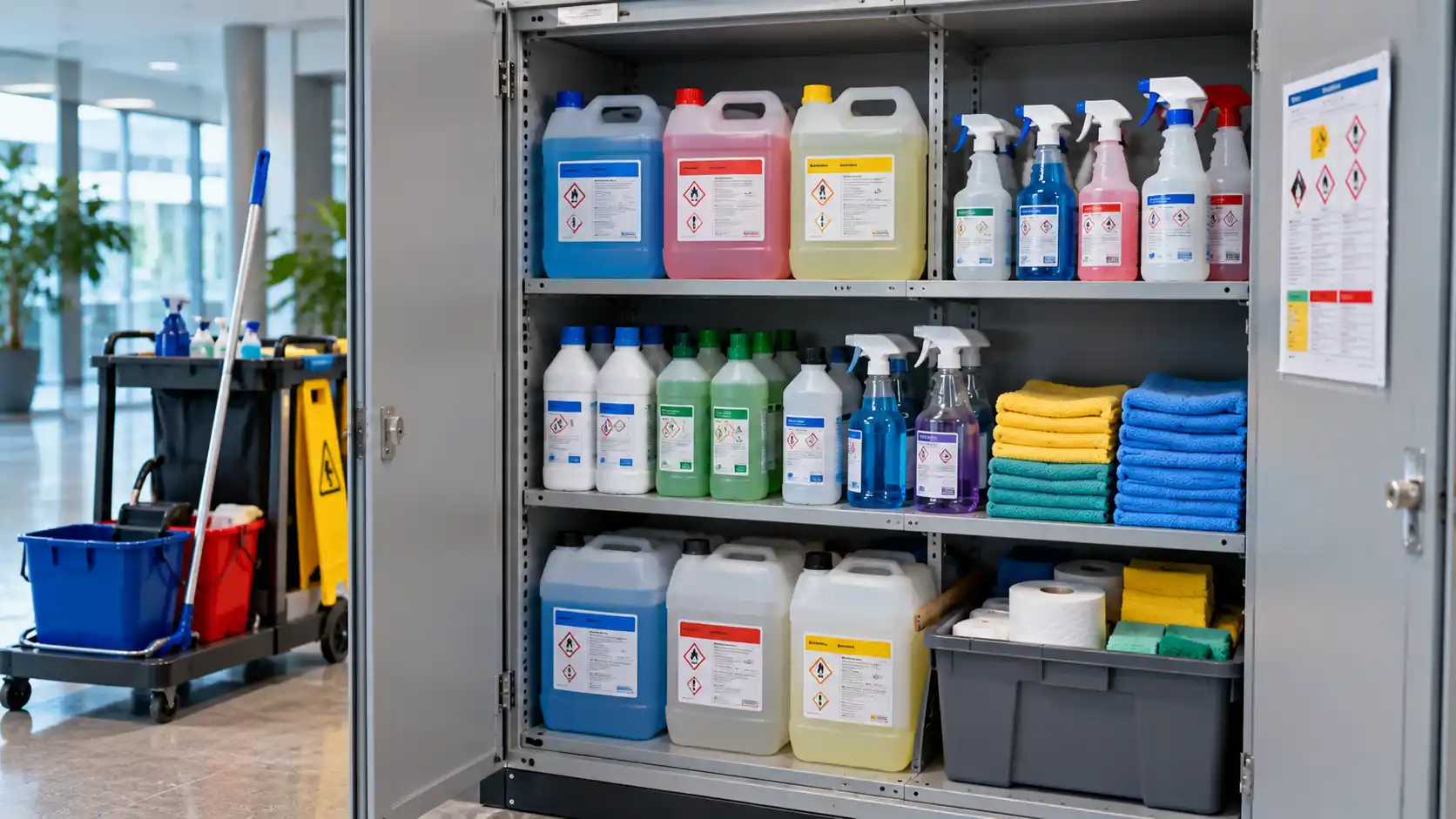
Correct chemical storage is one of the most important elements of fire prevention in cleaning operations. Products should be kept in designated storage locations that are suitable for their hazards, quantities and storage requirements.
Use designated chemical storage areas
Cleaning chemicals should be stored in approved, designated locations rather than being placed wherever space is available. Storage cupboards should be appropriate for the products they contain, protected from unnecessary heat and arranged to prevent accidental damage or spills.
Do not use electrical cupboards, boiler rooms, plant rooms, stairwells or escape corridors as informal chemical storage locations. These areas may contain ignition sources, safety equipment or essential escape routes. Their permitted use should follow the building’s fire risk assessment and site arrangements.
Separate incompatible substances
Different chemicals may react dangerously when they come into contact. Storage arrangements should therefore be based on chemical compatibility rather than convenience or product category alone.
For example, oxidising substances may require separation from flammable or combustible materials. Acids and alkalis may also require separate storage arrangements where their reaction could create heat, splashing or harmful gases.
Cleaning supervisors should use product information and the chemical risk assessment to establish which substances can be stored together. Where compatibility is uncertain, staff should seek guidance from a competent person rather than experimenting.
Keep containers sealed and correctly labelled
Containers should remain closed when not in use. This helps reduce leakage, evaporation, contamination and unnecessary release of vapours.
Every working container must have suitable identification. Operatives should never transfer chemicals into unlabelled bottles, drinks containers or food packaging. If a container becomes damaged, leaks or loses its label, it should be reported and managed under the organisation’s approved procedure.
Control the quantities stored
Keeping unnecessary quantities of flammable substances in working areas can increase the potential consequences of an incident. Organisations should determine how much material is genuinely required for the task and minimise the quantities held outside designated storage areas.
For workplaces covered by DSEAR, the employer must assess dangerous substances and control associated risks. HSE guidance identifies minimising indoor quantities of flammable liquids as an important principle. The appropriate amount depends on the process, task and risk assessment rather than a universal allowance.
Maintain appropriate ventilation and temperature conditions
Some chemicals can release vapours that may accumulate in enclosed areas. Storage arrangements should follow the manufacturer’s requirements and the findings of the relevant risk assessments.
Do not block ventilation openings or install makeshift fans without approval. Ventilation systems must be appropriate for the hazard and designed or assessed by competent people. Similarly, products should not be stored close to radiators, hot pipes, direct sunlight or equipment that may cause excessive heating.
Inspect chemical containers regularly
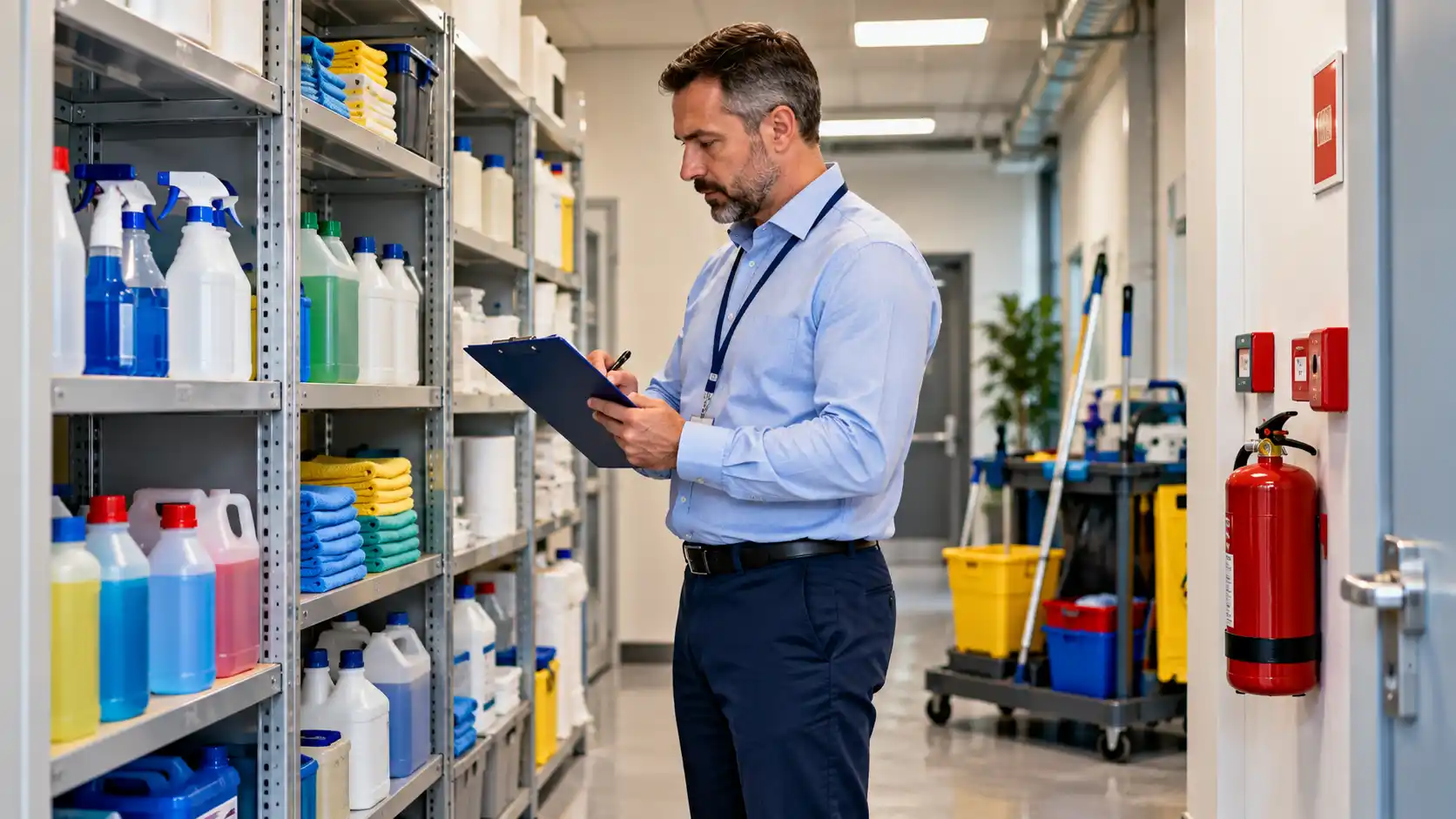
Routine checks help identify problems before they develop into more serious incidents. Supervisors should establish inspection arrangements appropriate to the site and chemicals involved.
| Inspection point | What to check | Required action |
|---|---|---|
| Container condition | Cracks, leaks, corrosion or damaged caps | Report and isolate under the approved procedure |
| Product labels | Missing, damaged or unreadable identification | Do not use unidentified products |
| Storage location | Heat, direct sunlight or unsuitable conditions | Correct the storage arrangement |
| Chemical compatibility | Incompatible substances stored together | Refer to the chemical assessment |
| Housekeeping | Spills, unnecessary packaging and clutter | Apply the approved cleaning and waste procedure |
| Emergency access | Obstructed exits, alarms or extinguishers | Remove the obstruction safely and report it |
Identifying and Controlling Ignition Hazards
Chemical storage controls are only effective when potential ignition sources are also managed. Cleaning teams frequently work around electrical equipment, heating systems, machinery, lighting and other building services. They must understand which activities and conditions may introduce ignition risks.
Electrical cleaning equipment
Vacuum cleaners, floor scrubbers, carpet cleaning machines, polishers and other powered equipment can become ignition sources if damaged, poorly maintained or unsuitable for the environment.
Before use, operatives should carry out the checks required by the employer. These may include examining cables, plugs, casings and visible signs of damage. Equipment that appears unsafe should be taken out of service in accordance with workplace arrangements and reported to a supervisor.
Do not continue using equipment with damaged wiring, unusual overheating, burning smells or other signs of electrical malfunction. Repairs should only be carried out by authorised competent persons.
Battery charging areas
Battery-powered cleaning machines and portable equipment may require charging between shifts. Charging should take place in designated locations that are suitable for the battery type and equipment manufacturer’s requirements.
Keep charging stations free from unnecessary combustible materials. Do not cover chargers, use damaged charging cables or position equipment close to chemical storage unless the arrangement has been assessed and approved. Where batteries or chargers show signs of overheating, swelling, unusual odours or damage, stop using them and follow the site’s reporting procedure.
Portable heaters and hot surfaces
Cleaning teams may work in areas containing portable heaters, radiators, hot pipes, commercial equipment or machinery. Flammable products and combustible waste should not be placed near heat sources.
Cleaning operatives should not move, disconnect or modify fixed building equipment unless authorised. Any unsafe arrangement should be reported to the facilities or maintenance team.
Smoking materials and naked flames
Smoking materials, matches, lighters and naked flames can ignite certain flammable products and vapours. Organisations should enforce their smoking policies and ensure that cleaning activities involving flammable substances are carried out away from unauthorised ignition sources.
Never use a lighter, match or flame to check a chemical leak, identify a product or test whether a vapour is present.
Maintenance work and hot work activities
Welding, grinding, cutting and other hot work may introduce sparks or heat into areas where cleaning chemicals are used or stored. Cleaning supervisors and contractors should coordinate activities before work begins.
Where hot work is planned, the organisation should follow its permit-to-work or other suitable authorisation arrangements, assess surrounding hazards and establish appropriate precautions. Cleaning operatives should not move chemicals into an unapproved location simply to make space for maintenance work.
Safe Handling, Dilution and Use of Cleaning Chemicals
Fire safety controls must continue throughout the cleaning process, not just while products are stored. Opening containers, transferring liquids, diluting concentrates and applying cleaning agents can release vapours or create spills.
Read product labels and Safety Data Sheets
Before introducing a product into a cleaning task, staff should understand its hazards, required precautions, storage instructions and emergency information.
Safety Data Sheets provide important information about chemical properties, handling, storage and emergency measures. They should be used to inform the workplace assessment, but an SDS is not a substitute for a suitable COSHH or fire risk assessment.
Relevant information may include:
- Product identification and hazard classification.
- Firefighting measures and unsuitable extinguishing media.
- Handling and storage precautions.
- Exposure controls and personal protective equipment.
- Accidental release and spill response arrangements.
- Stability, reactivity and incompatible materials.
Follow approved dilution procedures
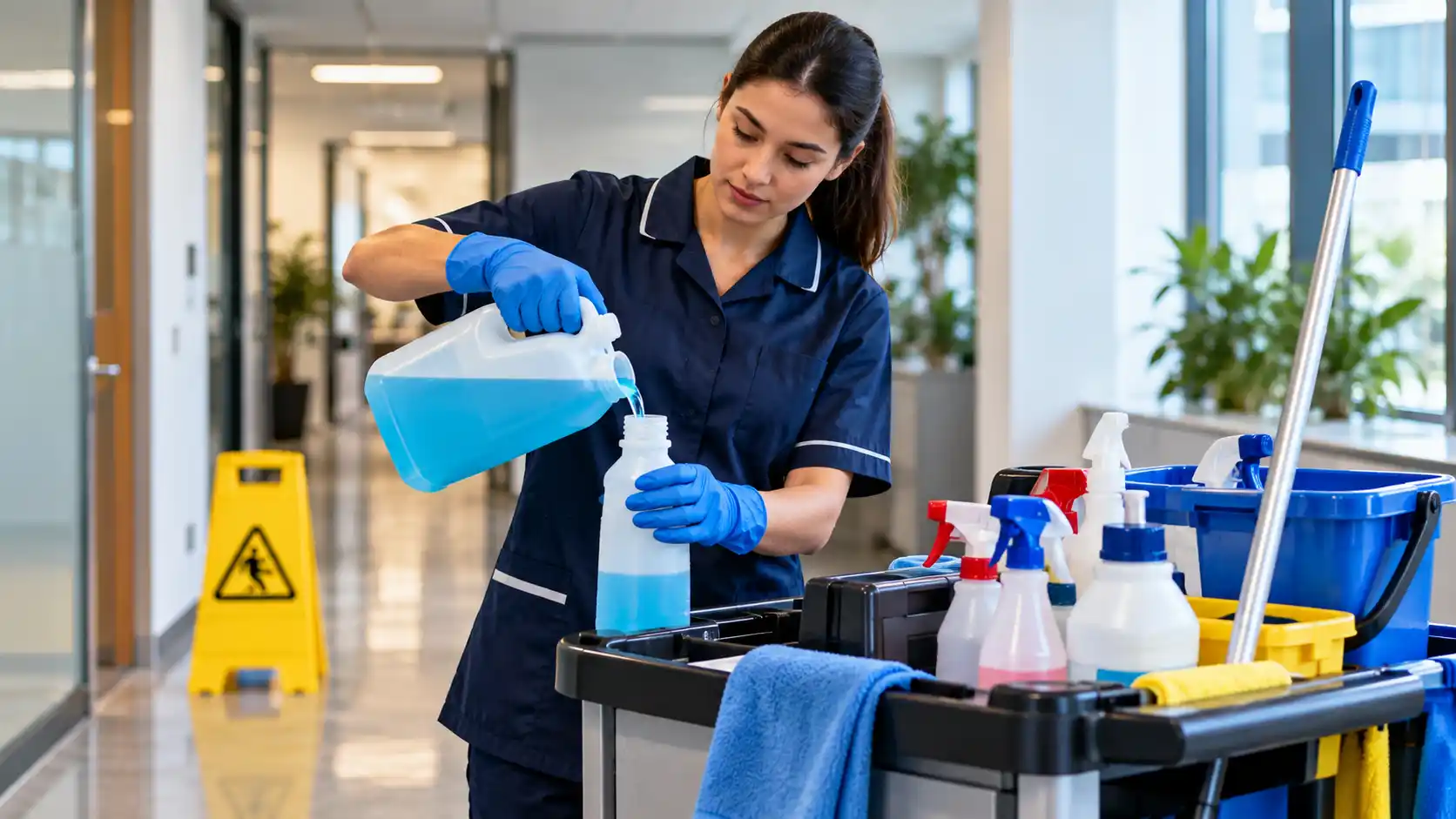
Concentrated cleaning products should only be diluted according to approved instructions. Operatives should use the correct dispensing systems, containers and protective equipment specified by their employer.
Do not improvise mixtures, combine products or change concentrations to improve cleaning performance. Such actions may create chemical reactions, vapour releases or unexpected hazards.
Control spills immediately
A chemical spill can create a fire hazard if the substance is flammable or if it reaches an ignition source. It can also create exposure, slip and environmental risks.
Workers should follow the site’s spill response procedure and use only the materials and methods approved for the particular product. They should not wash an unknown chemical into a drain, use an unsuitable absorbent or attempt to clean up a significant spill without the required training and equipment.
Maintain suitable ventilation
Cleaning products should be used in environments with ventilation appropriate to their hazards and the task. This is especially important for products that release vapours or are used in enclosed rooms.
Operatives should not assume that opening a door or window will always provide sufficient control. The employer must assess the actual exposure and fire risks and establish suitable measures.
Cleaning Cloths, Waste and Housekeeping Fire Risks
Waste management is an important part of fire prevention. Paper towels, disposable wipes, cardboard, packaging, textiles and some contaminated materials can contribute to fire development when they accumulate near ignition sources.
Manage contaminated cloths carefully
Some cloths and absorbent materials used with oils, solvents or other combustible substances may present a particular fire risk. Certain drying oils can undergo self-heating under specific conditions, potentially causing contaminated textiles to ignite.
Employers should identify whether the products used by cleaning teams can create self-heating or other waste-related hazards. Where required, they should provide suitable containers and disposal procedures based on the substance and relevant assessment.
Do not leave contaminated cloths in piles, inside equipment cupboards or beside heaters. Never assume that all used cleaning cloths can be treated as ordinary general waste.
Remove combustible waste regularly
Packaging, paper, cardboard and disposable cleaning materials should be removed through the approved waste management arrangements. Waste should not be allowed to accumulate in storage cupboards, plant rooms or corridors.
Waste containers should be appropriate for the materials being collected and positioned so that they do not obstruct escape routes or access to emergency equipment.
Keep fire doors and escape routes clear
Cleaning trolleys, floor machines, waste bags, chemical containers and equipment must not obstruct fire doors, stairways, corridors or emergency exits. Fire doors should not be wedged open using cleaning equipment.
These precautions help maintain the building’s fire protection arrangements and allow people to evacuate when required.
For more practical guidance, read our related article on fire safety housekeeping and how workplace organisation reduces risk.
Fire Safety Responsibilities of Cleaning Employers and Supervisors
Fire prevention is an organisational responsibility. Individual cleaning operatives must follow their training and workplace procedures, but employers and other relevant dutyholders must establish the systems that make safe working possible.
Responsibilities of employers and the responsible person
Under the Regulatory Reform (Fire Safety) Order 2005, the responsible person must take appropriate general fire precautions, arrange a suitable and sufficient fire risk assessment, provide relevant information and training, and establish emergency procedures.
The responsible person may be an employer, owner, occupier or another person with control of the premises, depending on the circumstances. Where several organisations share a building, relevant dutyholders must cooperate and coordinate their fire safety arrangements.
Responsibilities of cleaning supervisors
Cleaning supervisors should translate workplace policies into practical daily arrangements. They should ensure that staff understand which products are approved, where chemicals must be stored, how equipment should be checked and who should be contacted when a hazard is identified.
Supervisors should also coordinate cleaning schedules with facilities management, maintenance teams and other contractors where activities may introduce additional ignition sources or affect evacuation arrangements.
Responsibilities of cleaning operatives
Cleaning operatives should follow instructions, use products correctly, maintain good housekeeping, report defects and cooperate with emergency procedures. They should not undertake tasks for which they have not received suitable instruction or training.
Workers should also understand that their normal cleaning duties stop when an emergency requires evacuation. They must not delay leaving a building to collect equipment, chemicals or personal belongings.
UK Fire Safety Legislation and Chemical Safety Requirements
Several UK legal frameworks are relevant to cleaning activities involving hazardous substances and workplace fire risks. The requirements that apply depend on the workplace, the products used, the activities undertaken and the jurisdiction.
The following section focuses on England. Organisations operating in Scotland, Wales or Northern Ireland should check the separate fire safety legislation and guidance applicable to their location.
Regulatory Reform (Fire Safety) Order 2005
The Regulatory Reform (Fire Safety) Order 2005 establishes fire safety duties for relevant non-domestic premises in England and Wales. For this article, the focus is on its application in England.
The responsible person must carry out a suitable and sufficient fire risk assessment, implement appropriate preventive and protective measures, provide relevant information and instruction, and establish emergency arrangements.
Where dangerous substances are present or may be present, the fire risk assessment must consider the relevant dangerous-substance hazards. This is particularly important where cleaning products include flammable liquids, aerosols or other substances that may contribute to a fire or explosion.
Control of Substances Hazardous to Health Regulations 2002
The COSHH Regulations 2002 require employers to assess and control risks arising from hazardous substances at work. Cleaning chemicals may cause harm through inhalation, skin contact, eye contact or other exposure routes.
COSHH assessments should consider the way substances are stored, handled, used and disposed of, including arrangements for foreseeable incidents and emergencies.
Although COSHH is primarily concerned with health risks from hazardous substances, it is closely connected with chemical management and should be coordinated with fire safety and DSEAR assessments where relevant.
Dangerous Substances and Explosive Atmospheres Regulations 2002
DSEAR applies where dangerous substances create risks to people’s safety from fires, explosions or corrosion of metals. It is particularly relevant to workplaces using or storing flammable liquids, gases, vapours and other dangerous substances.
Employers must identify dangerous substances, assess the associated risks, eliminate or reduce risks where possible, establish appropriate control and mitigation measures, prepare emergency procedures and provide information and training.
Where explosive atmospheres may occur, employers must also address ignition-source control and other relevant requirements. Not every cleaning cupboard automatically creates a DSEAR hazardous area; the need for classification and specific controls must be determined through the appropriate assessment.
| Legal framework | Main focus | Relevance to cleaning teams |
|---|---|---|
| Regulatory Reform (Fire Safety) Order 2005 | Fire prevention, protection and emergency arrangements | Fire risk assessments, training, evacuation and safe storage arrangements |
| COSHH Regulations 2002 | Control of hazardous substances and exposure | Safe handling, storage, use, disposal and spill procedures |
| DSEAR 2002 | Fire and explosion risks from dangerous substances | Flammable products, vapours, quantities and ignition-source control |
Organisations should consult the current legislation and relevant official guidance when developing their procedures. A general blog article cannot replace a site-specific assessment or competent legal and technical advice.
How to Conduct a Fire Risk Assessment for Cleaning Activities
A fire risk assessment should consider the actual cleaning activities and the substances, equipment and storage arrangements involved. The responsible person should ensure that cleaning-related hazards are not overlooked simply because cleaning is considered a routine support function.
A practical assessment can follow these stages:
- Identify cleaning products and materials. Prepare an inventory of chemicals, aerosols, solvents, combustible waste and other relevant substances used or stored on the premises.
- Review product hazards. Examine labels and Safety Data Sheets to identify flammability, storage conditions, incompatible materials and emergency information.
- Identify ignition sources. Consider electrical equipment, battery charging, heaters, hot surfaces, smoking materials and maintenance work.
- Identify people at risk. Include cleaning operatives, supervisors, other employees, contractors, visitors and people who may need assistance during evacuation.
- Evaluate storage and working arrangements. Review quantities, ventilation, chemical compatibility, equipment condition, waste disposal and access to emergency facilities.
- Introduce suitable controls. Establish approved storage locations, safe systems of work, equipment checks, housekeeping procedures and emergency arrangements.
- Record findings and communicate them. Make sure relevant staff understand the identified hazards and the measures required to control them.
- Review the assessment. Update it when products, processes, quantities, premises or other relevant circumstances change, and review it regularly.
Where DSEAR applies, the employer should also ensure that the dangerous-substance assessment addresses the relevant fire and explosion risks. A COSHH assessment alone does not automatically satisfy DSEAR or fire safety requirements.
Fire Safety Training for Cleaning Teams
Training helps cleaning operatives recognise hazards and apply workplace procedures consistently. It should be suitable for the tasks performed, the products used, the premises and the level of risk identified by the employer.
Essential training topics
- Recognising fire and chemical hazard labels.
- Understanding the purpose and use of Safety Data Sheets.
- Following approved chemical storage and compatibility arrangements.
- Identifying potential ignition sources.
- Using electrical cleaning equipment safely.
- Understanding battery charging procedures.
- Following safe dilution, transfer and handling procedures.
- Recognising when a spill requires specialist assistance.
- Understanding fire alarm signals and evacuation routes.
- Reporting damaged containers, electrical faults and unsafe conditions.
- Understanding when not to attempt firefighting or spill clean-up.
Induction and refresher training
New cleaning operatives should receive appropriate site-specific induction before undertaking relevant tasks. This should include the location of chemical storage, emergency exits, alarm points, assembly areas and the procedure for reporting hazards.
Refresher instruction should be provided when necessary, particularly when new products or equipment are introduced, working methods change or inspections identify gaps in understanding.
Training records can help organisations demonstrate that relevant instruction has been provided. However, attendance alone does not prove that an operative can apply procedures correctly. Supervisors should also observe work practices and address unsafe behaviour or misunderstandings.
Emergency Procedures: What Should Cleaning Teams Do If a Fire Starts?
Cleaning operatives must know how to respond if a fire, smoke or suspected chemical-related incident occurs. The exact arrangements should follow the building’s emergency plan and the nature of the workplace.
In a fire emergency, the priority is to protect life and raise the alarm.
- Raise the alarm. Activate the appropriate fire alarm system or follow the site’s emergency reporting procedure.
- Warn people nearby. Alert colleagues and other people who may be affected, provided this can be done without exposing yourself to danger.
- Evacuate immediately. Follow the designated escape route and do not stop to collect cleaning equipment, chemicals or personal belongings.
- Close doors where safe to do so. This may help limit the spread of smoke and fire, but should never delay evacuation.
- Go to the assembly point. Follow the site’s evacuation procedure and report to the person responsible for checking attendance.
- Provide relevant information. Tell the responsible person or emergency responders about known chemical hazards, storage locations or other relevant details if it is safe to do so.
- Do not re-enter the building. Wait for authorised confirmation that it is safe to return.
Practical Daily Fire Safety Checklist for Cleaning Teams
A simple daily inspection routine can help cleaning teams identify hazards before they become incidents. The checklist below can be adapted to suit the workplace and its fire risk assessment.
Before starting work
- Check that approved cleaning products are available and correctly identified.
- Confirm that containers are closed and show no obvious signs of damage or leakage.
- Check that cleaning equipment has no visible electrical damage.
- Identify any heaters, hot surfaces or other ignition sources near the work area.
- Know the nearest fire alarm point and emergency escape route.
During cleaning activities
- Use products according to their labels and approved instructions.
- Keep flammable products away from ignition sources.
- Use suitable ventilation for the task.
- Do not mix chemicals or use unidentified products.
- Keep trolleys, cables and containers away from escape routes.
- Report spills, faults and unsafe conditions promptly.
At the end of the shift
- Return chemicals to designated storage locations.
- Close containers and check that storage areas are secure.
- Dispose of waste according to the approved procedure.
- Place contaminated cloths in the designated containers where required.
- Ensure charging equipment is used only in approved locations.
- Leave corridors, stairways and fire exits unobstructed.
- Report any outstanding fire safety concerns to the supervisor.
This checklist is a practical reminder, not a replacement for formal inspections, COSHH assessments, DSEAR assessments or the building’s fire risk assessment.

Common Fire Safety Mistakes Cleaning Teams Should Avoid
Many avoidable fire hazards develop through small deviations from established procedures. Organisations should identify these behaviours and address them through training, supervision and suitable workplace controls.
Storing chemicals wherever space is available
Using an electrical cupboard, corridor or boiler room as additional chemical storage can introduce hazards and obstruct essential building facilities. Products should be returned to designated locations.
Using unlabelled bottles
Unidentified containers make it difficult to determine product hazards, compatibility and emergency precautions. All working containers should have suitable identification.
Leaving chemical containers open
Open containers can increase the possibility of spills, contamination and vapour release. They should be closed when not in use.
Ignoring damaged electrical equipment
Continuing to use a vacuum cleaner, floor machine or charger with damaged cables or signs of overheating can create unnecessary ignition risks. Unsafe equipment should be reported and removed from use under the workplace procedure.
Accumulating waste and contaminated cloths
Leaving combustible waste or potentially self-heating contaminated textiles in unsuitable containers may increase fire risk. Waste arrangements should be based on the actual materials and their hazards.
Blocking fire exits with cleaning equipment
Cleaning trolleys, machines and waste bags must not obstruct escape routes, fire doors, extinguishers or alarm call points.
Assuming all cleaning products are non-flammable
Products should be assessed individually. Their intended purpose does not establish whether they are flammable or suitable for a particular storage arrangement.
How Employers Can Improve Fire Safety Management for Cleaning Contractors
Many organisations outsource cleaning services to specialist contractors. This arrangement does not remove the need for effective coordination between the organisation controlling the premises and the cleaning company.
The building’s responsible person and the cleaning contractor should exchange relevant information about site hazards, emergency procedures and the controls required for cleaning activities.
Effective contractor management should include:
- Providing site-specific fire safety and emergency information.
- Agreeing which cleaning products and equipment may be used.
- Confirming designated chemical storage locations.
- Reviewing relevant Safety Data Sheets and risk assessments.
- Coordinating cleaning work with maintenance and hot work activities.
- Establishing reporting arrangements for spills, faults and unsafe conditions.
- Ensuring cleaning staff receive appropriate induction and task-specific instruction.
- Reviewing incidents, near misses and inspection findings.
Out-of-hours cleaning requires particular attention. Staff working alone or when the building is largely unoccupied must understand how to raise the alarm, contact assistance and evacuate safely. Lone-working arrangements should be considered in the relevant risk assessments and emergency plans.
Conclusion: Building Safer Cleaning Operations Through Fire Prevention
Fire safety for cleaning teams depends on more than storing products neatly or keeping work areas tidy. It requires a coordinated approach to chemical identification, safe storage, ignition-source control, equipment maintenance, waste management, training and emergency planning.
Cleaning chemicals must be assessed according to their actual properties, with appropriate precautions established through product information and workplace risk assessments. Flammable products should be kept away from ignition sources, incompatible substances should be separated, and unnecessary quantities should not accumulate in working areas. Electrical equipment, battery charging, contaminated cloths and waste materials also require suitable controls.
In England, these arrangements should support the duties established by the Regulatory Reform (Fire Safety) Order 2005, COSHH Regulations 2002 and DSEAR 2002, where applicable. Employers, responsible persons, cleaning contractors and supervisors should work together to ensure that procedures reflect the actual premises and activities.
Ultimately, a safe cleaning operation is one where every operative understands the products they use, recognises unsafe conditions, follows approved procedures and knows what to do during an emergency. Consistent training, effective supervision and regular inspections can help organisations develop a stronger workplace fire prevention culture.
Frequently Asked Questions
What is fire safety for cleaning teams?
Fire safety for cleaning teams refers to the procedures and precautions used to prevent fires during cleaning activities. It includes safe chemical storage, ignition-source control, electrical equipment checks, waste management, housekeeping, staff training and emergency evacuation arrangements.
Why is chemical storage important for cleaning team fire safety?
Correct chemical storage helps prevent leaks, accidental mixing, vapour accumulation and contact between flammable substances and ignition sources. It also helps ensure that incompatible products are separated and that storage conditions follow the manufacturer’s instructions and workplace assessments.
Which cleaning products can create a fire hazard?
Depending on their formulation, some solvent-based cleaners, degreasers, alcohol-based disinfectants, aerosols and specialist cleaning products may be flammable. Their hazard classification should be checked using product labels and Safety Data Sheets.
Where should cleaning chemicals be stored in a workplace?
Cleaning chemicals should be stored in designated areas that are suitable for their chemical properties, quantities and storage requirements. The location should follow the workplace risk assessment and product instructions. Electrical cupboards, escape corridors and other unsuitable areas should not be used as informal storage locations.
Can cleaning chemicals be stored together in one cupboard?
Not necessarily. Chemical compatibility must be assessed before products are stored together. Some substances, including certain oxidising agents, acids, alkalis and flammable products, may require separation. Storage arrangements should follow the relevant Safety Data Sheets and chemical risk assessments.
What is the role of Safety Data Sheets in fire prevention?
Safety Data Sheets provide information about chemical hazards, storage conditions, handling precautions, firefighting measures and emergency response. Employers use this information to inform risk assessments and safe systems of work. An SDS does not replace a workplace risk assessment.
What does DSEAR mean for cleaning companies?
DSEAR stands for the Dangerous Substances and Explosive Atmospheres Regulations 2002. It requires employers to assess and control relevant risks from dangerous substances, including fire and explosion hazards. It may apply where cleaning operations involve flammable liquids, vapours or other dangerous substances.
How often should cleaning teams inspect chemical storage areas?
Inspection frequency should be established according to the workplace risk assessment, products stored, quantities and operating conditions. Routine checks should identify damaged containers, leaks, missing labels, incompatible storage and unsuitable environmental conditions.
What should cleaning staff do if a flammable chemical spills?
Staff should follow the product-specific spill procedure, stop the activity and keep people away from danger. Where the spill presents a significant fire, vapour or exposure risk, they should raise the alarm or request assistance, evacuate the affected area as necessary and avoid using unsuitable clean-up methods.
Can cleaning staff use fire extinguishers during a chemical fire?
Only where the employee has suitable training, the correct extinguisher is available, the incident is at an early stage and using it does not place anyone at risk. For an unknown chemical fire or a potentially dangerous vapour release, evacuation and emergency assistance should take priority.
Who is responsible for fire safety when cleaning is outsourced?
The responsible person under the fire safety legislation retains duties relating to the premises within their control. Cleaning contractors and other employers also have relevant duties concerning their employees and activities. The parties should cooperate, exchange risk information and coordinate emergency arrangements.
Does COSHH cover all workplace fire risks from cleaning chemicals?
No. COSHH addresses risks to health from hazardous substances. Fire and explosion risks from dangerous substances may also require consideration under DSEAR and the Regulatory Reform (Fire Safety) Order 2005. Employers should coordinate the relevant assessments rather than relying on COSHH alone.
Official Guidance and Further Reading
The following official resources provide further information about workplace fire safety, chemical management and dangerous substances:
- GOV.UK – Fire safety in the workplace: responsibilities
- GOV.UK – Fire risk assessments
- HSE – Control of Substances Hazardous to Health (COSHH)
- HSE – COSHH and cleaners: key messages
- HSE – Chemical Safety Data Sheets
- HSE – Dangerous Substances and Explosive Atmospheres Regulations
- HSE – Storage of flammable liquids in working areas
- Legislation.gov.uk – Regulatory Reform (Fire Safety) Order 2005
- Legislation.gov.uk – COSHH Regulations 2002
- Legislation.gov.uk – DSEAR 2002
Develop Your Knowledge of Workplace Fire Safety
Understanding fire hazards, chemical storage and workplace risk assessment is an important part of effective health and safety management. Explore professional fire safety and risk assessment learning resources to strengthen your knowledge and support safer working environments.
Explore Fire Safety & Risk AssessmentEditorial scope: This article provides general workplace guidance with an England-specific fire safety focus. The applicable requirements depend on the premises, activities and substances involved. Always consult current legislation, official guidance, product information and competent professional advice.