
Fire Safety Risk Registers: How to Record and Track Outstanding Issues
A practical guide to documenting fire safety deficiencies, prioritising outstanding actions, assigning responsibilities and maintaining an effective corrective action tracking system.

Identifying a fire safety problem is only the beginning of effective risk management. The real challenge is ensuring that every identified deficiency is documented, prioritised, assigned to an appropriate person and followed through until the necessary corrective measures have been completed and verified. Without a structured approach, important fire safety issues can remain unresolved, deadlines can be missed and management teams may struggle to demonstrate how identified risks are being controlled.
Fire safety risk registers provide a practical way to bring these responsibilities together. They create a central record of identified fire hazards, weaknesses in existing precautions, outstanding recommendations and actions required to improve fire safety arrangements. They also help responsible persons, building managers, employers and facilities teams understand which issues require immediate attention and which can be managed through planned improvement activities.
In workplaces, commercial buildings, industrial premises, educational facilities and multi-occupied properties, a properly maintained register can improve communication between departments, contractors and management teams. It also provides a useful management record for reviewing progress and identifying recurring problems.
Fire safety risk registers are structured records used to document identified fire hazards, deficiencies, existing controls, risk priorities, corrective actions, responsible individuals, target dates and completion evidence. They help organisations monitor outstanding fire safety issues and confirm whether corrective measures have been implemented effectively.
This guide explains how to develop, organise and maintain fire safety risk registers, including practical examples, essential register fields, prioritisation methods and procedures for tracking outstanding actions.
1. Understanding Fire Safety Risk Registers
A fire safety risk register is a management document that records identified fire-related risks and the measures required to control them. It provides a structured overview of potential hazards, weaknesses in existing fire precautions and actions that need to be completed to maintain suitable fire safety arrangements.
Unlike an informal inspection note or a simple list of maintenance requests, a well-designed register connects each identified issue with a defined action, an accountable owner, a target completion date and evidence demonstrating the outcome.
For example, a workplace inspection may identify a damaged fire door that does not close properly. Simply writing “fire door requires repair” in an inspection report does not establish how the issue will be managed. A risk register develops this finding into a trackable action by recording its location, potential consequences, interim arrangements, responsible department, repair deadline and verification requirements.
What should a fire safety risk register achieve?
- Provide a central record of identified fire safety issues.
- Show the current status of outstanding corrective actions.
- Identify the individuals or departments responsible for resolving problems.
- Support consistent risk prioritisation and management decisions.
- Highlight overdue actions and issues requiring escalation.
- Maintain evidence of inspections, repairs and completed improvements.
- Help management identify repeated failures and developing trends.
- Support reviews of fire safety arrangements and risk assessments.
The register should be a working management tool rather than a document that is prepared once and forgotten. Its information needs to reflect the current condition of the premises and the progress of outstanding corrective measures.
2. Why Recording and Tracking Outstanding Fire Safety Issues Matters
Fire safety issues can remain unresolved for several reasons. A maintenance department may be waiting for replacement equipment, a contractor may need access to a restricted area, or a building manager may be waiting for approval to arrange remedial work. Without proper tracking, these delays can become difficult to identify and control.
Recording outstanding issues creates visibility. Management can identify what needs attention, who is responsible and whether corrective measures are progressing according to the agreed plan.
Preventing important issues from being overlooked
Inspection findings are often distributed across different documents, emails, maintenance requests and contractor reports. This fragmentation can make it difficult to establish whether an identified problem has been addressed.
A central fire safety register connects these findings in one management system. Each issue receives a unique reference, allowing authorised personnel to locate its history, review previous actions and identify its current status.
Supporting accountability
Every corrective action should have a clearly identified owner. This does not mean that one person must personally perform every repair. Instead, the named owner is responsible for coordinating the work, obtaining necessary support and ensuring that progress is reported.
For example, a facilities manager may own an action relating to defective emergency lighting while an electrical contractor carries out the technical repair. The register should distinguish between the person accountable for delivery and the contractor undertaking the work.
Improving management decisions
When managers can see the number, severity, age and status of outstanding issues, they can make more informed decisions about maintenance resources, contractor arrangements and improvement priorities.
A register can also reveal patterns, such as repeated fire door defects across several floors, recurring obstructions in escape routes or frequent faults involving the same alarm system. These patterns may indicate that the organisation needs to address an underlying management or maintenance problem rather than repeatedly correcting individual symptoms.
Maintaining a reliable management record
Proper records help demonstrate how an organisation has identified, evaluated and responded to fire safety issues. They can support internal reviews, maintenance audits, management meetings and discussions with competent fire safety professionals.
However, maintaining a register alone does not establish that premises are safe or that all applicable legal requirements have been satisfied. The quality of the assessment, implementation of precautions and effectiveness of completed actions remain essential.
3. Fire Risk Register vs Fire Risk Assessment: Understanding the Difference
Fire risk assessments and fire safety risk registers are connected, but they serve different management purposes. Understanding the difference helps prevent organisations from treating a list of outstanding actions as a replacement for a complete assessment.
| Document | Main Purpose | Typical Information |
|---|---|---|
| Fire Risk Assessment | Evaluate fire hazards, people at risk and existing precautions. | Hazards, risk evaluation, protective measures and findings. |
| Fire Safety Risk Register | Organise identified risks and monitor their management. | Risk descriptions, priorities, controls and review status. |
| Corrective Action Register | Track individual improvements and outstanding recommendations. | Owners, deadlines, progress and closure evidence. |
| Fire Safety Logbook | Maintain operational records of relevant fire safety activities. | Testing, inspections, maintenance, drills and other records. |
An organisation may use one integrated system to manage these records, provided that the information remains clear, accessible and sufficiently detailed for each purpose.
For a complete understanding of the assessment process, see our fire risk assessment guide . It explains how fire hazards are identified, evaluated and controlled before improvement actions are established.
4. Essential Information to Include in Fire Safety Risk Registers
A useful fire safety risk register should contain enough information for a manager or authorised reviewer to understand each issue without having to reconstruct its history from several unrelated documents.
The exact format can vary according to the size, complexity and activities of the premises. However, the following information provides a practical foundation.
Unique reference and identification
Assign each issue a unique identification number. This makes communication, reporting and record retrieval easier. The reference might include the building code, department and sequential issue number.
For example: BLK01-FS-004. This could identify the fourth recorded fire safety issue within Building 01.
Location and description of the issue
Record the precise location of the problem, such as the floor, room, staircase, plant room or external area. Include a factual description of what was observed, when it was identified and the inspection or assessment from which the finding originated.
Avoid vague descriptions such as “fire equipment damaged”. A more useful entry would state that the fire extinguisher identified by its asset reference is damaged, describe its location and record the inspection date.
Risk evaluation and priority
The register should identify the potential consequences of the issue, the existing controls and the basis for its priority. Where a scoring method is used, include the applicable rating and explain how it was determined.
Corrective action and interim controls
Describe the improvement required in clear, actionable language. Where permanent remedial work cannot be completed immediately, document suitable interim controls determined through competent assessment.
Responsible person and target date
Record the individual responsible for coordinating the action, the department involved and the agreed completion date. A target date should reflect the urgency of the issue, the nature of the work and the practical arrangements needed to complete it.
Status and completion evidence
Each entry should show whether the action is open, in progress, awaiting verification, completed or overdue. The register should also identify supporting evidence, such as inspection reports, work orders, photographs, service documentation or competent verification records.
| Register Field | Information to Record |
|---|---|
| Issue ID | Unique reference number |
| Building and location | Premises, floor, room or equipment location |
| Finding date | Date the issue was identified |
| Finding source | Assessment, inspection, audit or incident |
| Issue description | Clear details of the observed deficiency |
| Risk evaluation | Likelihood, consequences and rationale where applicable |
| Existing controls | Precautions already implemented |
| Required action | Specific corrective or preventive measure |
| Action owner | Person accountable for coordinating delivery |
| Target date | Agreed completion deadline |
| Status | Open, in progress, overdue or awaiting verification |
| Completion evidence | Documents, photographs or verification records |
| Review date | Date for checking progress or effectiveness |
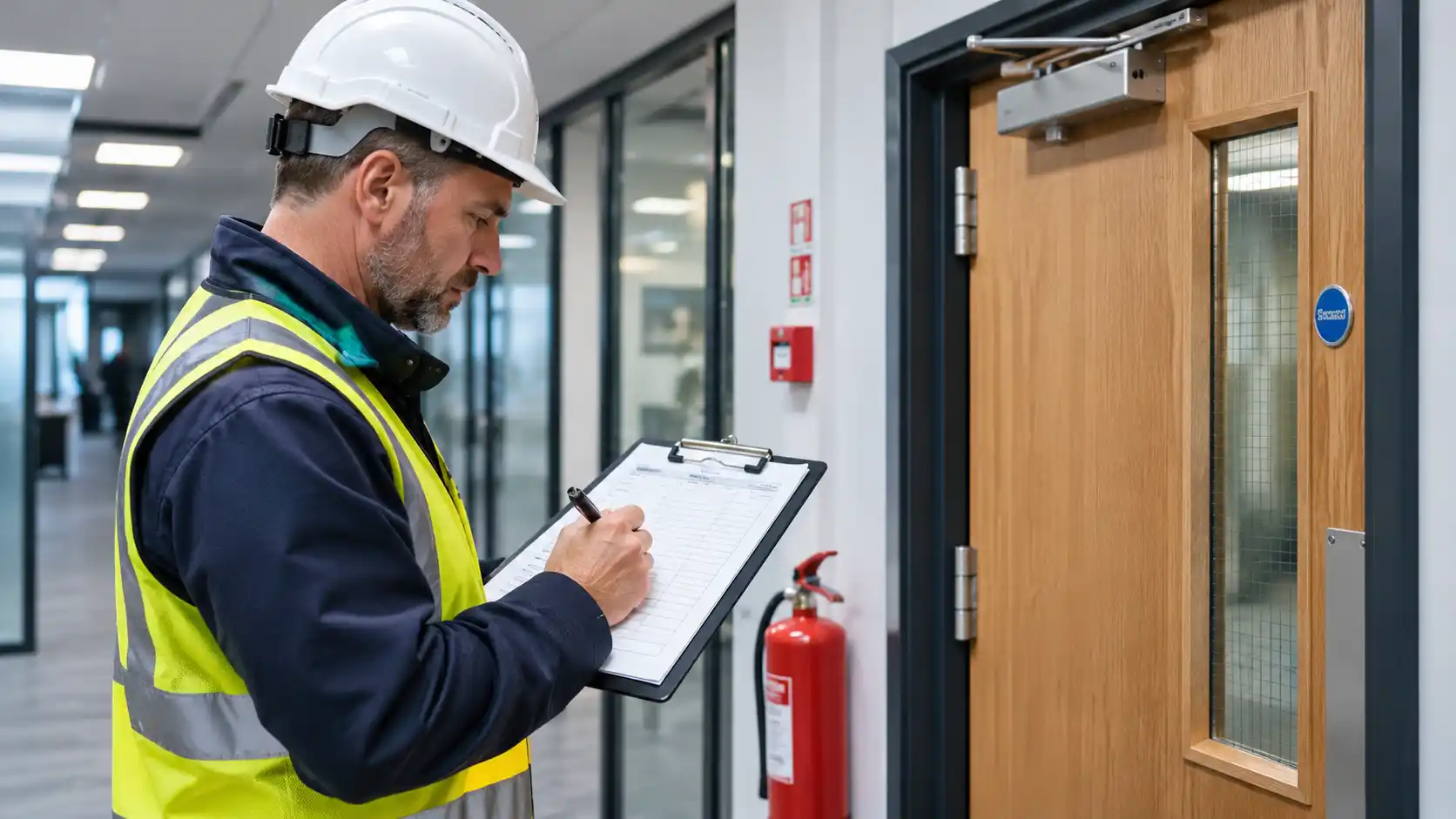
5. How to Create an Effective Fire Safety Risk Register
Developing a useful register requires more than creating a spreadsheet and entering a list of defects. The organisation needs a consistent process for collecting findings, evaluating risk, assigning responsibility and reviewing progress.
The following approach can help organisations establish a practical fire safety risk register that supports ongoing management activities.
-
Identify the premises and scope.
Establish which buildings, departments, floors, operational areas and fire safety systems will be covered. Identify relevant responsible persons, building managers and departments that need access to the information.
-
Collect fire safety findings.
Review fire risk assessments, inspection reports, maintenance records, fire alarm fault reports, fire door inspections, emergency lighting checks and other relevant records. Add new findings as they are identified.
-
Record each issue clearly.
Give every finding a unique reference and record its location, description, date, source and supporting information. Avoid combining unrelated issues into one entry because they may require different owners or completion dates.
-
Evaluate the associated risk.
Consider the potential consequences, likelihood of occurrence, people affected and effectiveness of existing precautions. Use an appropriate assessment method and record the reasoning behind the priority.
-
Determine corrective measures.
Specify what needs to happen to address the issue. Actions should be realistic, measurable and sufficiently detailed for the responsible department or contractor to understand the required outcome.
-
Assign an accountable action owner.
Identify who will coordinate the work, who will undertake it and who has the authority to approve resources or arrangements where necessary.
-
Set an appropriate completion date.
Establish a deadline based on the severity of the risk, the urgency of the corrective measure and any necessary interim precautions. Do not use arbitrary dates that fail to reflect the actual risk.
-
Monitor progress and update the record.
Review open entries regularly. Record changes in status, contractor updates, access restrictions, revised plans and reasons for any delay.
-
Verify completion and close the action.
Check that the required work has been completed and that the resulting fire safety measure is suitable and effective. Attach evidence and record who authorised closure.
6. Prioritising Fire Safety Issues in the Risk Register
Not every fire safety deficiency presents the same level of danger. Some issues may require immediate intervention, while others can be addressed through planned maintenance and management improvements.
Prioritisation helps organisations direct attention and resources towards the most significant risks. It should be based on competent assessment rather than the age of an issue or the convenience of completing it.
Assessing likelihood and potential consequences
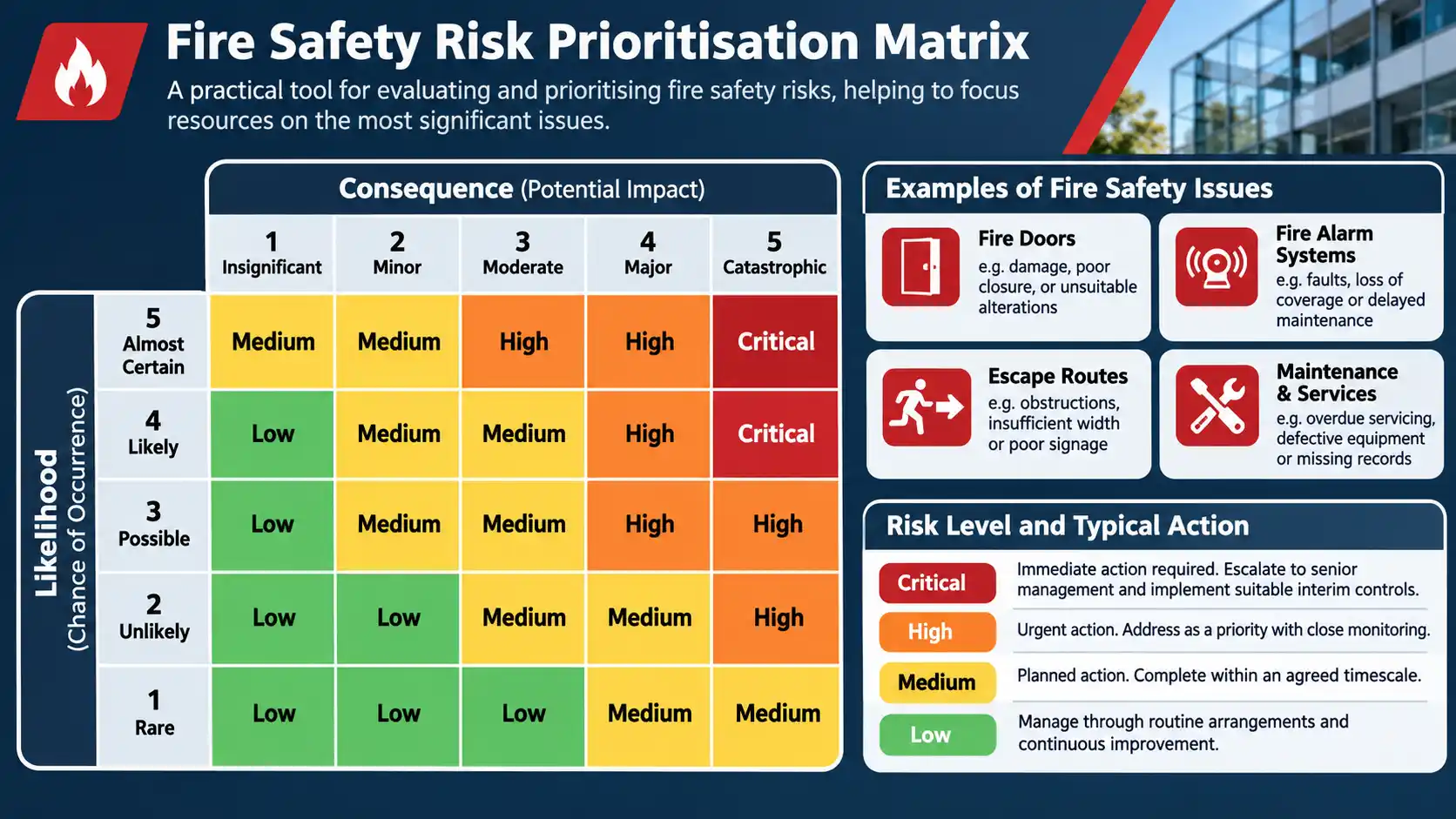
One commonly used management approach is a risk matrix that considers the likelihood of an event and the potential severity of its consequences.
The assessment should also consider the people who could be affected, existing protective measures, the condition of relevant fire safety systems and the possibility of fire or smoke spreading to other areas.
| Illustrative Priority | Typical Management Response | Example |
|---|---|---|
| Critical / Urgent | Immediate attention, escalation and suitable interim controls. | A serious escape-route obstruction or failure of an essential fire safety measure. |
| High / Significant | Prompt corrective action with close management monitoring. | A defective fire door affecting an important protected route. |
| Medium | Planned corrective work with an agreed deadline. | A documented maintenance deficiency requiring scheduled remedial work. |
| Low / Improvement | Manage through an appropriate improvement programme. | A non-urgent documentation improvement. |
These are illustrative management categories, not universal statutory classifications. Actual priorities must be determined through an appropriate assessment of the premises and the specific circumstances.
Why priority and completion deadlines must be connected
A priority rating is only useful when it influences management decisions. An organisation should establish appropriate response arrangements for different levels of risk, including escalation where necessary.
For example, a serious defect affecting an escape route should not remain in a routine maintenance queue while a minor administrative improvement receives attention first. The responsible person should ensure that appropriate immediate measures are considered and implemented.
For additional guidance on assessing the relative importance of different fire safety issues, read our article on fire risk prioritisation .
7. How to Record and Track Outstanding Fire Safety Actions
Recording an issue is not enough to demonstrate effective management. Every outstanding action needs a process that monitors progress from identification through to verification.
Use consistent action statuses
A standard set of status descriptions makes the register easier to understand and improves reporting consistency.
- Open: The issue has been recorded but corrective work has not yet started.
- Assigned: An accountable owner has accepted responsibility for coordinating the action.
- In Progress: Corrective work or an agreed improvement programme is underway.
- Awaiting External Support: The action requires a contractor, supplier or specialist input.
- Awaiting Verification: The reported work is complete but effectiveness has not yet been confirmed.
- Closed: The action has been checked, appropriate evidence recorded and closure authorised.
- Overdue: The agreed completion date has passed without verified completion.
An overdue action should not disappear simply because its deadline has passed. It should remain visible until its management status has been properly resolved.
Establish regular review arrangements
Review frequency should reflect the risk profile, number of outstanding issues and complexity of the premises. High-priority findings may require frequent or immediate follow-up, while lower-priority improvements may be reviewed through scheduled management meetings.
A practical review should consider:
- New issues identified since the previous review.
- High-priority actions that remain open.
- Actions approaching their agreed deadlines.
- Overdue actions and reasons for delay.
- Contractor progress and outstanding approvals.
- Whether interim controls remain effective.
- Evidence submitted for completed work.
- Any new circumstances that change the original risk evaluation.
Maintain a complete audit trail
Every significant update should be traceable. Record who changed the status, when the update was made, what information was added and why the change was necessary.
Where actions are delayed, retain the reason and any revised arrangements. Where the work is completed, preserve relevant inspection records, certificates, work orders, photographs or other suitable evidence.
This creates a useful history that can be reviewed when assessing recurring problems, evaluating contractor performance or examining the effectiveness of fire safety management arrangements.
8. Managing Overdue and Recurring Fire Safety Issues
Overdue actions require particular attention because they indicate that an agreed improvement has not been completed within the planned timescale. However, the significance of the delay depends on the nature of the issue and whether effective interim controls are in place.
Identify why an action is overdue
Management should establish the actual reason for the delay. Common examples include:
- Insufficient maintenance resources or budget approval.
- Delays in obtaining specialist equipment or replacement components.
- Difficulty arranging access to restricted areas.
- Contractor availability or scheduling problems.
- Unclear responsibilities between departments or organisations.
- Incomplete technical information or an inadequate work specification.
- Changes in building operations that affect the original corrective plan.
Escalate significant unresolved issues
Where a significant fire safety issue remains unresolved, the responsible person or relevant management authority should be informed promptly. The issue may require additional resources, specialist advice, revised working arrangements or further precautions.
The register should identify the escalation date, the person notified, the decision made and any additional controls implemented.
Investigate recurring problems
Repeated defects may indicate that previous corrective actions have addressed the immediate symptom without resolving the underlying cause.
For example, if escape routes repeatedly become obstructed, the organisation may need to examine storage arrangements, delivery procedures, housekeeping responsibilities and supervisory inspections.
Similarly, recurring fire door defects may require an investigation into inappropriate use, maintenance quality, building alterations or the suitability of replacement components.
Recording recurring findings helps management identify where wider improvements are necessary rather than repeatedly treating each defect as an isolated event.
9. Practical Fire Safety Risk Register Example
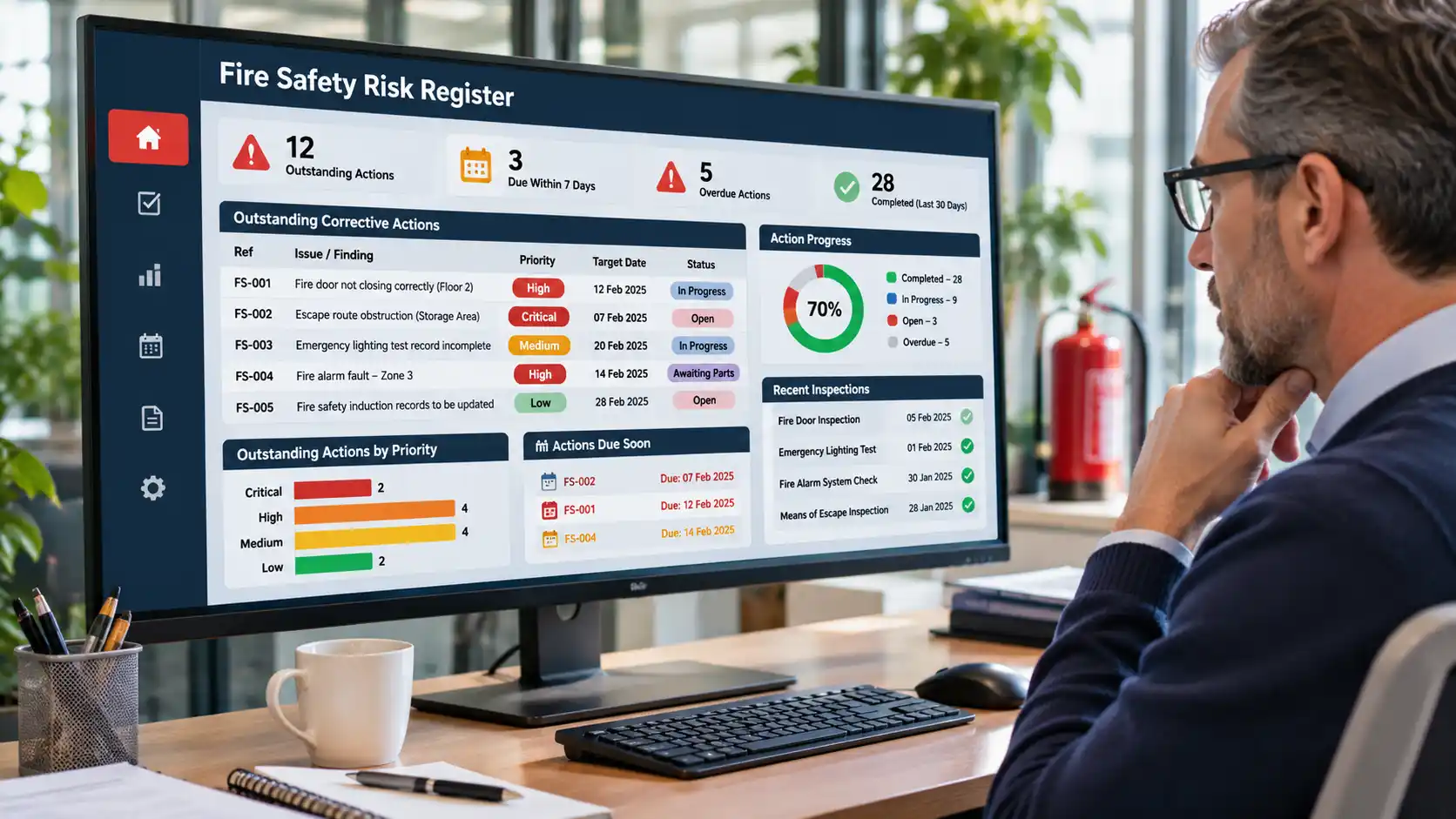
The following illustrative example shows how a building manager could record and monitor outstanding fire safety issues. It demonstrates the relationship between the identified finding, required action, accountable owner and verification evidence.
| Reference | Identified Issue | Priority | Corrective Action | Owner | Status |
|---|---|---|---|---|---|
| FS-001 | Fire door does not close correctly on Floor 2. | High | Arrange competent inspection and appropriate remedial work. | Facilities Manager | In Progress |
| FS-002 | Storage materials found in a designated escape route. | Urgent | Arrange immediate clearance and investigate recurrence. | Site Manager | Open |
| FS-003 | Emergency lighting inspection record incomplete. | Medium | Obtain relevant maintenance information and verify records. | Maintenance Team | Awaiting Verification |
| FS-004 | Fire safety induction records require updating. | Low | Review training records and arrange missing induction activities. | HR Manager | Open |
This example is intended to demonstrate register structure, not to establish universal risk ratings or completion deadlines. Actual priorities and required measures must be established by assessing the relevant premises and circumstances.
Example: Tracking a defective fire door
Imagine that a routine inspection identifies a fire door on the second floor that fails to close correctly. The inspection finding is recorded as FS-001.
The facilities manager reviews the finding and arranges an appropriate inspection by a competent person. The register records the issue, the initial priority, the required corrective work and the agreed deadline.
While the permanent repair is being arranged, suitable interim precautions are considered and implemented according to the circumstances. The responsible manager monitors the work and records contractor updates.
Once the repair is reported as complete, the door is checked to confirm that it operates as intended. Supporting evidence is attached to the record and an authorised person confirms that the corrective action can be closed.
If the door fails the verification check, the action should remain open or be reopened as appropriate. A contractor’s statement that the work is finished is not, by itself, proof that the fire safety issue has been effectively resolved.
10. Managing Fire Safety Risk Registers in Multi-Occupancy Buildings
Multi-occupancy premises introduce additional management challenges because different organisations may control separate areas while depending on shared fire safety systems and common escape routes.
Examples include office complexes, shopping centres, industrial estates, mixed-use developments and buildings containing multiple commercial tenants.
A tenant may identify a fire safety problem within its own premises, while a building manager may identify a defect affecting communal areas. Both findings may influence the wider building fire safety arrangements.
Coordinate responsibilities between organisations
A building-level register can help identify which organisation is responsible for coordinating each outstanding issue. It should distinguish between tenant-controlled areas, shared spaces and building infrastructure.
Relevant information should be communicated between responsible persons where their activities or precautions affect one another.
For example, if a contractor’s work affects a shared fire alarm system, the building management team and relevant occupiers need appropriate information about the work, its implications and the arrangements for restoring normal operation.
Maintain visibility of shared fire safety issues
A central management register should identify issues that affect several tenants or common building facilities. These may include:
- Defects affecting shared fire detection and alarm systems.
- Problems with communal escape routes and staircases.
- Damaged fire doors in shared areas.
- Compartmentation and fire-stopping deficiencies.
- Contractor activities that affect fire protection arrangements.
- Maintenance issues involving shared emergency systems.
This approach supports a coordinated management process and reduces the possibility of important findings being overlooked between organisational boundaries.
For further information, see our practical guide on managing fire risk in buildings with multiple occupiers .
11. Digital Fire Safety Risk Registers and Record Management
Organisations can maintain fire safety risk registers using spreadsheets, structured databases or dedicated safety management software. The most appropriate method depends on the size of the organisation, the number of premises and the complexity of its fire safety arrangements.
Using spreadsheets
Spreadsheets can be suitable for smaller premises with a manageable number of outstanding issues. They provide a straightforward way to record findings, assign owners, set deadlines and review action status.
However, organisations should control access, maintain suitable version management and protect important records from accidental alteration. A spreadsheet does not automatically provide a reliable audit trail or notify managers about overdue actions.
Using digital management systems
More complex organisations may benefit from digital systems that connect inspections, corrective actions, maintenance requests and management reporting.
Depending on the system, useful capabilities may include:
- Unique issue references and searchable records.
- Role-based access and assigned action ownership.
- Automated reminders for approaching deadlines.
- Notifications when actions become overdue.
- Photographic and documentary evidence attachments.
- Time-stamped changes and status histories.
- Reports showing outstanding and completed actions.
- Links between inspections and corrective action records.
Maintain data quality and access control
Digital systems are only as reliable as the information entered into them. Organisations should establish procedures for validating findings, updating action statuses, controlling access and retaining relevant supporting records.
They should also ensure that important fire safety information remains accessible to authorised people when required. Backups, appropriate retention arrangements and controlled document versions can help maintain the integrity of the records.
12. Common Mistakes to Avoid When Maintaining Fire Safety Risk Registers
Even when an organisation has a formal register, weaknesses in the way it is maintained can reduce its usefulness. The following mistakes should be addressed through appropriate management controls.
Recording vague findings
Descriptions such as “fire safety issue identified” do not provide enough information for someone to understand or resolve the problem. Each finding should identify the location, observed condition and required outcome.
Failing to assign an action owner
An action without an accountable owner can remain unresolved because different departments assume someone else is responsible. Every significant corrective action should have a clearly identified person responsible for coordinating its delivery.
Using unrealistic completion deadlines
Deadlines should reflect the actual risk and necessary corrective work. Unrealistic dates can create unnecessary overdue actions, while excessively generous timescales may allow significant problems to remain unresolved.
Closing actions without verification
An action should not be closed simply because a work order has been marked complete. The organisation should establish whether the required outcome has been achieved and retain appropriate evidence.
Ignoring repeated deficiencies
Recurring problems may indicate weaknesses in maintenance, supervision, training or operational controls. Reviewing trends can help identify the underlying causes.
Failing to review the register
A register that is not updated can provide an inaccurate picture of current fire safety conditions. Organisations should establish appropriate review arrangements and update the record whenever important information changes.
13. Best Practices for Effective Fire Safety Risk Registers
A well-maintained register should be simple enough to use consistently while containing sufficient detail to support meaningful management decisions.
The following practices can improve the quality and reliability of fire safety issue tracking.
- Use a consistent format across relevant buildings and departments.
- Assign a unique reference to every recorded issue.
- Record findings using clear and objective descriptions.
- Identify the source and date of each finding.
- Evaluate issues using an appropriate risk assessment method.
- Prioritise corrective measures according to their significance.
- Assign an accountable owner to each outstanding action.
- Agree realistic completion dates and interim precautions where necessary.
- Review overdue actions and escalate significant delays.
- Retain appropriate evidence of completed work.
- Verify the effectiveness of corrective measures before closure.
- Investigate repeated problems and identify underlying causes.
- Update records when buildings, activities or protective arrangements change.
- Ensure authorised managers can access relevant information.
- Use register reviews to identify opportunities for continual improvement.
Integrating the register into routine fire safety management
Fire safety risk registers should form part of an organisation’s wider fire safety management arrangements. They should be connected with inspection programmes, maintenance schedules, contractor management, staff training and emergency planning.
For example, an issue identified during a fire door inspection should be entered into the appropriate tracking system, assigned to an accountable person and followed through to verification. Information from the same process can inform future inspections and management reviews.
This integrated approach helps organisations move beyond reactive defect reporting and develop a more consistent method of managing fire safety improvements.
14. UK Fire Safety Recording Requirements and Management Considerations
Fire safety documentation should reflect the applicable legal framework and the responsibilities of the organisation. It is important not to assume that identical recording requirements apply throughout the United Kingdom.
England and the Fire Safety Order
In England, the Regulatory Reform (Fire Safety) Order 2005 establishes duties for responsible persons in relation to fire risk assessment and fire safety precautions.
The Section 156 amendments introduced by the Building Safety Act 2022 came into force on 1 October 2023. The relevant Home Office guidance explains that responsible persons must record their completed fire risk assessments in full, including findings, and record their fire safety arrangements.
The guidance also addresses the recording of assessor details, contact information and cooperation and information-sharing between responsible persons.
Official reference: GOV.UK – Section 156 Fire Safety Responsibilities .
Scotland
Scotland operates under its own fire safety legislative framework, including the Fire (Scotland) Act 2005 and the Fire Safety (Scotland) Regulations 2006.
Scottish Government guidance provides information about carrying out and recording fire safety risk assessments. It emphasises that an assessment is a practical process whose findings must lead to appropriate fire safety measures.
Official reference: Scottish Government – Fire Safety Risk Assessment Forms and Guidance .
Wales and Northern Ireland
Wales has its own application of fire safety legislation and associated guidance. Northern Ireland also operates under a separate legislative framework.
Organisations managing premises in these jurisdictions should consult the applicable government guidance and competent fire safety professionals before deciding which documentation and management arrangements are required.
Why a risk register is valuable beyond basic documentation
Regardless of the document format used, organisations benefit from maintaining clear records of identified deficiencies, planned corrective measures, action ownership and completion evidence.
A risk register can support this process, but it does not replace a fire risk assessment, statutory records, maintenance documentation or the implementation of appropriate fire safety precautions.
15. Developing Professional Competence in Fire Risk Management
Effective fire safety management requires people who understand how to identify hazards, evaluate risks, interpret assessment findings and coordinate suitable corrective measures.
Professionals responsible for maintaining fire safety risk registers can benefit from structured learning in fire risk assessment, inspection procedures, risk prioritisation, documentation and management systems.
Relevant professional development opportunities include:
- ProQual Level 4 Award in Advanced Fire Risk Assessment – relevant to developing advanced knowledge of fire risk assessment.
- ICTQual Level 3 Diploma Fire Risk Assessor – relevant to developing foundational professional knowledge of fire risk assessment.
- ICTQual AB Level 2 Award in Fire Safety Risk Assessment and Control – introduces important fire safety risk assessment and control concepts.
- ICTQual Level 3 Award in Importance of Fire Safety – supports understanding of the importance of effective fire safety arrangements.
The appropriate learning route depends on an individual’s existing knowledge, experience and professional responsibilities. A qualification should be considered alongside relevant practical competence and experience when determining suitability for a particular fire safety role.
16. Frequently Asked Questions About Fire Safety Risk Registers
What is a fire safety risk register?
A fire safety risk register is a structured record of identified fire hazards, deficiencies, risk priorities and required corrective measures. It normally includes action owners, target dates, current status and supporting completion evidence. It helps organisations monitor outstanding fire safety issues and manage improvements.
What should be included in a fire safety risk register?
It should include a unique issue reference, location, finding date, issue description, risk evaluation, existing controls, corrective action, responsible person, target completion date, current status, review information and evidence of completion.
Who is responsible for maintaining a fire safety risk register?
Responsibility depends on the organisation’s management arrangements. The responsible person retains applicable fire safety duties, while a designated fire safety manager, facilities manager or other authorised individual may coordinate register updates and action tracking. Responsibilities should be clearly documented.
How often should a fire safety risk register be reviewed?
Review frequency should reflect the premises, the level of risk and the number and importance of outstanding actions. Significant or urgent issues may require immediate follow-up, while routine actions can be monitored through scheduled management reviews. The register should also be updated when circumstances change.
What is the difference between a fire risk assessment and a risk register?
A fire risk assessment evaluates hazards, people at risk, existing precautions and necessary improvements. A fire safety risk register provides a structured way to record and monitor identified risks and outstanding management actions. The register supports the assessment process but does not replace it.
How should outstanding fire safety issues be prioritised?
Issues should be prioritised according to their potential consequences, likelihood, affected people, existing controls and circumstances of the premises. Significant deficiencies may require immediate action and suitable interim precautions. A risk matrix can support consistent decision-making when used appropriately.
How do you manage overdue fire safety actions?
Identify the reason for the delay, review whether interim controls remain suitable, inform the appropriate management authority and establish a realistic corrective plan. Significant unresolved issues should be escalated. The action should remain visible in the register until it is appropriately resolved and verified.
Can a spreadsheet be used as a fire safety risk register?
Yes. A spreadsheet can be suitable for smaller organisations with relatively straightforward requirements. It should contain clear issue references, action owners, priorities, deadlines and status information. Appropriate access controls, version management and record protection are also important.
What evidence is required to close a fire safety action?
Evidence depends on the nature of the issue. It may include inspection reports, contractor work records, photographs, maintenance documentation, certificates or confirmation from a competent person. The evidence should demonstrate that the required corrective outcome has been achieved.
Are fire safety risk registers legally required in the UK?
The legal requirements concern fire risk assessments, relevant findings, fire safety arrangements and other applicable records. A separate document specifically called a fire safety risk register is not a universal legal requirement across the UK. However, maintaining an effective action-tracking system is a valuable management practice. Requirements differ between UK jurisdictions.
Why are fire safety risk registers important in multi-occupancy buildings?
They help building managers and relevant responsible persons coordinate issues involving individual occupiers, communal areas and shared fire safety systems. A central record improves visibility of responsibilities and outstanding corrective measures across the building.
Conclusion: Make Fire Safety Issue Tracking an Ongoing Management Priority
Effective fire safety management does not end when an assessment or inspection has been completed. Identified deficiencies must be recorded, evaluated and followed through until appropriate corrective measures have been implemented and their effectiveness has been established.
Fire safety risk registers provide a practical framework for managing this process. By recording clear findings, assigning accountable owners, establishing appropriate deadlines and monitoring progress, organisations can improve visibility of outstanding issues and strengthen their fire safety management arrangements.
The most effective registers are accurate, regularly reviewed and connected with the wider management of premises. They help responsible persons and fire safety professionals identify unresolved problems, address recurring deficiencies and maintain evidence of corrective improvements.
Whether an organisation uses a simple spreadsheet or a dedicated digital system, the objective remains the same: ensure that important fire safety issues are not forgotten, responsibilities are clear and corrective actions are properly completed and verified.
Strengthen Your Fire Safety Management Knowledge
Develop your understanding of fire risk assessment, fire safety management, hazard identification and effective risk control through professional learning opportunities.
Explore the available fire safety qualifications and develop the knowledge needed to support effective fire risk management.
Official Guidance and Further Reading
The following resources provide additional information about fire risk assessments, recording requirements and fire safety management.
- GOV.UK – Fire Risk Assessments
- GOV.UK – Fire Safety Risk Assessment: 5-Step Checklist
- GOV.UK – Section 156 Fire Safety Responsibilities
- Scottish Government – Fire Safety Risk Assessment Guidance
- GOV.UK – A Guide for Persons with Duties Under Fire Safety Legislation
This article provides general fire safety management information and is not a substitute for a competent fire risk assessment or jurisdiction-specific professional and legal advice.