
Fire Risk Assessment Action Plans: Assigning Owners, Deadlines and Evidence
Discover how to turn fire risk assessment findings into practical safety improvements through clear responsibilities, realistic deadlines, effective monitoring and documented evidence of completion.
A fire risk assessment identifies hazards, evaluates existing precautions and highlights improvements needed to protect employees, visitors, contractors and other relevant people. However, identifying a problem is only the beginning. Organisations also need a structured process for ensuring that every important finding receives appropriate attention and is resolved effectively.
Fire risk assessment action plans provide that structure. They translate assessment findings into specific tasks, allocate responsibility to suitable individuals, establish completion deadlines and identify the evidence needed to demonstrate that improvements have been implemented.
Without an effective action plan, important recommendations can remain unresolved. A defective fire door might be reported but never repaired, an obstructed escape route might be cleared temporarily and become blocked again, or an identified training requirement might never reach the relevant employees. These situations demonstrate why fire safety management must extend beyond the production of an assessment report.
For UK organisations, action planning is also an important part of demonstrating effective fire safety arrangements. The responsible person must ensure that suitable preventive and protective measures are implemented, maintained, monitored and reviewed in accordance with applicable fire safety requirements.

What Are Fire Risk Assessment Action Plans and Why Are They Important?
A fire risk assessment action plan is a structured document or management register that records the corrective and preventive measures required following a fire risk assessment. It explains how identified deficiencies will be addressed, who will take responsibility, when each task should be completed and how the organisation will verify the result.
The main purpose is to ensure that assessment recommendations lead to practical improvements rather than remaining as observations in a report.
Understanding the Purpose of an Action Plan
A fire risk assessment may identify several issues within a workplace. These could include inadequate fire door maintenance, unsuitable storage arrangements, insufficient emergency lighting, blocked escape routes or gaps in employee training.
Each finding requires an appropriate management response. Some issues may be resolved immediately by the facilities team, while others require specialist contractors, management approval, technical investigations or capital investment.
An action plan brings these requirements together in one organised system. It allows managers to understand the current position, coordinate resources and monitor whether agreed improvements have been completed.
For example, if an assessment identifies a fire door that does not close properly, simply recording the observation does not resolve the problem. The organisation needs to arrange an appropriate inspection, determine the required repair, appoint a responsible person, set a suitable completion target and retain evidence of the completed work.
Why Organisations Need Structured Fire Safety Action Plans
Effective action plans provide several important management benefits:
- Clear accountability: Every action has an identified individual responsible for coordinating its completion.
- Risk-based decision-making: Findings can be prioritised according to the potential consequences and urgency of the identified issue.
- Better resource allocation: Managers can identify financial, technical and staffing requirements before work begins.
- Improved communication: Relevant departments understand their responsibilities and outstanding requirements.
- Documented progress: Management can monitor outstanding, completed and overdue actions.
- Demonstrable management: Records provide evidence of how the organisation responds to identified fire safety issues.
Fire Risk Assessment Versus Fire Risk Assessment Action Plan
Although these documents are closely connected, they serve different purposes. A fire risk assessment evaluates the hazards, people at risk and existing precautions. An action plan manages the improvements identified through that evaluation.
| Area | Fire Risk Assessment | Action Plan |
|---|---|---|
| Main purpose | Identify and evaluate fire risks. | Manage necessary improvements. |
| Primary focus | Hazards, people and precautions. | Actions, responsibilities and deadlines. |
| Key information | Findings and risk evaluation. | Tasks, owners and target dates. |
| Management use | Understand the current risk profile. | Control and monitor corrective work. |
| Evidence | Assessment records and supporting information. | Work orders, certificates, photographs and verification records. |
Both documents should remain connected. When an action is completed, its outcome should be recorded against the relevant assessment finding. Where improvements change the existing risk profile, the assessment should be reviewed and updated when necessary.
Organisations developing their assessment capabilities can also explore the complete fire risk assessment guide for further information about the assessment process.
Understanding the Key Elements of Effective Fire Risk Assessment Action Plans
A professional fire risk assessment action plan should contain enough information to support implementation, monitoring and verification. A simple list of problems is rarely sufficient because it does not establish ownership, priorities or completion requirements.
Identification of the Assessment Finding
Every action should begin with a clearly documented finding. The description should explain what was observed, where it was identified and why it requires attention.
For example, instead of writing “fire door problem”, a more useful finding would be: “The fire door separating the first-floor corridor from the protected stairway does not close fully when released, potentially affecting the intended fire and smoke separation.”
The second description provides enough context for managers and contractors to understand the issue and determine an appropriate response.
Recommended Corrective Action
The action should describe the improvement required rather than simply repeat the original finding. It should be specific enough to guide implementation while allowing competent specialists to determine the technical solution.
For example, an action could require a competent fire door specialist to inspect the assembly, identify the cause of the failure, complete suitable repairs and verify its operation.
Priority and Risk Classification
Every action should receive a priority based on its potential effect on life safety, the effectiveness of existing controls and the urgency of intervention.
Organisations may use a low, medium and high classification or a more detailed risk assessment methodology. The chosen system should be documented, consistently applied and appropriate to the complexity of the premises.
Named Action Owner and Supporting Personnel
Each action needs a clearly identified accountable owner. Supporting departments, contractors and technical specialists can also be recorded where they contribute to delivery.
For example, the facilities manager may coordinate the repair of a defective fire door, while a competent specialist undertakes the technical work and the responsible person oversees the wider fire safety arrangements.
Target Completion Date and Required Resources
The action plan should establish a realistic target date based on risk, urgency, technical complexity and resource availability. Where specialist work is required, the plan should identify procurement requirements, access arrangements and management approvals.
Completion Evidence and Verification
Finally, the organisation should define what evidence will demonstrate that the action has been completed successfully. This may include inspection reports, maintenance records, commissioning documentation, photographs or updated procedures.
| Action plan element | Information to record |
|---|---|
| Reference number | Unique identification for tracking. |
| Finding | Description and location of the issue. |
| Risk priority | Classification and justification. |
| Required action | Specific corrective or preventive measure. |
| Action owner | Named accountable individual. |
| Supporting resources | Departments, contractors and budget requirements. |
| Target date | Agreed completion deadline. |
| Interim controls | Temporary precautions where necessary. |
| Evidence | Documents and records required for closure. |
| Verification | Person responsible for checking effectiveness. |
| Status | Open, in progress, completed or overdue. |
These elements create a traceable relationship between an identified hazard, the required improvement and the evidence supporting the final decision.
How to Identify and Prioritise Actions Following a Fire Risk Assessment
Prioritising fire safety actions means deciding which findings require the most urgent attention and allocating resources accordingly. An organisation should not automatically address findings in the order they appear in the assessment report. The potential consequences of each issue should guide the response.
Evaluate the Potential Consequences of Each Finding
The first step is to understand how the identified deficiency could affect people if a fire occurred. Consider the possibility of fire starting, the likelihood of fire spreading, the effectiveness of existing precautions and the potential impact on escape and evacuation.
For example, an obstruction affecting a protected escape route may have a more immediate life-safety implication than a minor administrative inconsistency in a maintenance record.
Assessment should also consider people who may be particularly vulnerable, including individuals with disabilities, visitors unfamiliar with the premises, lone workers and employees working outside normal operating hours.
Use a Consistent Risk Prioritisation Method
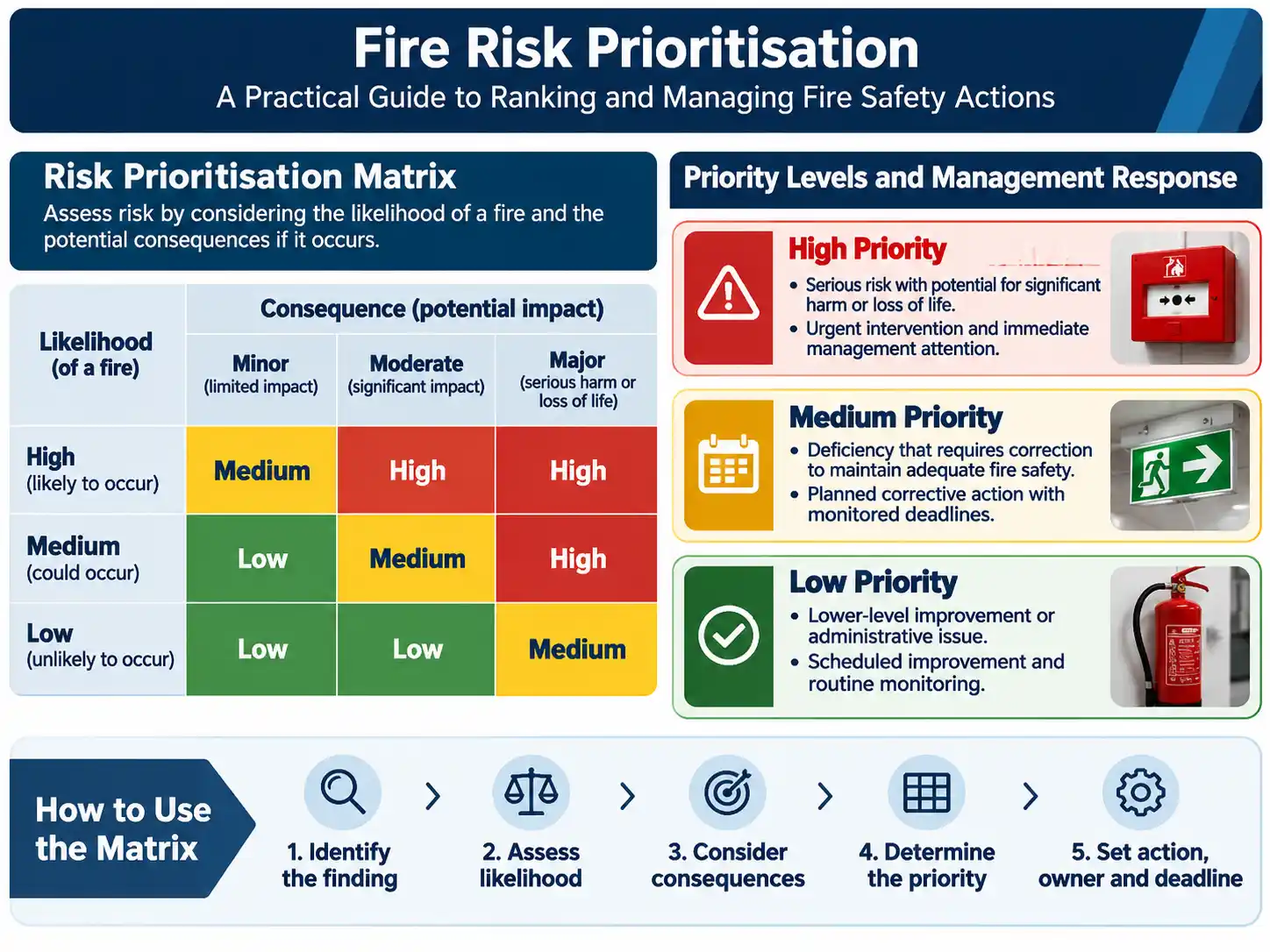
Organisations can use a documented risk matrix to support consistent decisions. A basic approach considers the likelihood of an event and the severity of its potential consequences.
For example, a three-level classification can help management distinguish between high, medium and low priorities. This is an illustrative management method, not a statutory UK classification system.
| Priority | General interpretation | Management response |
|---|---|---|
| High | Potential for serious harm or significant failure of an essential fire precaution. | Immediate management attention, suitable interim safeguards and urgent corrective action. |
| Medium | Deficiency requiring correction to maintain appropriate fire safety standards. | Planned corrective work with an assigned owner and monitored deadline. |
| Low | Lower-priority improvement or administrative deficiency that does not indicate an immediate serious threat. | Scheduled improvement and routine monitoring. |
Priority classifications should never replace professional judgement. A serious deficiency should not be downgraded simply because its repair is expensive or inconvenient.
Consider Existing Control Measures
The priority of a finding depends partly on whether effective precautions already exist. For example, a maintenance issue affecting one component may require a different response from a complete failure of a critical fire protection system.
However, the presence of other safety measures should not be used to justify leaving a significant deficiency unresolved. Management should assess whether the remaining precautions provide adequate protection and whether additional interim arrangements are necessary.
Consider Vulnerable People and Operational Conditions
Fire safety decisions should account for the actual people using the premises. A building occupied by people who require assistance to evacuate may need different arrangements from a small office occupied by fully mobile employees familiar with the escape routes.
Working patterns also matter. A defect may have different implications during a fully staffed day shift compared with an overnight shift where fewer employees are available to support emergency procedures.
Apply Interim Controls Where Necessary
Some corrective actions cannot be completed immediately. Specialist inspections, replacement components or significant building work may require additional time. In these situations, responsible management should assess whether temporary precautions are required while permanent improvements are arranged.
Depending on the circumstances, interim measures might involve restricting access to an affected area, removing combustible materials, increasing supervision, implementing alternative arrangements or suspending an unsafe activity.
Interim controls must be suitable for the identified risk, communicated to relevant people and monitored. They must not become a permanent substitute for necessary corrective work.
For additional guidance on this decision-making process, read Fire Risk Prioritisation: How to Rank Hazards by Urgency.
Assigning Responsibilities and Action Owners for Fire Safety Tasks
Assigning responsibility is one of the most important stages of fire risk assessment action planning. An organisation may identify the correct improvement and agree an appropriate deadline, but progress can still fail if nobody is clearly accountable for delivering the work.
Identify One Accountable Action Owner
Each action should have one clearly identified individual who coordinates its completion. This person does not necessarily carry out the technical work. Their responsibility is to ensure that the task progresses, required resources are arranged, relevant parties are informed and evidence is submitted.
For example, a facilities manager may own an action involving emergency lighting maintenance. A qualified electrical contractor may undertake the inspection and repairs, while the facilities manager ensures that the work is completed and documented.
Assigning several departments as joint owners without identifying an accountable individual can create confusion. Supporting teams should therefore be recorded separately from the person responsible for coordinating the action.
Match Responsibilities to Competence and Authority
Action owners should have sufficient knowledge, authority and access to resources to manage their assigned responsibilities. A person should not be expected to approve technical fire safety decisions outside their professional competence.
For example, a general administrator might coordinate the collection of maintenance documents, but should not independently certify the technical suitability of a fire alarm system.
Where specialist work is necessary, the organisation should engage appropriately competent contractors or professionals and ensure that the required work is clearly defined.
Establish Responsibility Across Departments
Fire safety improvements frequently involve several business functions. Facilities teams may manage building maintenance, HR may coordinate employee training, procurement may arrange specialist services, and senior management may approve expenditure.
Clear coordination helps prevent individual departments from assuming that another team is responsible for an outstanding finding.
| Role | Typical action planning responsibility |
|---|---|
| Responsible person | Overall responsibility for meeting applicable fire safety duties. |
| Fire safety manager | Coordinates fire safety arrangements and monitors identified improvements. |
| Facilities manager | Coordinates building maintenance and physical fire safety improvements. |
| HR manager | Coordinates relevant employee information, instruction and training. |
| Procurement team | Arranges purchasing and contractor appointments. |
| Specialist contractor | Completes authorised technical work within their competence. |
| Senior management | Provides oversight, resources and decisions requiring management authority. |
Use a Responsibility Assignment Framework
For larger organisations, a responsibility assignment matrix can help distinguish between the person performing the work, the person accountable for delivery, those who must be consulted and those who need to receive updates.
A RACI framework is one commonly used management approach:
- Responsible: The person or team carrying out the activity.
- Accountable: The individual ultimately answerable for its delivery.
- Consulted: Specialists or stakeholders providing relevant advice.
- Informed: People who need updates about progress or completion.
For instance, a fire door improvement might involve a facilities manager as the accountable owner, a specialist contractor as the person responsible for technical work, a fire safety professional as a consulted party and the responsible person as an informed management stakeholder.
Manage Shared Premises and Multiple Responsible Persons
Responsibility becomes more complicated in buildings occupied by several organisations. Landlords, managing agents, employers and individual occupiers may each have responsibilities relating to different parts of the premises or shared safety arrangements.
Organisations should establish who controls the relevant areas, identify dependencies and communicate significant findings with other responsible persons. Written records of agreed responsibilities and information-sharing arrangements can support effective coordination.
GOV.UK guidance on Section 156 of the Building Safety Act 2022 explains the importance of cooperation and coordination between responsible persons in multi-occupied buildings.
See the official Section 156 fire safety responsibilities guidance.
Setting Realistic Deadlines for Fire Safety Improvements
Deadlines help organisations convert fire safety recommendations into manageable tasks. However, completion dates should reflect the seriousness of the finding rather than being selected simply because they fit an internal project schedule.
Establish Deadlines According to Risk
High-priority findings require more urgent management attention than routine improvements. The organisation should determine the required response by considering the potential harm, effectiveness of existing precautions and availability of suitable corrective measures.
Where a serious and immediate safety concern exists, the appropriate response may involve immediate protective action, restricting use of an affected area or stopping an unsafe activity. A future target date alone would not be an adequate response.
Medium- and lower-priority actions can generally be scheduled according to their risk, complexity and operational requirements, provided that the arrangements remain appropriate and do not leave people exposed to unacceptable danger.
Consider the Complexity of Corrective Work
Some findings can be corrected through simple housekeeping improvements. Others may require specialist inspection, replacement equipment, building modifications or coordination with external organisations.
When setting a deadline, consider:
- The seriousness of the identified deficiency.
- Whether temporary precautions are required.
- The availability of competent contractors.
- Procurement and equipment delivery times.
- Building access and operational restrictions.
- Necessary technical approvals and inspections.
- Dependencies on other corrective actions.
Distinguish Between Target Dates and Legal Deadlines
An internal action plan may assign a target completion date to help managers control the work. However, this date should not be confused with a statutory deadline.
UK fire safety legislation does not provide one universal number of days for completing every action arising from a fire risk assessment. The appropriate response depends on the relevant legal duties, the circumstances and the nature of the identified risk.
Organisations should therefore avoid treating an internal priority table as a legal timetable.
Manage Delays and Revised Deadlines
Where an action cannot be completed by its original target date, the action owner should explain the reason, identify the outstanding requirements and notify the appropriate manager.
A revised deadline should be formally reviewed and approved by someone with appropriate authority. The organisation should also reassess whether interim precautions remain sufficient.
For example, if a specialist fire alarm component is delayed, the responsible team should not simply move the deadline forward. It should evaluate the implications of the delay, determine suitable temporary arrangements and record the management decision.
| Action priority | Illustrative management approach | Deadline control |
|---|---|---|
| Urgent | Immediate intervention and suitable temporary precautions where necessary. | Escalate to responsible management immediately. |
| High | Expedited corrective work with close management oversight. | Set a risk-justified target and monitor frequently. |
| Medium | Planned corrective work with allocated resources. | Agree a documented target date. |
| Low | Scheduled improvement and routine review. | Include in the improvement programme. |
These categories illustrate an internal planning approach only. They are not statutory completion periods or substitutes for competent assessment of risk.
What Evidence Is Required to Demonstrate Completion of Fire Safety Actions?
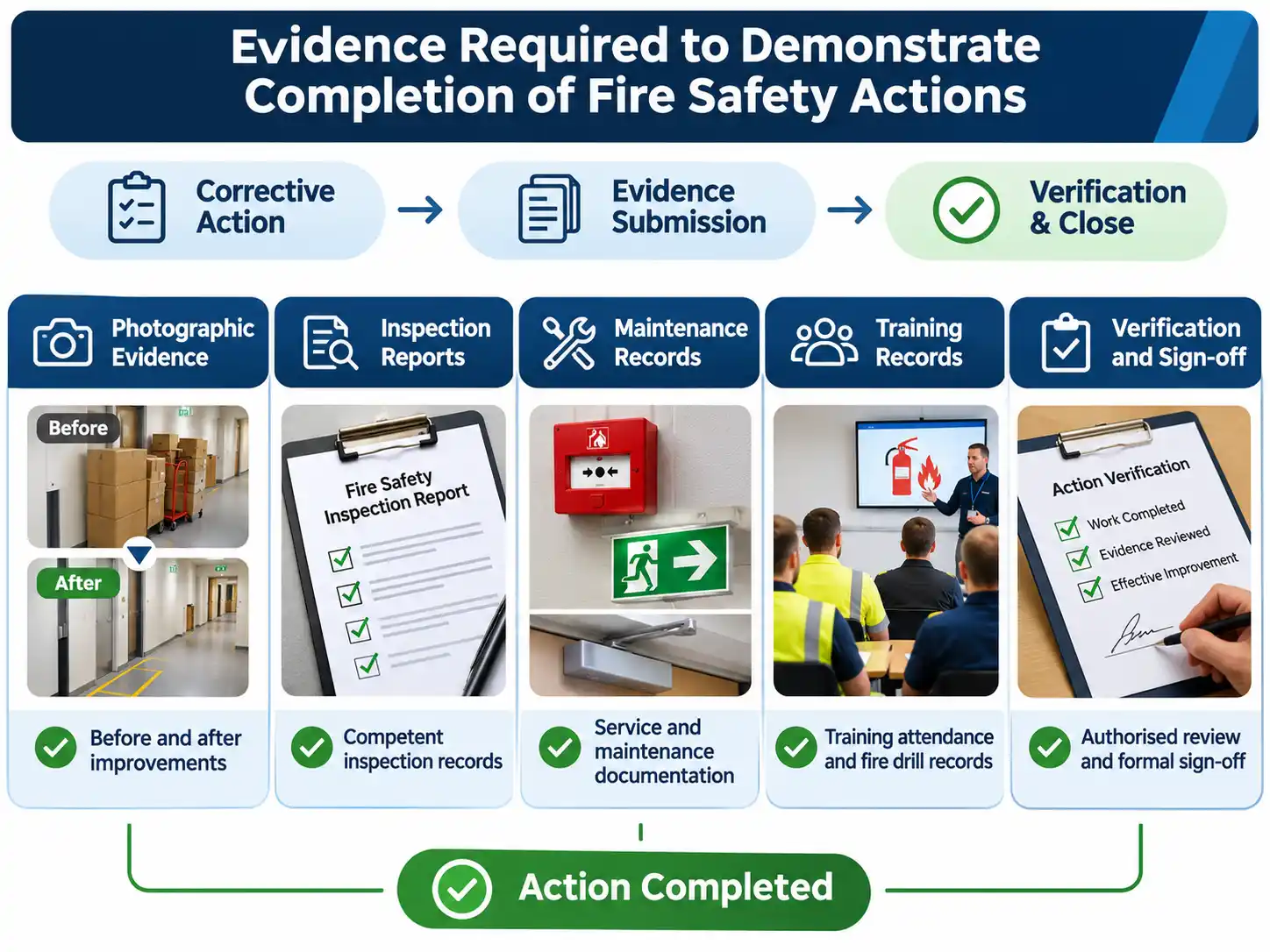
Completion evidence is the documented information used to demonstrate that an identified fire safety action has been implemented. It should show what was done, when it was completed, who carried out the work and whether the improvement was checked.
Closing an action based only on a verbal assurance can leave an organisation without sufficient information to demonstrate what happened or whether the original deficiency was resolved.
Photographic Evidence
Photographs can help demonstrate visible improvements. For example, before-and-after images may show that combustible materials have been removed from an unsuitable storage area or that an escape route has been cleared.
However, photographs have limitations. They cannot independently demonstrate the technical performance of a fire alarm, the correct operation of an emergency lighting system or the suitability of a fire door installation.
Inspection and Maintenance Records
Inspection reports, maintenance records and service documentation provide evidence of work undertaken on fire safety systems and equipment.
Depending on the action, these records may relate to:
- Fire alarm inspection and maintenance.
- Emergency lighting inspection and testing.
- Fire door inspection and remedial work.
- Fire extinguisher maintenance.
- Fire detection and suppression systems.
- Electrical inspection and corrective work.
- Fire stopping and compartmentation inspections.
The documentation should identify the equipment or location inspected, the work completed, any remaining defects and the person or organisation responsible.
Commissioning and Technical Documentation
Where new equipment or systems are installed, commissioning documentation may be needed to demonstrate that the installation has been tested and handed over appropriately.
For example, installing a replacement fire alarm component may require testing and relevant commissioning records. A building alteration affecting fire compartmentation may require specialist inspection and supporting documentation.
The required evidence depends on the nature of the work and the applicable technical requirements.
Training and Communication Records
Some fire risk assessment findings concern organisational arrangements rather than physical defects. For example, an assessment may identify that employees have not received suitable fire safety instruction.
In these circumstances, suitable evidence could include:
- Training attendance records.
- Training materials and learning outcomes.
- Employee communication records.
- Fire drill reports.
- Updated emergency procedures.
- Records showing that relevant employees received revised instructions.
Attendance alone may not demonstrate that an employee understood the necessary procedures. Where appropriate, organisations should also evaluate the effectiveness of training and identify additional support requirements.
Verification and Sign-Off Records
Evidence should be reviewed by an appropriate person before an action is closed. The reviewer should determine whether the submitted documents demonstrate that the original issue has been adequately addressed.
For example, a maintenance invoice may prove that a contractor attended the premises, but it does not necessarily prove that a defective fire safety system is now operating correctly.
Where technical verification is necessary, it should be completed by a suitably competent person.
| Fire safety action | Potential completion evidence | Verification consideration |
|---|---|---|
| Clear obstructed escape route | Photographs and inspection record. | Confirm the route remains unobstructed. |
| Repair defective fire door | Specialist inspection and repair report. | Verify correct closing and operation. |
| Improve emergency lighting | Maintenance and test documentation. | Confirm the system meets the required performance criteria. |
| Update fire evacuation procedure | Approved procedure and communication records. | Confirm relevant people have been informed. |
| Deliver staff training | Attendance and training records. | Evaluate whether training requirements have been met. |
| Inspect fire alarm system | Service and inspection report. | Confirm identified defects have been resolved. |
Maintain an Organised Evidence Register
Organisations should maintain a consistent approach to storing supporting documentation. Each evidence item should be linked to its action reference number so that managers can locate the relevant information without searching through unrelated records.
A suitable evidence register may include the document title, submission date, contractor or inspector, relevant location, version number and verification status.
Records should be stored securely, remain accessible to authorised personnel and be updated when new information becomes available.
How to Create a Step-by-Step Fire Risk Assessment Action Plan
Creating a practical action plan requires a structured process that connects assessment findings with management decisions and implementation. The following approach can be adapted to offices, commercial buildings, educational facilities, warehouses and other non-domestic premises.
-
Review the completed fire risk assessment.
Examine the assessment report, identify outstanding findings and confirm that the information accurately reflects the premises and its current activities.
-
Convert findings into individual actions.
Write each corrective or preventive requirement as a separate task. Avoid combining unrelated deficiencies into one action because this makes ownership and completion difficult to monitor.
-
Evaluate risk and establish priorities.
Assess the potential consequences, existing controls and urgency of each finding. Identify any issues requiring immediate intervention.
-
Assign accountable action owners.
Identify an individual with suitable authority and access to resources. Record supporting contractors and departments separately.
-
Define completion requirements.
Explain what must be achieved and what evidence will demonstrate that the action has been completed satisfactorily.
-
Set realistic target dates.
Establish deadlines according to risk and complexity. Identify dependencies, procurement requirements and specialist support.
-
Implement and monitor corrective work.
Track progress, review outstanding tasks and escalate delays. Introduce suitable interim precautions where required.
-
Review submitted evidence.
Check that the evidence relates to the original finding and demonstrates that the required improvement has been implemented.
-
Verify effectiveness and close the action.
Arrange an appropriate inspection or technical verification. Record the decision and update the action register.
-
Review the wider fire risk assessment.
Determine whether completed improvements or operational changes require the assessment, fire safety arrangements or emergency procedures to be updated.
Worked Example: Fire Risk Assessment Action Plan for an Office
Consider an office building where a fire risk assessment identifies several issues involving escape routes, fire doors, employee training and electrical equipment.
The following fictional example illustrates how findings can be converted into an organised action register. It is an educational example, not a professional assessment of an actual building.
| Finding | Required action | Owner | Priority | Evidence |
|---|---|---|---|---|
| Storage obstructing an escape route. | Remove stored materials and establish routine inspections. | Office Manager | High | Photographs and inspection record. |
| Fire door failing to close correctly. | Arrange specialist inspection and suitable repairs. | Facilities Manager | High | Specialist inspection and repair report. |
| Outdated fire evacuation instructions. | Review and communicate revised procedures. | Fire Safety Manager | Medium | Approved procedure and communication record. |
| Training records incomplete. | Review training requirements and complete necessary instruction. | HR Manager | Medium | Training attendance records. |
| Electrical equipment maintenance documentation missing. | Review available records and arrange appropriate inspection where required. | Facilities Manager | Medium | Inspection and maintenance documentation. |
Example of an Individual Action Record
A separate record should contain sufficient detail for an action owner and reviewer to understand the requirements.
Finding: Materials are obstructing part of an identified escape route.
Required action: Remove the obstruction and introduce a routine housekeeping inspection.
Accountable owner: Office Manager.
Supporting team: Facilities Department.
Priority: High, subject to the assessment of the actual risk.
Target date: To be determined according to the urgency of the finding.
Evidence: Photographs showing clearance and a documented inspection record.
Verification: Inspection by an authorised manager.
Status: Open until the action is verified and formally closed.
This format helps prevent an important issue from disappearing between departments. It also gives managers a clear record of the original problem, required improvement, assigned responsibility and completion decision.
Choose a Suitable Action Planning Tool
Small organisations may manage their action plans through a structured spreadsheet. Larger organisations may require a centralised compliance management system that supports document storage, automated notifications, task assignment and management reporting.
The best option is one that the organisation can maintain consistently and that allows authorised personnel to access accurate information when required.
Monitoring Progress and Tracking Fire Risk Assessment Action Plans
Creating an action plan does not guarantee that improvements will be completed. Organisations need a monitoring process that regularly checks progress, identifies delays and confirms that outstanding risks remain appropriately controlled.
Establish a Central Action Register
A central register provides management with a single reference point for outstanding and completed actions. It should be updated whenever there is a material change in progress, responsibility, deadline or evidence status.
Useful status categories include:
- Open: The action has been identified but work has not yet started.
- In progress: Corrective work is underway.
- Awaiting verification: Work has reportedly been completed but evidence or inspection remains outstanding.
- Completed: The action has been verified and formally closed.
- Overdue: The agreed target date has passed without verified closure.
- Escalated: Management attention is required because of a significant concern or delay.
Conduct Regular Progress Reviews
Progress meetings help managers understand which actions are moving forward and which require intervention. The review frequency should reflect the nature and risk of the outstanding findings.
High-priority findings may require immediate or frequent management attention, while lower-priority improvements may be reviewed through routine safety meetings.
During each review, managers should consider:
- Which actions have been completed since the previous review?
- Which actions remain outstanding?
- Are any agreed deadlines approaching or overdue?
- Are interim safety arrangements still effective?
- Are additional resources or specialist support required?
- Has the original finding changed or become more serious?
- Has sufficient evidence been submitted for completed work?
Monitor Overdue Actions and Escalate Concerns
Overdue actions require investigation rather than automatic deadline extensions. Managers should establish why the work has not been completed and whether the delay creates additional risk.
For example, a contractor delay may be manageable for a routine improvement but unacceptable where an essential fire safety precaution has failed and adequate alternative arrangements cannot be maintained.
Escalation procedures should identify who must be notified, what decisions they can make and how interim controls will be reviewed.
Use Performance Indicators to Understand Progress
Management indicators can help organisations identify recurring problems and evaluate the effectiveness of their action planning arrangements.
Potential indicators include:
| Indicator | What it helps management understand |
|---|---|
| Outstanding actions | The number of unresolved findings. |
| Overdue actions | Where agreed target dates have been missed. |
| High-priority open actions | The number of significant issues requiring management attention. |
| Verified completion rate | The proportion of actions formally verified and closed. |
| Repeated findings | Whether previous corrective measures have been ineffective or unsustained. |
| Evidence completeness | Whether actions have appropriate supporting documentation. |
These indicators should be interpreted alongside the actual risk profile. A high completion rate does not necessarily mean that fire safety is effective if the most serious findings remain unresolved.
Use Management Reviews to Drive Improvement
Senior management should receive information about significant outstanding actions, resource requirements, recurring deficiencies and any issues requiring strategic decisions.
These reviews can help organisations identify weaknesses in maintenance arrangements, contractor management, employee training and internal communication.
The objective should be continuous improvement rather than simply reducing the number of open tasks.

Best Practices for Improving Workplace Fire Safety Action Plans
Well-managed fire risk assessment action plans should be practical, regularly reviewed and connected to the organisation’s wider safety management arrangements. The following practices can improve their reliability and effectiveness.
Write Clear and Measurable Actions
A vague recommendation such as “improve fire safety” does not provide enough information for effective management. Actions should describe a specific improvement and make it possible to determine whether the requirement has been satisfied.
For example, a requirement to arrange a competent inspection of a defective fire door is more useful than a general instruction to check fire safety equipment.
Maintain a Direct Link to the Original Assessment
Every action should reference the relevant finding in the fire risk assessment. This makes it easier to understand why the improvement was required and whether the original issue has been resolved.
It also helps prevent actions from becoming disconnected from the wider risk evaluation.
Involve Relevant Employees and Departments
Employees often understand operational problems that may not be immediately visible to management. Consulting relevant staff can help identify practical difficulties, recurring obstructions and weaknesses in workplace procedures.
Contractors and building managers should also be involved where their work affects fire safety arrangements.
Integrate Fire Safety Into Routine Operations
Fire safety actions should not operate as an isolated administrative project. They should connect with maintenance schedules, procurement, contractor management, staff training and workplace inspections.
For example, if a fire risk assessment identifies combustible storage in a staff kitchen, the corrective action should be connected to housekeeping procedures and routine workplace inspections.
Read more about fire safety risks in staff rooms, canteens and workplace kitchens to understand how everyday working environments can create additional fire safety concerns.
Prevent Recurring Findings
Closing an action is not always the end of the improvement process. Some deficiencies return because the underlying cause has not been addressed.
For example, repeatedly removing materials from an escape route may not provide a sustainable solution if the organisation has not introduced appropriate storage facilities or housekeeping controls.
Managers should investigate why a problem occurred and consider whether changes to procedures, training, building arrangements or supervision are needed to prevent recurrence.
Use Digital Tools Where Appropriate
Digital registers and compliance platforms can help organisations manage large numbers of actions. They may provide automated reminders, centralised evidence storage, responsibility allocation and progress dashboards.
However, technology should support competent management rather than replace professional judgement. The organisation must still assess risks, allocate appropriate resources, verify improvements and review fire safety arrangements.
Keep Action Plans Current
Action plans should be reviewed when relevant circumstances change. Examples include building alterations, new equipment, changes in occupancy, revised working arrangements, fire incidents and the identification of additional deficiencies.
A plan that no longer reflects the condition or operation of the premises may provide a misleading picture of outstanding risks.
Develop Professional Fire Risk Assessment Competence
Effective action planning depends on the quality of the original assessment and the competence of those interpreting its findings. Managers and fire safety professionals need appropriate knowledge to understand hazards, evaluate recommendations and coordinate improvements.
Professional development can support these responsibilities by improving understanding of fire risk assessment methodology, workplace precautions, legal duties and safety management principles.
Relevant learning options include the ICTQual AB Level 3 Certificate in Fire Safety Risk Assessment and Control, which is relevant to individuals developing their fire risk assessment knowledge.
Those seeking more advanced professional development may explore the ProQual Level 5 Award in Fire Risk Assessment or the ProQual Level 5 Diploma in Fire Risk Assessment.
UK Fire Safety Regulations and Legal Responsibilities for Action Planning
Fire risk assessment action plans support the implementation and management of fire safety precautions. UK organisations should understand how their planning arrangements relate to applicable legislation and the duties of the responsible person.
Legal requirements depend on the country, type of premises and circumstances. The following discussion focuses on the principal fire safety framework relevant to non-domestic premises in England and Wales, with specific additional information about England-only requirements.
Regulatory Reform (Fire Safety) Order 2005
The Regulatory Reform (Fire Safety) Order 2005 is a central part of the fire safety framework for non-domestic premises in England and Wales.
Article 5 identifies the persons responsible for complying with relevant duties. Article 8 establishes duties concerning general fire precautions, while Article 9 requires a suitable and sufficient fire risk assessment.
Article 11 addresses fire safety arrangements, including effective planning, organisation, control, monitoring and review of preventive and protective measures.
These requirements provide an important legal foundation for structured action planning. Where an assessment identifies a deficiency, the responsible person must consider and implement the appropriate measures necessary to meet applicable duties.
Read the Regulatory Reform (Fire Safety) Order 2005 for the legislative text.
Building Safety Act 2022: Section 156
Section 156 of the Building Safety Act 2022 amended the Fire Safety Order and introduced important requirements relating to fire safety documentation and information.
From 1 October 2023, responsible persons must record their fire risk assessments in full, including the findings, and document their fire safety arrangements. This is not limited to workplaces employing five or more people.
The changes also address information-sharing and cooperation between responsible persons. Where multiple organisations have responsibilities within the same premises, they should establish the extent of their duties and coordinate their fire safety arrangements.
These requirements make reliable documentation and organised action management particularly important.
Official guidance is available through GOV.UK: Fire Safety Responsibilities Under Section 156.
Fire Safety Act 2021
The Fire Safety Act 2021 clarified the scope of the Fire Safety Order in relation to multi-occupied residential buildings in England and Wales.
Its provisions address the structure and external walls of buildings, including doors between domestic premises and common parts, where relevant to the scope of the legislation.
Organisations managing affected residential buildings should ensure that their fire risk assessment and action planning arrangements address applicable building-related risks.
View the Fire Safety Act 2021.
Fire Safety (England) Regulations 2022
The Fire Safety (England) Regulations 2022 introduced additional duties for responsible persons in certain residential buildings in England. These include requirements relating to fire safety information, building plans, external wall information, firefighting equipment and fire doors, depending on the building’s characteristics.
For organisations responsible for affected buildings, action planning may need to address inspections, maintenance, information-sharing and other applicable requirements.
These regulations apply in England and should not be presented as a general UK-wide regulation.
Read the Fire Safety (England) Regulations 2022.
Management of Health and Safety at Work Regulations 1999
The Management of Health and Safety at Work Regulations 1999 establish wider workplace risk management responsibilities. They require employers to assess risks and make appropriate arrangements for the effective planning, organisation, control, monitoring and review of preventive and protective measures.
Where workplace activities introduce fire-related risks, organisations should consider how those risks interact with their fire safety arrangements and other health and safety management processes.
Consult the Management of Health and Safety at Work Regulations 1999.
Who Is the Responsible Person?
The responsible person is generally the employer, owner, landlord or another person with control of the relevant premises, depending on the circumstances and applicable legislation.
Where more than one responsible person has duties relating to the same premises, cooperation and coordination are important. An organisation should not assume that another business, landlord or managing agent has automatically accepted responsibility for every fire safety issue.
GOV.UK provides further information in its guide to workplace fire safety responsibilities.
Keep Legislation and Guidance Under Review
Organisations should periodically check official legislation and government guidance to ensure that their fire safety management arrangements remain appropriate.
Fire risk assessment action plans should reflect applicable legal duties, the findings of competent assessments and the actual circumstances of the premises. A generic checklist cannot replace a suitable and sufficient assessment or competent professional advice where required.
Frequently Asked Questions About Fire Risk Assessment Action Plans
1. What is a fire risk assessment action plan?
A fire risk assessment action plan is a structured record of improvements identified through a fire risk assessment. It specifies the required actions, accountable individuals, target dates, priorities and evidence needed to demonstrate completion.
2. Why are action plans important for workplace fire safety?
They help organisations convert assessment findings into practical improvements. They also support accountability, risk prioritisation, resource allocation, progress monitoring and the documentation of corrective measures.
3. Who should be responsible for fire risk assessment actions?
Each action should have an identified owner with appropriate authority and access to resources. The responsible person retains their applicable legal responsibilities, while managers, employees and competent contractors may coordinate or complete specific tasks.
4. How should fire safety action deadlines be established?
Deadlines should reflect the seriousness of the finding, potential consequences, existing precautions and complexity of the corrective work. Serious or immediate safety concerns require urgent intervention rather than reliance on routine target dates.
5. What evidence should be collected when an action is completed?
Evidence depends on the task. It may include photographs, inspection reports, maintenance records, commissioning documents, contractor reports, training records, updated procedures and verification records.
6. How often should fire risk assessment action plans be reviewed?
Action plans should be monitored at intervals appropriate to the risks and outstanding work. They should also be reviewed when significant changes, incidents, new findings or overdue actions require management attention.
7. What should happen when a fire safety action becomes overdue?
The action owner should explain the delay, identify any additional risks and inform the appropriate manager. The organisation should review interim precautions, establish a suitable revised target where appropriate and escalate serious concerns.
8. Are fire risk assessment action plans a legal requirement in the UK?
The Fire Safety Order establishes duties concerning risk assessment, preventive and protective measures and fire safety arrangements. It does not prescribe one universal action-plan template. A structured action plan is a useful management method for implementing and monitoring required improvements.
9. Can a spreadsheet be used to manage fire safety actions?
Yes. A well-designed spreadsheet can manage findings, owners, deadlines, priorities, evidence and status. Larger or more complex organisations may benefit from dedicated compliance software.
10. What is the difference between completing an action and verifying it?
Completion means that the assigned work has reportedly been carried out. Verification means that an appropriate person has checked the evidence or inspected the improvement and confirmed that the original requirement has been addressed.
11. Do small businesses need to record fire risk assessment findings?
Yes. Section 156 of the Building Safety Act 2022 amended the Fire Safety Order so that responsible persons must record the fire risk assessment in full and document fire safety arrangements. The previous employee-number threshold no longer applies.
12. Can a fire risk assessment action be closed without supporting evidence?
Closing an action without appropriate evidence creates a weakness in the management process. The organisation should obtain suitable documentation or verification before formally confirming that the required improvement has been completed.
Conclusion: Turn Fire Risk Assessment Findings Into Measurable Improvements
Effective fire risk assessment action plans provide the connection between identifying hazards and maintaining a safer working environment. They help organisations translate assessment recommendations into clearly defined tasks, assign accountable owners, establish appropriate deadlines and maintain reliable completion evidence.
Successful action planning also requires ongoing monitoring. Managers must review progress, investigate delays, maintain suitable interim precautions and verify that corrective measures have addressed the original findings.
For UK organisations, these arrangements should support the wider responsibilities established by the Regulatory Reform (Fire Safety) Order 2005 and relevant amendments, including Section 156 of the Building Safety Act 2022.
Ultimately, an action plan should not be judged by the number of completed tasks alone. Its real value lies in whether identified risks have been appropriately controlled, fire safety arrangements remain effective and relevant people are adequately protected.
Develop Your Professional Fire Risk Assessment Knowledge
Explore specialist fire safety and risk assessment certifications designed to develop professional knowledge, practical understanding and workplace fire safety management capabilities.
Explore Fire Risk Assessor CertificationReferences and Further Reading
The following official and professional resources provide additional information about fire risk assessment, workplace responsibilities and relevant UK legislation.
- GOV.UK – Fire Safety Risk Assessment: Five-Step Checklist
- GOV.UK – Fire Safety Risk Assessment: Offices and Shops
- Regulatory Reform (Fire Safety) Order 2005
- Building Safety Act 2022 – Section 156
- GOV.UK – Fire Safety Responsibilities Under Section 156
- Fire Safety Act 2021
- Fire Safety (England) Regulations 2022
- GOV.UK – Workplace Fire Safety Responsibilities
Content reviewed for the UK regulatory context as at November 2026. Always consult the latest official legislation and guidance before making compliance decisions.