
Fire Risk Assessment Records: What to Document and Why
Learn what fire risk assessment records should contain, how to document hazards and control measures, and how UK businesses can maintain accurate fire safety evidence to support safer workplaces and effective risk management.

Fire safety management involves more than identifying hazards, installing fire protection equipment and preparing emergency procedures. Organisations must also maintain reliable information showing what risks have been identified, which precautions are in place, what improvements are required and whether those measures continue to work effectively. This is where fire risk assessment records become an essential part of workplace safety management.
A well-maintained record provides a structured account of the assessment process and the decisions made to protect employees, visitors, contractors and other people who may use a building. It also helps managers monitor outstanding actions, coordinate inspections, review changes to premises and provide evidence when fire safety arrangements are examined.
For UK businesses, maintaining written fire risk assessment information is an important legal and practical responsibility. However, many organisations make the mistake of treating the assessment report as their entire fire safety documentation system. In reality, the report should connect with supporting evidence such as inspection records, maintenance documents, staff training information, evacuation drill reports and action-plan updates.
This guide explains what should be documented, how to organise fire safety evidence and how responsible persons can maintain records that remain useful throughout the operational life of their premises.
A complete fire risk assessment record should identify the premises, responsible person and assessor; document fire hazards and people at risk; evaluate existing precautions; record significant findings and required improvements; explain emergency arrangements; and include assessment and review dates. Supporting records should demonstrate how fire safety systems are inspected, maintained and monitored.
What Are Fire Risk Assessment Records and Why Are They Important?
Fire risk assessment records are documented information describing the fire hazards present within a premises, the people who could be affected, the existing precautions, the findings of the assessment and the additional actions needed to control identified risks. They also provide a reference for monitoring changes and reviewing whether fire safety arrangements remain suitable.
These records form part of an organisation’s wider fire safety management system. They help translate the assessment process into practical responsibilities, measurable actions and ongoing monitoring activities.
Understanding the Purpose of Fire Safety Documentation
The main purpose of fire risk assessment documentation is to establish a clear and traceable record of how fire risks are managed. Without reliable documentation, an organisation may struggle to establish what was assessed, which weaknesses were identified, whether corrective measures were completed or when the arrangements were last reviewed.
Good records support several important management activities:
- Risk identification: They establish which ignition sources, combustible materials and other hazards have been considered.
- Protection of people: They identify employees, contractors, visitors and individuals who may need additional assistance during evacuation.
- Management accountability: They show which person or department is responsible for maintaining particular safety arrangements.
- Corrective action: They provide a reference for monitoring outstanding improvements and completion dates.
- Ongoing monitoring: They help managers identify recurring defects, missed inspections and weaknesses in safety arrangements.
- Evidence and communication: They provide information that can be reviewed by management, relevant authorities and competent fire safety professionals.
Legal Importance of Maintaining Written Records in the UK
In England and Wales, the Regulatory Reform (Fire Safety) Order 2005 establishes duties relating to fire risk assessment and fire precautions in relevant non-domestic premises. The responsible person must ensure that an appropriate assessment is carried out and kept under review.
Written-record requirements were strengthened through changes introduced by Section 156 of the Building Safety Act 2022, which came into force on 1 October 2023. These changes extended the requirement to record the full fire risk assessment and its review to all relevant premises covered by the Order, rather than relying on the previous employee-number threshold.
Businesses should consult the current legislation and official guidance applicable to their premises. Scotland and Northern Ireland operate separate fire safety legislation and regulatory arrangements, so organisations should not automatically apply England and Wales requirements to every UK location.
Useful official resources include the Regulatory Reform (Fire Safety) Order 2005 and the government’s five-step fire safety risk assessment checklist.
Why Incomplete Records Can Create Problems
Consider a workplace that has a functioning fire alarm, suitable extinguishers and clearly marked escape routes. If management cannot produce reliable testing information, inspection records or evidence of staff training, it may be difficult to demonstrate that these arrangements are being properly managed.
Similarly, an assessment may identify damaged fire doors and recommend repairs. If the action plan is not updated, management may not know whether the repairs have been completed or whether the issue remains outstanding.
Documentation does not replace effective fire precautions. It supports the planning, implementation and verification of those precautions.
What Information Should Be Included in Fire Risk Assessment Records?
A useful fire risk assessment report should provide enough information for someone familiar with the premises to understand the hazards, evaluate the findings and follow the recommended improvements. It should be specific to the building and its activities rather than relying on generic statements that could apply to any workplace.
Premises and Building Information
The assessment should begin with accurate information about the location and nature of the premises. This establishes the context in which the assessment was undertaken.
- Full premises address and building identification.
- Type and purpose of the building.
- Business activities and operational processes.
- Number of floors and relevant building areas.
- Approximate occupancy and visitor arrangements.
- Construction characteristics where relevant to fire safety.
- Operating hours and periods of reduced occupancy.
- Relevant previous assessment and review information.
Responsible Person and Assessor Details
Records should identify the responsible person and the individual or organisation that carried out the assessment. The report should include the assessment date, assessor details, relevant competence information and the scope of the assessment.
Where specialist support is appointed, the organisation should retain appropriate information demonstrating that the selected person has suitable knowledge, training and experience for the complexity of the premises.
Assessment Findings and Existing Precautions
The document should describe the significant hazards identified during the assessment, the people who may be affected and the precautions already available. It should explain the reasoning behind important findings and identify weaknesses requiring further action.
Supporting Documentation Checklist
The following table provides a practical overview of documents that may form part of an organisation’s wider fire safety record system. Not every document will apply to every premises; the relevant evidence depends on the building, equipment, activities and assessment findings.
| Document or record | What it demonstrates | Typical record owner |
|---|---|---|
| Fire risk assessment report | Identified hazards, people at risk, evaluation and significant findings. | Responsible person or appointed assessor |
| Fire risk assessment action plan | Required improvements, priorities, owners and completion progress. | Facilities or safety manager |
| Fire alarm inspection and testing records | Relevant testing, servicing, defects and corrective work. | Facilities team or appointed contractor |
| Emergency lighting records | Testing, servicing, faults and repairs. | Facilities team |
| Fire door inspection records | Condition, defects and remedial work relating to relevant fire doors. | Building or facilities manager |
| Fire extinguisher service records | Inspection, maintenance and equipment condition. | Responsible person or service contractor |
| Staff training records | Training topics, attendance and relevant refresher activities. | HR or safety department |
| Fire drill reports | Drill observations, evacuation performance and improvements. | Fire safety coordinator |
| Emergency plan | Emergency procedures, communication and evacuation arrangements. | Responsible person |
| Relevant electrical inspection records | Inspection findings and the management of electrical safety issues. | Facilities or electrical contractor |
| Contractor and hot-work permits | Controls applied to relevant temporary high-risk activities. | Site management |
| Assessment review records | Review dates, changes considered and resulting decisions. | Responsible person |
These documents should be connected to the assessment where they provide evidence for a particular precaution or finding. Keeping files in separate folders without clear references can make it difficult to understand how they support the organisation’s fire safety arrangements.
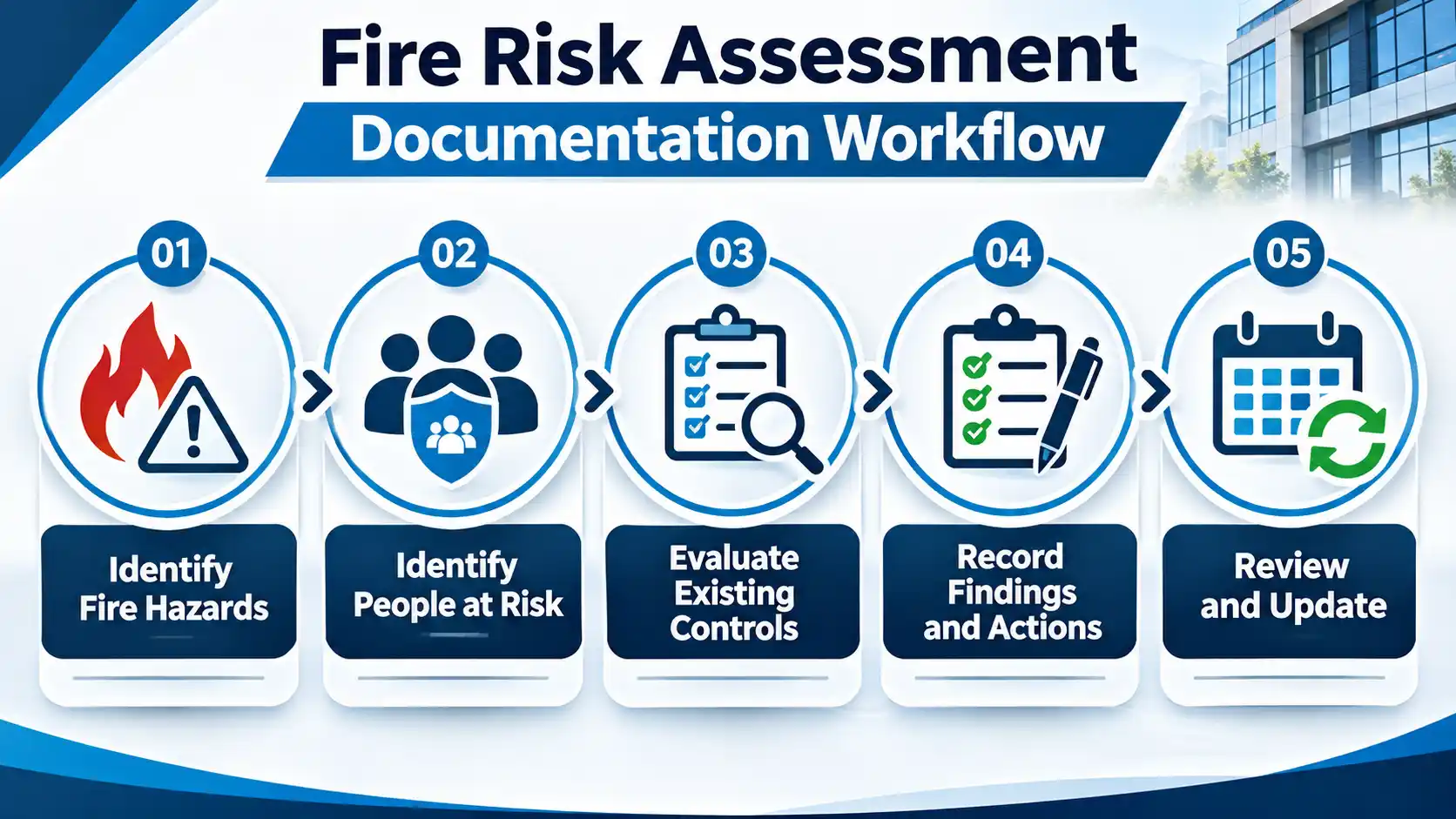
How to Document Fire Hazards, People at Risk and Existing Safety Measures
Accurate documentation begins with a systematic examination of the premises. The assessor should identify how a fire could start, what materials could contribute to its development, who could be affected and whether the existing precautions provide suitable protection.
Recording Fire Hazards and Sources of Ignition
Fire hazards should be described in a way that identifies their location, nature and potential consequences. General statements such as “electrical hazards present” do not provide enough practical information for effective risk management.
Relevant ignition sources may include:
- Damaged electrical equipment and defective electrical installations.
- Portable heaters and heating equipment.
- Cooking appliances and commercial kitchen equipment.
- Smoking materials and smoking arrangements.
- Hot work, welding, grinding and cutting operations.
- Contractor activities and temporary electrical supplies.
- Equipment generating heat during normal operation.
Combustible materials should also be recorded. These may include cardboard packaging, paper, textiles, waste, furniture, flammable liquids and other stored materials.
For example, a cleaning storage room may contain chemical products, packaging and electrical equipment. The assessment should identify relevant ignition sources, storage conditions, ventilation arrangements and the precautions required for the specific substances and activities.
Businesses can explore additional workplace examples in our guide to fire safety for cleaning teams, chemical storage and ignition risks.
Identifying People Who May Be at Risk
Fire risk assessment records should consider everyone who may be present in the building, not just permanent employees. Different groups may experience different levels of exposure or face additional challenges during an emergency.
Relevant groups include:
- Permanent and temporary employees.
- Visitors, customers and members of the public.
- Contractors and maintenance personnel.
- Night-shift and lone workers.
- Children and older people where relevant to the premises.
- People with mobility, sensory or other disabilities.
- Individuals unfamiliar with the building or its evacuation arrangements.
Documentation should explain how these people may be affected and identify relevant arrangements to support their safe evacuation. Where individual assistance arrangements are necessary, the organisation should manage personal information appropriately and make sure relevant staff understand their responsibilities.
Recording Existing Fire Safety Measures
The assessment should document the precautions already provided and evaluate their suitability. Simply listing equipment does not establish that it is correctly positioned, maintained, accessible or appropriate for the premises.
Relevant precautions may include:
- Fire detection and alarm systems.
- Fire doors and compartmentation arrangements.
- Emergency lighting and escape route signage.
- Suitable means of escape.
- Fire extinguishers and other relevant firefighting equipment.
- Automatic fire suppression systems where provided.
- Emergency communication and evacuation procedures.
- Housekeeping and combustible-material storage arrangements.
The assessor should record significant defects, limitations and areas requiring further investigation. Where a location could not be accessed, this limitation should be clearly stated instead of assuming that the area is satisfactory.
Example of a Practical Hazard Record
| Assessment element | Example information |
|---|---|
| Location | Ground-floor staff kitchen. |
| Hazard | Cooking equipment positioned close to combustible materials. |
| People at risk | Employees, contractors and visitors using the area. |
| Existing controls | Supervision arrangements, equipment maintenance and housekeeping procedures. |
| Finding | Combustible packaging is stored too close to a heat-producing appliance. |
| Recommended action | Remove unnecessary packaging and establish a suitable storage arrangement. |
| Verification | Record completion and verify the revised arrangement during a follow-up inspection. |
This example illustrates how a finding should be connected to a location, affected people, existing controls and a practical improvement. Organisations should adapt their records to their actual premises and risk profile.
For additional examples of ignition and housekeeping hazards, see our article on fire safety risks in staff rooms, canteens and workplace kitchens.
Fire Risk Assessment Records: Key Findings, Control Measures and Action Plans
One of the most valuable parts of a fire risk assessment report is its record of significant findings. These findings should explain what was identified, why it matters and what action is needed to maintain or improve fire safety.
Documenting Significant Findings
A significant finding is an important issue identified during the assessment that requires management attention. It may relate to a missing precaution, defective equipment, unsuitable storage arrangements, inadequate escape arrangements or another weakness in the fire safety provisions.
Each finding should provide enough information for the responsible person to understand the issue without needing to interpret vague technical statements.
A useful finding should identify:
- The location and nature of the issue.
- The hazard or weakness identified.
- The people or activities potentially affected.
- The relevant existing precautions.
- The reason further action is necessary.
- The recommended improvement.
- Any limitations or additional investigation required.
Creating an Effective Fire Risk Assessment Action Plan
An action plan converts assessment findings into manageable improvement activities. It should establish clear ownership and a process for monitoring completion.
Each action should include a description, priority, responsible individual, target date, progress status and evidence of completion. Where appropriate, the action plan should also identify interim precautions while permanent improvements are being arranged.
| Finding | Required action | Responsible person | Progress evidence |
|---|---|---|---|
| Fire door does not close correctly. | Arrange competent inspection and suitable repair. | Facilities manager | Inspection report and repair confirmation. |
| Combustible materials obstruct an escape route. | Remove obstruction and introduce routine checks. | Department supervisor | Photographic evidence and inspection log. |
| Staff training records are incomplete. | Review training coverage and arrange required instruction. | HR or safety manager | Attendance and training records. |
| Fire alarm defect identified. | Arrange appropriate investigation and corrective work. | Facilities manager | Contractor report and fault closure record. |
Monitoring Corrective Actions
Organisations should not consider an action complete merely because someone has reported that the work has been undertaken. Suitable verification should be recorded.
For example, a fire door repair may require inspection to confirm that the door operates correctly and that relevant components have been restored. Similarly, a storage issue should be checked after corrective action to ensure that the improved arrangement is being maintained.
Where an action remains outstanding, its status should be visible. Managers should review overdue items, understand the reason for delay and determine whether additional interim precautions are necessary.
Documenting Decisions and Risk Acceptance
Sometimes a recommended action requires additional investigation, funding or specialist input. The organisation should document the decision-making process, including the reasons for the selected approach and any temporary arrangements.
However, a management decision to defer work does not remove a legal duty or make an unsafe condition acceptable. Significant safety concerns must be addressed appropriately and without relying on administrative explanations as a substitute for effective precautions.

How to Record Fire Safety Inspections, Maintenance and Staff Training
A fire risk assessment describes the fire safety position at a particular point in time. Inspection, maintenance and training records help demonstrate how the arrangements are monitored after the assessment has been completed.
Fire Alarm Inspection and Testing Records
Fire alarm documentation should provide a reliable history of relevant routine tests, servicing, faults and corrective work. Records should identify the date, equipment or system tested, results, defects discovered and action taken.
Where contractors undertake servicing, organisations should retain the relevant service documentation and connect significant defects with their internal action-tracking arrangements.
Emergency Lighting Records
Emergency lighting supports safe movement when normal lighting fails. Records should demonstrate that the relevant testing and maintenance arrangements are being followed.
Where defects are identified, the organisation should record the affected location, the nature of the fault, any temporary arrangements and confirmation of repair.
Fire Door and Compartmentation Records
Fire doors and compartmentation arrangements help restrict the spread of fire and smoke. Inspection documentation should identify relevant doors or locations, the condition of components, defects and corrective actions.
Where building alterations, refurbishment or maintenance work could affect fire separation, the responsible person should obtain relevant information and consider whether the fire risk assessment needs to be reviewed.
Fire Extinguisher and Firefighting Equipment Records
Records should identify the relevant equipment, its location, inspection or maintenance activity and any defects requiring attention. Service documentation should be retained alongside relevant building safety information.
Equipment arrangements should be assessed for suitability. The presence of an extinguisher alone does not demonstrate that the organisation has selected the right equipment or that people are appropriately instructed in its use.
Staff Fire Safety Training Records
Staff training records help demonstrate that employees have received relevant information and instruction about fire hazards, emergency arrangements and their responsibilities.
A useful training register may include:
- Employee or participant identification.
- Training date and subject.
- Training provider or instructor.
- Method of delivery.
- Attendance or completion evidence.
- Relevant refresher or follow-up requirements.
- Additional instruction where roles or workplace risks require it.
Training should be appropriate to the person’s responsibilities and the risks of the premises. Temporary employees and contractors should receive relevant information before undertaking activities that could affect fire safety.
Fire Drill and Evacuation Records
Fire drill records should provide more than confirmation that an evacuation exercise took place. They should capture what was tested and whether the arrangements worked as intended.
Useful information includes the drill date, participating areas, relevant attendance information, observations, evacuation difficulties and improvements identified.
For example, a drill may reveal that employees are unfamiliar with an alternative escape route or that visitors are not receiving clear instructions. These findings should be reviewed and addressed through suitable training or procedural improvements.
Use a central fire safety logbook or digital record system to bring together alarm tests, emergency lighting checks, equipment maintenance, fire door inspections, training activities and evacuation drills. Link important findings to the fire risk assessment action plan.
Best Practices for Maintaining Accurate and Up-to-Date Fire Risk Assessment Records
Maintaining fire risk assessment records should be a continuous management activity rather than an occasional administrative exercise. Organisations need a consistent process for recording new information, checking existing documents and ensuring that important changes are reflected in the assessment.
Establish a Central Documentation System
Organisations should establish a clearly structured system for storing fire safety records. This may involve a physical logbook, an electronic document-management platform or a combination of both.
The system should make it easy for authorised people to locate the current assessment, supporting evidence, action plans and review history.
Useful document categories include:
- Current fire risk assessment and previous versions.
- Assessment review records.
- Action plans and completion evidence.
- Fire safety system inspection and maintenance records.
- Training and evacuation drill documentation.
- Emergency plans and relevant building information.
- Contractor reports and relevant certificates.
Use Consistent Document Naming and Version Control
Document naming conventions reduce confusion when several versions of an assessment exist. Each file should have a clear title, premises reference, date and version identifier where appropriate.
For example, a naming structure might be:
Building-A_Fire-Risk-Assessment_2026-11_Version-02.pdf
Building-A_Fire-Alarm-Service_2026-10.pdf
Building-A_Fire-Action-Plan_2026-11.xlsx
Superseded assessments should not be confused with the current version. Retaining an appropriate history helps managers understand previous findings, changes and decisions.
Record Every Review and Significant Change
A fire risk assessment should be reviewed regularly and whenever significant changes could affect fire safety. A review should consider whether the previous findings remain accurate and whether the existing precautions continue to provide suitable protection.
Important review triggers may include:
- Building extensions, refurbishment or changes to internal layouts.
- Changes in the type of work undertaken.
- Introduction of new machinery or heat-producing equipment.
- Changes in occupancy or the people using the premises.
- Introduction or increased storage of combustible or dangerous substances.
- Changes to fire alarm, emergency lighting or suppression arrangements.
- Fire incidents, near misses or repeated equipment defects.
- Changes to escape routes or building access arrangements.
Where a review identifies that the assessment needs updating, the organisation should amend the relevant documentation and communicate any resulting changes to those affected.
Improve Record Accuracy Through Regular Checks
Management should periodically check whether the documentation reflects actual conditions within the building. This can involve comparing the assessment with inspection findings, checking action-plan progress and verifying that relevant maintenance information is available.
For example, if the assessment identifies a particular fire door as an important protective measure, managers should be able to locate its relevant inspection and maintenance evidence.
Protect Digital Records and Control Access
Digital records can improve accessibility and reduce the administrative burden associated with paper files. However, an electronic system must be managed properly.
Recommended arrangements include:
- Role-based access permissions.
- Regular backups and recovery arrangements.
- Document version control.
- Secure storage of sensitive information.
- Clear approval and amendment procedures.
- Reliable retrieval of documents during inspections or emergencies.
Personal information contained in staff training or evacuation assistance records should be handled in accordance with applicable data protection requirements.
Use a Regular Documentation Review Process
A practical management review can help identify missing or outdated records before they create wider problems.
| Review area | Questions to consider |
|---|---|
| Assessment | Is the current assessment available and does it reflect the premises? |
| Action plan | Are actions assigned, monitored and supported by completion evidence? |
| Equipment | Are relevant testing, inspection and maintenance records available? |
| Training | Are training records current and appropriate to staff responsibilities? |
| Emergency arrangements | Are evacuation procedures and drill findings documented? |
| Changes | Have relevant building, occupancy or operational changes been considered? |
| Accessibility | Can authorised staff retrieve important documents when required? |
These checks should support, rather than replace, the assessment and review process required for the specific premises.

How Long Should Fire Risk Assessment Records Be Kept and Who Is Responsible?
Two important questions arise when organisations establish a fire safety documentation system: who is accountable for maintaining the records, and how long should different documents remain available?
Who Is Responsible for Maintaining Fire Risk Assessment Records?
The responsible person has the relevant legal duties under the applicable fire safety legislation. In a workplace, this will commonly be the employer, building owner or person who has control of the premises, depending on the circumstances.
In larger or shared buildings, responsibilities may be distributed between different organisations and individuals. Employers, managing agents, landlords and other parties may each have responsibilities relating to the areas or activities they control.
Specialist assessors, facilities managers and contractors can provide technical support, but appointing someone to prepare or maintain documentation does not automatically transfer the responsible person’s legal accountability.
How Long Should Fire Risk Assessment Records Be Retained?
There is no single universal retention period that can safely be applied to every type of fire safety document and every premises. Requirements and good-practice retention decisions depend on the applicable legal framework, the document type, contractual obligations, operational needs and potential future use of the information.
Organisations should establish a documented retention policy that distinguishes between assessment reports, maintenance evidence, training information, incident records and building alteration documentation.
The following table provides a management approach rather than a statement of statutory retention periods.
| Record category | Recommended retention approach | Management consideration |
|---|---|---|
| Current fire risk assessment | Maintain throughout its period of relevance. | Keep the current approved version accessible. |
| Previous assessment versions | Retain an appropriate assessment history. | Preserve evidence of earlier findings and decisions. |
| Action plans | Retain with the related assessment and completion evidence. | Maintain an audit trail of outstanding and completed work. |
| Equipment maintenance records | Follow applicable requirements and a documented retention policy. | Consider equipment lifecycle, contracts and defect history. |
| Staff training records | Follow employment, safety and data-retention requirements. | Keep appropriate evidence of relevant instruction. |
| Fire drill reports | Retain according to the organisational safety-record policy. | Use previous results to identify recurring weaknesses. |
| Building alteration records | Retain while relevant to the building’s fire safety history. | Preserve information affecting compartmentation and fire precautions. |
| Incident and investigation records | Apply relevant legal, insurance and organisational requirements. | Consider investigations and potential future claims. |
Organisations should seek appropriate legal or specialist advice where retention obligations are uncertain, particularly for complex buildings or records associated with incidents, enforcement action or significant building alterations.
Managing Records in Multi-Occupied Buildings
Multi-occupied premises can involve several responsible persons, each controlling different areas or activities. Examples include commercial buildings with multiple tenants, managed offices and mixed-use properties.
In these circumstances, relevant fire safety information should be communicated between parties where their duties overlap. The parties should establish who maintains common-area records, who manages individual occupier arrangements and how important defects or building changes are reported.
Clear written arrangements can reduce uncertainty when responsibilities change or a new managing agent takes over the building.
Making Records Accessible for Inspection
Important fire safety documents should be accessible to authorised people who need them to perform their responsibilities. Organisations should know where the current assessment is stored and how supporting evidence can be retrieved.
Where electronic systems are used, access should not depend on one employee’s personal account or an unavailable device. Suitable access arrangements and backup procedures help maintain continuity when personnel change.
Frequently Asked Questions About Fire Risk Assessment Records
What Are Fire Risk Assessment Records?
Fire risk assessment records are written documents that describe the fire hazards identified within a premises, the people who may be affected, existing precautions, assessment findings and the actions needed to control risks. They also provide information about assessment reviews and relevant supporting fire safety arrangements.
What Documents Should Be Included in a Fire Risk Assessment?
A fire risk assessment should include premises details, responsible person and assessor information, identified hazards, people at risk, existing fire precautions, significant findings, recommended improvements and review information. Supporting evidence may include maintenance records, inspection reports, staff training information, evacuation drill reports and emergency plans.
Is It a Legal Requirement to Keep Fire Risk Assessment Records in the UK?
Yes, written fire risk assessment records are required under the relevant fire safety framework. In England and Wales, the Regulatory Reform (Fire Safety) Order 2005, as amended, requires the responsible person to record the full assessment and its review. Scotland and Northern Ireland have separate fire safety legislation, so organisations should check the rules applicable to their location.
Who Is Responsible for Maintaining Fire Risk Assessment Records?
The responsible person is accountable for ensuring that the required fire risk assessment is carried out, recorded and reviewed. This may be an employer, building owner or person controlling the premises. A competent assessor or facilities manager may provide support, but delegation does not automatically remove the responsible person’s legal duties.
How Often Should Fire Risk Assessment Records Be Updated?
Records should be reviewed regularly and updated whenever changes could affect fire safety. Examples include building alterations, new equipment, changes in occupancy, new hazardous materials, changes to escape arrangements and fire incidents. The review process should be appropriate to the nature and risks of the premises.
How Long Should Fire Risk Assessment Records Be Kept?
Retention depends on the type of document, applicable legal requirements and organisational needs. There is no single retention period that applies universally to every fire safety record. Businesses should maintain a documented retention policy and preserve relevant assessment history, action plans and supporting evidence.
What Happens If Fire Risk Assessment Records Are Missing or Incomplete?
Missing or incomplete records can make it difficult to demonstrate that fire risks have been assessed, precautions monitored and required actions addressed. They can also create problems during management reviews, inspections and investigations. The responsible person should identify documentation gaps, obtain the necessary information and address any underlying fire safety weaknesses.
Can Fire Risk Assessment Records Be Stored Digitally?
Yes. Digital storage can provide convenient access, version control and efficient document management. However, records should be secure, accurate, backed up and accessible to authorised people. Organisations should also maintain appropriate procedures for reviewing documents and protecting personal information.
Conclusion: Building a Reliable Fire Risk Assessment Record System
Fire risk assessment records are an essential part of effective workplace fire safety management. They provide a documented account of identified hazards, people at risk, existing precautions, significant findings and the actions required to maintain safe conditions.
However, a well-managed system should extend beyond the initial assessment report. Inspection records, equipment maintenance information, training documentation, evacuation drill reports and corrective action evidence all contribute to a clearer understanding of how fire safety arrangements operate in practice.
Businesses should establish clear documentation responsibilities, maintain suitable version control, review assessments when significant changes occur and ensure that important records remain accessible. They should also distinguish between legal requirements and recommended management practices when establishing their retention policies.
Ultimately, effective fire risk assessment records help organisations make informed decisions, monitor safety improvements and demonstrate a systematic approach to protecting people and property.
Develop Your Professional Knowledge of Fire Risk Assessment
Understanding fire risk assessment documentation is an important part of professional fire safety practice. Developing the right knowledge and assessment skills can help individuals contribute more effectively to workplace fire prevention, risk evaluation and safety management.
Explore professional learning pathways designed to develop fire risk assessment knowledge and practical competence.
Explore ProQual Level 4 Explore ProQual Level 5 Explore ICTQual Level 3Further Reading and Official Resources
The following resources provide additional guidance on fire risk assessment, documentation and workplace fire safety:
- GOV.UK – Fire Risk Assessments: Responsibilities and the five-step assessment process.
- GOV.UK – Fire Safety Risk Assessment: Five-Step Checklist: Official assessment and review guidance.
- Regulatory Reform (Fire Safety) Order 2005: The relevant fire safety framework for England and Wales.
- GOV.UK – Fire Safety in the Workplace: Additional workplace fire safety guidance.
Editorial note: This article provides general fire safety information, not a substitute for a premises-specific assessment or professional legal advice. Organisations should check the current legislation and guidance applicable to their jurisdiction and building type.