
Fire Alarm Systems Explained: Components, Testing and Technician Skills
Understand how modern fire alarm systems detect potential emergencies, communicate warnings and support building safety. Explore essential components, detection technologies, testing principles, common faults and the professional skills required of a fire alarm technician.
Fire alarm systems are essential life-safety installations in commercial buildings, industrial facilities, educational institutions, healthcare environments and other premises. Their purpose is to detect signs of fire, process information and provide an effective warning that allows people to respond to an emergency.
However, a reliable fire alarm installation involves much more than detectors and audible alarms. It combines sensing technologies, control and indicating equipment, electrical circuits, communication interfaces, notification appliances and backup power arrangements. Every component must work as part of a coordinated system.
Understanding how fire alarm systems work is important for building managers, facilities teams, fire safety professionals, maintenance personnel and aspiring technicians. It also provides a foundation for people interested in developing specialist knowledge through professional fire alarm technician training.
How Fire Alarm Systems Work
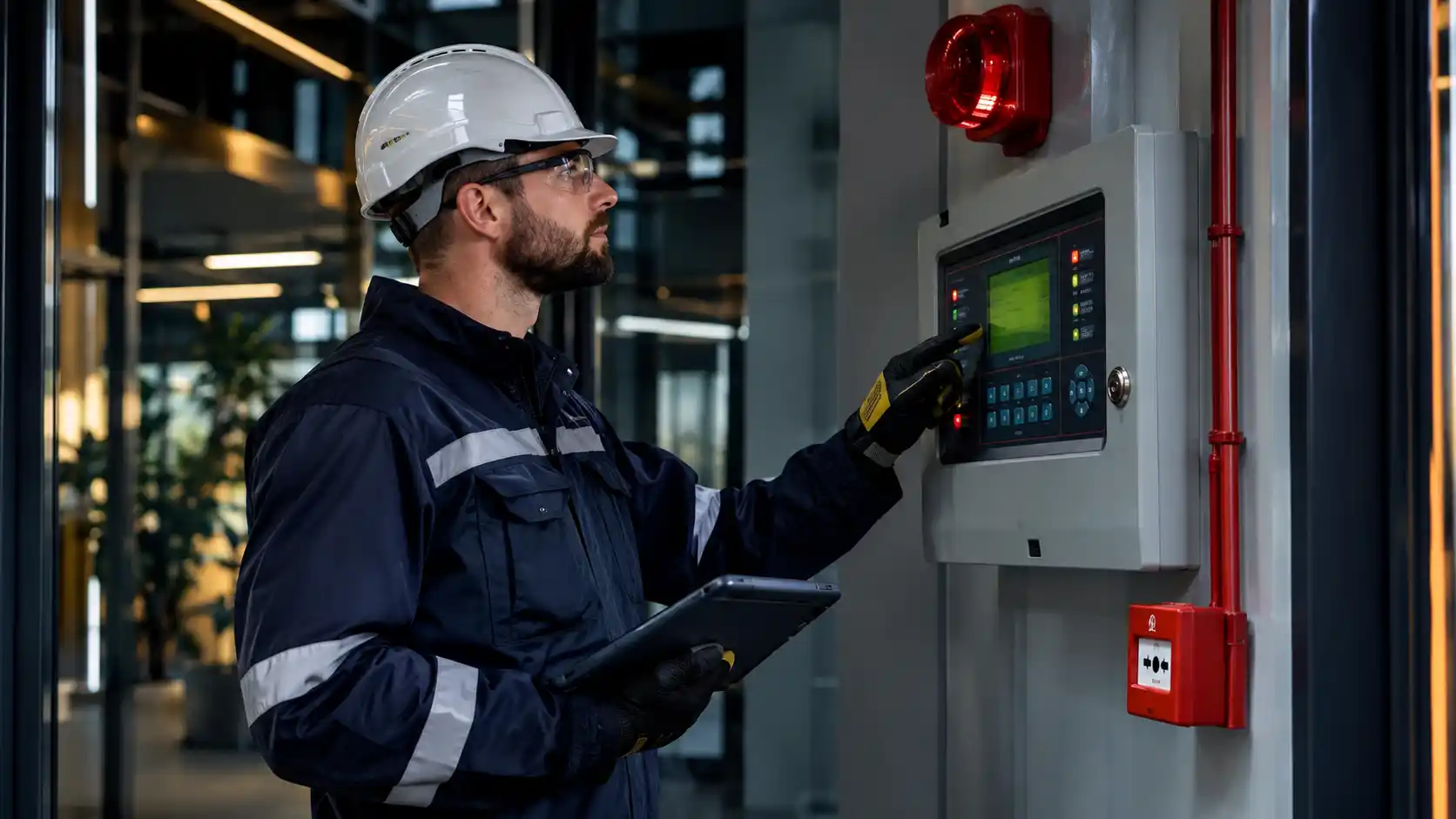
A fire alarm system works by monitoring a building for signs of fire and communicating an appropriate warning when an initiating device detects a potential emergency. Its operation follows a connected sequence involving detection, signal transmission, processing, notification and, where designed, control of other building systems.
The exact sequence depends on the system design, the type of initiating device, the control equipment configuration and the programmed cause-and-effect arrangements. An automatic smoke detector, for example, may initiate an alarm when its sensing chamber identifies smoke. A manual call point allows a person to raise the alarm without waiting for automatic detection.
The operating sequence
A smoke, heat, flame or other suitable detector identifies a condition associated with a possible fire. Alternatively, a person operates a manual call point.
The initiating device communicates its status to the fire alarm control and indicating equipment through the relevant circuit or communication arrangement.
The control equipment evaluates the incoming information and determines the appropriate system response according to its configuration and programmed functions.
Audible and visual notification devices operate as configured, communicating the required warning to people within the protected premises.
Where included in the design, the system may communicate with remote monitoring equipment, release door-holding devices, initiate smoke-control sequences or operate other fire safety interfaces.
Occupants follow the building’s emergency procedures, while responsible personnel investigate the system indication and arrange appropriate emergency and technical support.
This process demonstrates why a fire alarm system must be considered as an integrated life-safety installation. A detector may identify smoke correctly, but the overall warning function can still be compromised by damaged wiring, incorrect configuration, defective sounders or a power supply problem.
What happens inside the control panel?
The fire alarm control and indicating equipment acts as the central monitoring and coordination point. It receives information from initiating devices, monitors circuit conditions, displays system status and activates programmed outputs.
Depending on the installation, the display may identify an alarm location, a device address, a zone, a communication fault or a disabled circuit. Technicians use these indications alongside system drawings, device schedules and maintenance documentation to understand the condition of the installation.
Modern systems can also support event histories, device-level information and remote communication. These capabilities make accurate configuration, access control and documentation increasingly important.
Main Components of Fire Alarm Systems
Fire alarm systems contain several interconnected components. Although individual products and system architectures differ, the main functional groups are detection devices, manual initiating devices, control equipment, notification appliances, power supplies, communication circuits and interface modules.
1. Fire alarm control and indicating equipment
The control and indicating equipment is the central point of a fire alarm installation. It receives information from field devices, supervises relevant circuits, processes alarm and fault conditions and communicates the system’s operational status.
A technician should understand the panel’s controls, indications, zone or address information, event history, access arrangements and manufacturer-specific operating procedures. Incorrect operation or unauthorised changes can affect system reliability.
2. Automatic fire detectors
Automatic detectors monitor environmental conditions associated with fire. Common examples include optical smoke detectors, heat detectors, multi-sensor devices and flame detectors.
The detector type must be appropriate for the environment, expected fire characteristics, building layout and design requirements. A kitchen, plant room, warehouse and office may present very different detection challenges.
3. Manual call points
Manual call points allow occupants to initiate the fire alarm when they identify a fire or another emergency requiring activation. They are commonly positioned along escape routes and near exits in accordance with the system design and applicable recommendations.
They are important because automatic detection is not the only method of identifying an emergency. A person may observe flames before smoke reaches an automatic detector or may identify a fire in a location where automatic detection is not provided.
4. Alarm notification devices
Notification devices communicate the warning to building occupants. Common examples include electronic sounders, bells, voice alarm equipment and visual alarm devices.
Audible notification must be suitable for the acoustic conditions and intended occupancy of the premises. Visual warning devices can support people who may not adequately perceive an audible signal and may form part of an inclusive warning strategy.
5. Power supply and standby batteries
Reliable electrical power is fundamental to the operation of a fire alarm system. The primary supply supports normal operation, while standby power provides continued operation when the normal electrical supply is interrupted.
Battery condition, charger performance, connection integrity and installation records are important maintenance considerations. Technicians should follow the manufacturer’s instructions and applicable design requirements when inspecting or replacing batteries.
6. Cables, circuits and communication pathways
Cables and communication pathways connect detectors, call points, control equipment and output devices. Their configuration depends on whether the installation uses conventional circuits, addressable loops or other approved communication arrangements.
Circuit continuity, insulation condition, correct identification, termination quality and protection against physical damage are important technical considerations. A circuit fault may affect one device, a section of a loop or a wider part of the installation, depending on the architecture.
7. Input and output interface modules
Interface modules allow fire alarm systems to communicate with other building services. They may monitor the status of external equipment or initiate a defined action following an alarm.
Examples include door release arrangements, smoke control equipment, plant shutdown signals, lift interfaces and fire suppression monitoring. Their operation must follow the approved cause-and-effect strategy and commissioning documentation.
| Component | Main function | Technical consideration |
|---|---|---|
| Control equipment | Processes and displays system information | Correct configuration and fault monitoring |
| Smoke detector | Identifies smoke-related conditions | Environmental suitability and contamination |
| Heat detector | Responds to temperature conditions | Appropriate selection and positioning |
| Manual call point | Allows manual alarm initiation | Accessibility and functional testing |
| Sounder or visual device | Provides occupant warning | Coverage and correct operation |
| Standby battery | Supports operation during power failure | Capacity, condition and connections |
| Interface module | Communicates with other systems | Correct input/output functionality |
Types of Fire Detection Technologies
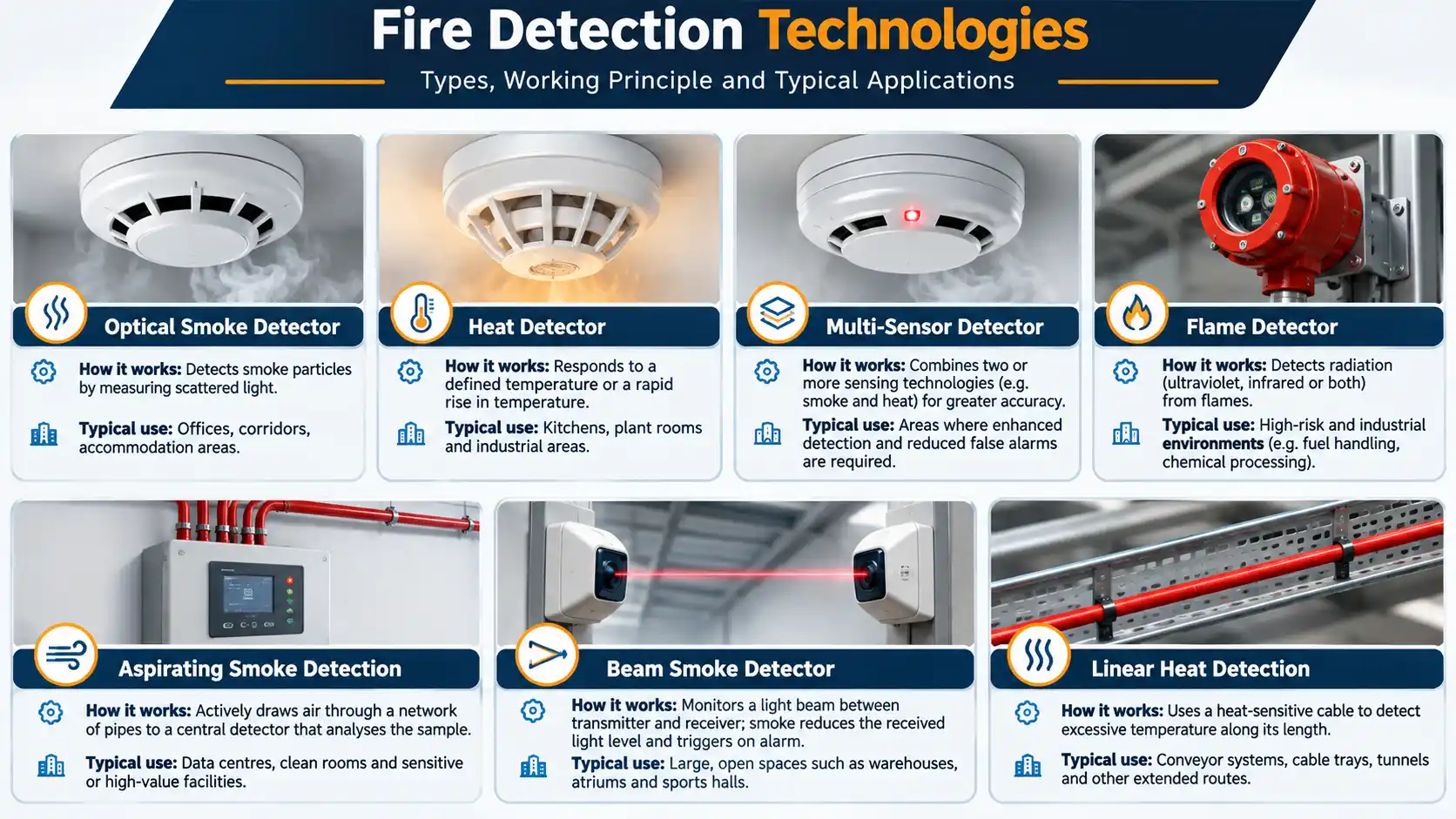
Fire detection technology is selected according to the risks, characteristics and operational conditions of the protected environment. No single detector is suitable for every building or every type of fire.
Optical smoke detectors
Optical smoke detectors commonly use a light source and photosensitive receiver within a sensing chamber. When smoke enters the chamber, light is scattered towards the receiver, creating a measurable change that can initiate an alarm.
They are widely used in offices, corridors, accommodation areas and other locations where their performance is appropriate. However, dust, steam, aerosols and environmental contamination can affect detector operation and contribute to unwanted alarms.
Heat detectors
Heat detectors respond to temperature-related conditions rather than relying on smoke entering a sensing chamber. Common operating principles include fixed-temperature detection and rate-of-rise detection.
Fixed-temperature devices operate when a defined temperature threshold is reached. Rate-of-rise devices respond to a rapid increase in temperature. Some products combine both principles.
Heat detectors may be suitable in environments where smoke detectors are more vulnerable to unwanted activation, provided their use is consistent with the design requirements. Their slower response to some developing fires must also be considered.
Multi-sensor detectors
Multi-sensor detectors combine information from more than one sensing technology, such as smoke and heat. The device or control system evaluates the combined information to determine an appropriate response.
Their advantage is the ability to assess multiple fire-related indicators. However, the detector’s operating mode and configuration must be appropriate for the protected environment. A multi-sensor device should never be assumed to be automatically suitable for every location.
Flame detectors
Flame detectors identify radiation associated with flames. Depending on the technology, they may respond to ultraviolet, infrared or combined radiation characteristics.
They are used in selected industrial and specialist environments, including locations where rapidly developing fires may present a particular risk. Selection requires careful consideration of viewing angles, obstructions, environmental interference and the anticipated fire scenario.
Aspirating smoke detection
Aspirating smoke detection systems draw air samples through a network of pipes to a central detection unit. The equipment analyses the samples to identify smoke-related particles.
Such systems can provide very early warning in environments where conventional point detection may be difficult to install or maintain. Examples include data centres, communication facilities, specialist industrial spaces and certain large or sensitive buildings.
Beam smoke detectors
Beam smoke detectors use a projected light beam between a transmitter and receiver, or a combined reflective arrangement. Smoke entering the detection path reduces the received light intensity and may initiate an alarm.
They can be useful in large open spaces with high ceilings, but alignment, structural movement, obstructions and environmental conditions need to be considered during installation and servicing.
Linear heat detection
Linear heat detection uses a cable or sensing element to identify excessive temperature along a defined route. It can be useful for protecting cable trays, tunnels, industrial equipment, conveyors and other extended areas.
The suitability of a detector technology should always be assessed against the building’s fire risk, design strategy and the current relevant technical recommendations.
| Detection technology | What it detects | Typical application |
|---|---|---|
| Optical smoke | Smoke particles | Offices and suitable occupied areas |
| Heat | Temperature or temperature rise | Selected kitchens and industrial spaces |
| Multi-sensor | Combined environmental indicators | Areas requiring suitable multi-criteria detection |
| Flame | Flame radiation | Specialist industrial environments |
| Aspirating | Airborne smoke particles in sampled air | Data centres and sensitive facilities |
| Beam | Smoke affecting a projected light beam | Large open internal spaces |
| Linear heat | Temperature along a sensing cable | Conveyors, tunnels and cable routes |
Types of Fire Alarm Systems
Fire alarm systems can be classified according to how their devices communicate with the control equipment and how the system identifies the location of an initiating event. Conventional, addressable and wireless installations are common architectural approaches. Intelligent functionality may also be incorporated into addressable systems.
Conventional fire alarm systems
Conventional systems divide a building into detection zones. Multiple devices are connected within a circuit or zone, and the control equipment identifies the zone associated with an alarm or fault.
This approach can be suitable for relatively straightforward buildings where zone-based identification meets the requirements of the system design. However, the control panel may not identify the exact individual detector that initiated the alarm.
Addressable fire alarm systems
Addressable systems assign individual identification information to devices. The control equipment can display the identity or location of the initiating device, allowing a more precise investigation.
These systems are commonly used in larger or more complex buildings. They can support detailed device monitoring, programmed functions and more sophisticated fault identification.
Intelligent fire alarm systems
Intelligent systems use more advanced device processing and communication capabilities. Depending on the manufacturer and equipment, detectors may provide additional information about environmental conditions, contamination or operating status.
The control equipment uses the available information and programmed logic to manage system responses. This can support improved discrimination between fire conditions and certain unwanted environmental influences.
Wireless fire alarm systems
Wireless systems communicate through radio-based devices instead of relying entirely on traditional field cabling. They may be useful in historic buildings, premises where cable installation is difficult or projects requiring reduced disruption.
Wireless systems still require appropriate power arrangements, communication supervision, radio coverage assessment, device identification and maintenance. Their suitability must be demonstrated through the system design rather than assumed.
| System type | Device identification | Important consideration |
|---|---|---|
| Conventional | Primarily by zone | Zone layout and fault identification |
| Addressable | Individual device address | Device programming and loop communication |
| Intelligent | Detailed device information | Configuration and detector algorithms |
| Wireless | Identified wireless device | Radio communication and battery management |
Fire Alarm Testing and Maintenance Principles
Fire alarm testing and maintenance are essential to ensuring that an installed system remains capable of performing its intended life-safety functions. A system that worked correctly during commissioning cannot automatically be assumed to remain reliable throughout its operational life.
Dust accumulation, building alterations, damaged wiring, failed batteries, changes in room use, detector contamination and communication faults can all affect system performance. A structured maintenance programme helps identify these problems before they compromise the installation.
Understanding the UK testing framework
In the UK, BS 5839-1 provides recommendations for fire detection and fire alarm systems in non-domestic premises. The standard should be considered alongside the building’s fire risk assessment, the system design, applicable legal duties and manufacturer instructions.
The 2025 edition of BS 5839-1 introduced updated provisions covering detector selection, system documentation, maintenance, false alarm management and other technical matters. Technicians and organisations should ensure that their working procedures reflect the applicable current edition and any relevant transition arrangements.
It is important to distinguish between routine checks undertaken by responsible premises personnel and specialist inspection, testing and servicing undertaken by competent persons.
Routine user checks
The responsible person should establish a suitable routine for checking the system’s general condition and ensuring that arrangements for responding to faults are in place.
Relevant checks may include reviewing the control panel for fault indications, confirming that the system has not been inadvertently disabled, and arranging weekly operation tests in accordance with the installation’s instructions.
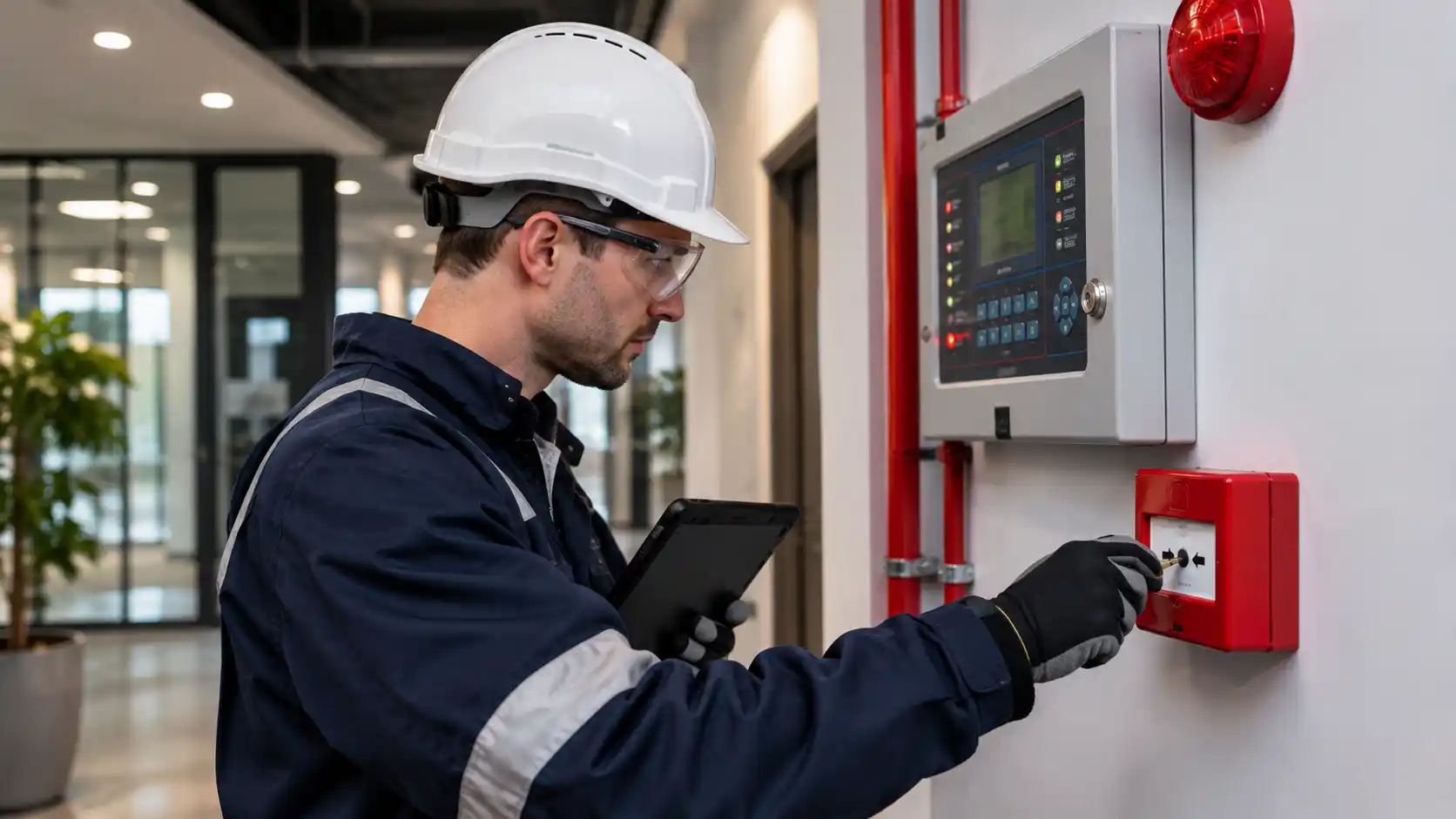
For example, a weekly test may involve operating a manual call point using the correct test key, confirming the expected warning operation and recording the outcome. Different call points can be selected in rotation so that the installation receives appropriate coverage over time.
Competent-person inspection and servicing
Specialist servicing involves more detailed examination and functional assessment of the fire alarm installation. It may include inspection of detectors, manual call points, sounders, interfaces, control equipment, power supplies and communication circuits.
The engineer should consider the condition of devices, environmental changes, system event history, previous faults and any alterations to the building. Tests should be carried out in accordance with the applicable standard, manufacturer instructions and agreed maintenance scope.
Fire alarm testing procedure
A properly planned testing activity should begin before any device is operated. The technician must understand the system configuration, the testing scope, the building’s emergency arrangements and the potential impact of the work.
Examine the system drawings, device schedule, maintenance records, previous service reports and manufacturer guidance.
Agree the test scope, timing, access requirements and communication arrangements with the building’s responsible person.
Where remote alarm transmission is provided, coordinate the necessary test arrangements with the monitoring provider to reduce the risk of an unintended emergency response.
Examine accessible equipment for damage, contamination, obstruction, incorrect identification and other visible conditions affecting operation.
Test the relevant devices and system functions using suitable approved equipment and the manufacturer’s specified procedure.
Confirm that the required notification devices and associated interfaces respond correctly within the authorised test scope.
Remove test arrangements, restore any temporarily isolated functions, check the panel status and confirm that the system is returned to its intended operating condition.
Record the work performed, defects identified, repairs completed, remaining limitations and recommendations for further action.
How frequently should fire alarm systems be tested?
Frequency depends on the system, premises, applicable guidance and maintenance arrangements. The following table illustrates common arrangements described in the UK government fire safety risk assessment guidance for offices and shops. It is an illustrative reference, not a universal servicing schedule.
| Activity | Illustrative frequency | Responsible party |
|---|---|---|
| Visual control panel check | Daily | Responsible premises personnel |
| Routine fire alarm test | Weekly | Trained and authorised user |
| Specialist servicing | Six-monthly example in the guidance | Competent specialist |
| Additional inspection and maintenance | According to system and risk requirements | Competent specialist |
The government guidance also emphasises maintaining a logbook containing records of testing, false alarms and maintenance. Organisations should consult the current applicable standard and competent fire alarm service provider when establishing their actual maintenance programme.
Documentation and maintenance records
Documentation provides evidence of the system’s operational history and helps technicians understand changes, previous defects and outstanding recommendations.
Useful maintenance records include:
- Dates and details of routine tests.
- Device identification and locations tested.
- Control panel indications and system status.
- False alarm incidents and investigation findings.
- Inspection and servicing reports.
- Battery replacement and power supply information.
- Details of modifications, repairs and extensions.
- Agreed variations and relevant technical documentation.
- Outstanding defects and corrective action records.
Common Fire Alarm Faults and Escalation Procedures
Fire alarm faults can affect detection, communication, power supplies, warning devices or system interfaces. Identifying the displayed fault is only the first step. A competent technician must investigate the underlying cause and determine whether the system’s intended safety functions have been affected.
Detector contamination and unwanted alarms
Dust, construction debris, insects, steam and aerosols can influence detector performance. In some environments, an unsuitable detector type or incorrect placement can also contribute to repeated unwanted alarms.
Investigation should consider the location, environmental conditions, detector history and installation design. Replacing a detector without understanding the cause may simply reproduce the same problem.
Open-circuit and short-circuit faults
An open-circuit fault may occur when a conductor is disconnected, damaged or otherwise interrupted. A short circuit may result from damaged insulation or an unintended electrical connection.
The control equipment may indicate the affected circuit or loop. Investigation should follow the manufacturer’s instructions and appropriate electrical safety procedures.
Communication failures
Addressable and wireless installations rely on communication between devices and control equipment. A communication fault may be associated with damaged wiring, connection problems, device failure, interference, configuration errors or communication pathway issues.
Technicians should establish whether the fault affects an individual device, a circuit section or a wider system function before determining the appropriate repair.
Standby battery and power supply faults
A battery-related fault may indicate deteriorated battery condition, loose connections, charging problems or loss of the primary supply.
Battery inspection and replacement must follow the equipment manufacturer’s instructions and the system’s design requirements. The technician should also confirm that the power supply has returned to its intended operating condition.
Sounder and notification device faults
A sounder circuit may fail because of damaged wiring, a defective notification appliance, an output problem or an incorrect system configuration. A device that appears physically intact may still fail to provide the intended warning.
Functional verification is therefore important. Where visual alarm devices or voice alarm interfaces are included, their performance should also be assessed within the authorised test scope.
How should technicians escalate faults?
Fault escalation means communicating a defect to the appropriate responsible person and arranging a suitable corrective response. The level of urgency depends on the fault’s effect on system operation and the building’s fire safety arrangements.
| Fault condition | Possible implication | Appropriate response |
|---|---|---|
| Detector fault | Potential loss of automatic detection at a location | Investigate and arrange authorised repair |
| Loop fault | Potential communication or device availability issue | Assess affected sections and system impact |
| Battery fault | Reduced standby power reliability | Check power supply and battery condition |
| Sounder fault | Potential reduction in warning coverage | Assess affected notification areas |
| Repeated unwanted alarms | Disruption and possible reduced confidence in alarms | Investigate causes and review detector suitability |
| System isolation | One or more functions may be unavailable | Confirm authorisation and impairment controls |
A technician should not simply silence, reset or clear a fault indication without understanding the underlying condition. Where a life-safety function remains unavailable, the responsible person must be informed promptly and suitable interim precautions arranged.
False alarm management is another important responsibility. Repeated unwanted alarms can disrupt building operations and undermine confidence in the warning system. Investigation should consider detector selection, environmental conditions, building activities, maintenance history and system configuration.
For example, organisations should consider fire risks in staff rooms, canteens and workplace kitchens, where cooking activities, steam and aerosols can influence the suitability of detection arrangements. Read our related guide on fire safety risks in staff rooms, canteens and workplace kitchens .
Similarly, storage rooms and archive facilities can contain combustible materials, changing layouts and restricted access. Understanding these conditions is important when reviewing fire detection arrangements. Explore our article on preventing fires in storage rooms, archives and document facilities .
Essential Fire Alarm Technician Skills
A fire alarm technician needs a combination of technical understanding, practical competence, analytical ability and professional communication skills. The role is not limited to installing or replacing devices. It involves understanding how the complete system supports building fire safety and how its performance can be maintained.
Technical knowledge of fire alarm systems
Technicians should understand conventional and addressable architectures, detection principles, circuit arrangements, control equipment, notification appliances, power supplies and system interfaces.
They should also understand the relationship between the building’s fire risk assessment, the intended protection objectives and the installed detection strategy.
Installation and inspection skills
Practical installation and inspection knowledge helps technicians identify incorrect device positioning, damaged components, unsuitable environmental conditions, poor cable identification and other installation issues.
Technicians must understand relevant installation documentation and work within their authorised level of competence. Electrical work and system modifications require the appropriate training, authorisation and safety arrangements.
Testing and fault diagnosis
Fault diagnosis involves interpreting system indications, examining relevant records, identifying possible causes and carrying out suitable verification procedures. Technicians need a methodical approach rather than replacing components based on assumptions.
They should be familiar with appropriate testing equipment, manufacturer procedures and the limitations of the instruments and methods being used.
Understanding technical standards
UK fire alarm professionals should be familiar with the purpose and application of BS 5839-1 and the relevant product standards in the BS EN 54 series. The exact requirements depend on the installation and the work being undertaken.
A technician should be able to identify the applicable design documentation, recognise when a matter requires specialist review and understand why departures from recommendations must be properly justified and recorded.
Documentation and reporting
Accurate documentation is a core professional skill. Service reports, test records, fault descriptions and handover information must be clear enough for other technicians and responsible personnel to understand the work completed and any remaining limitations.
Communication and professional conduct
Technicians regularly communicate with facilities managers, building owners, contractors, fire safety professionals and other technical specialists. They must explain defects, recommend appropriate corrective action and communicate system impairments without creating unnecessary confusion.
Health and safety awareness
Working with fire alarm equipment may involve electrical systems, ladders, ceiling voids, restricted areas, occupied buildings and other workplace hazards. Technicians should understand risk assessments, safe systems of work, access controls and the precautions required for their specific tasks.
Technical competence
Understand system components, circuits, detectors and control equipment.
Analytical thinking
Investigate faults methodically and identify underlying causes.
Professional reporting
Maintain clear testing, inspection and maintenance records.
Safety awareness
Work within competence and follow appropriate safety procedures.
Fire Alarm Technician Training, Qualifications and Career Development
Developing a career as a fire alarm technician requires a structured understanding of fire detection, alarm equipment, system operation, inspection, testing and maintenance. The precise entry route depends on an individual’s previous experience, intended responsibilities and the requirements of employers.
People entering the sector may begin by developing foundational knowledge of fire safety and electrical principles before progressing towards specialist fire alarm system training.
Why professional training matters
Training helps learners understand the purpose and operation of fire alarm systems, recognise important components, interpret system information and appreciate the responsibilities associated with inspection and maintenance.
Structured learning can also develop awareness of technical standards, professional conduct, risk management, documentation and fault reporting. These subjects are particularly relevant to individuals seeking to move into specialist fire safety roles.
However, completing a course should not automatically be interpreted as authorisation to undertake every installation, commissioning, inspection or repair task. Practical experience, product-specific knowledge, supervised development and demonstrated competence remain important.
ICTQual AB Level 3 Certificate in Fire Alarm Technician
Individuals seeking to develop specialist knowledge in fire alarm technology can explore the ICTQual AB Level 3 Certificate in Fire Alarm Technician .
This course is relevant to learners interested in understanding fire alarm systems and developing knowledge associated with the technician role. It provides a course pathway to consider when planning professional development in fire detection and alarm technology.
ICTQual AB Level 3 Certificate in Advanced Fire Safety
Professionals who want to strengthen their wider understanding of fire prevention, fire protection and workplace fire safety can also consider the ICTQual AB Level 3 Certificate in Advanced Fire Safety .
Broader fire safety knowledge is valuable because fire alarm installations form part of a wider building protection strategy. Understanding hazards, people at risk, emergency arrangements and fire prevention measures helps professionals appreciate the purpose of the systems they work with.
Advanced fire safety design and building risk management
Experienced professionals interested in progressing towards more advanced fire safety design and risk management responsibilities may explore the ProQual Level 6 Diploma in Advanced Fire Safety Design and Building Risk Management .
Advanced study can support a broader understanding of building fire safety strategy, technical design considerations and risk management. It should be considered as part of a suitable professional development plan rather than as a substitute for task-specific technical competence.
Potential career opportunities
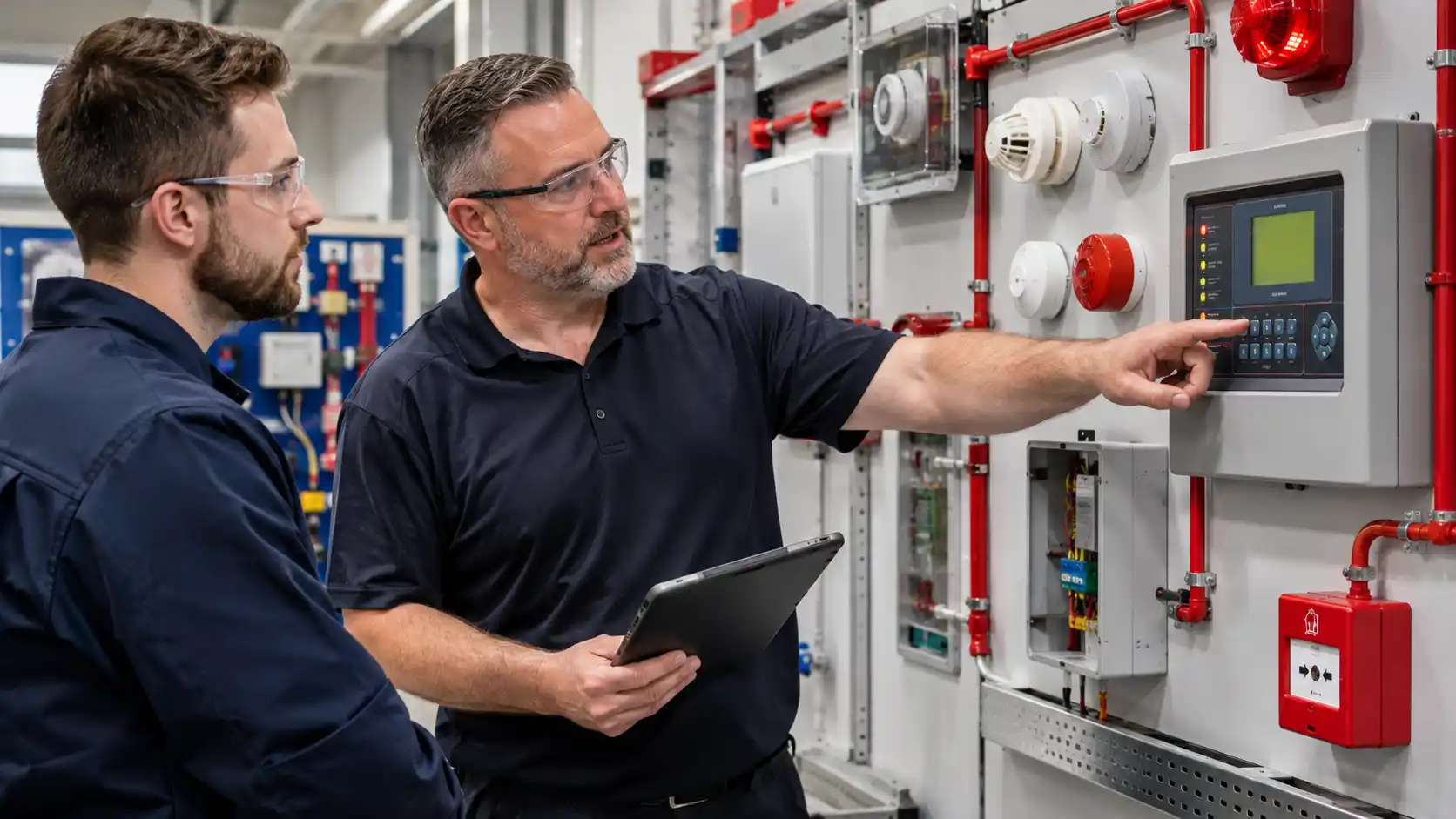
Depending on training, practical experience and demonstrated competence, professionals may explore opportunities in different areas of the fire safety sector.
- Fire alarm installation support.
- Fire alarm inspection and maintenance.
- Fire detection system servicing.
- Fire safety equipment support.
- Facilities and building maintenance.
- Fire safety coordination and technical support.
- Specialist fire protection and system management.
Progression depends on the responsibilities involved, practical experience, employer requirements, additional training and any applicable certification or competency arrangements.
UK Fire Alarm Standards and Professional Responsibilities
Fire alarm system design, installation, commissioning, inspection and maintenance should be considered within the wider UK fire safety framework. Requirements may vary according to the type of premises and the applicable jurisdiction.
BS 5839-1:2025
BS 5839-1:2025 provides recommendations for fire detection and fire alarm systems in non-domestic premises. The revised edition includes updated guidance on system categories, detector selection, interfaces, documentation, maintenance and false alarm management.
The Fire Industry Association’s guide to the 2025 revision highlights the importance of competent personnel, ongoing competence development, appropriate detector selection and accurate system records.
Technicians should use the applicable edition and understand the system-specific documentation rather than relying on outdated procedures.
Fire safety responsibilities
In England and Wales, fire safety duties for relevant non-domestic premises are governed by the applicable fire safety legislation. Responsible persons must ensure that relevant fire safety measures are maintained in an efficient state, efficient working order and good repair.
The precise duties and enforcement arrangements differ across the UK. Organisations should refer to the appropriate government guidance for their location and premises type.
A technician contributes by providing competent technical services, communicating defects and recording work accurately. The technician does not automatically assume the legal responsibilities of the building’s responsible person.
Practical Considerations for Reliable Fire Alarm Systems
A technically sound installation must also remain appropriate for the building throughout its operational life. Changes in room use, building layouts, occupancy, ventilation, equipment and fire hazards can affect the suitability of the original detection strategy.
Building alterations and changes of use
A new partition, suspended ceiling, storage arrangement or change in room function may affect detector coverage or accessibility. Building managers should ensure that proposed changes are reviewed by an appropriately competent specialist before they compromise the installed protection arrangements.
Managing false alarms
False alarm management should focus on identifying the cause rather than simply resetting the control panel. Environmental conditions, detector suitability, maintenance quality and operational activities should all be considered.
Records of repeated unwanted alarms can help identify patterns and support more effective corrective action. The 2025 revision of BS 5839-1 places increased emphasis on investigating false alarms and documenting relevant system information.
Accessibility and effective warning
Warning arrangements should take account of the people who use the building. Audible alarms alone may not provide an effective warning for everyone. Depending on the building and its evacuation strategy, visual or other suitable warning arrangements may be required.
Cybersecurity and connected fire alarm systems
Modern fire alarm installations may use IP networks, remote services and connected control equipment. These capabilities introduce additional considerations around authorised access, communication pathways and configuration management.
Access to connected equipment should be controlled, credentials managed securely and changes undertaken by authorised personnel. The 2025 edition of BS 5839-1 gives greater prominence to remote services and cybersecurity considerations.
Conclusion: Building Knowledge and Competence in Fire Alarm Systems
Fire alarm systems are integrated life-safety installations that combine automatic detection, manual initiation, control equipment, warning devices, electrical supplies and communication interfaces. Their effectiveness depends on appropriate design, correct installation, suitable configuration and ongoing maintenance.
Understanding detection technologies, conventional and addressable architectures, testing procedures and common faults provides an important foundation for anyone working in fire safety or considering a career as a fire alarm technician.
Professional competence also requires practical experience, technical knowledge, safe working practices, accurate documentation and the ability to recognise when specialist support is needed. Ongoing learning is important as technology, standards and building requirements develop.
Develop Your Knowledge of Fire Alarm Technology
Interested in developing your understanding of fire detection, alarm systems, inspection and professional fire safety responsibilities? Explore specialist training opportunities and take the next step in your professional development.
Explore Fire Alarm Technician TrainingFrequently Asked Questions About Fire Alarm Systems
These answers address common questions about fire detection technology, maintenance, technician responsibilities and professional development.
What is a fire alarm system?
A fire alarm system is an integrated arrangement of detectors, manual call points, control equipment, warning devices and supporting components designed to identify signs of fire and alert building occupants.
How does a fire alarm system work?
A detector or manual call point initiates a signal. The control equipment receives and processes the information before activating the programmed warning devices and any associated system interfaces.
What are the main components of a fire alarm system?
The main components include control and indicating equipment, automatic detectors, manual call points, sounders, visual alarm devices, power supplies, batteries, communication circuits and interface modules.
What are the different types of fire alarm systems?
Common architectures include conventional, addressable and wireless systems. Intelligent detection and processing capabilities may also be incorporated into modern installations.
What is the difference between conventional and addressable systems?
Conventional systems generally identify an alarm by zone, whereas addressable systems can identify the individual initiating device through its assigned address.
What is the difference between a smoke detector and a heat detector?
A smoke detector responds to smoke-related particles, while a heat detector responds to temperature conditions or a rapid temperature increase. Their suitability depends on the environment and fire detection strategy.
How often should fire alarm systems be tested in the UK?
Weekly user testing is a common arrangement in UK fire safety guidance. Specialist inspection and servicing should also be arranged by competent persons according to the applicable standard, system design, risk and manufacturer instructions.
Who is responsible for fire alarm maintenance?
The responsible person must ensure that appropriate fire safety maintenance arrangements are in place. Specialist inspection, servicing and repairs should be undertaken by competent personnel with the required knowledge and experience.
What are common fire alarm system faults?
Common faults include detector contamination, open or short circuits, communication failures, standby battery problems, defective sounders and power supply issues.
What skills does a fire alarm technician need?
Important skills include understanding detection devices, control equipment, wiring and circuits, inspection procedures, testing, fault diagnosis, documentation, communication and workplace safety.
What training is useful for aspiring fire alarm technicians?
Specialist fire alarm technician training can develop knowledge of detection systems, components, system operation, testing principles and maintenance responsibilities. Practical experience and demonstrated competence are also important.
What is BS 5839-1:2025?
BS 5839-1:2025 is the British Standard code of practice for the design, installation, commissioning and maintenance of fire detection and fire alarm systems in non-domestic premises.
Technical References and Further Reading
The following sources provide further information on fire alarm operation, UK maintenance responsibilities and technical standards.
This article is provided for general educational purposes. It is not a substitute for the full applicable British Standards, a site-specific fire risk assessment, manufacturer instructions or competent professional advice. Always verify current requirements before undertaking technical work on a fire alarm installation.