
How to Evaluate Whether Fire Safety Controls Are Working
A practical guide to inspecting, testing and monitoring workplace fire safety controls, identifying weaknesses and ensuring that preventive and protective measures remain effective.

Effective workplace fire safety depends on more than installing fire alarms, providing extinguishers or displaying evacuation instructions. Organisations must establish whether their existing fire safety controls actually perform the functions for which they were introduced. A control may appear suitable during an initial inspection but become ineffective because of poor maintenance, operational changes, human behaviour or inadequate management.
For employers, facilities managers, responsible persons and fire safety professionals, knowing how to evaluate whether fire safety controls are working is an essential part of effective fire risk management. It involves checking physical precautions, reviewing maintenance records, observing workplace activities, testing emergency arrangements and examining whether identified weaknesses are being corrected.
A fire safety control should not be considered effective simply because it exists. It must be appropriate for the identified hazard, available when required, properly maintained and capable of protecting people under the conditions in which the workplace operates.
This guide explains how to evaluate fire safety controls in workplaces across the UK, including practical inspection methods, performance indicators, a comprehensive evaluation checklist and strategies for improving weaknesses in existing fire prevention and protection arrangements.
Evaluate fire safety controls by inspecting their physical condition, checking testing and maintenance records, observing workplace practices, reviewing employee training and evacuation performance, investigating faults and monitoring corrective actions. Compare the evidence with the original fire risk assessment to determine whether each control remains suitable, operational and effective.
What Does It Mean to Evaluate Whether Fire Safety Controls Are Working?
Evaluating whether fire safety controls are working means systematically checking whether the measures introduced to prevent fires, detect incidents, restrict fire spread and support safe evacuation are achieving their intended purpose. It requires organisations to examine both the condition of safety equipment and the effectiveness of the management arrangements supporting it.
Fire safety controls are generally designed to manage different stages of a potential fire emergency. Some controls reduce the likelihood of ignition, while others provide early warning, restrict the movement of smoke and fire or help occupants evacuate safely. Their effectiveness depends on how well individual measures work together.
Understanding the Difference Between Having a Control and Having an Effective Control
An important part of workplace fire safety is distinguishing between the presence of a control and evidence of its effectiveness. A fire extinguisher mounted on a wall does not automatically demonstrate that it is suitable, accessible or properly maintained. Similarly, an evacuation plan does not demonstrate that employees understand the procedure.
| Existing Control | What Presence Alone Shows | What Effective Evaluation Requires |
|---|---|---|
| Fire alarm system | An alarm system has been installed. | Appropriate testing, fault monitoring, maintenance and verification of warning arrangements. |
| Fire doors | Fire-resisting doors are installed. | Checks of condition, closing operation, seals, gaps and unauthorised modifications. |
| Emergency lighting | Lighting units are present. | Appropriate functional and duration testing, maintenance and records. |
| Fire extinguishers | Extinguishers are available. | Suitability, accessibility, condition, servicing and appropriate user instruction. |
| Fire evacuation plan | A written procedure exists. | Staff understanding, practical drills, suitable arrangements and corrective actions. |
| Fire safety training | Training has been delivered. | Evidence that employees understand their responsibilities and emergency procedures. |
Types of Fire Safety Controls That Need Evaluation
A comprehensive review should consider several categories of fire safety controls rather than focusing exclusively on firefighting equipment.
Preventive Controls
Preventive controls aim to reduce the likelihood of a fire starting. Examples include safe electrical practices, housekeeping, control of ignition sources, appropriate storage of combustible materials, smoking arrangements and contractor management. Evaluation involves checking whether these precautions are consistently followed during normal workplace operations.
Detective and Warning Controls
These measures identify developing fires and alert people to danger. Fire detection systems, smoke detectors, heat detectors and audible or visual warning devices fall into this category. Their effectiveness depends on suitable coverage, operational condition, appropriate maintenance and warning arrangements that meet the needs of people using the premises.
Passive Fire Protection Controls
Passive fire protection helps restrict the spread of fire and smoke through building structures. Fire doors, fire-resisting walls, compartmentation and appropriate fire-stopping are examples. Evaluation should identify damage, missing seals, defective self-closing devices and unauthorised alterations that could compromise their intended performance.
Emergency Response Controls
Emergency response controls help people respond appropriately when a fire occurs. These include evacuation procedures, emergency lighting, exit signage, assembly arrangements, fire wardens and employee instruction. Their effectiveness must be considered in relation to the actual people, activities and conditions within the building.
Why Is It Important to Evaluate Fire Safety Controls in the Workplace?
Evaluating fire safety controls is important because workplace conditions change over time. Equipment deteriorates, employees change roles, storage arrangements develop, contractors introduce temporary hazards and building layouts may be modified. Controls that were appropriate when first introduced may no longer be suitable for the current environment.
Regular evaluation helps organisations recognise these changes, identify developing weaknesses and take corrective action before they contribute to a serious incident.
Protecting Employees, Visitors and Contractors
The primary purpose of fire safety management is to protect people from harm. Employees, visitors, contractors, customers and other building users may all be exposed to workplace fire hazards. Some individuals may require additional assistance because of mobility limitations, sensory impairments, temporary injuries or unfamiliarity with the premises.
Evaluating controls helps establish whether warning systems, escape routes and emergency procedures remain suitable for everyone who may need to use them. It also allows organisations to identify situations where existing arrangements may not provide sufficient protection.
Identifying Equipment Failure and Deterioration
Fire safety equipment requires appropriate inspection, testing and maintenance. A detector may become contaminated, an alarm component may develop a fault, emergency lighting may fail or a fire door may become damaged through repeated use.
Without effective monitoring, these defects may remain undetected. A structured evaluation process helps managers establish whether important protective systems are available and whether identified defects have been resolved.
Maintaining Effective Evacuation Arrangements
An evacuation procedure must work under realistic conditions. Employees should know how to respond when an alarm activates, where to go and how to report problems. Escape routes must remain available, and people who need additional assistance must have appropriate arrangements.
Drills, observations and staff feedback can reveal practical weaknesses that may not appear in written emergency plans. These findings should be used to improve procedures and communicate any necessary changes.
Supporting Legal Responsibilities and Fire Safety Management
In England and Wales, the Regulatory Reform (Fire Safety) Order 2005 establishes duties concerning fire risk assessment and general fire precautions. Responsible persons must ensure that appropriate fire safety measures are maintained.
The Home Office guidance explains that fire risk assessments should be reviewed regularly and when significant changes occur or there is reason to believe the assessment is no longer valid. A review should consider whether previous recommendations have been implemented and whether safety measures have deteriorated.
Read the official GOV.UK guide for persons with duties under fire safety legislation for further information.
Reducing Business Disruption and Financial Loss
A workplace fire can cause damage to buildings, equipment, inventory and business-critical infrastructure. It may also interrupt production, affect customer services and create significant recovery costs.
Evaluating fire safety controls supports business continuity by helping management identify weaknesses in prevention, protection and emergency arrangements. It also provides information that can guide maintenance planning and investment in suitable improvements.
Improving Accountability and Management Decisions
A documented evaluation process makes responsibilities clearer. Management can identify who is responsible for inspections, maintenance, training, reporting defects and completing corrective actions.
This makes fire safety performance easier to monitor and helps decision-makers direct resources towards the most important risks.

How to Evaluate Whether Fire Safety Controls Are Working: Key Steps
A reliable evaluation process should combine workplace inspections, documentary evidence, employee feedback and performance monitoring. The following steps provide a practical framework for organisations seeking to evaluate whether fire safety controls are working.
- Review the current fire risk assessment. Establish which hazards were identified, what controls were introduced and what level of protection each measure is intended to provide.
- Identify the controls requiring verification. Prepare an inventory of relevant preventive, detective, protective and emergency response measures.
- Inspect the physical condition of controls. Examine equipment, fire doors, escape routes, signage, emergency lighting and relevant building features.
- Review testing and maintenance records. Check whether inspections, functional tests, servicing and defect reporting are completed appropriately.
- Observe workplace practices. Assess housekeeping, storage, ignition source control, contractor activities and employee behaviour.
- Evaluate employee knowledge and emergency arrangements. Check training records, staff understanding, drill observations and arrangements for people needing assistance.
- Measure performance and investigate weaknesses. Review defects, repeated failures, overdue actions and other relevant performance information.
- Record findings and implement improvements. Assign corrective actions, responsibilities and appropriate completion dates, then verify the results.
Step 1: Review the Existing Fire Risk Assessment
Begin by examining the latest fire risk assessment. It provides the basis for understanding the hazards within the premises, the people who may be affected and the precautions selected to manage the risks.
Identify the significant findings and establish whether recommended actions have been completed. Consider whether the original assessment still reflects the building’s layout, activities, occupancy and operational conditions.
If there have been changes to production processes, storage, electrical equipment, building layout or occupancy, establish whether the existing controls remain appropriate.
A useful starting point is the Fire Risk Assessment Guide , which provides further context on identifying hazards and assessing workplace fire risks.
Step 2: Inspect Physical Fire Safety Controls
Conduct a structured inspection of the workplace to establish whether existing fire precautions remain in suitable condition. The inspection should cover relevant operational areas, storage locations, plant rooms, escape routes and shared facilities.
Fire Alarm and Detection Systems
Review available testing and maintenance records and establish whether faults have been reported and resolved. Check whether detectors, call points and warning devices are accessible and whether any changes to the premises may have affected their suitability or coverage.
Functional testing and specialist inspection should be undertaken in accordance with the system design, applicable guidance and manufacturer’s requirements by appropriately competent persons.
Fire Doors and Compartmentation
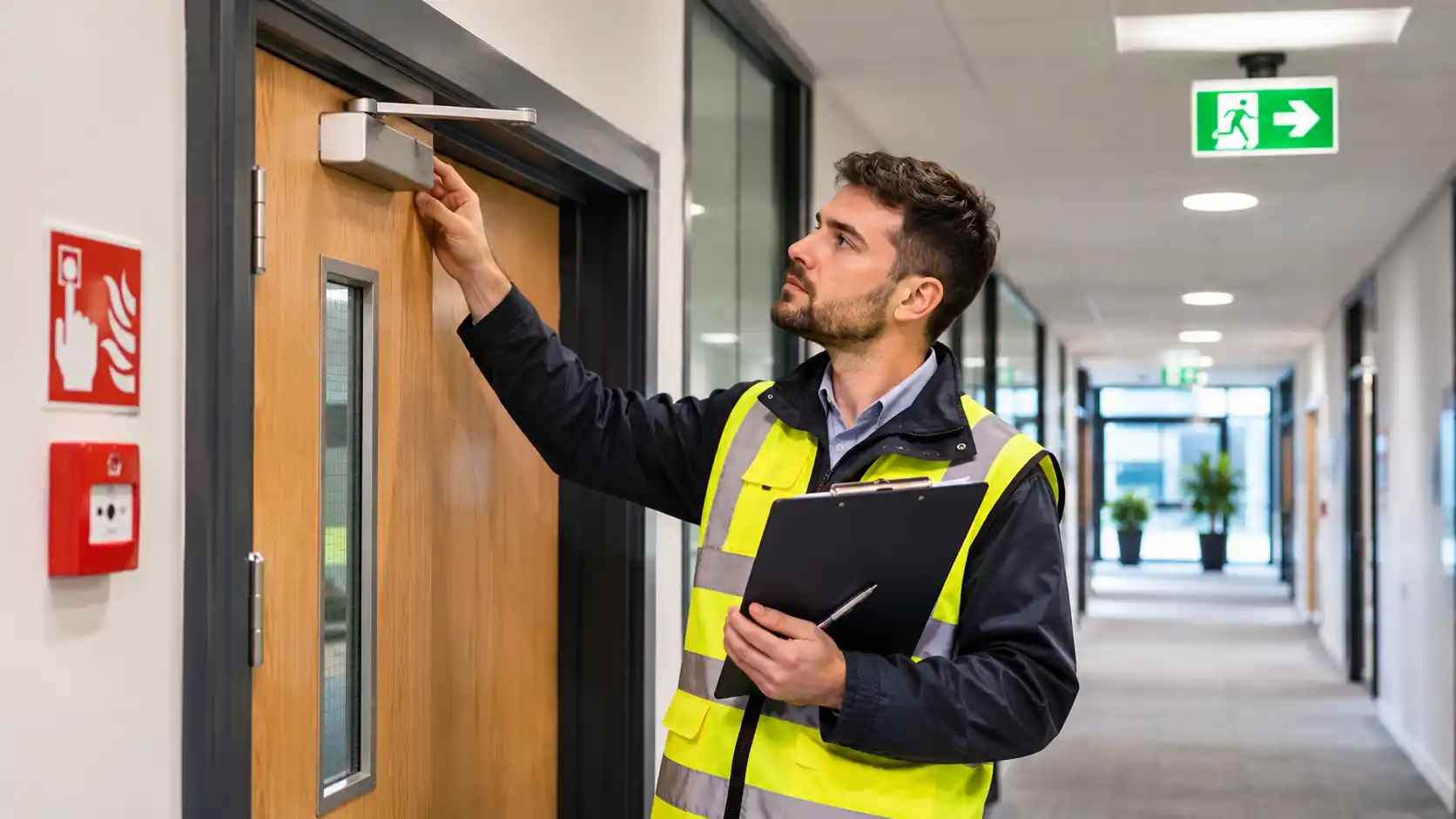
Inspect fire doors for visible damage, defective seals, missing components, damaged glazing and problems with closing mechanisms. Check whether doors are being held open inappropriately or whether alterations have affected their intended function.
Where relevant, review fire-stopping around service penetrations and identify building alterations that could have compromised fire-resisting construction. Suspected defects requiring technical assessment should be referred to a competent specialist.
Emergency Lighting and Escape Routes
Establish whether escape routes are free from obstructions, final exits can be opened as intended and signs remain visible. Review emergency lighting test records and identify damaged or non-operational fittings.
Consider whether the arrangements remain appropriate during different working periods, including night shifts and periods of reduced staffing.
Fire Extinguishers and Firefighting Equipment
Check whether equipment is suitable for the risks identified, clearly accessible, appropriately positioned and maintained. Look for visible damage, missing equipment, obstructed access and overdue servicing.
The inspection should also establish whether employees understand the limitations of firefighting equipment and know when evacuation must take priority.
Step 3: Review Testing and Maintenance Records
Documentary evidence helps establish whether fire safety controls are being managed consistently. However, records should be checked against actual workplace conditions rather than accepted as proof of effectiveness on their own.
Relevant documentation may include:
- Fire alarm testing and maintenance records.
- Emergency lighting inspection and test records.
- Fire door inspection reports.
- Fire extinguisher servicing documentation.
- Fire safety training attendance records.
- Fire evacuation drill reports.
- Fire risk assessment review records.
- Corrective action and defect registers.
- Contractor inspection and maintenance reports.
Look for repeated defects, missed inspections, incomplete records and actions that remain unresolved. These findings may indicate weaknesses in the management arrangements supporting the controls.
Step 4: Observe Workplace Practices
Some fire safety failures occur because employees do not consistently follow established procedures. Therefore, workplace observation is an important part of evaluating whether controls are working.
Observe whether combustible materials are stored safely, waste is removed appropriately, electrical equipment is used responsibly and escape routes remain unobstructed. Pay attention to contractor activities, hot work, temporary electrical installations and changes in workplace operations.
Speak with supervisors and employees to establish whether they understand reporting procedures and know how to respond when a fire safety defect is identified.
Step 5: Evaluate Employee Training and Emergency Preparedness
Employees are an important part of workplace fire safety. Even well-maintained equipment may not provide adequate protection if people do not understand the emergency arrangements.
Review whether staff have received appropriate fire safety information and instruction. Consider temporary workers, new employees, contractors and visitors where relevant.
Review evacuation drill findings to identify difficulties with alarm recognition, communication, route availability, assembly arrangements and assistance for individuals who may need additional support.
A drill should be evaluated for lessons and improvement opportunities, not simply recorded as completed.
Step 6: Compare Findings Against the Intended Performance
After gathering evidence, compare actual workplace performance with the requirements and intended purpose of each control. Consider whether it is suitable, available, maintained and consistently implemented.
For example, a fire door inspection may identify a damaged closer. The relevant question is not simply whether the door has been inspected, but whether the defect affects its ability to close correctly and what action is needed to restore its intended performance.
Step 7: Record Findings and Assign Corrective Actions
Record identified deficiencies clearly and explain why they matter. Each action should have an identified owner, a suitable completion deadline and a method of verifying that the problem has been resolved.
Significant or immediate threats to life safety require prompt action and appropriate interim precautions. Lower-priority administrative improvements can be managed through a proportionate improvement programme.
Step 8: Verify That Improvements Have Worked
Closing an action in a register does not automatically establish that the underlying problem has been resolved. Reinspect the affected area, review relevant test evidence and confirm that the improved control performs as intended.
If the same problem returns, investigate its underlying cause. Repeated defects may indicate inadequate resources, unclear responsibilities, insufficient training or ineffective maintenance arrangements.
Key Performance Indicators for Evaluating Fire Safety Controls
Fire safety performance indicators help organisations understand whether their fire safety management arrangements are improving or deteriorating. They provide measurable information that can support management reviews, maintenance planning and corrective action.
No single indicator can establish whether a workplace is adequately protected. A balanced approach should combine inspection results, system performance, employee engagement, maintenance information and corrective action monitoring.
| Performance Indicator | What to Monitor | What It Can Reveal |
|---|---|---|
| Outstanding fire safety actions | Number and risk significance of unresolved actions. | Whether identified weaknesses are being addressed. |
| Maintenance completion | Scheduled maintenance completed against the programme. | Whether systems receive appropriate maintenance. |
| Equipment faults | Reported defects, recurring faults and resolution times. | Potential weaknesses in equipment reliability. |
| Fire door defects | Inspection findings and repeated damage. | Whether passive protection is being maintained. |
| Training completion | Relevant employee training and instruction records. | Whether people receive appropriate information. |
| Evacuation drill findings | Observed problems and corrective actions. | Whether emergency arrangements are practical. |
| Fire safety incidents | Fires, near misses and recurring hazards. | Emerging weaknesses in prevention and control. |
Leading and Lagging Fire Safety Indicators
Organisations should distinguish between leading and lagging indicators when evaluating fire safety performance.
Leading Indicators
Leading indicators monitor activities intended to prevent failures. Examples include completed inspections, maintenance programme performance, employee training, hazard reporting and timely completion of corrective actions.
These indicators help management recognise potential weaknesses before a serious fire incident occurs.
Lagging Indicators
Lagging indicators examine events or failures that have already occurred. Examples include fire incidents, near misses, equipment failures, repeated defects and disruption caused by fire-related events.
These indicators provide important information about previous performance, but organisations should not rely on incident numbers alone. A workplace with no reported fires may still have serious weaknesses in its fire safety arrangements.
Professional Recommendation
Use both leading and lagging indicators. A low number of reported incidents does not prove that fire safety controls are effective. Combine incident information with inspection evidence, system reliability, employee knowledge and action completion records.
Evaluate Whether Fire Safety Controls Are Working Checklist
A structured checklist helps responsible persons and workplace managers assess whether important fire safety controls are being implemented, maintained and reviewed. It can be used during routine inspections, internal reviews and fire risk assessment follow-up activities.
The checklist below is a practical management aid. It should be adapted to the building, its activities, the people using the premises and the fire precautions identified in the relevant risk assessment.
Fire Prevention Controls
Fire Detection and Warning Systems
Passive Fire Protection
Emergency Escape Arrangements
Firefighting Equipment
Training and Emergency Preparedness
Monitoring and Corrective Actions
This is a progress indicator only, not a fire safety compliance score.
If any item cannot be verified, record the finding and establish what further inspection, testing, maintenance or management action is necessary. A completed checklist should never replace a suitable and sufficient fire risk assessment or specialist inspection where required.
For an additional reference, consult the official GOV.UK Fire Safety Risk Assessment: 5-Step Checklist .

How to Identify and Improve Weaknesses in Existing Fire Safety Controls
Identifying a fire safety weakness is only the first part of the improvement process. Organisations must understand why the control is failing, determine the level of risk and introduce measures that address the underlying problem.
Recognise Common Signs of Ineffective Fire Safety Controls
Certain findings may indicate that workplace fire safety controls are not performing as intended.
- Repeated equipment faults or unresolved maintenance issues.
- Fire doors that do not close correctly.
- Obstructed or poorly maintained escape routes.
- Missing or incomplete inspection records.
- Employees who cannot explain emergency procedures.
- Repeated housekeeping and storage problems.
- Outstanding corrective actions that remain overdue.
- Uncontrolled changes to building layouts or workplace activities.
Investigate the Root Cause of the Problem
Repeated defects should not be treated as isolated maintenance issues without further investigation. Management should establish why the problem occurred and whether other controls may be affected.
For example, a fire door repeatedly found open may not simply require another instruction to employees. The underlying cause could involve unsuitable access arrangements, poor supervision, inadequate staff awareness or an incorrectly specified door arrangement.
Correcting the underlying cause is generally more effective than repeatedly addressing the same visible symptom.
Prioritise Weaknesses According to Risk
Not every identified defect presents the same level of danger. Management should consider the potential consequences, the people who may be affected, the likelihood of exposure and the reliability of other available precautions.
A defect that could seriously compromise an escape route or an important fire protection system requires a different response from a minor record-keeping improvement.
The Fire Risk Prioritisation Guide explains how organisations can organise identified fire risks and direct attention towards the most important issues.
Develop a Corrective Action Plan
An effective action plan should explain the problem, identify the required improvement and make responsibility clear. It should also include a completion deadline and evidence needed to confirm that the action has worked.
| Identified Weakness | Recommended Improvement | Verification Evidence |
|---|---|---|
| Defective fire door closer | Arrange appropriate inspection and repair. | Post-repair inspection and functional verification. |
| Blocked escape route | Remove obstruction and improve housekeeping supervision. | Follow-up inspection and monitoring records. |
| Incomplete alarm maintenance records | Investigate the missing evidence and restore proper record control. | Verified service and maintenance documentation. |
| Employees unfamiliar with evacuation arrangements | Provide suitable instruction and practical familiarisation. | Training records and drill observations. |
| Repeated equipment faults | Investigate underlying causes and arrange specialist attention. | Technical report and evidence of successful resolution. |
Verify the Effectiveness of Corrective Actions
After an improvement has been implemented, carry out appropriate verification. This may involve a follow-up inspection, functional test, review of maintenance documentation or observation of the revised workplace procedure.
Corrective action should only be closed when there is sufficient evidence that the identified deficiency has been addressed and the control is operating as intended.
Review Fire Safety Actions After Inspections
Inspection findings should be connected to the wider fire safety management process. Review outstanding actions, check completion dates, investigate repeated defects and confirm that relevant changes have been reflected in the fire risk assessment.
This is particularly important when several departments, contractors or building occupiers are responsible for different fire safety measures.
Organisations can also refer to our guide on How to Review Fire Safety Actions After an Inspection for further information about managing inspection findings and improvement actions.
Best Practices for Ensuring Workplace Fire Safety Controls Remain Effective
Fire safety controls should be managed through a continuous process of inspection, maintenance, communication and review. Organisations should not rely on occasional checks or assume that controls will remain effective without active management.
Establish a Planned Inspection and Maintenance Programme
Develop a programme covering the relevant fire safety systems and equipment within the premises. Inspection and maintenance frequencies should be based on the equipment, applicable requirements, manufacturer instructions, relevant guidance and the findings of the fire risk assessment.
Clearly identify who is responsible for each activity, how defects should be reported and how completion evidence will be maintained.
Keep Fire Risk Assessments Under Regular Review
A fire risk assessment should reflect current workplace conditions. It should be reviewed when significant changes occur, following a relevant incident or when there is reason to believe that existing findings may no longer be valid.
Changes to occupancy, building layout, equipment, storage arrangements and working practices should be considered because they may affect the suitability of existing fire safety precautions.
Encourage Employee Participation
Employees often recognise workplace hazards because they work with the equipment and procedures every day. Encourage staff to report damaged equipment, blocked escape routes, unusual electrical conditions and other potential fire safety concerns.
Reporting arrangements should be simple, accessible and supported by appropriate management action. Employees should also receive feedback so they know that reported issues are being addressed.
Maintain Accurate Fire Safety Documentation
Effective records help organisations demonstrate what inspections have been completed, which defects have been identified and how improvements have been managed.
Maintain relevant fire risk assessments, testing records, maintenance reports, training information, drill observations and corrective action registers. Records should be accessible to the appropriate people and kept up to date.
Use Competent Professionals Where Necessary
Some fire safety evaluations require specialist technical knowledge. Examples include assessing complex alarm systems, investigating defects in passive fire protection and evaluating specialist suppression arrangements.
Organisations should ensure that people undertaking specialist inspections, maintenance or assessments have suitable competence for the work involved. The complexity and risk profile of the premises should inform the level of professional support required.
Learn From Incidents, Near Misses and Drill Findings
Every relevant fire incident, near miss, equipment failure or evacuation drill observation provides information that can help improve fire safety arrangements.
Investigate the circumstances, identify contributing factors and determine whether existing controls were appropriate. Where improvements are necessary, update procedures, communicate lessons and verify that the changes have been implemented.
Promote Continuous Improvement in Fire Safety Management
Fire safety performance should be reviewed as an ongoing management responsibility. Periodic reviews can help senior management understand recurring defects, overdue actions, maintenance performance and areas requiring additional attention.
This creates a continuous improvement cycle: identify weaknesses, introduce improvements, verify results and review whether the changes remain effective.
Important Management Principle
An effective fire safety management system does not simply record that controls have been installed or inspected. It establishes whether those controls remain suitable, operational, maintained and capable of protecting people under the actual conditions of the workplace.
Frequently Asked Questions About Evaluating Fire Safety Controls
These frequently asked questions explain how organisations can assess fire safety performance, identify weaknesses and maintain effective workplace fire precautions.
How do you evaluate whether fire safety controls are working?
Evaluate fire safety controls through physical inspections, equipment testing, maintenance record reviews, employee observations and evacuation exercises. Compare the findings with the fire risk assessment and verify that identified corrective actions have resolved the weaknesses.
How often should fire safety controls be checked?
Checking frequencies depend on the type of control, the building, the level of risk and applicable guidance. Some precautions require routine operational checks, while specialist systems require scheduled testing and maintenance. Significant changes and defects should trigger an appropriate review.
What are the signs that fire safety controls are ineffective?
Common warning signs include recurring equipment faults, damaged fire doors, obstructed escape routes, overdue maintenance, incomplete records and employees who do not understand evacuation procedures. Repeated unresolved findings may indicate weaknesses in the wider management system.
What documents are needed to evaluate fire safety controls?
Relevant documents include the fire risk assessment, alarm testing records, emergency lighting records, fire door inspection reports, equipment servicing documentation, employee training records, drill reports and corrective action registers. The documents should be checked against actual workplace conditions.
What is the difference between fire safety inspection and evaluation?
An inspection checks the condition of equipment, premises and workplace arrangements at a particular time. Evaluation goes further by examining whether the controls achieve their intended purpose using inspection findings, testing evidence, records, observations and performance information.
Which fire safety performance indicators should workplaces monitor?
Useful indicators include outstanding corrective actions, overdue maintenance, equipment faults, fire door defects, training completion, evacuation drill findings and reported fire incidents. A combination of leading and lagging indicators provides a more balanced understanding of performance.
Who is responsible for evaluating workplace fire safety controls?
Responsibility depends on the organisation, premises and applicable legal duties. In England and Wales, the responsible person has duties concerning fire risk assessment and general fire precautions. Employers, facilities managers and competent specialists may support inspections, maintenance and ongoing evaluation.
What should happen when a fire safety control fails?
The failure should be reported, assessed and addressed promptly according to its risk and significance. Appropriate interim precautions may be necessary while repairs are arranged. Once corrected, the control should be checked to confirm that it is working as intended.
Can a workplace have a fire risk assessment and still have ineffective controls?
Yes. A fire risk assessment identifies hazards and evaluates the precautions needed, but equipment may deteriorate and workplace conditions can change. Organisations must maintain and review controls to ensure that the assessment remains relevant and the precautions continue to provide appropriate protection.
Conclusion: Making Fire Safety Controls More Effective
Knowing how to evaluate whether fire safety controls are working is fundamental to effective workplace fire risk management. Organisations must look beyond the presence of equipment and documentation to establish whether their preventive, protective and emergency arrangements perform their intended functions.
Physical inspections, appropriate testing, maintenance records, employee feedback, evacuation exercises and performance indicators all contribute to a more reliable evaluation process. When weaknesses are identified, management should investigate their causes, prioritise improvements, assign responsibilities and verify that corrective actions have worked.
A consistent approach helps employers, responsible persons and fire safety managers maintain suitable precautions as workplace conditions change. Most importantly, it supports arrangements designed to protect employees, visitors, contractors and everyone who may be affected by a workplace fire.
Strengthen Your Fire Safety Knowledge
Explore professional fire safety and risk assessment qualifications designed to develop knowledge of workplace hazards, fire prevention, risk evaluation and effective control measures.
Explore Fire Safety QualificationsOfficial Fire Safety Guidance and Further Reading
The following official resources provide additional information about workplace fire risk assessment, fire precautions and the review of fire safety arrangements.