
Types of Fire Extinguishers: Uses, Classes and Safety Considerations
Understand the different types of fire extinguishers, their applications, fire classifications, colour identification and essential safety considerations for selecting suitable firefighting equipment in UK workplaces and commercial environments.
Fire extinguishers are an important part of workplace fire protection, helping trained individuals respond to certain small fires before they develop into more serious incidents. However, not every extinguisher is suitable for every type of fire. The burning material, surrounding environment, electrical hazards and properties of the extinguishing agent all influence whether a particular extinguisher is appropriate.
Understanding the types of fire extinguishers is essential for employers, facilities managers, fire marshals, safety officers and anyone involved in workplace fire prevention. Selecting unsuitable equipment can increase danger, spread burning materials, expose people to electrical hazards or create additional risks during an emergency.
In the UK, fire extinguishers are commonly identified by their extinguishing agent, including water, foam, carbon dioxide (CO2), dry powder and wet chemical. Each has different capabilities and limitations. Specialist equipment, including water mist and metal-fire extinguishers, may also be necessary for particular environments.
This guide explains the main fire extinguisher types, UK fire classes, applications, identification colours, selection considerations, workplace responsibilities and inspection requirements. It also explains when attempting to extinguish a fire is unsafe and why evacuation must always take priority over protecting property.
Quick Answer: What Are the Main Types of Fire Extinguishers?
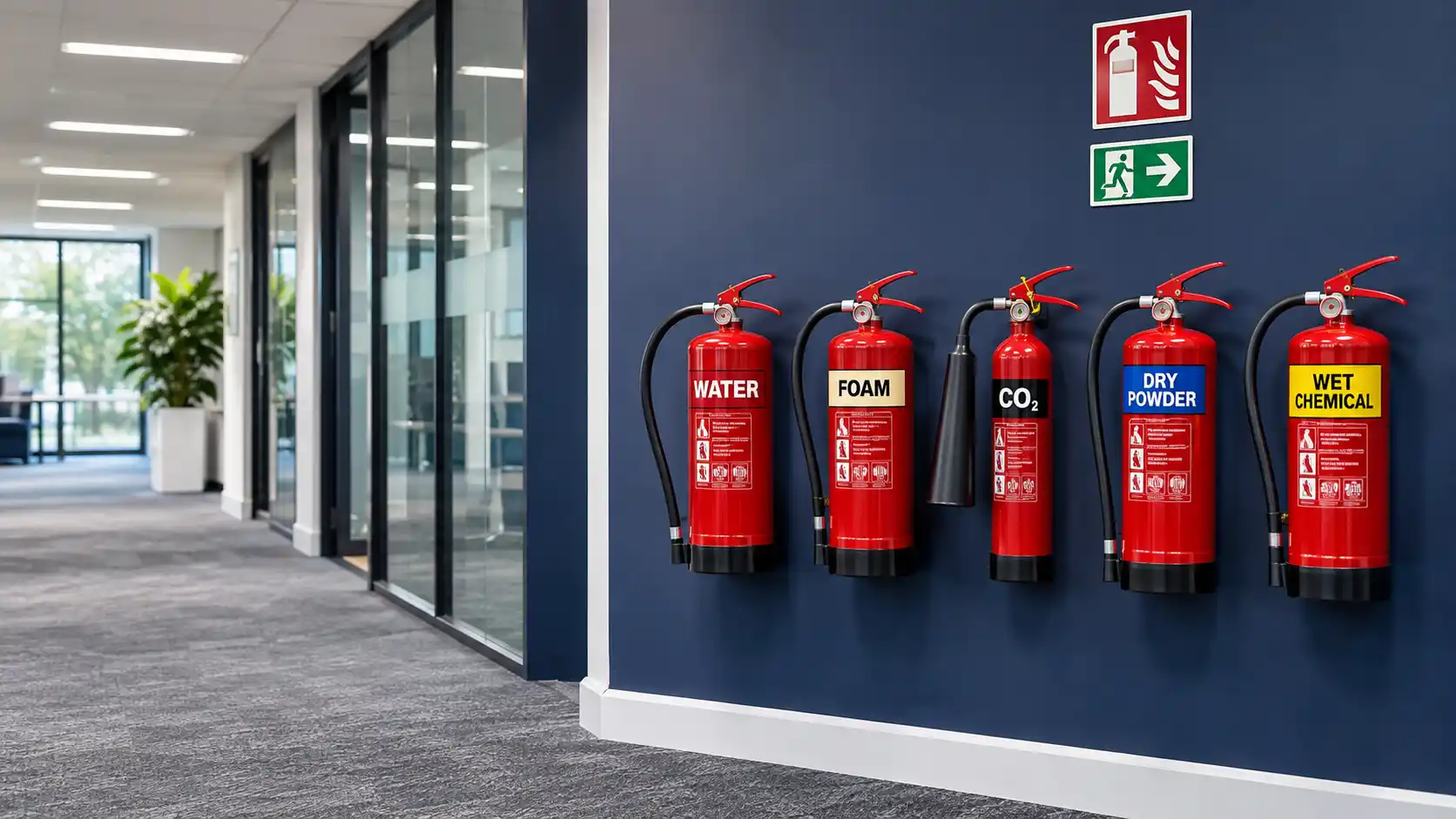
The five commonly encountered portable fire extinguisher types in UK workplaces are water, foam, carbon dioxide (CO2), dry powder and wet chemical. They are designed for different fire hazards, including combustible solids, flammable liquids, flammable gases, combustible metals and cooking oils.
The correct extinguisher must be selected according to the fire risk assessment, the product’s certified fire rating, its instructions and the conditions in which it will be used.
Why Does Correct Fire Extinguisher Selection Matter?
Correct fire extinguisher selection matters because different combustible materials respond differently to extinguishing agents. An agent that effectively cools burning paper may be dangerous when applied to burning cooking oil or live electrical equipment.
Fire extinguishers work through mechanisms such as cooling, smothering, oxygen displacement and interruption of the chemical combustion reaction. Their effectiveness depends on the characteristics of the fire and the agent’s ability to control it without creating additional hazards.
Preventing Fire Escalation
A suitable extinguisher may help control an early-stage fire when the fire is small, the correct equipment is immediately available and a trained person can operate it safely. Early intervention can limit damage to equipment, materials and workplace infrastructure.
However, portable extinguishers are not substitutes for fire alarms, evacuation arrangements, automatic suppression systems or emergency services. Their purpose is to provide an additional protective measure within a properly planned fire safety strategy.
Protecting People and Property
Selecting suitable fire safety equipment helps reduce unnecessary exposure to flames, smoke, hazardous discharge materials and electrical risks. It can also protect important business assets, machinery, information technology equipment and operational facilities.
Supporting Workplace Fire Safety Compliance
Employers and other responsible persons must consider the need for appropriate firefighting equipment when managing workplace fire risks. Equipment should reflect the nature of the premises, the activities performed, the substances present and the people who may be affected.
In England and Wales, Article 13 of the Regulatory Reform (Fire Safety) Order 2005 addresses appropriate firefighting equipment, accessibility, ease of use and signage. The legislation requires equipment provision to be determined according to relevant premises and hazard conditions.
Read the Regulatory Reform (Fire Safety) Order 2005, Article 13 for the legal requirements.
What Are the Different Types of Fire Extinguishers?
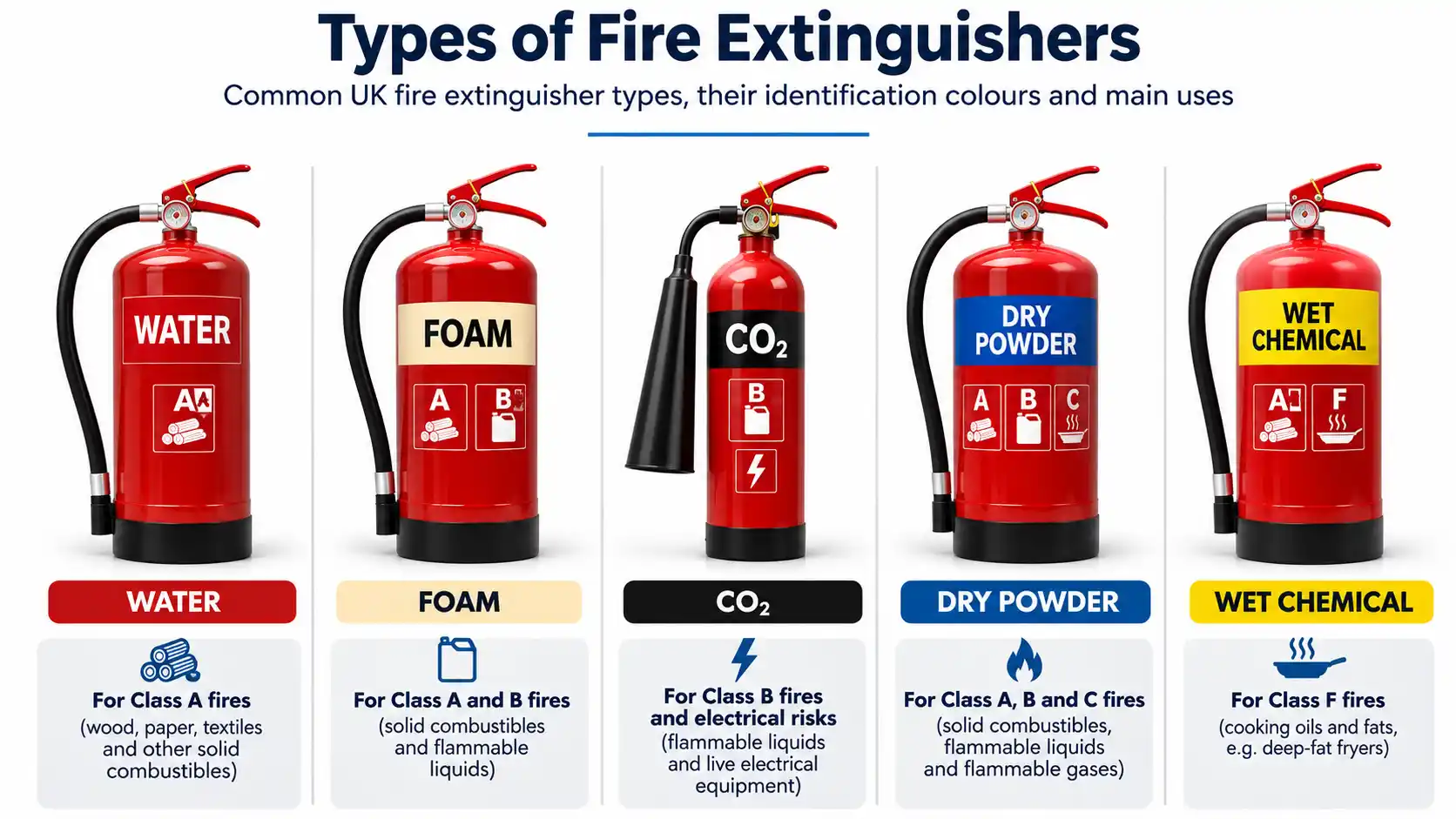
Fire extinguishers are manufactured with different extinguishing agents to address specific fire hazards. Their identification colours help users recognise the general agent contained inside, while the label provides the important information about suitability and limitations.
Modern portable extinguishers generally have red bodies with a contrasting identification colour on the label or band. Users should never select an extinguisher based on colour alone. The manufacturer’s instructions, fire rating and electrical warnings must also be checked.
Water Fire Extinguishers – Red
Water fire extinguishers are primarily designed for Class A fires involving ordinary combustible solid materials. These include wood, paper, cardboard, textiles and other suitable solid fuels.
Water works mainly through cooling. When discharged onto an appropriate burning material, it absorbs heat and reduces the temperature below the level required to sustain combustion.
Suitable Applications
- Paper and cardboard storage areas.
- Offices containing ordinary combustible materials.
- Educational buildings and suitable commercial premises.
- Warehouses storing suitable solid combustible products.
- Areas where a Class A fire risk has been identified.
Limitations and Safety Considerations
Standard water extinguishers must not be used on live electrical equipment, flammable liquid fires, flammable gases, combustible metals or cooking oils and fats. Water can conduct electricity and can violently spread burning cooking oil.
Water-based specialist products, including certain water mist extinguishers, may have additional tested applications. These must never be assumed to have the same capabilities as standard water extinguishers.
Foam Fire Extinguishers – Cream
Foam fire extinguishers are commonly designed for Class A and Class B fires, subject to their individual ratings. They contain a water-based solution that produces foam when discharged.
On suitable solid materials, the water content helps cool the burning fuel. On appropriate flammable liquid fires, the foam can create a covering over the liquid surface, restricting contact between the fuel and oxygen while helping to suppress flammable vapours.
Suitable Applications
- Suitable wood, paper and textile fires.
- Approved flammable liquid storage areas.
- Workshops containing suitable liquid fuel hazards.
- Commercial premises where both Class A and B risks exist.
Limitations and Safety Considerations
Conventional foam extinguishers should not be used on live electrical equipment unless the specific product is expressly approved for the relevant electrical application and its instructions are followed. They are not suitable for cooking oil fires, flammable metal fires or gas fires.
Different foam formulations have different properties. Environmental considerations, including restrictions affecting certain fluorinated foam formulations, should also be considered when specifying or replacing equipment.
Carbon Dioxide (CO2) Fire Extinguishers – Black
Carbon dioxide fire extinguishers contain pressurised CO2 gas and are commonly used for suitable Class B fires and fires involving live electrical equipment.
Carbon dioxide helps extinguish flames by reducing the local oxygen concentration around the fire. Its discharge is non-residue-producing, making it useful in areas containing sensitive electrical and electronic equipment.
Suitable Applications
- Suitable flammable liquid fires.
- Computer and server rooms with appropriate fire risks.
- Electrical control panels and equipment.
- Workplaces containing sensitive electronic equipment.
- Selected laboratories and technical environments.
Limitations and Safety Considerations
CO2 extinguishers provide limited cooling of solid combustible materials. Consequently, a fire may reignite after the gas disperses if hot material remains.
They must not be treated as suitable extinguishers for deep-fat fryers or cooking oil fires. CO2 can also create an asphyxiation hazard in confined or poorly ventilated spaces.
The discharge horn and other components can become extremely cold. Users must hold the extinguisher only by the designated insulated handle and follow the manufacturer’s operating instructions.
Dry Powder Fire Extinguishers – Blue
Dry powder extinguishers contain a specially formulated chemical powder that helps interrupt the combustion process. Their applications depend on the powder formulation and the manufacturer’s approved fire ratings.
Standard ABC powder extinguishers are designed for suitable Class A, Class B and Class C fires. Some products are also approved for use around certain electrical equipment, subject to their label and operating restrictions.
Suitable Applications
- Suitable combustible solid fires.
- Approved flammable liquid fires.
- Suitable flammable gas fires.
- Some outdoor industrial and commercial applications.
- Selected vehicle, workshop and engineering environments.
Limitations and Safety Considerations
Dry powder can reduce visibility, irritate the respiratory system and contaminate machinery, electrical equipment and sensitive components. It is generally unsuitable for enclosed spaces where the discharged powder could create additional risks for occupants.
Powder extinguishers also provide limited cooling, so materials may reignite after the initial flames are suppressed. Standard ABC powder is not suitable for Class F cooking oil fires.
Specialist Dry Powder Extinguishers
Certain industrial environments require specialist Class D extinguishers for combustible metals such as magnesium, sodium, potassium and particular forms of aluminium or titanium.
Metal-fire extinguishing agents must be selected for the specific material. A powder designed for one metal cannot automatically be assumed suitable for another.
Wet Chemical Fire Extinguishers – Yellow
Wet chemical fire extinguishers are primarily designed for Class F fires involving cooking oils and fats. They are especially relevant to commercial kitchens, restaurants, catering facilities and food preparation environments.
The extinguishing agent is discharged as a controlled spray. It helps cool the burning cooking material and produces a surface layer through a chemical process that suppresses the fire and reduces the possibility of reignition.
Suitable Applications
- Commercial deep-fat fryers.
- Restaurant and hotel kitchens.
- Commercial catering equipment.
- Food preparation facilities.
- Other identified cooking oil and fat fire risks.
Limitations and Safety Considerations
Wet chemical extinguishers should not be treated as general-purpose equipment for every fire. Their suitability for Class A materials depends on the individual product’s rating.
They must not be used outside their stated applications. Staff should receive appropriate training in their use, especially when commercial cooking appliances and hot oil are involved.
Water Mist Fire Extinguishers
Water mist extinguishers use a specialised nozzle to release very fine water droplets. The resulting mist helps absorb heat and can reduce the temperature of burning materials.
Some specialist water mist products are tested for multiple fire classes, and their design may offer advantages in particular environments. However, their suitability depends entirely on the manufacturer’s certification and stated applications.
Water mist should not automatically be considered safe for electrical, metal or cooking oil fires. Check the actual product rating and operating instructions before specifying it.
Understanding UK Fire Classes
Fire classes identify fires according to the type of material that is burning. Understanding these classifications is essential when selecting fire extinguishers and developing workplace fire protection arrangements.
The UK classification system recognises Classes A, B, C, D and F. Electrical equipment is considered a separate hazard when determining extinguisher suitability, rather than a separate lettered fire class in the UK system.
Class A – Solid Combustible Materials
Class A fires involve ordinary solid combustible materials, generally of an organic nature. Examples include wood, paper, cardboard, fabric and certain plastics.
Water and suitable foam extinguishers are commonly used for these fires. The selected equipment must have an appropriate Class A rating.
Class B – Flammable Liquids
Class B fires involve flammable liquids such as petrol, solvents, certain paints and other combustible liquid products.
Suitable foam, CO2 and appropriately rated dry powder extinguishers may be used, depending on the nature of the liquid and the surrounding conditions.
Class C – Flammable Gases
Class C fires involve flammable gases such as propane, butane and methane. These materials can create particularly serious hazards because escaping gas may continue feeding a fire.
Suitable dry powder equipment may be provided for identified gas fire risks. However, extinguishing the visible flame without stopping the gas supply can create an explosive atmosphere. The gas supply must only be isolated when it is safe and appropriate to do so.
Class D – Combustible Metals
Class D fires involve combustible metals, including certain forms of magnesium, sodium, potassium, titanium and aluminium.
These fires require specialist extinguishing agents selected according to the metal involved. Conventional water, foam and general-purpose powder extinguishers may be ineffective or dangerous.
Class F – Cooking Oils and Fats
Class F fires involve cooking oils and fats, particularly those used in commercial deep-fat fryers and food preparation equipment.
Wet chemical extinguishers are specifically designed for these risks. Standard water extinguishers must never be used on burning cooking oil because the water can cause violent splashing and spread burning oil.
Electrical Equipment Fires – A Separate Hazard Consideration
Fires involving live electrical equipment require additional care because of the possibility of electric shock and equipment damage. Electrical equipment does not form a separate lettered fire class in the UK classification system.
CO2 extinguishers are commonly selected for suitable live electrical equipment fires. Certain dry powder extinguishers may also be approved for specific electrical applications. The relevant voltage limits and safety distance must be confirmed from the product label.
If it is safe to do so, electrical power should be isolated by an appropriate competent person. Once the electrical equipment is no longer energised, the underlying burning material determines the relevant fire class.
Fire Extinguisher Types and Uses: Comparison Table
The following table provides a practical overview of common UK extinguisher types, their identification colours and typical applications. It is an introductory reference, not a substitute for the specific manufacturer’s instructions or a competent assessment of the premises.
| Extinguisher Type | Identification Colour | Typical Applications | Important Limitations |
|---|---|---|---|
| Water | Red | Class A | Not for live electrical, liquid, gas, metal or Class F fires. |
| Foam | Cream | Class A and B, where rated | Not for Class F, metal or gas fires; conventional units are not for live electrical equipment. |
| CO2 | Black | Class B and suitable electrical risks | Not for Class A, D or F; confined-space asphyxiation risk. |
| Dry Powder | Blue | ABC powder: Classes A, B and C | Not for Class F; specialist metal powder is a separate product. Generally unsuitable for enclosed spaces. |
| Wet Chemical | Yellow | Class F and Class A where rated | Not a general-purpose extinguisher; follow product restrictions. |
| Water Mist | Product-specific | Depends on tested product ratings | Never assume multi-class suitability without checking certification and instructions. |
| Specialist Class D Powder | Product-specific | Specific combustible metal fires | Agent must be compatible with the particular metal. |
How to Choose the Right Fire Extinguisher
Choosing the correct fire extinguisher requires a structured assessment of workplace hazards, activities, materials and environmental conditions. The most suitable extinguisher is not necessarily the one with the widest advertised range of applications. It is the one that safely addresses the actual fire risks identified within the premises.
Identify Potential Fire Hazards
Start by identifying materials that could catch fire and the activities that may introduce ignition sources. This includes combustible materials, flammable liquids, gas cylinders, cooking equipment, electrical installations, machinery and hot work operations.
Determine the Applicable Fire Classes
Assess which fire classes are relevant to each area. A warehouse may have substantial Class A risks, while a commercial kitchen may have Class F hazards. An engineering workshop could contain flammable liquids, compressed gases and specialist combustible metal risks.
Assess the Operating Environment
Consider whether extinguishers will be used indoors or outdoors, in confined spaces, near electrical equipment or in areas containing sensitive machinery. Environmental conditions can influence the suitability of particular extinguishing agents.
Check Extinguisher Ratings and Certification
Fire extinguishers should be selected using their actual tested performance ratings and product instructions. For example, a Class A rating may include a numerical performance designation, while a Class B rating indicates tested liquid-fire capability.
Do not assume that two extinguishers of the same agent type and capacity have identical performance. Compare the certified ratings, operating instructions and relevant product standards.
Consider the People Who May Use the Equipment
The weight, operating method, accessibility and physical requirements of extinguishers should be considered. Employees must not be expected to operate equipment that is beyond their competence or physical capability.
Establish Suitable Locations
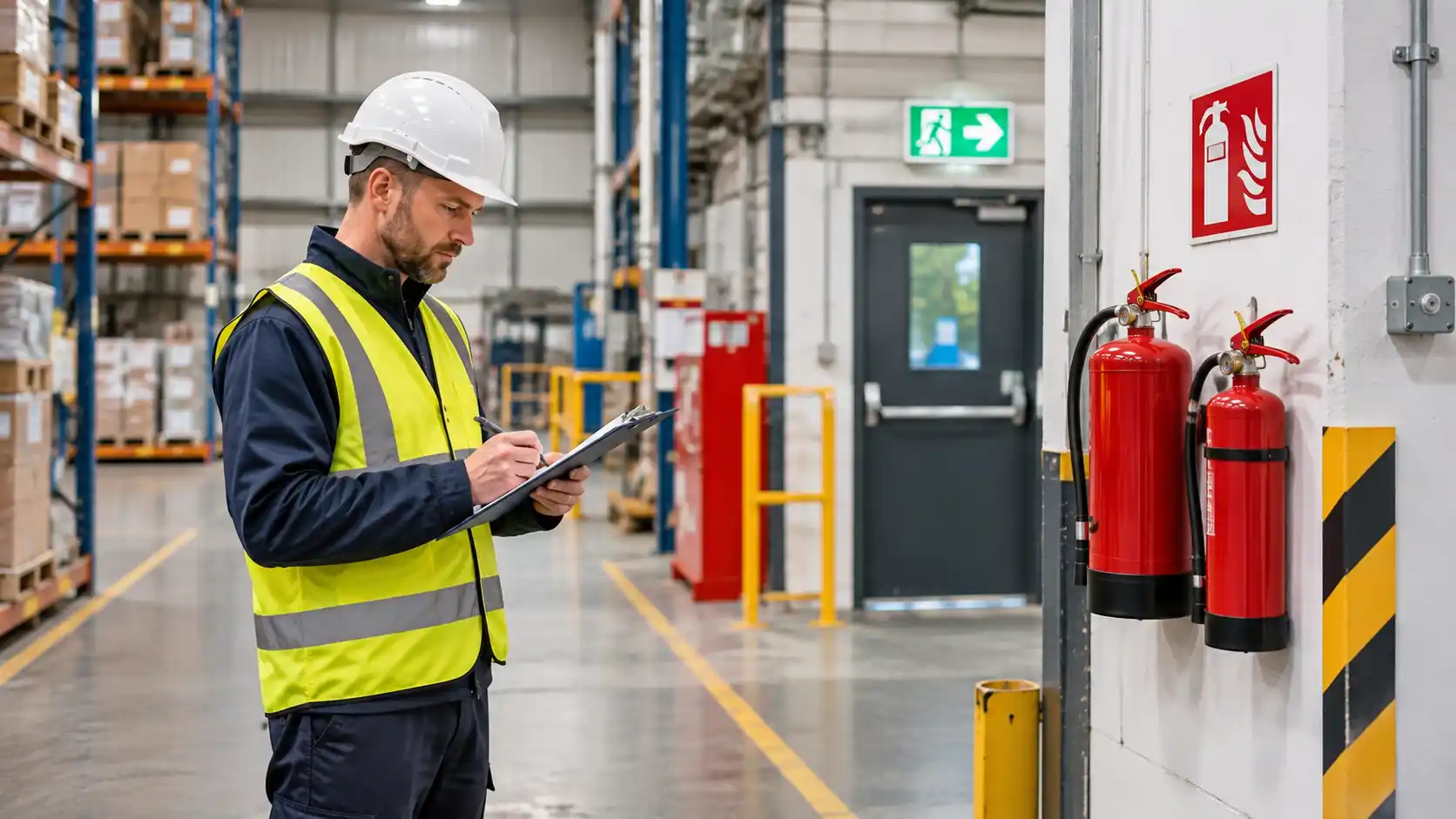
Extinguishers should be visible, accessible and positioned where they can be approached without exposing users to unnecessary danger. Equipment must not obstruct emergency exits or reduce the effective width of escape routes.
The position should also reflect the location of the relevant hazard. A specialist extinguisher for a particular process may need to be accessible near that process, but not positioned where a user would have to approach the fire to retrieve it.
Effective workplace fire safety requires trained personnel who can recognise fire hazards, monitor potential ignition sources and respond appropriately to fire emergencies. Develop these essential skills through the ICTQual Level 3 Award in Fire Watcher, covering fire prevention, hot work monitoring and emergency response procedures.Fire Extinguisher Applications Across Different Workplaces
Different working environments present different combinations of combustible materials, ignition sources and operational hazards. Fire extinguisher arrangements should therefore be developed for the actual activities taking place in each location.
Office Buildings
Offices commonly contain paper, furniture, textiles, electrical equipment and computer systems. These materials may create Class A fire risks alongside hazards involving electrical equipment.
Suitable water-based equipment may be selected for ordinary combustible materials, while CO2 extinguishers may be considered for appropriate electrical risks. The final arrangement must reflect the fire risk assessment and equipment specifications.
Commercial Kitchens and Restaurants
Commercial kitchens can involve hot cooking oils, deep-fat fryers, gas appliances, electrical equipment and combustible packaging. These hazards require careful separation and assessment.
Wet chemical extinguishers are particularly relevant to Class F risks. Other suitable extinguishers may also be required for different hazards within the kitchen and surrounding premises.
Industrial Facilities and Manufacturing Units
Manufacturing facilities may contain combustible materials, flammable liquids, compressed gases, hot machinery and specialist metal-processing operations. The extinguisher selection should reflect each process and the specific substances involved.
In facilities that process combustible metals, specialist Class D equipment may be necessary. General-purpose extinguishers should not be assumed suitable for these operations.
Warehouses and Storage Facilities
Warehouses often contain cardboard, packaging, wooden pallets, textiles and stored goods. These materials may create significant Class A fire loads.
Storage of flammable liquids, aerosols, gases or specialist products can introduce additional hazards. Fire extinguisher provision should be coordinated with storage arrangements, fire detection, compartmentation and emergency access.
Workshops and Maintenance Areas
Workshops may involve welding, grinding, cutting, fuel storage, solvents, machinery and electrical equipment. Hot work activities require particular attention because sparks and hot surfaces can ignite nearby combustible materials.
Suitable firefighting equipment should be determined through the risk assessment and the specific hot work control arrangements. More information is available in our guide on managing fire risks during building maintenance work .
When Should You Not Attempt to Fight a Fire?
Fire extinguishers are intended for appropriate early-stage incidents. They should never be used as a reason to delay evacuation, expose people to smoke or approach a fire that is spreading.
The priority during a fire emergency is always life safety. Raising the alarm, warning others, evacuating and contacting the fire and rescue service take precedence over protecting property.
When the Fire Is Spreading
A fire that is increasing in size, producing substantial smoke or spreading beyond its original material is not an appropriate situation for an ordinary workplace extinguisher attempt. Leave immediately and follow the emergency evacuation plan.
When Escape Routes Are Threatened
Never attempt to extinguish a fire if doing so could trap you between the fire and your exit. Anyone considering using an extinguisher must have a clear and safe escape route behind them.
When Toxic Smoke or Dangerous Conditions Exist
Smoke may contain toxic gases, irritating particles and other hazardous combustion products. Reduced visibility and poor air quality can make even a relatively small fire dangerous.
When the Correct Extinguisher Is Unavailable
Do not experiment with an unsuitable extinguisher. Using the wrong extinguishing agent can spread burning material, create electrical hazards or intensify a chemical reaction.
When the User Has Not Received Appropriate Training
Employees without appropriate training should not be expected to undertake firefighting. Workplace emergency procedures should explain when evacuation is required and identify whether any designated personnel have a limited firefighting role.
How to Use a Fire Extinguisher Safely
Operating procedures differ between extinguisher types. The manufacturer’s instructions and practical training should always take priority over general operating mnemonics.
The PASS method is commonly used as a basic reminder for many portable extinguishers. It represents Pull, Aim, Squeeze and Sweep. However, not every extinguisher uses an identical application technique.
Pull – Release the Safety Pin
For applicable extinguisher designs, remove the safety pin or tamper-protection device according to the manufacturer’s instructions. This prepares the extinguisher for operation.
Aim – Direct the Discharge Correctly
Direct the extinguishing agent towards the appropriate part of the fire, following the equipment instructions and the technique taught during training. For many conventional extinguishers this involves directing the discharge towards the base of the flames.
Squeeze – Operate the Handle
Operate the handle or control mechanism as instructed. Maintain awareness of the discharge direction and the remaining escape route.
Sweep – Apply the Agent as Trained
Where appropriate for the extinguisher type, use a controlled sweeping movement to cover the affected burning material. Foam and wet chemical extinguishers may require different application techniques to avoid disturbing burning liquid or hot cooking oil.
If the fire does not respond immediately, the extinguisher becomes ineffective or conditions deteriorate, stop the attempt and evacuate. Never return to a fire to retrieve equipment or check whether it has reignited.
Fire Extinguisher Inspection and Maintenance
Fire extinguishers must remain in serviceable condition to perform effectively during an emergency. A damaged, discharged, obstructed or incorrectly positioned extinguisher may not provide the intended protection.
Inspection and maintenance arrangements should follow the relevant product instructions, applicable standards and the recommendations of a competent service provider.
Routine Visual Checks
Regular workplace checks should confirm that extinguishers remain accessible, identifiable and apparently serviceable. Depending on the equipment and premises, checks may include:
- Confirming that the extinguisher is in its designated position.
- Checking that access is not blocked by furniture or stored goods.
- Inspecting the cylinder for visible damage or corrosion.
- Checking the safety pin and tamper seal.
- Examining the hose, nozzle and other visible components.
- Checking pressure indicators where fitted.
- Confirming that the operating instructions remain legible.
- Checking that inspection and maintenance records are available.
Professional Servicing
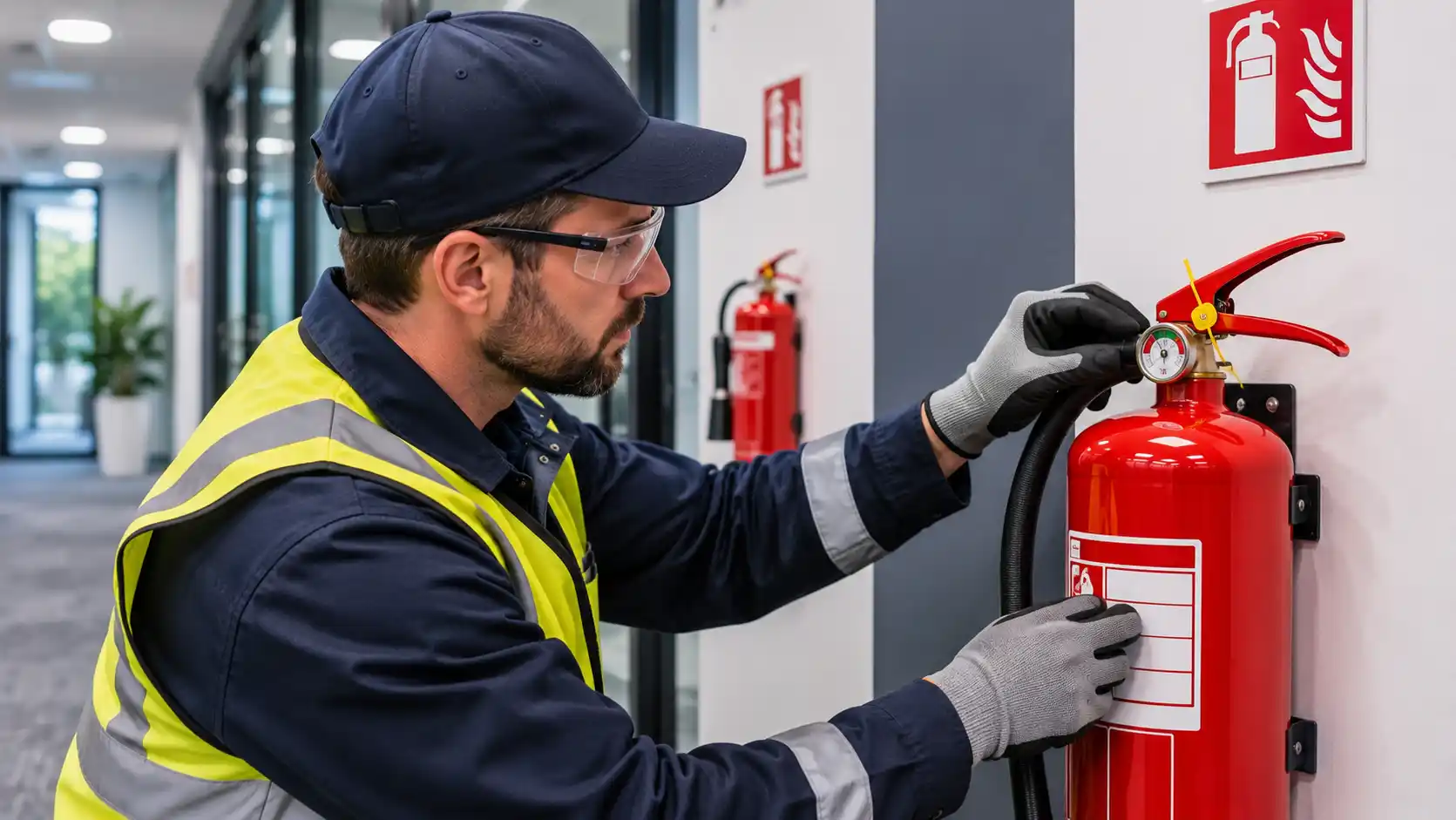
Portable extinguishers require periodic maintenance by a competent person. The UK government workplace fire risk assessment guidance identifies annual maintenance by a competent person as the normal arrangement for portable fire extinguishers.
The applicable maintenance standard is BS 5306-3, while BS 5306-8 provides guidance on selecting and installing portable extinguishers. Product-specific requirements and current editions should be checked with a competent fire protection specialist.
After an Extinguisher Has Been Used
A discharged extinguisher must not simply be returned to its normal position and assumed ready for another emergency. Even a partial discharge can affect its operational reliability.
Arrange the appropriate inspection, servicing, recharging or replacement before the equipment is returned to service. Update relevant records and review whether the incident indicates a need to improve the existing fire risk assessment.
Workplace Fire Extinguisher Inspection Checklist
- Correct extinguisher type provided for identified hazards.
- Equipment accessible and clearly visible.
- Identification labels and operating instructions readable.
- Safety pins and tamper seals intact.
- No visible damage, leakage or corrosion.
- Pressure indicators checked where applicable.
- Maintenance records kept up to date.
- Used or damaged extinguishers reported promptly.
- Staff know the emergency evacuation procedure.
- Training arrangements reviewed when workplace risks change.
UK Fire Safety Legislation and Extinguisher Responsibilities
Fire extinguisher provision in the UK is connected to wider fire safety responsibilities. The legal requirements depend on the jurisdiction, type of premises, activities undertaken and hazards identified.
Regulatory Reform (Fire Safety) Order 2005
In England and Wales, the Regulatory Reform (Fire Safety) Order 2005 establishes duties for responsible persons in relevant non-domestic premises.
Article 13 addresses firefighting and fire detection. It requires appropriate firefighting equipment where necessary to safeguard relevant persons, with equipment that is accessible, simple to use and properly indicated.
The assessment of appropriate equipment considers the premises, activities, substances present and the number of people who may be present.
Fire Safety Act 2021
The Fire Safety Act 2021 clarifies the scope of the Fire Safety Order in relation to certain parts of multi-occupied residential buildings, including external walls and flat entrance doors. It is relevant to understanding the wider responsibilities involved in managing fire safety in buildings.
Fire Safety (England) Regulations 2022
These regulations introduce additional fire safety requirements for specified residential buildings in England. Their provisions include duties relating to information, fire safety instructions and other building-specific measures.
Scotland and Northern Ireland
Scotland and Northern Ireland have their own fire safety legislation and enforcement arrangements. Businesses operating across the UK should identify the applicable requirements in each jurisdiction rather than assuming that the same legislation applies everywhere.
For additional guidance, consult the official UK workplace fire safety responsibilities guidance and the relevant jurisdiction-specific authorities.
Who Is Responsible for Fire Extinguisher Provision?
Depending on the premises and circumstances, the responsible person may be an employer, building owner, landlord, occupier or another individual or organisation with control of the premises.
Their responsibilities include carrying out and reviewing fire risk assessments, implementing appropriate fire precautions, maintaining relevant equipment and providing staff with necessary information, instruction and training.
Why Fire Safety Training Is Important
Providing suitable fire extinguishers is only one part of an effective workplace fire protection strategy. Employees also need to understand fire hazards, warning arrangements, evacuation procedures and the limitations of firefighting equipment.
Appropriate fire safety training helps people recognise potential hazards, report unsafe conditions and respond correctly when an emergency occurs. It also supports responsible persons in establishing consistent workplace fire safety arrangements.
Developing Fire Safety Awareness
General fire safety awareness helps employees understand how fires start, how they spread and which precautions reduce the likelihood of an incident. It should include the importance of housekeeping, safe electrical practices, ignition-source control and emergency reporting.
Fire Marshal and Fire Warden Responsibilities
Designated fire marshals and fire wardens may have additional duties under the organisation’s emergency arrangements. Depending on the premises and risk assessment, these responsibilities may include supporting evacuation, communicating emergency information, identifying hazards and assisting with workplace fire safety checks.
They should understand the limits of their responsibilities and must never be expected to undertake unsafe firefighting activities.
Professional Fire Risk Assessment Knowledge
Individuals involved in assessing and managing workplace fire risks need a broader understanding of fire hazards, protective measures, equipment selection, emergency arrangements and compliance responsibilities.
Structured professional learning can help develop this knowledge. Explore the ICTQual AB Level 3 Certificate in Fire Safety Risk Assessment and Control for learning focused on fire hazards, risk assessment and control measures.
Individuals seeking wider fire safety knowledge can also explore the ICTQual AB Level 3 Certificate in Fire Safety Awareness .
For specialist professional development, the fire safety and risk assessment qualifications directory provides access to different learning pathways and awarding organisations.
Common Mistakes When Selecting Fire Extinguishers
Incorrect equipment selection and poor maintenance can undermine workplace fire protection. Understanding common mistakes helps organisations improve their equipment arrangements and emergency preparedness.
Choosing Equipment Based on Colour Alone
Identification colours provide a useful visual reference, but they do not communicate every operational restriction. Users must examine the complete label, fire ratings and manufacturer instructions.
Assuming One Extinguisher Works on Every Fire
Different extinguishing agents have different capabilities. A multi-purpose extinguisher may cover several fire classes, but it does not automatically address every hazard present in a workplace.
Ignoring Specialist Fire Risks
Industrial operations involving combustible metals, commercial cooking oils or particular chemical substances may require specialist equipment. General-purpose extinguishers should not be substituted without competent technical assessment.
Positioning Equipment Inappropriately
Extinguishers that are hidden, obstructed or positioned too close to hazardous activities may be difficult or unsafe to access during an emergency. Positioning should reflect the fire risk assessment and evacuation arrangements.
Neglecting Inspection and Servicing
Equipment can deteriorate through corrosion, physical damage, accidental discharge and environmental exposure. Regular checks and competent maintenance are essential for maintaining serviceability.
Failing to Train Employees
Employees may misunderstand extinguisher limitations or delay evacuation because they believe they must fight a fire. Clear instructions and appropriate training help prevent this mistake.
Frequently Asked Questions About Types of Fire Extinguishers
What are the five main types of fire extinguishers?
The five commonly used portable fire extinguisher types in UK workplaces are water, foam, carbon dioxide (CO2), dry powder and wet chemical. Each is designed for particular fire hazards and has specific operating limitations.
Which fire extinguisher is suitable for electrical fires?
CO2 extinguishers are commonly selected for suitable fires involving live electrical equipment. Some dry powder products may also be suitable. Always check the electrical rating, voltage restrictions and manufacturer’s instructions.
Which extinguisher is used for Class A fires?
Water extinguishers are commonly used for Class A fires involving materials such as wood, paper, cardboard and textiles. Suitable foam, dry powder and other specialist products may also have Class A ratings.
Which fire extinguisher is used for cooking oil fires?
Wet chemical extinguishers are specifically designed for Class F fires involving cooking oils and fats. Standard water, foam and CO2 extinguishers should not be used as substitutes for appropriate Class F equipment.
What colour is a CO2 fire extinguisher?
CO2 fire extinguishers are identified by a black label or colour band. Modern UK portable extinguishers generally have red bodies with an identification colour indicating the extinguishing agent.
What colour is a dry powder fire extinguisher?
Dry powder fire extinguishers use a blue identification colour. Standard ABC powder and specialist metal-fire powders have different applications, so the complete product label should always be checked.
What are the six classes of fire in the UK?
The UK system has five lettered fire classes: A, B, C, D and F. Electrical equipment fires are treated as an additional hazard consideration rather than a separate lettered fire class.
Can a water extinguisher be used on an electrical fire?
Standard water extinguishers must not be used on live electrical equipment because of the risk of electric shock. Use only equipment specifically suitable for the electrical hazard and follow the manufacturer’s instructions.
Why are dry powder extinguishers unsuitable for some enclosed spaces?
Discharged powder can reduce visibility, irritate the respiratory system and make evacuation more difficult. It can also contaminate sensitive equipment. These limitations make standard powder extinguishers generally unsuitable for enclosed spaces.
How often should fire extinguishers be inspected?
Extinguishers should receive regular visual checks under the organisation’s inspection arrangements and periodic professional maintenance by a competent person. Annual maintenance is the normal arrangement described in UK workplace fire risk assessment guidance, subject to the applicable product and maintenance requirements.
Are fire extinguishers compulsory in every UK workplace?
The requirement is risk-based rather than a universal rule that every workplace must have an identical number and type of extinguishers. Appropriate firefighting equipment must be considered and provided where necessary under the applicable fire safety legislation.
Can one fire extinguisher cover multiple fire classes?
Yes. Certain extinguishers, including suitable ABC dry powder products, are designed for more than one fire class. However, multi-class suitability does not mean the extinguisher is appropriate for every environment or every type of fire.
What should you do if a fire extinguisher does not put out a fire?
Stop the attempt, leave the area, raise the alarm and evacuate. Contact the fire and rescue service by calling 999. Never remain in a dangerous area to continue using extinguishers.
Conclusion: Choosing the Right Fire Extinguisher for Effective Protection
Understanding the different types of fire extinguishers is essential for developing effective workplace fire protection arrangements. Water, foam, CO2, dry powder and wet chemical extinguishers have different applications, operating mechanisms and limitations. Specialist water mist and Class D products may also be appropriate for particular hazards.
Effective extinguisher selection requires more than identifying a colour or choosing the most versatile product. Organisations must understand the materials present, identify relevant fire classes, assess environmental conditions, consider electrical hazards and ensure that suitable equipment is accessible and maintained.
UK workplaces should connect extinguisher provision with their fire risk assessment, emergency planning, staff instruction and applicable legal responsibilities. Equipment should be selected and maintained with appropriate professional competence.
Most importantly, extinguishers must never replace evacuation and emergency response arrangements. Protecting people must always take priority over attempting to control a fire.
Develop Your Professional Fire Safety Knowledge
Understanding fire hazards, extinguisher applications and workplace risk controls is an important part of effective fire safety management. Explore professional fire safety and risk assessment learning pathways to strengthen your knowledge and support safer working environments.
Explore Fire Safety QualificationsOfficial Guidance and Further Reading
The following sources provide additional information about fire extinguisher selection, workplace responsibilities, maintenance and UK fire safety requirements.
- GOV.UK – Fire Safety Risk Assessment: Offices and Shops – Guidance on fire risk assessment and firefighting equipment.
- Legislation.gov.uk – Regulatory Reform (Fire Safety) Order 2005 – Relevant legislation for England and Wales.
- GOV.UK – Fire Safety in the Workplace – Responsible-person duties, fire safety equipment and training.
- GOV.UK – Fire Safety Risk Assessment: Five-Step Checklist – A practical risk assessment reference.
- NFPA – Fire Extinguisher Types – Additional international information about extinguishing agents.
Editorial note: This article provides general educational information and should not be treated as a substitute for a competent fire risk assessment, manufacturer instructions, professional equipment specification or legal advice. Requirements differ across UK jurisdictions.