
Fire Safety Management Reviews: Questions Senior Leaders Should Ask
A practical guide to evaluating fire safety governance, organisational accountability, risk controls, legal compliance and continuous improvement through effective senior management reviews.
Fire safety management reviews help senior leaders determine whether an organisation’s arrangements are genuinely protecting people, controlling workplace fire risks and meeting relevant legal responsibilities. A meaningful review goes beyond checking whether fire extinguishers have been inspected or whether employees have attended a training session. It examines whether leadership decisions, operational controls, risk assessments, emergency arrangements and monitoring systems are working together effectively.
For directors, business owners, facilities managers, health and safety leaders and responsible persons, the central question is not simply whether a fire safety policy exists. It is whether the organisation can demonstrate that its fire safety arrangements remain suitable, properly implemented, adequately resourced and responsive to changing risks.
Organisations may have documented procedures but still experience weaknesses in implementation. Maintenance actions may remain overdue, contractors may introduce uncontrolled ignition sources, employees may be unfamiliar with evacuation procedures, or changes to premises may not be reflected in the fire risk assessment. These issues demonstrate why senior-level oversight is essential.
This guide explains what fire safety management reviews involve, which questions senior leaders should ask, how to evaluate compliance and operational performance, and how to turn review findings into measurable improvements. It focuses on UK workplaces and non-domestic premises, with particular attention to the responsibilities that apply in England and Wales.
1. What Are Fire Safety Management Reviews and Why Are They Important for Senior Leaders?
Fire safety management reviews are structured evaluations of an organisation’s policies, responsibilities, operational controls and performance relating to fire prevention and protection. They enable senior management to assess whether existing arrangements are appropriate for the premises, activities, workforce and people who may be affected by a fire.
A management review is broader than a routine fire safety inspection. An inspection may identify a damaged fire door, an obstructed escape route or a defective alarm component. A management review considers why the defect occurred, whether reporting arrangements worked, who was responsible for resolving it, whether the problem has happened previously and whether management controls require improvement.
Understanding the Purpose of a Management Review
The purpose is to establish whether fire safety is being managed as an ongoing organisational responsibility rather than an isolated technical or administrative activity. Senior leaders need reliable information about current risks, the effectiveness of controls, the allocation of resources and the organisation’s ability to respond to changing circumstances.
For example, an organisation may report that all scheduled fire alarm inspections have been completed. However, the management review should also establish whether faults identified during testing were resolved, whether temporary arrangements were implemented while equipment was unavailable and whether repeated defects indicate a wider maintenance problem.
This distinction between activity and effectiveness is fundamental. Completing an inspection does not automatically demonstrate that a risk has been controlled. Similarly, recording employee attendance at fire training does not prove that people understand the emergency procedures or can follow them under realistic conditions.
Why Senior Leadership Involvement Matters
Senior leaders influence the resources, priorities and management systems that determine how fire safety is implemented. They approve budgets, assign responsibilities, establish reporting arrangements and decide how competing organisational priorities are managed.
Without appropriate leadership involvement, fire safety can become fragmented between facilities management, human resources, maintenance contractors, department managers and operational teams. Each function may complete individual tasks while important responsibilities remain unclear or disconnected.
Senior-level oversight helps connect these activities. It provides an opportunity to identify weaknesses that cannot be resolved by frontline employees alone, such as inadequate maintenance funding, insufficient competent personnel, delayed capital improvements or unclear arrangements between landlords and occupiers.
What Should a Management Review Achieve?
A well-organised review should produce a clear understanding of the organisation’s current fire safety position and establish what needs to happen next. Its outcomes should include:
- Confirmation that significant fire hazards and people at risk have been identified.
- Assessment of whether existing preventive and protective measures remain suitable.
- Clear understanding of legal responsibilities and management accountability.
- Identification of overdue inspections, maintenance defects and corrective actions.
- Evaluation of employee competence and emergency preparedness.
- Identification of changes that may affect the validity of existing fire risk assessments.
- Agreed improvement priorities, resource requirements and completion responsibilities.
Organisations seeking to strengthen their understanding of workplace fire safety responsibilities can also explore the ICTQual Level 3 Award in Importance of Fire Safety, which provides relevant learning in the importance of recognising and managing fire safety risks.
2. Which Key Areas Should Be Evaluated During a Fire Safety Management Review?
A comprehensive fire safety management review should examine the complete management system rather than concentrating on one department or type of equipment. The scope should reflect the organisation’s size, premises, activities, occupancy, hazards and level of risk.
Senior leaders should evaluate the following interconnected areas.
Leadership, Policy and Accountability
The first area concerns the organisation’s fire safety policy and management responsibilities. Leaders should establish whether responsibilities are formally assigned, communicated and understood at every relevant level.
A policy should explain the organisation’s approach to preventing fires, maintaining protective measures, preparing for emergencies and reviewing performance. It should be supported by practical procedures and clearly identified responsibilities.
Senior leaders should determine whether the policy remains relevant to current operations and whether managers have sufficient authority and resources to implement it.
Fire Risk Assessment and Hazard Identification
Fire risk assessments provide the foundation for identifying hazards, evaluating risks and determining appropriate precautions. The review should consider whether assessments cover the full premises, relevant work activities, people at risk and changes in occupancy or building arrangements.
Attention should be given to ignition sources, combustible materials, electrical installations, dangerous substances, storage arrangements, housekeeping, contractor activities and conditions that could contribute to fire spread.
Leaders should also establish whether significant findings have been translated into practical controls and whether outstanding recommendations are monitored.
Fire Prevention and Protective Systems
Preventive measures reduce the likelihood of a fire starting, while protective measures help detect, contain and control a fire and support safe evacuation.
The review should examine relevant fire detection and alarm systems, emergency lighting, fire doors, fire-resisting construction, smoke control systems, firefighting equipment and escape routes.
It should also assess the maintenance arrangements supporting these measures. The existence of equipment is not sufficient if it is defective, unsuitable, inaccessible or inadequately maintained.
Emergency Planning and Business Continuity
Fire emergencies can affect people, property, essential services and organisational operations. Leaders should assess whether emergency procedures are suitable for the premises and whether arrangements have been coordinated with relevant external parties.
Business continuity considerations may include alternative premises, critical records, essential equipment, communication arrangements, recovery responsibilities and arrangements for maintaining important services following an incident.
Workforce Competence and Communication
Employees need appropriate information, instruction and training based on their duties and the risks associated with their working environment. The review should consider induction arrangements, refresher training, fire warden responsibilities, contractor information and communication with visitors.
Managers should also determine whether employees can report hazards and raise concerns without unnecessary barriers.
Monitoring, Records and Corrective Actions
Fire safety records provide evidence of inspections, maintenance, training, drills, risk assessments and management decisions. However, records must be accurate, accessible and useful for decision-making.
The review should establish whether identified problems have named owners, realistic deadlines, suitable interim controls and evidence of completion.
| Review area | What senior leaders should examine | Expected evidence |
|---|---|---|
| Leadership and governance | Responsibilities, policy and oversight | Policy, responsibility matrix and meeting records |
| Risk assessment | Hazards, people at risk and significant findings | Current fire risk assessment and review history |
| Prevention | Ignition sources, storage and housekeeping | Inspection records and operational procedures |
| Protection | Alarm, doors, lighting and firefighting systems | Testing, maintenance and defect reports |
| Emergency readiness | Evacuation procedures and assistance arrangements | Emergency plans, drill reports and training records |
| Improvement | Outstanding actions and recurring weaknesses | Action registers and management review minutes |

3. Are Current Fire Prevention Strategies Effective in Reducing Workplace Fire Risks?
Effective fire prevention strategies reduce the likelihood of ignition and limit the conditions that allow a fire to develop. Senior leaders should assess whether preventive controls address the organisation’s actual hazards rather than simply confirming that generic workplace policies exist.
Fire prevention needs to be integrated into routine operations, maintenance, procurement, housekeeping, contractor management and workplace supervision.
Identifying Sources of Ignition
Potential ignition sources vary according to the nature of the workplace. They may include defective electrical equipment, overheating machinery, cooking appliances, heating systems, welding operations, grinding activities, smoking materials and inappropriate use of temporary electrical equipment.
Leaders should ask whether the organisation understands where these hazards exist and whether inspection, maintenance and authorisation procedures are suitable.
For example, a manufacturing organisation may have a formal electrical maintenance programme but insufficient controls over temporary equipment used by contractors. This could create an additional ignition risk that is not adequately addressed by routine maintenance schedules.
Managing Combustible Materials and Housekeeping
Combustible materials can increase the likelihood and consequences of fire. Packaging, waste, paper, textiles, chemicals and stored products should be managed according to the hazards and conditions present.
Senior leaders should examine whether storage arrangements are appropriate, waste is removed regularly, combustible materials are kept away from ignition sources and escape routes remain unobstructed.
Housekeeping standards should be monitored through workplace inspections and departmental supervision. Repeated failures may indicate inadequate management arrangements rather than isolated employee behaviour.
Controlling High-Risk Work Activities
Hot work, maintenance, refurbishment and contractor activities can introduce hazards that are not normally present during routine operations.
Where appropriate, organisations should use risk assessments, permit-to-work procedures, competent supervision and suitable precautions before work begins. Controls may include removing combustible materials, protecting nearby surfaces, checking concealed spaces, managing equipment isolation and establishing appropriate post-work monitoring.
Leaders should determine whether contractor controls are applied consistently and whether departments understand who authorises higher-risk activities.
Further guidance on a specific workplace hazard is available in Fire Safety for Cleaning Teams: Chemical Storage and Ignition. This is particularly relevant where cleaning materials, aerosols, electrical equipment and chemical storage arrangements introduce additional risks.
Effective fire safety management also requires competent personnel to monitor high-risk activities such as welding, grinding and other hot work operations. Individuals responsible for these duties can develop relevant knowledge and practical skills through the ICTQual Level 3 Award in Fire Watcher, which covers fire hazard identification, hot work monitoring, fire prevention and emergency response procedures.
Evaluating Whether Preventive Controls Actually Work
The effectiveness of prevention should be assessed using more than policy documents. Leaders should examine inspection findings, incident reports, near misses, recurring defects, maintenance information and employee feedback.
Where the same problems continue to appear, management should investigate their underlying causes. Repeated poor housekeeping, for example, may reflect inadequate storage capacity, insufficient waste collection arrangements or unclear supervisory responsibilities.
Similarly, recurring electrical defects may indicate that the maintenance programme, equipment procurement arrangements or defect escalation process requires improvement.
Reviewing Prevention Performance
Useful performance indicators may include:
- Number and severity of fire-related hazards identified during inspections.
- Frequency of repeated housekeeping and storage deficiencies.
- Outstanding electrical and maintenance defects.
- Compliance with relevant hot-work authorisation procedures.
- Time taken to investigate and resolve reported fire hazards.
- Number of recurring issues requiring management intervention.
Indicators should be interpreted in context. An increase in reported hazards may reflect improved reporting culture rather than deteriorating safety performance. Leaders should therefore examine trends alongside inspection quality, risk exposure and the effectiveness of corrective actions.
4. How Can Senior Leaders Assess Fire Safety Compliance and Organisational Responsibilities?
Senior leaders should evaluate whether the organisation understands the fire safety legislation applicable to its premises and whether legal duties are reflected in practical management arrangements. Compliance should be assessed through evidence of implementation rather than assumptions based on policies or contractual arrangements.
Understanding the Responsible Person
In England and Wales, the Regulatory Reform (Fire Safety) Order 2005 establishes duties for the responsible person and other relevant persons who have control of premises.
Depending on the circumstances, the responsible person may be an employer, owner, landlord, occupier or another person with control over the premises. Where multiple responsible persons have duties, cooperation and coordination are essential.
Senior leaders should confirm who holds responsibility for each relevant part of the premises, how duties are communicated and whether appropriate management arrangements exist.
The official GOV.UK workplace fire safety guidance explains who may be a responsible person and outlines the associated responsibilities.
Reviewing Relevant Legal Duties
The Fire Safety Order includes several important requirements that should inform management oversight.
| Legal provision | Subject | Management review consideration |
|---|---|---|
| Article 8 | General fire precautions | Are appropriate precautions implemented to protect relevant persons? |
| Article 9 | Fire risk assessment | Is the assessment suitable, sufficient and regularly reviewed? |
| Article 11 | Fire safety arrangements | Are arrangements planned, organised, controlled, monitored and reviewed? |
| Article 13 | Firefighting and detection | Are appropriate detection and firefighting provisions available and maintained? |
| Article 15 | Emergency procedures | Are appropriate procedures and evacuation arrangements established? |
| Article 21 | Training | Do employees receive appropriate fire safety training? |
| Article 22 | Cooperation and coordination | Do relevant responsible persons cooperate and coordinate their arrangements? |
These provisions should be considered in the context of the legislation and its amendments. The authoritative text is available through Legislation.gov.uk: Regulatory Reform (Fire Safety) Order 2005.
Checking Responsibility Allocation
One of the most important questions concerns whether responsibilities are clear at operational level. Organisations should avoid relying on vague descriptions such as “facilities will deal with fire safety” without defining the activities, authority and reporting arrangements involved.
A responsibility matrix can identify who is accountable for risk assessment, equipment maintenance, emergency planning, training, inspection, contractor control and corrective actions.
Where responsibilities are shared between a landlord, managing agent and occupier, the organisation should document the relevant areas of control and establish how information is exchanged.
Assessing Compliance Evidence
Senior leaders should request evidence that demonstrates the implementation of legal duties. This may include:
- Current fire risk assessments and review records.
- Fire safety policies and organisational responsibility documents.
- Inspection, testing and maintenance records.
- Emergency plans and relevant evacuation arrangements.
- Employee fire safety training records.
- Records of cooperation with other responsible persons.
- Corrective action registers and evidence of completed work.
- Relevant inspection, enforcement or audit correspondence.
Records should be checked for completeness, accuracy, relevance and consistency. A document may exist but still be unsuitable if it does not reflect the current building, work activities or people using the premises.
Considering Differences Across the UK
The Fire Safety Order applies in England and Wales. Scotland and Northern Ireland operate separate fire safety legislation and regulatory arrangements. Organisations operating across the UK should therefore establish which legal requirements apply to each location rather than using one jurisdiction’s compliance checklist everywhere.
For organisations in England, the government’s guide for persons with duties under fire safety legislation provides additional information about responsible persons, risk assessment, management arrangements, training and cooperation.
Leaders should also consider the Fire Safety Act 2021, the Fire Safety (England) Regulations 2022 and relevant provisions of the Building Safety Act 2022 where applicable.
5. Are Employees Adequately Trained and Prepared to Respond to Fire Emergencies?
Employees play a significant role in fire prevention, hazard reporting and emergency response. However, the existence of a training programme does not automatically mean that employees are competent or prepared. Senior leaders should assess whether workforce knowledge matches actual workplace risks and responsibilities.
Reviewing Fire Safety Awareness
Employees should receive appropriate information and instruction about the fire risks relevant to their work. They should understand how to raise the alarm, recognise emergency warnings, report hazards, follow evacuation instructions and identify designated escape routes.
Training arrangements should reflect the nature of the organisation and the people who use its premises. Employees working in industrial environments may require different instructions from those working in an office, warehouse, healthcare facility or commercial kitchen.
Senior leaders should examine induction arrangements, refresher training, attendance records and the methods used to confirm understanding.
Evaluating Fire Warden and Emergency Personnel Competence
Where employees are assigned specific emergency responsibilities, they should receive suitable training and instruction for their roles. Fire wardens and other nominated personnel may have responsibilities involving evacuation assistance, communication, area checks or coordination with emergency responders.
The organisation should establish whether sufficient competent personnel are available across different shifts, locations and operational areas.
Leaders should also consider staff absence, annual leave, night operations and periods when fewer employees are present. Emergency arrangements that depend on one trained individual may be unreliable when that person is unavailable.
Assessing Evacuation Preparedness
Emergency plans should reflect the actual building, occupancy and fire safety strategy. Employees need to understand the warning system, the appropriate response, available escape routes and any relevant assembly arrangements.
Evacuation drills can help evaluate how procedures work in practice. They may reveal communication problems, unfamiliarity with routes, delays, accessibility difficulties and weaknesses in staff coordination.
Drill findings should be reviewed rather than filed away. Leaders should ask whether identified weaknesses were investigated and whether the relevant procedures were subsequently improved.
Supporting People Who May Need Additional Assistance
Emergency preparedness must consider the needs of people who may experience difficulty responding to an alarm or leaving the premises. This may include people with mobility, sensory or cognitive impairments, temporary injuries or other circumstances affecting evacuation.
Where appropriate, individual evacuation arrangements should be developed and coordinated with relevant people. The organisation should assess whether communication systems, assistance procedures and any designated evacuation equipment are suitable and properly managed.
Visitors, contractors, agency workers and members of the public should also receive appropriate information. Leaders should not assume that everyone entering the premises already understands its emergency procedures.

Measuring Training Effectiveness
Senior leaders should consider indicators such as training completion, competency assessments, drill observations, employee feedback and repeated procedural errors.
Completion rates are useful, but they should not be treated as the only measure of competence. An employee may attend training but still be unable to explain what action is required when a fire alarm activates.
Organisations seeking structured fire safety awareness development can consider the ICTQual AB Level 1 Award in Fire Safety Awareness and the LICQual Level 1 Award in Fire Safety.
6. How Should Senior Leaders Evaluate Fire Risk Assessments, Emergency Plans and Control Measures?
Senior leaders should evaluate whether fire risk assessments and emergency plans reflect current conditions and whether the resulting control measures are implemented, maintained and periodically checked. The quality of the documentation is important, but its practical relevance is even more important.
Assessing the Quality of Fire Risk Assessments
A suitable and sufficient fire risk assessment should identify relevant fire hazards, people who may be at risk, existing precautions, remaining risks and additional actions required. It should consider the premises, work activities, occupancy and circumstances that may affect fire safety.
Leaders should examine whether the assessment includes:
- Sources of ignition, fuel and oxygen.
- Employees, visitors, contractors and other relevant persons.
- People who may require additional assistance during evacuation.
- Fire detection, alarm and warning arrangements.
- Escape routes, final exits and emergency lighting.
- Fire doors, compartmentation and other relevant protective measures.
- Dangerous substances and higher-risk work activities.
- Maintenance arrangements and identified defects.
- Emergency procedures and employee training.
- Significant findings and prioritised corrective actions.
Establishing Whether Assessments Remain Current
Fire risk assessments should be reviewed regularly and when there is reason to suspect they may no longer be valid or when significant relevant changes occur.
Examples include building alterations, changes in occupancy, new machinery, different work processes, increased storage, changes to escape arrangements, modifications to fire protection systems or changes in the people using the premises.
A review does not always require a completely new assessment. Depending on the circumstances, a competent person may be able to verify that previous findings remain valid, that necessary actions have been completed and that relevant conditions have not deteriorated.
The government’s fire risk assessment guidance explains the importance of identifying hazards, evaluating risks, recording significant findings and reviewing assessments regularly.
Evaluating Emergency Plans
Emergency plans should explain how people will be warned, what action they should take, how evacuation will be organised and which individuals have specific responsibilities.
Senior leaders should verify that the procedures are consistent with the building’s fire safety strategy and suitable for the actual occupancy arrangements.
Particular attention should be given to communication during emergencies, visitor management, contractor arrangements, reduced-staffing periods and people who may need assistance.
Checking the Reliability of Control Measures
Fire safety control measures are only effective when they remain suitable and operational. Leaders should request evidence that important systems are inspected, tested and maintained according to relevant requirements, manufacturers’ instructions, applicable standards and the building’s risk assessment.
Where a defect is discovered, the organisation should assess its significance, determine whether interim precautions are required and arrange appropriate corrective work.
For example, a defective fire alarm component may require urgent escalation depending on its effect on warning arrangements and the building’s overall fire strategy. Simply recording the fault as a maintenance request is not necessarily an adequate management response.
Reviewing Outstanding Fire Safety Actions
Outstanding actions should be assessed according to their potential consequences, not merely their age or administrative status. A minor documentation improvement and a defect affecting an important escape route should not receive identical priority.
Each action should have a clear description, risk-based priority, responsible owner, target completion date and appropriate verification method.
The article Fire Safety Risk Registers: How to Record and Track Outstanding Actions provides additional context on maintaining visibility of unresolved fire safety issues.
Senior leaders can also refer to How to Review Fire Safety Actions After an Inspection when strengthening the process for reviewing inspection findings and monitoring corrective work.
7. What Are the Best Practices for Improving Fire Safety Management Reviews?
Effective fire safety management reviews require a consistent process, reliable evidence, appropriate participation and clear decision-making. They should be proportionate to the organisation’s risk profile while remaining sufficiently detailed to identify important weaknesses.
Establish a Structured Review Schedule
Organisations should establish a management review schedule that reflects their size, complexity and level of risk. The frequency of formal reviews is a management decision informed by relevant legal requirements, operational circumstances and the organisation’s own governance arrangements.
It is important to distinguish between reviewing the management system and reviewing the fire risk assessment. They are related but not identical activities.
Reviews should also be triggered by significant changes, serious incidents, major defects, relevant enforcement action or evidence that existing controls may no longer be suitable.
Use Reliable and Verifiable Evidence
Management decisions should be based on information that can be checked. This includes inspection reports, maintenance records, risk assessments, training information, drill findings, incident reports and corrective action registers.
Leaders should question inconsistencies. For example, if a department reports full compliance but inspection records show repeated escape-route obstructions, the discrepancy requires investigation.
Involve Relevant Departments and Competent Persons
Fire safety management involves different functions. Facilities managers, maintenance teams, health and safety professionals, operational managers, HR representatives and relevant contractors may each hold information that contributes to the overall assessment.
Senior leaders should ensure that appropriate competent advice is available when technical issues require specialist evaluation. Management oversight does not replace the need for competent fire risk assessment or technical inspection.
Encourage Reporting and Open Communication
Employees should be able to report hazards, damaged equipment, unsafe storage and concerns about emergency procedures. Managers should investigate reports and communicate the actions taken.
A positive reporting culture helps organisations identify weaknesses before they lead to more serious consequences.
Prioritise Actions According to Risk
Management reviews should distinguish between critical risks, significant deficiencies and routine improvement opportunities. Prioritisation should reflect the potential impact on people, the likelihood and consequences of fire, the reliability of existing precautions and the urgency of corrective action.
Organisations should avoid allowing administrative convenience or budget availability to determine whether a significant safety issue is addressed promptly.
Maintain Clear Review Records
Management review records should capture the issues discussed, evidence examined, decisions made, resources approved, responsibilities assigned and actions required.
Records should make it possible for another manager, auditor or competent professional to understand why decisions were taken and how identified weaknesses are being addressed.
Integrate Fire Safety into Wider Organisational Governance
Fire safety should form part of the organisation’s wider approach to risk management, operational assurance and business continuity.
Where appropriate, management review findings should be considered alongside building maintenance, contractor management, procurement, workforce planning and capital investment decisions.
This integrated approach helps prevent fire safety from becoming a separate administrative function that receives attention only after an inspection or incident.

For professionals with wider advisory responsibilities, the ICTQual Level 4 Diploma in Senior Fire Safety Advisor is another relevant learning option for developing knowledge associated with professional fire safety responsibilities.
8. How Can Senior Leaders Use Review Findings to Strengthen Fire Safety Performance and Continuous Improvement?
A management review creates value when its findings lead to decisions and measurable improvements. Identifying weaknesses is only the beginning. Organisations must determine the causes, agree appropriate actions, provide resources and verify that improvements are effective.
Translate Findings into an Action Plan
Every significant finding should be converted into a defined action. The action plan should explain the problem, the required improvement, its priority, the responsible individual, the completion deadline and the evidence needed to confirm resolution.
Where immediate correction is not possible, appropriate interim precautions should be considered according to the risk. The organisation should not assume that adding an item to a maintenance schedule automatically controls the underlying risk.
Identify Root Causes Rather Than Treating Symptoms
Repeated fire safety deficiencies often indicate weaknesses in management systems. A blocked corridor may result from inadequate storage facilities, poor delivery arrangements or insufficient supervision. Repeated maintenance delays may reflect unclear contractor responsibilities or inadequate escalation procedures.
Root cause analysis helps management determine whether corrective action should address an individual incident, a departmental process or a wider organisational weakness.
Allocate Appropriate Resources
Some improvements can be completed through better procedures, communication and supervision. Others may require technical expertise, additional personnel, building alterations or investment in fire protection systems.
Senior leaders should consider the resources required to maintain an effective level of protection and avoid treating essential safety expenditure as an optional operational improvement.
Use Performance Indicators Carefully
Performance indicators can help management monitor trends and identify areas requiring intervention. They should be relevant to the organisation’s risks and supported by reliable information.
| Performance indicator | What it helps assess | Possible management response |
|---|---|---|
| Overdue corrective actions | Effectiveness of action management | Escalate overdue high-risk issues and review ownership |
| Repeated inspection defects | Recurring operational weaknesses | Investigate underlying causes and improve controls |
| Maintenance fault duration | Timeliness of defect resolution | Review service arrangements and escalation processes |
| Training completion and competency | Workforce preparedness | Improve training coverage and competency checks |
| Evacuation drill findings | Practical effectiveness of emergency procedures | Revise procedures and provide additional instruction |
| Risk assessment review status | Whether assessments remain current | Review significant changes and outstanding findings |
Learn from Incidents, Near Misses and External Findings
Incidents and near misses provide opportunities to identify weaknesses in prevention and response arrangements. Organisations should investigate relevant events, identify contributing factors and communicate lessons to the departments and people affected.
External inspection findings, contractor reports and audit recommendations can also provide useful evidence. Senior leaders should ensure that external observations are assessed and incorporated into the improvement process where relevant.
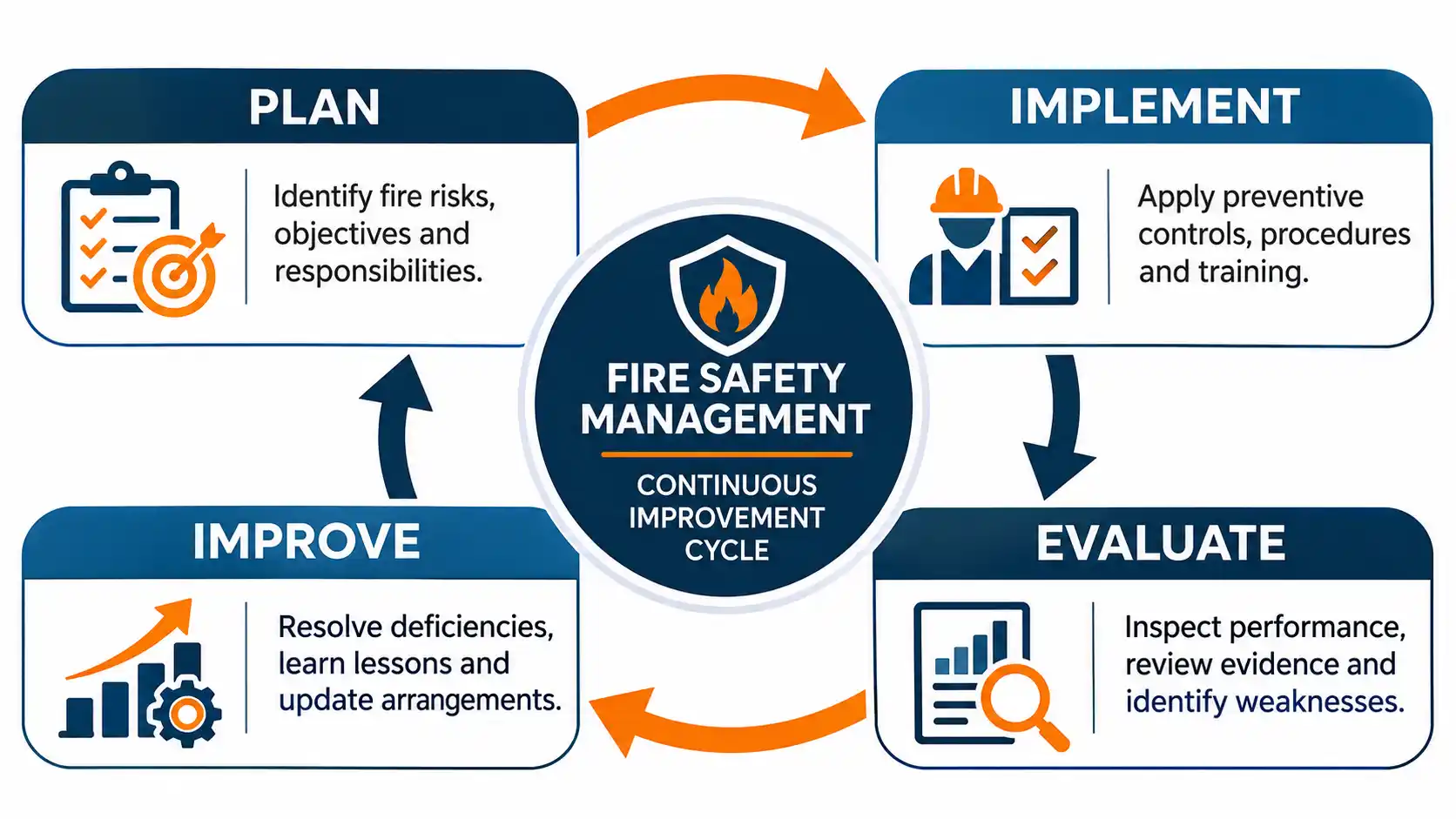
Develop a Continuous Improvement Cycle
Continuous improvement requires a repeatable management process. A practical approach can be organised into four connected stages:
This approach should operate throughout the organisation. It should not be restricted to an annual management meeting or an isolated compliance exercise.
9. Senior Leadership Fire Safety Management Review Checklist
The following checklist provides a practical starting point for directors, responsible persons, facilities managers and fire safety professionals conducting a structured review.
Leadership and governance
- Are fire safety responsibilities clearly assigned and communicated?
- Does the fire safety policy reflect current organisational activities?
- Are senior leaders receiving relevant performance information?
- Are sufficient competent people and resources available?
Risk assessment and prevention
- Are fire risk assessments suitable and current?
- Have significant changes been assessed?
- Are ignition sources and combustible materials appropriately controlled?
- Are contractor activities and high-risk work properly managed?
Protection and emergency readiness
- Are relevant fire protection systems maintained?
- Are escape routes and exits suitable and available?
- Are emergency plans consistent with the building’s fire strategy?
- Are arrangements suitable for people requiring additional assistance?
Training and communication
- Do employees receive appropriate fire safety information and training?
- Are nominated emergency personnel competent and available?
- Are visitors and contractors given relevant instructions?
- Are drill findings recorded and addressed?
Monitoring and improvement
- Are inspections and maintenance activities monitored?
- Are outstanding actions assigned and prioritised?
- Are repeated defects investigated?
- Are improvement actions verified after completion?
Turning Checklist Findings into Management Decisions
The checklist should not be treated as a simple pass-or-fail exercise. Each response should be supported by evidence and followed by appropriate action where weaknesses are identified.
For example, if senior leaders discover that maintenance records are complete but recurring equipment defects remain unresolved, the management response should examine repair arrangements, contractor performance, escalation procedures and interim controls.
Likewise, if training attendance is high but evacuation drills identify repeated delays, the organisation should review the content, practical application and suitability of its emergency arrangements.
These examples demonstrate why effective reviews must consider the quality and outcomes of fire safety management rather than relying on administrative completion rates alone.
10. Frequently Asked Questions About Fire Safety Management Reviews
What is a fire safety management review?
A fire safety management review is a structured evaluation of an organisation’s fire safety responsibilities, risk assessments, preventive measures, protective systems, emergency arrangements and performance monitoring. It helps senior leaders determine whether fire safety arrangements remain suitable, effective and properly implemented.
Why should senior leaders conduct fire safety management reviews?
Senior leaders should conduct reviews to maintain oversight of organisational fire risks, assess legal responsibilities, identify management weaknesses and ensure that appropriate resources are available. Reviews also help organisations monitor corrective actions and improve fire safety performance.
What questions should directors ask about workplace fire safety?
Directors should ask whether fire risks are properly assessed, responsibilities are clear, preventive and protective measures are maintained, employees are adequately trained, emergency plans are suitable and outstanding actions are resolved within appropriate timescales.
How often should fire safety management reviews take place?
The appropriate frequency depends on organisational risk, complexity, operational changes and governance arrangements. A planned review schedule is useful, but additional reviews should take place when significant changes, incidents, serious defects or other circumstances indicate that existing arrangements may no longer be suitable. This should be distinguished from the separate legal requirement to review fire risk assessments regularly.
Is a fire safety management review the same as a fire risk assessment?
No. A fire risk assessment evaluates hazards, people at risk and the precautions needed to protect them. A management review examines the wider effectiveness of the organisation’s fire safety management arrangements, including responsibilities, implementation, monitoring, resources and improvement. Both activities support effective fire safety management.
Who is responsible for fire safety management in a workplace?
Under the Fire Safety Order in England and Wales, the responsible person may be an employer, owner, landlord, occupier or another person with control of the premises. Other persons may also have duties according to their control. Where responsibilities overlap, relevant parties must cooperate and coordinate their arrangements.
What evidence should senior managers examine during a fire safety review?
Useful evidence includes fire risk assessments, inspection records, alarm and emergency lighting maintenance reports, fire door inspection findings, training records, evacuation drill reports, incident investigations, contractor documentation and outstanding corrective action registers.
How can an organisation measure fire safety management performance?
Organisations can monitor indicators such as overdue corrective actions, recurring defects, maintenance response times, training competence, evacuation drill findings and the status of risk assessment reviews. These indicators should be interpreted alongside the actual risk profile and quality of the supporting evidence.
What should happen when a management review identifies serious fire safety weaknesses?
The organisation should assess the level of risk, implement appropriate interim precautions where necessary, assign competent personnel to corrective work and escalate significant issues to the appropriate management level. Completion should be verified rather than assumed from an administrative status update.
Does the Regulatory Reform (Fire Safety) Order 2005 apply throughout the UK?
No. The Regulatory Reform (Fire Safety) Order 2005 applies in England and Wales. Scotland and Northern Ireland have separate fire safety legislation. Organisations operating across the UK should establish the applicable legal requirements for each location.
Can a fire safety consultant support management reviews?
Yes. A suitably competent fire safety professional can provide technical advice, examine assessment quality, review control measures and identify areas requiring improvement. However, appointing a consultant does not automatically transfer the legal duties of the responsible person or remove the need for effective organisational oversight.
How can fire safety management reviews support continuous improvement?
Reviews support continuous improvement by identifying weaknesses, investigating underlying causes, prioritising corrective actions, allocating resources and monitoring whether changes have improved performance. Lessons from inspections, drills, incidents and maintenance findings should inform subsequent reviews.
Conclusion: Making Fire Safety Management a Leadership Priority
Fire safety management reviews provide senior leaders with an important opportunity to assess whether organisational arrangements are protecting people and controlling fire risks effectively. They bring together legal responsibilities, risk assessment, prevention, protection, workforce competence, emergency preparedness and performance monitoring.
The most valuable reviews go beyond confirming that policies exist or inspections have been completed. They examine whether responsibilities are understood, control measures remain suitable, problems are resolved promptly and management decisions are supported by reliable evidence.
Senior leaders should use review findings to strengthen accountability, improve resource allocation, address recurring weaknesses and establish measurable improvement priorities. They should also ensure that fire safety remains connected to wider organisational governance and operational decision-making.
Ultimately, effective fire safety leadership depends on consistent oversight and a willingness to act on evidence. When management reviews lead to practical improvements, organisations are better positioned to prevent fires, protect people and maintain effective emergency arrangements.
Develop Professional Fire Safety Management Knowledge
Strengthen professional understanding of fire safety responsibilities, risk assessment, compliance and organisational management through relevant fire safety learning programmes.
Explore Senior Fire Safety Advisor Training