
Workplace Fire Evacuation Plan: Steps, Roles and Checklist
A practical UK-focused guide to developing an effective fire evacuation procedure, assigning responsibilities, protecting employees and visitors, and ensuring everyone can reach a place of safety during a fire emergency.
A workplace fire evacuation plan is an essential part of an organisation’s fire safety arrangements. When a fire occurs, employees, visitors, contractors and other occupants need to understand how to recognise the alarm, leave the building safely, use suitable escape routes and report to a designated assembly point. Without clear procedures, confusion and delayed decisions can increase the risk of injury.
Creating an effective plan involves more than displaying an emergency exit diagram. Employers and other responsible persons must consider the building layout, fire hazards, occupancy levels, escape facilities, warning systems, individual support requirements and the responsibilities of designated personnel. The arrangements must also be communicated, practised and reviewed so that they remain suitable as the workplace changes.
For UK organisations, evacuation planning must form part of a wider fire risk management approach. This includes understanding applicable fire safety legislation, maintaining escape routes, providing suitable instruction and ensuring that employees know what action to take when an alarm sounds.
A workplace fire evacuation plan explains how everyone on the premises will be warned, how they should leave safely, who coordinates the response, where occupants should assemble and how the organisation will account for people after evacuation.
This guide explains how to create a workplace fire evacuation plan in the UK, allocate emergency responsibilities, support people who may need assistance, organise roll calls and conduct effective fire drills. It also provides a practical fire evacuation checklist that employers can use when reviewing their existing arrangements.

What Is a Fire Evacuation Plan?
A workplace fire evacuation plan is a documented set of instructions describing how people should respond to a fire emergency and leave a building or affected area safely. It identifies how the alarm will be raised, which escape routes should be used, who is responsible for coordinating the evacuation, where people should assemble and how their safety will be confirmed.
The purpose is to establish a consistent response that does not depend on employees making unfamiliar decisions under pressure. Everyone should know the basic procedure before an incident occurs, including what to do if their normal route is unavailable or they require assistance.
What Should a Workplace Fire Evacuation Plan Include?
The content should reflect the actual premises and the findings of its fire risk assessment. A suitable plan will generally address the following areas:
| Plan Component | What It Should Explain |
|---|---|
| Fire warning arrangements | How occupants recognise an alarm and what action they must take. |
| Escape routes and exits | Primary and alternative routes, emergency exits and access arrangements. |
| Evacuation responsibilities | Who coordinates the response, supports occupants and communicates information. |
| Individual assistance | Arrangements for people who may need support to evacuate. |
| Assembly arrangements | Where occupants should report and how a roll call will be completed. |
| Emergency communication | Who contacts emergency services and provides relevant information. |
| Training and drills | How occupants learn the procedures and how their effectiveness is tested. |
| Review and maintenance | How the organisation keeps arrangements accurate and operational. |
Why Is an Evacuation Plan Important?
A well-developed fire evacuation plan supports life safety, legal compliance and operational resilience. It provides employees with clear instructions instead of leaving them to interpret an emergency independently.
- Protects occupants: Clear escape arrangements help people move towards safety without unnecessary delay.
- Reduces confusion: Employees understand the alarm response, exit routes and assembly arrangements.
- Clarifies responsibilities: Designated personnel understand their duties and reporting arrangements.
- Supports vulnerable occupants: Individual arrangements address mobility, sensory, cognitive and temporary assistance needs.
- Improves emergency coordination: Accurate occupancy information helps managers and emergency responders understand who may still be inside.
- Strengthens preparedness: Drills and reviews identify weaknesses before an actual emergency.
Importantly, an evacuation plan should not be treated as a standalone document. It must work alongside the fire risk assessment, fire detection and warning systems, emergency lighting, fire doors, signage, staff instruction and building management arrangements.
UK Legal Responsibilities for Workplace Fire Evacuation
Workplace fire evacuation arrangements are connected to legal duties relating to fire prevention, emergency procedures, employee instruction and the protection of relevant persons. The exact legislative framework depends on where the workplace is located within the UK.
England and Wales: Regulatory Reform (Fire Safety) Order 2005
The Regulatory Reform (Fire Safety) Order 2005 is the principal fire safety framework for most non-domestic premises in England and Wales.
It places duties on the responsible person, which may be an employer, owner, occupier, landlord or another person with control of the premises. Where more than one responsible person has duties, they must cooperate and coordinate their arrangements.
Relevant duties include carrying out a suitable and sufficient fire risk assessment, implementing appropriate general fire precautions, establishing emergency procedures and providing employees with adequate fire safety training.
Article 15 is particularly relevant to evacuation planning. It requires appropriate procedures for serious and imminent danger, including safety drills where necessary, and the nomination of a sufficient number of competent persons to implement evacuation procedures.
Article 21 also addresses employee safety training, including instruction on appropriate precautions and actions to protect employees and other relevant persons.
Scotland and Northern Ireland
Employers must not automatically apply England and Wales legislation to workplaces in other UK nations. Scotland and Northern Ireland have separate fire safety legislative frameworks.
- Scotland: Fire safety duties are primarily addressed through the Fire (Scotland) Act 2005 and the Fire Safety (Scotland) Regulations 2006.
- Northern Ireland: The principal framework includes the Fire and Rescue Services (Northern Ireland) Order 2006 and associated fire safety regulations.
Organisations operating across several UK nations should verify the requirements applicable to each site and seek competent advice where the legal position is uncertain.
What Must Employers Provide?
Although specific legal provisions differ, practical workplace fire safety arrangements should address several essential areas:
- Suitable and regularly reviewed fire risk assessments.
- Appropriate fire detection and warning arrangements.
- Clearly identified and adequately maintained escape routes.
- Suitable emergency lighting and exit signage where required.
- Effective emergency procedures and evacuation arrangements.
- Appropriate employee information, instruction and training.
- Arrangements for people who may need assistance to evacuate.
- Appropriate testing, maintenance and review of fire safety measures.
A fire evacuation plan does not automatically make a workplace compliant. It must reflect a suitable fire risk assessment, actual building conditions, appropriate safety measures and the needs of everyone who may be affected.
Employers can consult the official GOV.UK workplace fire safety guidance for information about responsible persons, risk assessments, evacuation plans, training and enforcement.
How to Create a Workplace Fire Evacuation Plan
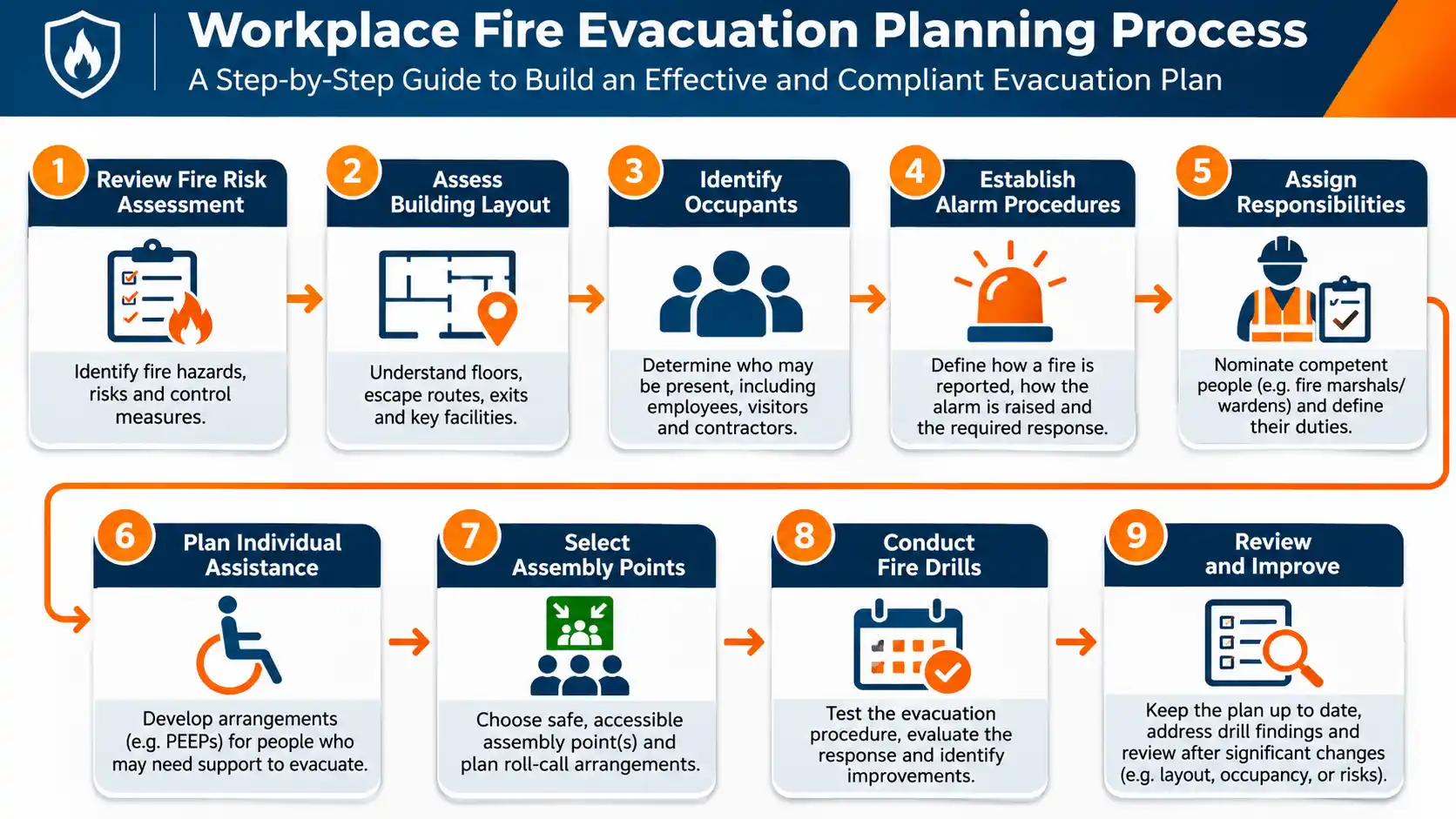
Creating a practical workplace fire evacuation plan should follow a structured process. The organisation must understand its premises, identify foreseeable emergency scenarios, assess who may be affected and determine how occupants can reach safety.
Step 1: Review the Fire Risk Assessment
Begin by examining the existing fire risk assessment. Identify potential ignition sources, combustible materials, dangerous substances, high-risk activities and areas where fire or smoke could affect escape routes.
Consider how the building is used, how many people normally occupy it and whether occupancy changes during different shifts. A warehouse operating overnight may have different evacuation challenges from a daytime office or public-facing retail environment.
The assessment should also consider people who may be unfamiliar with the premises, including visitors, contractors, delivery personnel and temporary workers.
Step 2: Understand the Building Layout
Inspect the premises and obtain accurate floor plans. Identify stairways, corridors, protected routes, final exits, fire doors, emergency lighting, alarm points and any areas with restricted access.
Determine whether the building uses simultaneous evacuation, phased evacuation or another suitable strategy. This decision must be consistent with the building’s fire strategy, risk assessment and relevant fire safety arrangements.
Identify alternative escape routes and consider what would happen if smoke, fire, structural damage or another hazard made the primary route unusable.
Step 3: Identify Everyone Who May Need to Evacuate
Prepare an occupancy profile that includes employees, managers, visitors, contractors, agency workers and other people who may be present.
Consider shift patterns, lone working, temporary staff, public access and people who may require additional assistance. Do not assume that a building’s occupants will remain the same throughout the working day.
Step 4: Establish the Alarm and Evacuation Procedure
Explain how a fire should be reported, how the alarm is raised and what occupants must do when it activates. The instructions should be consistent with the installed fire alarm system and the building’s evacuation strategy.
Include the procedure for reporting a suspected fire, responding to an alarm, using alternative routes and contacting the fire and rescue service through 999.
Step 5: Allocate Roles and Responsibilities
Nominate sufficient competent personnel to implement the evacuation arrangements. Consider the size of the workplace, the number of floors, operating hours, staff availability and the complexity of the building.
Provide deputies and backup arrangements so that the procedure does not depend on one individual being present.
Step 6: Establish Accessible Evacuation Arrangements
Determine whether any employees or regular visitors require individual arrangements. Agree suitable procedures and ensure that the required equipment, communication and trained assistance are available.
Visitors who may need assistance should also be considered through suitable general arrangements and site-specific support procedures.
Step 7: Select Assembly Points and Roll-Call Procedures
Choose a safe assembly location that is sufficiently separated from the building and does not obstruct emergency vehicle access. Define how employees, visitors and contractors will be accounted for.
Step 8: Communicate and Practise the Plan
Make the arrangements accessible to employees and relevant third parties. Explain the alarm response, escape routes, responsibilities and assembly arrangements during induction and refresher training.
Conduct suitable drills and use the results to identify weaknesses, improve communication and update the procedure.
Step 9: Review and Update the Document
Review the plan whenever there is a significant change in building layout, occupancy, working arrangements, fire hazards, access requirements or emergency equipment.
Record the date of review, responsible person, identified issues and corrective actions. Ensure that updated information is communicated to affected personnel.
Alarm and Escape Procedures
Alarm and escape procedures explain exactly what people should do when a fire is discovered or an alarm activates. They must be simple, consistent and appropriate to the building’s evacuation strategy.
What Should Employees Do When a Fire Alarm Sounds?
Employees should follow the workplace’s established fire emergency instructions. A typical simultaneous evacuation procedure includes the following actions:
- Recognise the warning. Stop work and treat the alarm as a genuine emergency unless authorised information confirms otherwise.
- Leave promptly. Follow the designated escape route without collecting personal belongings or delaying unnecessarily.
- Use a safe exit. Avoid areas affected by smoke, fire or other hazards. Use an alternative route if the normal route is unsafe.
- Help within the agreed procedure. Follow established arrangements for anyone who needs assistance, without placing yourself or others in danger.
- Reach the assembly point. Proceed directly to the designated safe location and report to the appropriate coordinator.
- Remain available. Do not leave the assembly point or re-enter the premises until authorised by the appropriate emergency authority or designated person.
Primary and Alternative Escape Routes
A workplace should have suitable escape routes and exits based on its occupancy, layout and risk assessment. The routes should be clearly identified, adequately maintained and available whenever the premises are occupied.
Primary routes provide the normal planned way out. Alternative routes provide another means of escape when the primary route is affected by fire, smoke or another obstruction.
Employees should understand both arrangements. A route shown on a floor plan is not necessarily a usable escape route if it is obstructed, locked, poorly maintained or inaccessible to the people expected to use it.
Keeping Escape Routes Clear
Escape routes must not become storage areas. Boxes, stock, waste, cleaning equipment, electrical cables and other obstructions can restrict movement or delay evacuation.
Workplace housekeeping therefore plays a direct role in evacuation safety. Employers should implement routine inspections and assign responsibility for reporting obstructions or defects.
For further practical guidance, read our article on fire safety housekeeping and how workplace organisation reduces risk.
What About Fire Lifts and Passenger Lifts?
Ordinary passenger lifts should not be used during a fire evacuation unless the building has a specifically designed and authorised evacuation arrangement. The correct procedure depends on the building’s fire strategy and the equipment available.
Where evacuation lifts are provided, their use must follow the building’s approved arrangements, operating procedures and appropriate management controls. Employees should not assume that a normal lift is safe during a fire.
Communication During an Evacuation
Communication arrangements should explain who raises the alarm, who contacts 999 and who communicates essential information to emergency responders.
The caller should provide the premises address, location of the suspected fire, known hazards, information about people who may remain inside and any other relevant details. Staff must not delay their own evacuation to make a call if doing so would place them in danger.
Organisations should also have a backup communication method where normal communication systems may become unavailable.
Roles and Responsibilities in a Fire Evacuation Plan
An effective evacuation procedure requires clear responsibilities and an appropriate chain of command. Employees should understand who coordinates the response, who provides assistance and how important information reaches the person managing the incident.
The Responsible Person or Employer
The responsible person retains responsibility for ensuring that appropriate fire safety arrangements are implemented. Depending on the premises, this may be the employer, owner, occupier, landlord or another person with control of the building.
Responsibilities include arranging fire risk assessments, implementing appropriate precautions, establishing emergency procedures, providing information and training, and ensuring that nominated personnel are competent to perform their duties.
Fire Marshal or Fire Warden
Fire marshals and fire wardens help implement the organisation’s evacuation procedures. Their duties should be clearly defined and supported by appropriate training.
Depending on the workplace, responsibilities may include directing occupants towards suitable exits, reporting observed hazards, supporting agreed assistance arrangements, helping coordinate the assembly point and communicating information to the evacuation coordinator.
They should never be expected to enter dangerous areas, search smoke-filled rooms or delay their own escape to complete checks.
Understand the distinction between these roles in our guide to fire marshal vs fire warden responsibilities.
Managers and Supervisors
Managers and supervisors should ensure that employees understand the procedures applicable to their work areas. They may coordinate departmental information, support induction training and report problems with escape routes or emergency equipment.
They should also help ensure that new employees, temporary workers and contractors receive relevant instructions before beginning work.
Employees
Employees should understand how to raise the alarm, where to find escape routes and where to assemble. They should follow instructions, avoid actions that create additional danger and report fire safety concerns.
Visitors and Contractors
Visitors and contractors may be unfamiliar with the building. Organisations should provide appropriate emergency instructions through reception, induction, sign-in arrangements or other suitable communication methods.
Where contractors work in higher-risk areas, they should receive relevant information about the alarm, escape routes and nominated emergency personnel before work begins.
| Role | Main Responsibility | Important Limitation |
|---|---|---|
| Responsible person | Ensure appropriate fire safety arrangements and competent personnel are in place. | Delegation does not remove underlying legal duties. |
| Fire marshal or warden | Support the implementation of evacuation procedures. | Must not undertake unsafe rescue or firefighting activities. |
| Managers | Communicate procedures and support departmental readiness. | Must follow the established emergency command arrangements. |
| Employees | Follow alarm instructions and evacuate safely. | Must not re-enter without authorisation. |
| Visitors and contractors | Follow the information provided and report to the assembly point. | May require additional guidance because they are unfamiliar with the premises. |
Supporting People Who Need Assistance
A workplace fire evacuation plan must consider everyone who may be present, including individuals who cannot use standard escape arrangements without assistance. Accessibility should be addressed during planning rather than treated as an issue to resolve after the alarm sounds.
People may require assistance because of permanent or temporary mobility limitations, visual or hearing impairments, cognitive needs, injury, pregnancy or other circumstances affecting their ability to evacuate independently.
Personal Emergency Evacuation Plans (PEEPs)
A Personal Emergency Evacuation Plan (PEEP) is an individual arrangement developed to support a particular person’s safe evacuation. It should reflect their needs, the building’s design, the available escape facilities and the assistance that can reliably be provided.
Where appropriate, employers should discuss arrangements with the individual, identify suitable methods of assistance, allocate trained personnel and test the procedure. Plans should be reviewed when a person’s circumstances or workplace arrangements change.
Government guidance on means of escape for disabled people explains the importance of considering individual requirements and suitable evacuation arrangements.
Important Elements of an Individual Evacuation Arrangement
- The person’s preferred and practical evacuation method.
- Suitable accessible routes and available alternative arrangements.
- Any equipment required, such as an evacuation chair where appropriate.
- The names or roles of trained personnel who will provide assistance.
- Reliable communication methods, including arrangements for hearing or visual impairments.
- Procedures for situations where the designated assistant is unavailable.
- How the person’s location and status will be communicated to emergency responders.
- Training, testing and review arrangements.
Refuges and Evacuation Equipment
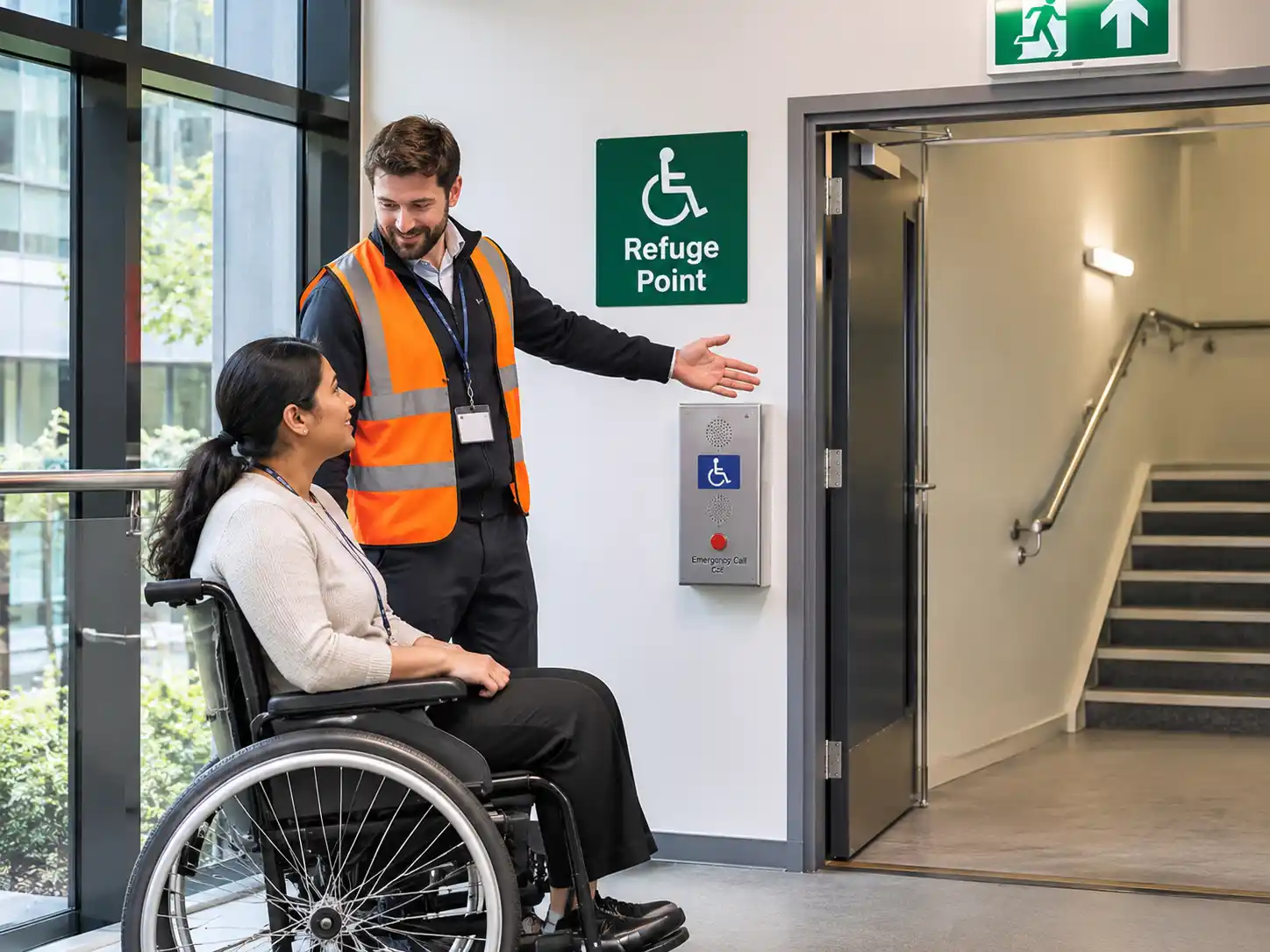
Some buildings include designated refuges or evacuation equipment. A refuge may provide a temporary place of relative safety within a building’s fire safety strategy, but it should not automatically be considered the final destination for evacuation.
Where refuges, evacuation chairs or evacuation lifts are part of the arrangement, their suitability, location, maintenance, communication systems and operating procedures must be considered. Personnel expected to use the equipment should receive appropriate training and practice.
Arrangements must be realistic, agreed with the individual and supported by available personnel and equipment. A plan that depends on someone who is frequently absent may not provide reliable protection.
Supporting Visitors Who Need Assistance
Visitors may arrive without advance notice or may not have informed reception about their requirements. Workplaces should therefore consider general procedures that enable visitors to request assistance and receive appropriate support.
Reception teams and hosts should understand how visitors are included in emergency arrangements. Sign-in records may help identify who is present, but they should not be treated as a replacement for an effective evacuation procedure.
Assembly Points and Roll Call
An assembly point is a designated location where people gather after leaving the premises during an emergency. It provides a controlled location for communication, headcounts and the reporting of missing persons.
How to Select a Suitable Assembly Point
The assembly point should be identified through the workplace fire risk assessment and emergency planning process. Its location should consider the building, surrounding hazards, likely evacuation routes and emergency vehicle access.
A suitable assembly point should:
- Be positioned at a safe distance from the building and foreseeable fire hazards.
- Not obstruct fire appliances, emergency responders or access roads.
- Be accessible to people who may require mobility assistance.
- Have enough space for the expected number of occupants.
- Be clearly communicated and identified where appropriate.
- Allow the organisation to organise roll calls and emergency communications.
- Have an alternative location if the normal assembly point becomes unsafe.
How to Conduct an Effective Roll Call
The purpose of a roll call is to establish who has reached safety and identify anyone who may be unaccounted for. It should include employees, visitors, contractors and other people known to be on the premises.
Organisations can use several methods, including departmental registers, visitor records, sign-in systems, shift attendance lists or suitable digital evacuation management tools.
Regardless of the method, the procedure should have a clear coordinator and a reliable way of communicating missing-person information to the emergency services.
Recommended Roll-Call Procedure
- Gather at the designated location. Direct occupants to the correct assembly point without obstructing emergency access.
- Organise departmental groups. Managers or nominated coordinators should use their available attendance information.
- Check employee attendance. Record people who are present and identify anyone not accounted for.
- Check visitor and contractor records. Use available reception and site access information.
- Report discrepancies. Pass information about missing or potentially trapped individuals to the incident coordinator and emergency responders.
- Maintain communication. Record significant updates and follow instructions from the emergency services.
What If Someone Is Missing?
If someone is not accounted for, the information should be reported immediately to the fire and rescue service or the appropriate emergency incident commander. Provide their name, last known location, work area and any relevant information about mobility or other assistance needs.
Employees and fire wardens should never re-enter a burning or potentially dangerous building to search for missing people. Rescue operations must be left to appropriately equipped and trained emergency responders.
Using Digital Systems for Occupant Accountability
Digital visitor management and staff attendance systems can help organisations identify who is expected to be on site. However, records may be incomplete if employees bypass sign-in procedures, systems become unavailable or people move between sites.
For this reason, digital tools should support, rather than replace, a documented roll-call process. Organisations should maintain suitable backup arrangements and explain how discrepancies will be handled.
Fire Drills and Review of the Evacuation Plan
A written workplace fire evacuation plan is only effective when people understand it and the arrangements work in practice. Fire drills provide an opportunity to evaluate the evacuation procedure, identify weaknesses and improve emergency preparedness.
Why Are Fire Drills Important?
Fire drills help employees become familiar with alarms, escape routes, assembly arrangements and their responsibilities. They can also reveal problems that may not be obvious during a document review.
For example, a drill may identify that a corridor is routinely obstructed, an exit is difficult to open, visitors do not understand the alarm or the roll-call system does not account for contractors.
Government workplace guidance recommends at least one fire drill per year and recording the results. More frequent drills may be appropriate depending on the fire risk assessment, workforce turnover, building complexity and changes in working arrangements.
How to Organise a Fire Drill
Before conducting a drill, management should establish its objectives and decide how the exercise will be controlled. The drill must be planned to avoid creating unnecessary risks, confusing emergency responders or disrupting essential safety arrangements.
- Set the objectives. Decide whether the drill will test alarm awareness, evacuation routes, assistance procedures, assembly arrangements or roll-call accuracy.
- Inform relevant coordinators. Ensure that the people responsible for controlling the exercise understand their duties and the safety arrangements.
- Prepare the workplace. Check that escape routes, emergency equipment and communication arrangements are suitable for the exercise.
- Activate the planned exercise. Follow the agreed procedure for raising the alarm and initiating evacuation.
- Observe the response. Monitor route selection, occupant behaviour, assistance arrangements and assembly-point management.
- Complete the roll call. Check whether everyone has been accounted for using the established method.
- Record the findings. Document observations, delays, problems and areas requiring improvement.
- Implement corrective actions. Assign responsibility and target dates for resolving identified weaknesses.
What Should a Fire Drill Checklist Measure?
| Evaluation Area | Questions to Consider | Evidence to Record |
|---|---|---|
| Alarm awareness | Did occupants recognise the alarm and respond appropriately? | Observed response and communication issues. |
| Escape routes | Were the planned routes available and suitable? | Obstructions, defects and route selection. |
| Staff responsibilities | Did nominated personnel understand their duties? | Role performance and coordination. |
| Individual assistance | Were agreed assistance arrangements effective? | Equipment, communication and support issues. |
| Assembly point | Could occupants reach and organise at the correct location? | Accessibility, congestion and organisation. |
| Roll call | Could the organisation account for employees and visitors? | Missing records and reconciliation issues. |
| Corrective actions | Were problems assigned for resolution? | Action owner, priority and completion date. |
Reviewing the Workplace Fire Evacuation Plan
Plans should be reviewed regularly and whenever circumstances change. A review should not simply confirm that the document still exists. It should establish whether its instructions remain accurate and whether the organisation can implement them effectively.
Important review triggers include:
- Building extensions, refurbishments or changes to internal layouts.
- New machinery, equipment or processes that introduce additional fire hazards.
- Changes in the number or type of people occupying the premises.
- Changes to employee duties, shifts or operating hours.
- New requirements for individual evacuation assistance.
- Changes to fire alarm systems, emergency lighting or escape facilities.
- Problems identified during fire drills, inspections or actual emergencies.
- Changes to applicable legislation or official guidance.
Every significant change should be documented, communicated to affected personnel and reflected in the organisation’s relevant fire safety records.

Workplace Fire Evacuation Checklist for Employers
Employers can use the following checklist to review whether their workplace evacuation arrangements address the main operational requirements. It is a practical review aid and should be used alongside the applicable fire risk assessment and official guidance.
Fire Evacuation Plan Checklist
- A suitable fire risk assessment has been completed and reviewed.
- The evacuation strategy is appropriate for the premises.
- Fire alarm and warning arrangements are clearly explained.
- Primary and alternative escape routes have been identified.
- Emergency exits are accessible and suitable for use.
- Escape routes are kept clear of obstructions.
- Emergency lighting and exit signs are maintained where required.
- Assembly points have been selected and communicated.
- A sufficient number of competent evacuation personnel have been nominated.
- Deputies and backup arrangements are available.
- Fire wardens and other designated personnel understand their responsibilities.
- New employees receive appropriate fire safety instruction.
- Visitors and contractors receive relevant emergency information.
- People requiring assistance have suitable arrangements.
- Individual evacuation plans are reviewed when circumstances change.
- Roll-call arrangements cover employees, visitors and contractors.
- Procedures explain how missing-person information is reported.
- Emergency service contact arrangements are documented.
- Fire drills are conducted at an appropriate frequency.
- Drill results and corrective actions are recorded.
- The evacuation plan is reviewed after relevant changes or incidents.
What Records Should Employers Maintain?
Organisations should retain suitable evidence demonstrating that fire safety arrangements are established, communicated and reviewed. The exact records will depend on the premises and applicable legal requirements.
- Current fire risk assessment and review records.
- Current emergency and evacuation procedures.
- Fire safety induction and refresher training records.
- Fire marshal and fire warden appointment and training records.
- Fire drill reports and evaluation findings.
- Maintenance and testing records for relevant fire safety systems.
- Individual evacuation arrangements where applicable.
- Corrective action and inspection records.
Common Mistakes When Developing a Workplace Fire Evacuation Plan
Even organisations with written emergency procedures can have weaknesses in their practical arrangements. The following mistakes should be considered during planning and review.
Using a Generic Plan Without Assessing the Premises
A generic template may provide a useful starting point, but it cannot replace a site-specific assessment. A warehouse, hospital, school and office have different occupancy patterns, hazards and evacuation challenges.
Failing to Identify Backup Personnel
If the evacuation procedure depends on a single fire marshal, the arrangements may fail when that person is absent. Sufficient competent personnel and deputies should be available for the premises and its operating hours.
Ignoring Visitors and Contractors
Employee-only procedures overlook people who may be unfamiliar with the building. Visitor management, contractor induction and suitable assembly-point arrangements should be included.
Assuming Everyone Can Use the Same Exit
Standard escape arrangements may not be suitable for everyone. Employers should identify individual requirements and provide appropriate assistance, accessible routes and suitable equipment where needed.
Allowing Escape Routes to Become Obstructed
Blocked corridors, locked exits and poorly maintained doors can undermine even a well-written plan. Routine checks and effective housekeeping are essential.
Failing to Test Roll-Call Arrangements
An organisation may have an attendance system but no clear procedure for reconciling missing employees, visitors or contractors. Fire drills should test the actual accountability process.
Not Updating the Plan After Workplace Changes
Changes in layout, occupancy, equipment and working practices may make previous arrangements unsuitable. Plans must be reviewed and updated when necessary.
Strengthen Workplace Fire Safety Knowledge and Management Skills
Effective fire evacuation depends on informed managers, competent fire wardens and employees who understand their responsibilities. Professional fire safety training can help organisations develop the knowledge needed to support workplace emergency arrangements.
Explore relevant professional learning programmes covering fire marshal duties, workplace fire safety, fire safety management and risk assessment.
Explore Fire Marshal TrainingFurther Professional Fire Safety Learning
Depending on their responsibilities and career objectives, learners and organisations may also explore:
- OSHAA 30 Hours Professional Diploma in Fire Safety at Workplace – for structured professional learning in workplace fire safety.
- ICTQual Level 3 Diploma in Industrial Fire Safety Management – for learners interested in industrial fire safety management.
- QualCert Level 3 Award in Fire Safety for Managers – for managers seeking structured fire safety knowledge.
Training supports competence and awareness, but completing a course does not automatically make an individual competent for every workplace role. Competence must reflect the specific duties, risks, experience and training required for the premises.
Frequently Asked Questions About Workplace Fire Evacuation Plans
What is a workplace fire evacuation plan?
A workplace fire evacuation plan is a documented procedure explaining how people should respond to a fire, leave the premises safely, use designated escape routes, report to assembly points and be accounted for after evacuation.
Is a fire evacuation plan a legal requirement in the UK?
Workplace fire safety legislation requires appropriate emergency procedures and fire safety arrangements. In England and Wales, the Regulatory Reform (Fire Safety) Order 2005 establishes relevant duties for responsible persons. Scotland and Northern Ireland have separate legislative frameworks.
Who is responsible for creating a workplace fire evacuation plan?
The responsible person must ensure that appropriate fire safety arrangements are established. This may be an employer, owner, occupier, landlord or another person with control of the premises. Competent fire safety professionals may assist with developing the arrangements.
How often should workplace fire drills be conducted?
UK government workplace guidance recommends at least one fire drill per year for relevant workplaces, or more frequently where the fire risk assessment indicates a need. High staff turnover, complex premises and changes in working arrangements may justify additional exercises.
What should employees do when a fire alarm sounds?
Employees should stop work, follow the workplace evacuation procedure, use a safe escape route, proceed to the designated assembly point and remain there until authorised to leave or re-enter.
What is the difference between a fire marshal and a fire warden?
The terms are frequently used interchangeably in workplaces. Both generally refer to designated personnel who support fire safety and evacuation arrangements. Their exact responsibilities should be defined by the employer. Read our detailed fire marshal vs fire warden guide.
What is a Personal Emergency Evacuation Plan?
A Personal Emergency Evacuation Plan (PEEP) is an individual arrangement developed to help someone who may need assistance to evacuate. It considers the person’s needs, suitable routes, equipment, trained assistance and communication arrangements.
What should be included in a fire evacuation checklist?
A fire evacuation checklist should cover alarm arrangements, escape routes, emergency exits, staff responsibilities, accessibility, assembly points, roll-call procedures, training, drills and review arrangements.
Can employees use lifts during a fire evacuation?
Ordinary passenger lifts should not be used unless the building has an authorised evacuation lift arrangement and a suitable procedure. Occupants must follow the building’s specific fire evacuation instructions.
What should happen if someone is missing after evacuation?
The missing person’s information and last known location should be reported promptly to the emergency services. Employees and fire wardens must not re-enter a dangerous building to search for missing people.
When should a workplace fire evacuation plan be reviewed?
It should be reviewed regularly and whenever significant changes occur, including alterations to the premises, occupancy, working practices, fire hazards, escape facilities or individual assistance requirements.
Conclusion: Building a Safer Workplace Through Effective Evacuation Planning
A workplace fire evacuation plan is a fundamental part of effective fire safety management. It establishes how employees, visitors, contractors and other occupants should respond when a fire occurs, and ensures that responsibilities are understood before an emergency develops.
Developing a reliable plan requires organisations to assess their premises, identify suitable escape routes, establish alarm procedures, nominate competent personnel, support people who need assistance and select appropriate assembly points. These arrangements must be communicated, practised and reviewed to remain effective.
Employers should not rely solely on written instructions or assume that employees will automatically know what to do. Regular fire safety training, suitable fire drills, clear communication and effective maintenance help turn documented procedures into practical workplace readiness.
By following a structured approach and using the checklist in this guide, organisations can identify weaknesses, strengthen their emergency arrangements and improve their ability to protect people during a fire emergency.
Review your current fire risk assessment and evacuation arrangements, confirm that all occupants are considered, test the procedures through suitable drills and record improvements. Effective fire safety depends on preparation, competent people and continuous review.
Develop Your Professional Fire Safety Knowledge
Explore professional fire safety, fire marshal and fire risk management programmes designed to develop practical knowledge and support workplace safety responsibilities.
Explore Fire Safety QualificationsOfficial Fire Safety Guidance and Further Reading
The following authoritative resources provide further information on UK fire safety responsibilities, evacuation arrangements and emergency planning.
- GOV.UK – Fire Safety in the Workplace
- GOV.UK – Fire Safety and Evacuation Plans
- GOV.UK – Fire Safety Equipment, Drills and Training
- Regulatory Reform (Fire Safety) Order 2005
- GOV.UK – Means of Escape for Disabled People
- OSHA – Emergency Evacuation Plan Elements (international supplementary reference, not UK law).
Editorial note: This article provides general workplace fire safety information and is not a substitute for a suitable and sufficient fire risk assessment, specialist fire safety advice or the applicable legislation and official guidance for your premises. Legal requirements may differ between England, Wales, Scotland and Northern Ireland. Employers should obtain competent advice where necessary.