
Fire Marshal vs Fire Warden: Duties and Training Explained
Understanding the difference between a fire marshal and a fire warden is essential for employers, safety managers and employees responsible for workplace fire safety. Although these job titles are frequently used interchangeably in the UK, organisations may assign different responsibilities depending on their premises, emergency procedures and fire risk assessment. This guide explains the meaning of both roles, their responsibilities before, during and after a fire alarm, the relevant UK legal requirements and the training needed to perform these duties competently.
Employers, responsible persons, facilities managers, health and safety professionals, fire safety coordinators, appointed fire marshals, fire wardens and employees interested in workplace fire safety training.

Fire Marshal vs Fire Warden: What Is the Difference?
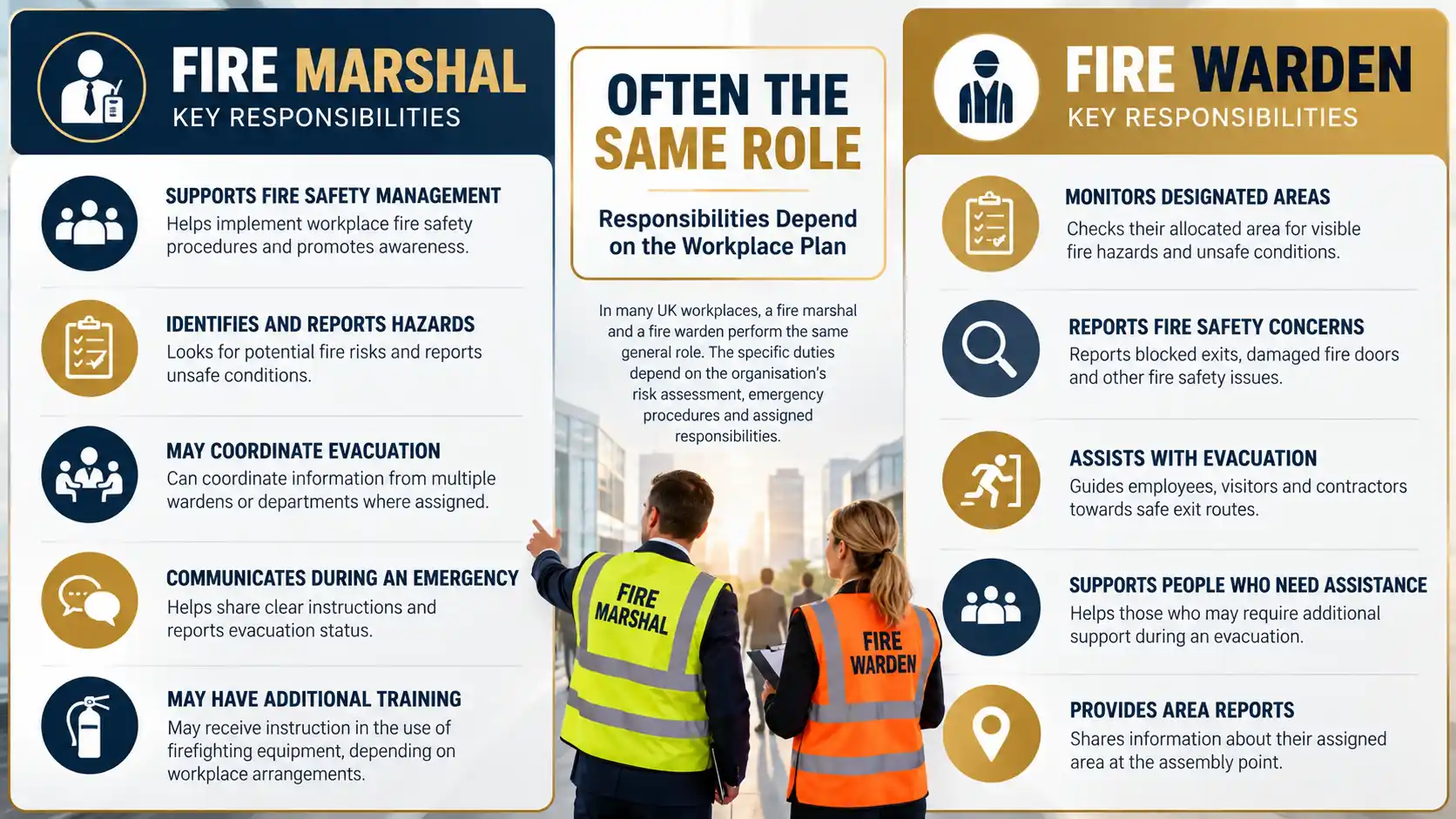
In most UK workplaces, a fire marshal and a fire warden are different names for the same appointed workplace fire safety role. Both may help maintain fire safety arrangements, guide people during evacuations, communicate emergency information and report fire safety concerns. An organisation can divide their responsibilities into separate operational and supervisory roles, but there is no universal legal hierarchy between the two titles.
What Is a Fire Marshal?
A fire marshal is a person appointed by an organisation to support the implementation of workplace fire safety procedures and help protect employees, visitors, contractors and other people who may be present in a building. The role involves both preventative responsibilities and emergency response duties, depending on the arrangements established by the employer.
Fire marshals are commonly selected from existing employees who understand the workplace, its daily activities, building layout and potential hazards. They receive additional instruction and training so that they can support the organisation’s fire safety arrangements.
A fire marshal does not automatically become responsible for all legal fire safety obligations of a business. The responsible person retains their statutory duties. The marshal assists with specific arrangements that have been delegated to them and should understand the limits of their authority.
Main Responsibilities of a Fire Marshal
Depending on the fire risk assessment and the workplace emergency plan, fire marshal duties may include:
- Supporting the implementation of workplace fire safety procedures.
- Identifying and reporting potential fire hazards.
- Monitoring whether escape routes and emergency exits remain accessible.
- Reporting damaged or obstructed fire doors and other fire safety concerns.
- Helping employees understand emergency procedures.
- Supporting planned fire drills and evacuation exercises.
- Guiding people towards designated emergency exits during an alarm.
- Checking designated areas for occupants when this can be done safely under the evacuation plan.
- Reporting evacuation information to the responsible person or designated incident coordinator.
- Assisting with communication between employees and emergency services when instructed and appropriate.
Some workplaces also assign fire marshals an additional supervisory function. For example, a senior marshal may coordinate the information received from several wardens and communicate the evacuation status to the incident coordinator. This arrangement is determined by the organisation rather than by a nationally prescribed job-title structure.
Why Are Fire Marshals Important?
During an emergency, employees and visitors may become confused, particularly when they hear an unexpected fire alarm or encounter an unfamiliar evacuation route. A trained marshal can provide clear instructions and support the planned evacuation procedure.
Their preventative contribution is equally important. Regularly reporting blocked exits, defective fire doors, unsafe storage and other potential hazards helps management identify problems before an emergency occurs. However, appointed marshals do not replace competent maintenance contractors, fire risk assessors or the responsible person.
What Is a Fire Warden?
A fire warden is an employee or appointed individual who assists with workplace fire safety arrangements and helps implement emergency evacuation procedures. The individual is normally assigned a particular floor, department, building section or operational area to help ensure that fire safety responsibilities are properly coordinated.
In many organisations, a fire warden performs exactly the same work as a fire marshal. The difference is often only the terminology used by the employer. Other organisations choose to use both titles to distinguish day-to-day monitoring activities from emergency coordination duties.
Typical Fire Warden Responsibilities
A fire warden may have responsibilities that include routine observation, reporting and assisting with evacuation procedures.
- Monitoring assigned workplace areas for visible fire hazards.
- Reporting blocked emergency exits and escape routes.
- Identifying fire doors that appear damaged or are being improperly obstructed.
- Reporting missing or damaged emergency signs.
- Helping new employees understand the workplace fire action plan.
- Knowing the nearest appropriate emergency exits.
- Assisting with evacuation communication during an alarm.
- Checking designated areas only where the agreed procedure and conditions make this safe.
- Helping visitors and contractors understand how to evacuate.
- Reporting relevant observations after an evacuation or fire drill.
Fire Warden Responsibilities in Different Workplaces
A fire warden working in a small office may be responsible for a single working area and a relatively straightforward evacuation procedure. In a hospital, hotel, shopping centre or industrial facility, the arrangements may be more complex and involve multiple departments, different evacuation strategies and additional communication requirements.
For example, a warehouse may allocate wardens to separate storage areas. Their responsibilities may involve identifying obstructed escape routes, reporting fire hazards and communicating with the emergency coordinator when the alarm activates.
In a multi-storey office, each floor may have nominated wardens who assist people towards the correct escape routes and report the status of their assigned areas. The organisation must ensure that sufficient trained people are available to implement its evacuation plan.
Fire Marshal vs Fire Warden: Key Differences Explained
The most important distinction is that the terms are frequently interchangeable, but employers may define separate responsibilities for organisational reasons. A comparison becomes useful when both titles are used within the same workplace.
The following table illustrates one possible arrangement. It should not be interpreted as a universal legal distinction between the two job titles.
| Comparison | Fire Marshal | Fire Warden |
|---|---|---|
| Meaning | Appointed person supporting workplace fire safety. | Appointed person supporting workplace fire safety. |
| Common usage | May be used as the general or supervisory role title. | May be used for an individual responsible for an assigned area. |
| Routine checks | May coordinate or participate in checks. | May monitor conditions within an assigned area. |
| Fire prevention | Identifies and reports potential fire safety problems. | Identifies and reports potential fire safety problems. |
| Evacuation | May coordinate evacuation activities. | May guide occupants towards designated exits. |
| Communication | May coordinate information from several areas. | Reports assigned-area information to the coordinator. |
| Roll call | May coordinate assembly-point reports. | May provide information about assigned areas or departments. |
| Training | Must be appropriate to assigned responsibilities. | Must be appropriate to assigned responsibilities. |
| Legal hierarchy | No automatic legal seniority based on the title. | No automatic legal seniority based on the title. |
The actual duties should be recorded in the organisation’s fire emergency arrangements. If an employer decides to use both titles, employees should receive clear job descriptions explaining who coordinates the response, who reports information and which areas each person is responsible for.
Can a Fire Marshal and Fire Warden Have Different Responsibilities?
Yes. An organisation can create separate fire marshal and fire warden responsibilities if doing so improves its workplace fire safety arrangements. This is particularly useful in larger buildings, multi-storey offices, manufacturing facilities and premises with several operational departments.
Consider a company with five floors and several hundred employees. It may appoint individual wardens for each floor and a lead marshal to coordinate information between the different departments.
Example of a Divided Responsibility Structure
Lead Fire Marshal
- Coordinates communication between appointed wardens.
- Receives evacuation reports from designated areas.
- Communicates unresolved evacuation issues to the incident coordinator.
- Supports management with emergency procedure reviews.
Department Fire Wardens
- Monitor their designated workplace areas.
- Assist occupants using the approved evacuation procedures.
- Report problems with escape routes and emergency equipment.
- Provide information about their assigned areas during evacuation.
Should One Role Always Be Senior?
No. The title alone does not establish authority or seniority. A lead marshal may have a coordinating responsibility because the employer has specifically assigned it. A warden may also have substantial responsibilities within a specialist area.
What matters is that everyone understands the emergency arrangements, has appropriate training and knows whom to contact when an issue arises.
Duties Before a Fire Alarm: Prevention and Preparedness
Fire marshal and fire warden responsibilities do not begin when an alarm sounds. Preventative activities are an important part of workplace fire safety. Routine observations, communication and reporting help organisations identify problems before they contribute to an emergency.
Monitoring Fire Hazards
Appointed personnel should understand the types of fire hazards that may exist in their workplace. Common examples include improperly stored combustible materials, overloaded electrical equipment, unsuitable charging arrangements and activities involving ignition sources.
Marshals and wardens should report hazards through the organisation’s reporting arrangements rather than attempting work outside their competence or authority.
Checking Escape Routes and Emergency Exits
Escape routes must remain available and usable. Where routine monitoring is part of the appointed person’s duties, they should identify and report obstructions, damaged door hardware, missing signs and other problems that could prevent safe evacuation.
Employees should also understand that fire doors are designed to help restrict the spread of fire and smoke. They must not be deliberately wedged open unless an appropriately designed and maintained automatic hold-open arrangement is in place.
Knowing the Emergency Plan
Appointed personnel must understand the evacuation procedure that applies to their particular premises. This includes knowing the location of emergency exits, alternative escape routes, assembly points, alarm procedures and reporting arrangements.
They should know whether the building uses simultaneous, phased or another approved evacuation strategy. They should not independently change the evacuation arrangements because they believe an alternative approach would be more convenient.
Helping Prepare Other Employees
Fire marshals and wardens can help employees become familiar with the building’s fire action notices, emergency exits and reporting procedures. They may also support induction activities and organised evacuation exercises.
Employers should make suitable arrangements for contractors, temporary workers and visitors, who may not have the same knowledge of the building as permanent employees.
Supporting Fire Drills
Fire drills help organisations determine whether employees understand emergency instructions and whether evacuation arrangements work in practice. Appointed marshals and wardens can help communicate instructions, observe evacuation difficulties and provide feedback after the exercise.
Findings should be communicated to management so that any weaknesses can be investigated and corrected. The purpose is to improve emergency preparedness rather than simply record that a drill has taken place.
Duties During a Fire Alarm: Emergency Evacuation Responsibilities
During an alarm, fire marshals and wardens should follow the established emergency plan. Their responsibilities must prioritise human safety. They should never take unnecessary risks or delay their own evacuation to complete an assigned check.
1. Respond to the Alarm Immediately
When an alarm activates, appointed personnel should follow the procedures established for their building. This may involve directing occupants towards the appropriate exits, communicating information and carrying out designated tasks.
Anyone discovering a fire should raise the alarm using the approved method and follow the emergency procedure. Staff must not assume that another person has already reported the incident.
2. Guide People Towards Safe Exit Routes
Fire marshals and wardens can help employees and visitors identify the safest available designated escape routes. Instructions should be calm, clear and consistent with the building’s evacuation strategy.
People should not be encouraged to collect personal belongings, return to their workstations or use ordinary passenger lifts during an evacuation, unless a specific lift forms part of an approved evacuation arrangement.
3. Assist Visitors and People Requiring Additional Support
Not everyone can evacuate a building in the same way. People may have mobility, sensory, communication or other support requirements that affect their ability to respond to an alarm.
The workplace fire risk assessment and evacuation arrangements should consider individual needs and identify appropriate assistance. Appointed personnel should understand their specific responsibilities and any agreed personal emergency evacuation arrangements.
Staff should not improvise unsafe lifting or carrying methods. They should follow the planned procedure and seek assistance where required.
4. Check Designated Areas Only When Safe
In some buildings, nominated personnel may be expected to check specific rooms or areas to establish whether people have evacuated. This activity is sometimes referred to as a building sweep.
A sweep must be limited by the emergency plan, available conditions and the person’s training. It must not involve entering areas affected by fire or smoke, moving towards danger or remaining in the building when evacuation is necessary.
Fire marshals and fire wardens are not firefighters. They should not put themselves in danger, search unsafe areas, attempt rescues beyond their training or delay their own escape. Their primary responsibility is to help implement safe evacuation arrangements.
5. Communicate Evacuation Information
Once occupants have evacuated, wardens may provide information about their assigned areas to the designated coordinator. This could include whether their area was checked, whether an obstacle was encountered or whether someone may still be unaccounted for.
Information should be accurate and should distinguish between confirmed observations and assumptions. Nobody should claim that the entire building is empty simply because their own department has evacuated.
6. Know the Firefighting Limitations
A fire marshal may receive additional instruction in the use of portable firefighting equipment. However, having an extinguisher course or marshal appointment does not mean that the person must tackle a fire.
Any attempt to use firefighting equipment must be consistent with the emergency plan, the person’s training and the conditions present. The fire must be at an early stage, an appropriate extinguisher must be available and a safe escape route must remain accessible.
If there is doubt, significant smoke, rapid fire development or any danger to people, evacuation must take priority. Employees should never delay raising the alarm or leaving the building to attempt firefighting.

Duties After Evacuation: Assembly Points and Reporting
Reaching the assembly point is not the end of the emergency procedure. Accurate reporting helps the organisation and emergency services understand whether everyone has been accounted for and whether further action may be necessary.
Supporting the Assembly Point Procedure
Fire marshals and wardens may help direct employees towards the designated assembly point. They should support the established headcount or reporting arrangement without creating confusion or blocking access for emergency responders.
Reporting Missing or Unaccounted-for Persons
If somebody cannot be accounted for, the information must be communicated immediately to the responsible person, incident coordinator or fire and rescue service as appropriate.
It is important to report the person’s name, department and last known location if this information is available. No marshal or warden should re-enter the building to look for someone.
Communicating with Emergency Services
When firefighters arrive, designated representatives may provide information about the building layout, known hazards, fire location, evacuation status and any people reported missing.
Fire marshals should provide information within their knowledge and avoid making assumptions. They should follow instructions from the fire and rescue service.
Preventing Unauthorised Re-entry
Employees should remain at the assembly point until the incident controller or the appropriate authority confirms that it is safe to return. A fire alarm stopping does not automatically mean that the premises are safe.
Recording and Reviewing the Incident
Following an actual emergency or a fire drill, appointed personnel can contribute to the review by reporting observations. These may include blocked exits, confusion about evacuation routes, communication problems or difficulties experienced by people requiring assistance.
Management should use this information to identify improvements in training, emergency procedures and fire safety arrangements.
Fire Marshal and Fire Warden Training: What Is Required?
Appropriate fire marshal and fire warden training helps appointed personnel understand their responsibilities, recognise workplace fire hazards and respond correctly during an emergency. The training should be suitable for the building, its fire risk assessment and the duties assigned to each individual.
In England and Wales, the Regulatory Reform (Fire Safety) Order 2005 establishes important obligations relating to safety assistance, emergency procedures and employee training. The legislation requires the responsible person to nominate a sufficient number of competent people to implement evacuation arrangements.
Competence is based on an appropriate combination of training, experience, knowledge and other relevant qualities. A course certificate can provide evidence of learning, but it does not automatically prove that an individual is competent for every workplace situation.
Essential Topics in Fire Marshal Training
Effective training should address the following areas, with the depth of instruction reflecting the individual’s expected responsibilities.
Understanding Fire Safety
- Basic principles of fire behaviour.
- Common workplace fire hazards and ignition sources.
- How fire and smoke can affect escape routes.
- Basic fire prevention and good housekeeping.
- The importance of maintaining effective fire safety arrangements.
Workplace Emergency Procedures
- Understanding the workplace emergency plan.
- Recognising fire alarms and warning signals.
- Knowing how to raise an alarm.
- Understanding emergency exits and alternative escape routes.
- Knowing the designated assembly point.
- Understanding reporting and communication arrangements.
Evacuation Responsibilities
- How to guide people towards safe exits.
- How to communicate clearly during an emergency.
- Assisting visitors and contractors.
- Understanding arrangements for people with mobility or other support needs.
- Recognising the limitations of designated area checks.
- Reporting unaccounted-for persons accurately.
Firefighting Equipment Awareness
- Recognising different types of fire extinguishers.
- Understanding the hazards associated with firefighting attempts.
- Knowing when firefighting equipment should not be used.
- Receiving practical instruction if the workplace role includes equipment use.
Communication and Incident Reporting
- Reporting fire hazards and unsafe conditions.
- Communicating evacuation information.
- Working with the designated emergency coordinator.
- Reporting faults, incidents and drill observations.
- Understanding the importance of accurate records.
Practical Training and Workplace Familiarisation
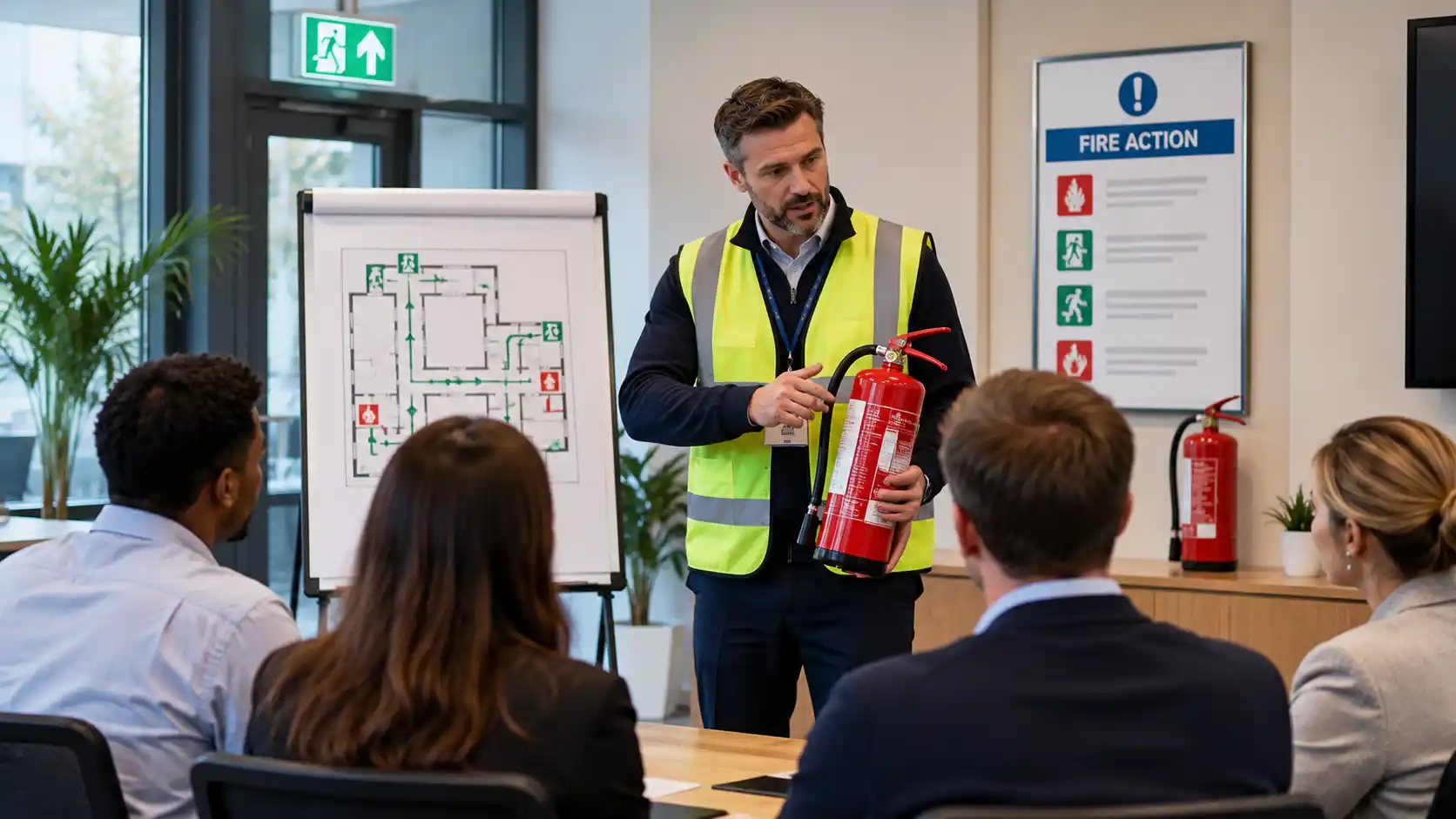
General fire awareness is useful, but a marshal or warden must also understand how the procedures work in the actual premises where they are appointed. This includes becoming familiar with the escape routes, alarm arrangements, assembly points and assigned responsibilities.
Practical exercises may involve walking designated escape routes, identifying emergency exits, understanding door operation, practising communication procedures and participating in evacuation drills.
Where a marshal is expected to use extinguishers, specific instruction and appropriate practical training should be provided. It should not be assumed that general awareness training is sufficient for this additional responsibility.
Do Fire Wardens Need Training in the UK?
Yes. Employees who are expected to carry out fire warden or fire marshal duties need sufficient training to understand and perform those duties safely and competently.
In England and Wales, Article 21 of the Regulatory Reform (Fire Safety) Order 2005 requires adequate employee fire safety training. Article 15 establishes the requirement to nominate sufficient competent people to implement relevant evacuation procedures.
The government guidance for offices and shops also explains that employees performing supervisory fire responsibilities, including fire marshals and wardens, should receive additional training appropriate to their role.
When Should Fire Marshal Training Be Provided?
Training arrangements should consider:
- When a new employee is appointed to a fire marshal or warden position.
- When employees change departments or assigned responsibilities.
- When emergency procedures or evacuation arrangements change.
- When building layouts or escape routes are altered.
- When new fire hazards or operational risks are introduced.
- When a review identifies gaps in knowledge or practical ability.
- When employees need additional instruction after an emergency or fire drill.
How Often Should Fire Marshals Receive Refresher Training?
Refresher training should be repeated as often as necessary to maintain competence and account for changes in the workplace. Employers should use their fire risk assessment, staff responsibilities, previous drill results and changes in risk to determine the appropriate arrangements.
It is important to distinguish training frequency from fire drill frequency. GOV.UK workplace guidance advises businesses to carry out at least one fire drill each year, with additional drills where appropriate. Specific guidance for offices and shops also explains that drills should be carried out at least annually or as determined by the fire risk assessment.
This does not establish a universal annual refresher-course requirement for every fire marshal and warden. Training frequency must be risk-based and suitable for the actual role.
How Should Employers Record Training?
Employers should maintain appropriate training records. Useful information includes the employee’s name, training date, training subject, provider where applicable, assessment outcome and any additional training requirements.
Records help organisations demonstrate that employees have received appropriate instruction and identify when further training or reassessment may be necessary.
UK Fire Safety Legislation and the Responsibilities of Appointed Personnel
Fire marshal and fire warden responsibilities should be understood in the context of the fire safety legislation applying to the relevant UK nation. The terminology used by an employer does not replace the legal duties imposed on the responsible person or other dutyholders.
England and Wales: Regulatory Reform (Fire Safety) Order 2005
The Regulatory Reform (Fire Safety) Order 2005 is the main fire safety legislation for non-domestic premises in England and Wales. It places responsibilities on the responsible person, which may include employers, owners, occupiers or other people with control of the premises.
Several provisions are particularly relevant to workplace fire marshals and wardens:
- Article 13 – Fire-fighting and fire detection: Addresses appropriate fire detection, warning and firefighting arrangements, including the appointment and competence of people responsible for implementing relevant firefighting measures.
- Article 15 – Procedures for serious and imminent danger: Requires appropriate emergency procedures, including safety drills, and nomination of a sufficient number of competent people to implement evacuation procedures.
- Article 18 – Safety assistance: Addresses the appointment of competent people to assist with preventive and protective measures, including appropriate numbers, time and resources.
- Article 21 – Training: Requires adequate safety training for employees, including suitable instruction about precautions and actions needed to protect themselves and others. Training should be repeated periodically where appropriate and adapted to new or changed risks.
Read the full Regulatory Reform (Fire Safety) Order 2005 and the government’s workplace fire safety guidance .
Scotland: Fire (Scotland) Act 2005
Non-domestic fire safety duties in Scotland are principally established by the Fire (Scotland) Act 2005 and Fire Safety (Scotland) Regulations 2006. These apply to the relevant workplaces, commercial premises and other non-domestic premises.
Employers and other dutyholders must ensure suitable fire safety risk assessments and arrangements are in place. Competent people may need to be nominated to assist with evacuation and other fire safety duties.
Further information is available from the Scottish Government’s non-domestic fire safety guidance .
Northern Ireland: Fire and Rescue Services (Northern Ireland) Order 2006
Northern Ireland has its own fire safety legislative framework. The Fire and Rescue Services (Northern Ireland) Order 2006 and Fire Safety Regulations (Northern Ireland) 2010 are important pieces of legislation governing fire safety in relevant non-domestic premises.
Employers and people with control of premises must address fire risks, provide appropriate precautions and ensure that employees receive suitable fire safety instruction and training.
Consult the Northern Ireland Fire & Rescue Service business fire safety guidance for further information.
The above legislation establishes fire safety obligations; it does not create a universal qualification called a fire marshal licence. Employers must ensure that appointed people are suitable and competent for the specific responsibilities they are expected to perform. Organisations operating across the UK should check the legislation and guidance applicable to each premises.
How to Choose the Right Fire Marshal or Fire Warden Course
Choosing a suitable fire marshal course or fire warden training programme requires more than comparing course titles. Employers should consider the responsibilities assigned to employees, the risks present in their premises and the learning outcomes of the available training.
1. Identify the Required Level of Responsibility
Begin by defining the duties that employees will perform. A person who only helps guide occupants towards exits may need a different training emphasis from someone who coordinates several departments or has additional firefighting responsibilities.
2. Review the Course Learning Content
An appropriate course should address the relevant principles of fire safety, workplace evacuation, emergency communication, hazard reporting and the duties of appointed personnel.
Check whether the programme includes the specific subjects needed for your premises. If practical extinguisher use is expected, verify whether separate hands-on training is required.
3. Check the Awarding Organisation and Qualification Details
Where a formal qualification is preferred, review the awarding organisation, qualification specification, assessment method and learning outcomes. Confirm that the course content relates to the intended workplace role.
A qualification level or award title alone does not guarantee that the programme covers every responsibility in your emergency plan.
4. Consider Online and Practical Learning
Online learning can be useful for developing theoretical knowledge and understanding workplace fire safety responsibilities. However, appointed personnel must also become familiar with the actual building and its evacuation procedures.
Employers should combine appropriate learning with workplace induction, route familiarisation, evacuation exercises and additional practical instruction where required.
5. Keep Training Records and Review Competence
The employer should maintain training records and periodically review whether each appointed person can perform their responsibilities. Changes to the building, staff arrangements or fire risk assessment may require additional instruction.
ProQual Level 2 Award for Fire Marshals
Employees and individuals interested in developing their understanding of workplace fire marshal responsibilities can explore the ProQual Level 2 Award for Fire Marshals.
Review the qualification’s published learning outcomes and assessment requirements to determine whether it meets your intended learning needs.
Explore Fire Marshal QualificationExplore the Complete Fire Safety Training Guide
Employers and learners who want to understand broader workplace fire safety responsibilities can also read the fire safety training guide. It provides an additional learning resource covering the importance of effective fire safety training and workplace preparedness.
Read the Fire Safety Training GuideUnderstanding Fire Watcher Training
Fire watcher duties are related to fire safety but should not automatically be confused with fire marshal or fire warden responsibilities. Fire watchers may be assigned to monitor activities such as hot work, observe potential ignition hazards and help ensure that specific fire precautions are maintained.
Their responsibilities may be different from those of an employee appointed to help implement a building evacuation procedure. Therefore, employers should select training according to the actual role being performed.
For people whose duties specifically involve fire watching, the following training options may be relevant:
- ICTQual Level 3 Diploma in Fire Watcher
- ICTQual Level 3 Certificate in Fire Watcher
- ICTQual Level 2 Award in Fire Watcher
These are fire watcher training options, not automatic substitutes for a workplace fire marshal or fire warden programme. Always compare their specifications with the duties assigned by the employer.
How Many Fire Marshals or Fire Wardens Does a Workplace Need?
There is no single staffing ratio that is suitable for every workplace. The responsible person should determine how many competent people are needed by considering the fire risk assessment, building layout, evacuation strategy and number of people likely to be present.
Simply appointing one fire marshal for an entire large building may not provide sufficient coverage. Equally, a small premises with a straightforward evacuation procedure may not require the same number of appointed people as a complex industrial facility.
Factors That Affect the Required Number
- Building size: Larger premises may need more people to cover different areas.
- Number of occupants: The maximum number of employees, visitors and contractors must be considered.
- Building layout: Multiple floors, separate buildings and complex escape routes can increase coordination requirements.
- Working patterns: Different shifts must have appropriate fire safety coverage.
- Fire hazards: Higher-risk activities may require additional arrangements.
- Occupant requirements: The organisation must consider people who may need additional assistance.
- Absence arrangements: Sufficient cover should be available when appointed personnel are on leave or unavailable.
The number of appointed personnel must also be sufficient for the time and resources available to complete their assigned duties. Employers should review coverage whenever occupancy, building arrangements or operational risks change.
Common Fire Marshal and Fire Warden Mistakes to Avoid
Even where employees have received training, unclear responsibilities and poor workplace arrangements can undermine effective fire safety management. Employers and appointed personnel should pay attention to the following common problems.
1. Assuming the Two Job Titles Always Have Different Legal Meanings
The titles are frequently interchangeable. Creating two separate positions without defining their responsibilities can lead to confusion. Organisations should clearly document any intended differences.
2. Appointing Employees Without Suitable Training
An employee should not be assigned evacuation responsibilities without understanding the emergency plan and receiving appropriate instruction. Training should reflect the duties they are expected to perform.
3. Expecting Wardens to Search Dangerous Areas
A building sweep must never encourage people to enter smoke-affected or otherwise dangerous areas. The appointed person’s safety must remain a priority.
4. Assuming Every Marshal Must Fight Fires
Fire marshals are primarily appointed to support fire safety arrangements and evacuation procedures. Firefighting should only be attempted where the organisation’s arrangements, training and conditions permit it safely.
5. Ignoring Shift and Department Coverage
A company may have enough trained marshals during normal office hours but inadequate coverage at night or during weekends. Appointments must reflect actual working patterns and building occupancy.
6. Treating a Course Certificate as Automatic Legal Compliance
A certificate is evidence of completed learning, but it does not replace a suitable fire risk assessment, workplace induction, emergency planning or practical familiarity with the premises.
7. Failing to Review the Emergency Arrangements
Changes to departments, building layouts, working activities and employee responsibilities can affect evacuation arrangements. Management should review procedures and training when significant changes occur.
Practical Examples: Fire Marshal vs Fire Warden in Different Workplaces
Understanding how these responsibilities work in different settings helps employers allocate suitable duties and identify the training required.
Example 1: Office Building
A multi-storey office appoints wardens for individual floors. They help employees understand the evacuation procedure, guide people towards designated exits and report information to the lead marshal.
The lead marshal coordinates information from different departments and communicates with the designated incident coordinator. Each person’s responsibilities are documented in the emergency arrangements.
Example 2: Manufacturing Facility
A manufacturing facility may have separate operational areas containing machinery, combustible materials and other fire hazards. The fire risk assessment identifies different emergency requirements across these areas.
Appointed personnel may report unsafe storage, obstructed escape routes and problems affecting emergency communication. Their training must account for the risks and evacuation procedures specific to the facility.
Example 3: Hotel or Shopping Centre
Hotels and shopping centres contain people who may be unfamiliar with the premises. Fire marshals and wardens may have additional responsibilities for communicating with visitors, contractors and members of the public.
Appropriate training should address the building’s evacuation arrangements, visitor management, accessible escape procedures and communication with other responsible people.
Example 4: Construction and Hot Work Areas
A construction site may require fire prevention monitoring during activities that generate sparks or heat. Fire watcher arrangements may be required where specified by the relevant risk assessment and hot-work controls.
This is a separate responsibility from general building evacuation management. An organisation should not assume that a trained fire marshal automatically has the necessary competence to perform every specialist fire watching duty.
Frequently Asked Questions: Fire Marshal vs Fire Warden
1. Is a fire marshal the same as a fire warden?
In most UK workplaces, a fire marshal and fire warden perform the same general fire safety responsibilities. Both may help prevent fire risks, communicate emergency procedures and support safe evacuation. Some organisations use the two titles for different responsibilities, but this is an internal management arrangement rather than a universal legal distinction.
2. What does a fire marshal do at work?
A fire marshal helps implement workplace fire safety procedures. Duties may include identifying and reporting hazards, monitoring escape routes, supporting employee awareness, assisting with fire drills, guiding people during evacuation and communicating relevant information at the assembly point.
3. Do fire wardens need training in the UK?
Yes. People appointed to carry out fire warden or fire marshal responsibilities should receive adequate training appropriate to their duties. In England and Wales, Articles 15 and 21 of the Regulatory Reform (Fire Safety) Order 2005 are particularly relevant to competent evacuation personnel and employee training.
4. Is fire marshal training a legal requirement?
Employers have legal obligations to provide appropriate fire safety instruction and training and ensure that appointed personnel are competent for their responsibilities. However, the legislation does not prescribe one universally compulsory course title or certificate for every fire marshal.
5. Does a fire marshal have more authority than a fire warden?
Not automatically. A marshal may have additional coordinating duties if the organisation assigns them. However, there is no universal legal hierarchy based on these job titles. The employer should define the reporting structure and responsibilities clearly.
6. Can one employee be both a fire marshal and a fire warden?
Yes. In smaller workplaces, the same person may perform both roles because the responsibilities overlap. The employer must ensure that the combined workload is manageable and that sufficient trained personnel are available to implement the emergency arrangements.
7. How many fire marshals are required in a workplace?
The required number depends on the workplace’s fire risk assessment, building layout, number of occupants, operational hazards, working patterns and evacuation arrangements. There is no single staffing ratio that automatically applies to all UK workplaces.
8. How often should fire marshal training be refreshed?
Refresher training should be provided as often as necessary to maintain competence and reflect changes in workplace risks and responsibilities. There is no universal annual refresher-course interval prescribed for every workplace. Training should be reviewed against the organisation’s fire risk assessment and emergency plan.
9. Can a fire warden use a fire extinguisher?
A fire warden may be permitted to use an appropriate extinguisher if specifically trained and if the circumstances and workplace emergency arrangements allow safe use. The individual must never put themselves or other occupants at risk or delay evacuation.
10. Can fire marshals enter a room to check whether everyone has evacuated?
Only where a designated check is part of the emergency plan and conditions make it safe. Marshals must not enter areas affected by fire or smoke, search dangerous locations or delay their own evacuation.
11. Are fire watcher and fire warden the same role?
Not necessarily. Fire watchers may monitor specific fire hazards, such as sparks and heat during hot-work activities. Fire wardens generally support building fire safety arrangements and evacuation. Responsibilities can overlap in some workplaces, but the required training should match the actual work.
12. What qualification is suitable for a workplace fire marshal?
A suitable programme should address workplace fire safety, emergency procedures, evacuation responsibilities and the specific duties expected of the learner. The ProQual Level 2 Award for Fire Marshals is one relevant training option to review. Employers should compare its learning outcomes with their workplace requirements and should not assume that one certificate replaces all site-specific instruction.
Conclusion: Understanding Fire Marshal and Fire Warden Responsibilities
The difference between a fire marshal and a fire warden is usually a matter of workplace terminology and assigned responsibilities. In many organisations, both titles describe employees who support fire prevention, emergency communication and safe evacuation. Where different positions are created, employers should clearly document their responsibilities and reporting arrangements.
Effective workplace fire safety depends on appropriate appointments, role-specific training, clear emergency procedures and regular review of the fire risk assessment. Marshals and wardens must understand their responsibilities while recognising the limits of their competence and authority.
Organisations should also ensure that enough trained personnel are available across different departments and shifts. Above all, emergency procedures must prioritise the safety of employees, visitors and everyone else who may be affected by a fire.
For individuals interested in developing their workplace fire safety knowledge, exploring a relevant fire marshal qualification is a useful starting point. Employers should select training that reflects the actual responsibilities and risks of their premises.
Develop Your Fire Marshal Knowledge and Competence
Explore relevant fire safety training and qualifications to strengthen your understanding of workplace fire prevention, emergency procedures and fire marshal responsibilities.
Explore Fire Marshal TrainingOfficial Fire Safety Legislation and References
The following authoritative resources can help employers, safety professionals and learners understand workplace fire safety responsibilities and the legal framework applicable to their premises.
- The Regulatory Reform (Fire Safety) Order 2005 – Main fire safety legislation for England and Wales.
- Article 15 – Emergency procedures and competent personnel – Establishing and implementing evacuation arrangements.
- Article 18 – Safety assistance – Appointment and adequacy of competent persons.
- Article 21 – Training – Adequate employee fire safety training.
- GOV.UK – Fire Safety in the Workplace – Responsible persons and workplace fire safety duties.
- GOV.UK – Fire Safety Equipment, Drills and Training – Training and emergency drill arrangements.
- GOV.UK – Fire Safety Risk Assessment: Offices and Shops – Government guidance on workplace fire marshals, wardens and evacuation procedures.
- Scottish Government – Non-Domestic Fire Safety – Fire safety legislation and guidance in Scotland.
- Northern Ireland Fire & Rescue Service – Business Fire Safety – Fire safety responsibilities for Northern Ireland businesses.
Editorial note: This article provides general workplace fire safety information. It is not a substitute for a suitable fire risk assessment, competent professional advice or the legislation and guidance applicable to a particular premises.