
How to Review Fire Safety Actions After an Inspection
A practical UK workplace guide to evaluating inspection findings, prioritising fire risks, assigning responsibilities, verifying corrective measures and maintaining continuous fire safety improvement.
Completing a fire safety inspection is only one stage of effective fire risk management. The real value of an inspection depends on what an organisation does with its findings. Identified hazards, maintenance deficiencies, weaknesses in emergency arrangements and gaps in staff awareness must be evaluated, prioritised and addressed through a structured corrective action process.
Knowing how to review fire safety actions after an inspection helps Responsible Persons, facilities managers, employers and fire safety professionals determine whether recommended improvements have been completed and whether they have genuinely reduced the risks to people using the premises. Simply marking an action as complete does not demonstrate that a fire safety problem has been resolved.
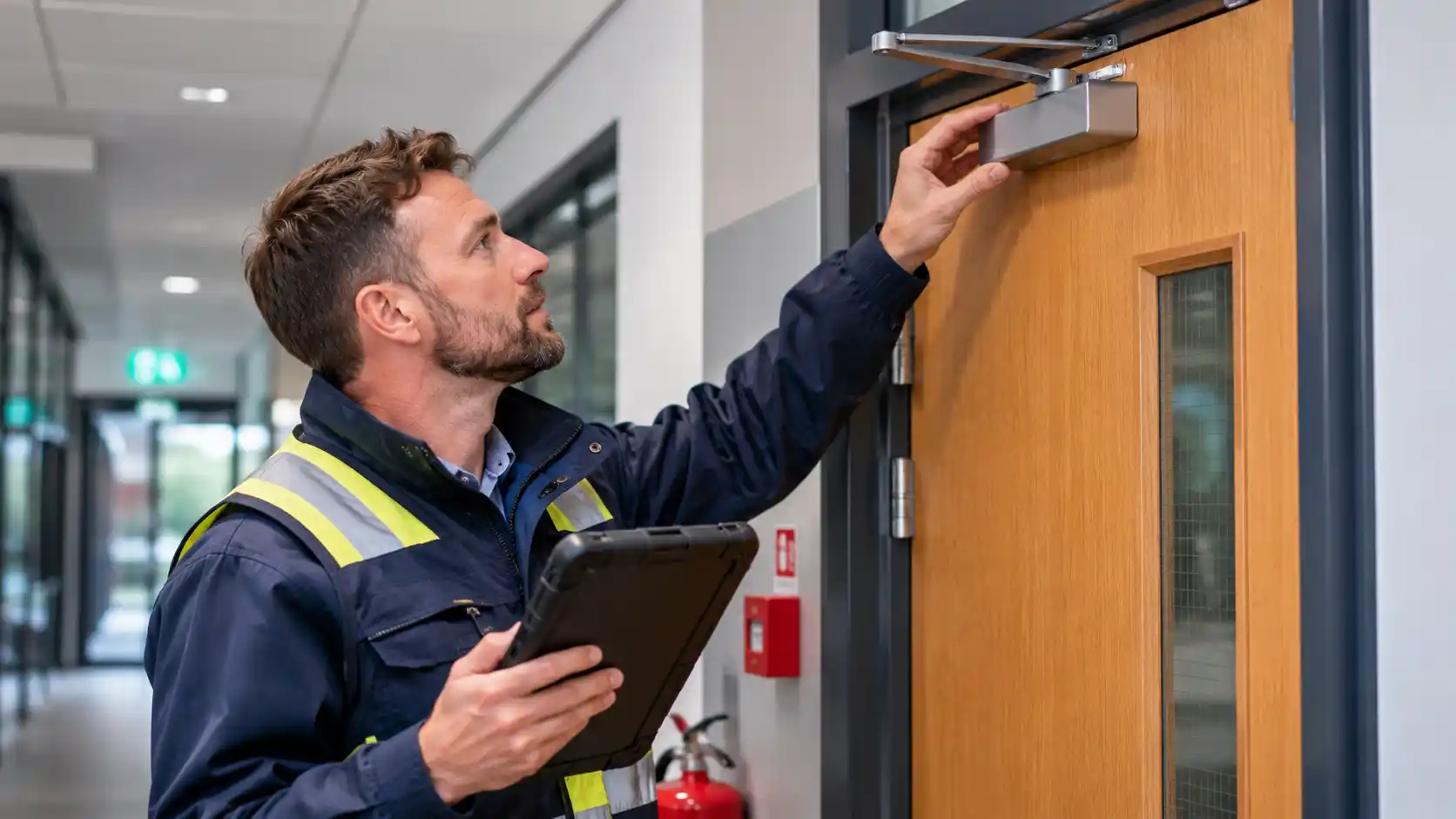
For example, an inspection may identify a fire door that does not close correctly. Arranging a repair is an important first step, but management must also establish whether the correct repair was completed, whether the door closes effectively and whether suitable evidence has been retained. If the underlying problem remains, the action should not be treated as successfully closed.
This guide explains a practical, evidence-based approach to reviewing inspection findings in UK workplaces. It covers risk prioritisation, action ownership, deadlines, verification, overdue recommendations, documentation and continuous improvement. It is relevant to offices, warehouses, educational facilities, healthcare environments, retail premises, hospitality businesses and other non-domestic buildings.

1. What Does It Mean to Review Fire Safety Actions After an Inspection?
Reviewing fire safety actions after an inspection is the structured process of examining identified deficiencies, assessing their risk, monitoring corrective measures and confirming whether the completed work has achieved its intended safety outcome. It connects inspection findings with practical improvements and provides management with evidence that fire safety responsibilities are being actively managed.
A fire safety inspection may identify immediate hazards, maintenance problems, weaknesses in fire prevention arrangements or opportunities to improve existing controls. These findings should be converted into clearly defined actions rather than remaining as observations in an inspection report.
Understanding the difference between an inspection and an action review
An inspection primarily identifies and records the condition of fire safety arrangements at a particular time. A post-inspection review evaluates the organisation’s response to the findings and determines whether the necessary improvements have been achieved.
| Inspection activity | Post-inspection review activity | Expected outcome |
|---|---|---|
| Identify a damaged fire door. | Check the repair, installation and functional performance. | Effective fire and smoke separation is maintained. |
| Identify obstructed escape routes. | Verify removal of obstructions and review storage controls. | Escape routes remain accessible. |
| Identify missing maintenance records. | Obtain records and establish an effective maintenance system. | Maintenance can be demonstrated and monitored. |
| Identify inadequate staff awareness. | Review training arrangements and assess staff understanding. | People understand their emergency responsibilities. |
What should a post-inspection review examine?
- The original inspection findings and recommendations.
- The significance of each identified fire safety deficiency.
- Existing controls and any additional measures required.
- The person responsible for implementing each action.
- Agreed completion dates and progress updates.
- Evidence showing what work has been completed.
- Whether the corrective measures have actually reduced risk.
- Any remaining issues requiring escalation or further investigation.
A useful review also distinguishes between an action that has been completed administratively and one that has been verified as effective. This distinction prevents organisations from reporting improvements that have not yet produced a demonstrable safety benefit.
2. Why Reviewing Fire Safety Actions After an Inspection Is Important
Reviewing inspection actions is essential because identifying a fire safety problem does not automatically remove the hazard. An organisation must take suitable measures to address the issue and maintain appropriate protection for employees, visitors, contractors and other relevant people.
Protecting employees, visitors and other occupants
The primary purpose of fire safety management is to protect people. Unresolved inspection findings may leave occupants exposed to hazards that could affect fire prevention, early warning, evacuation or protection against fire spread.
For example, a defective emergency lighting system may affect the ability of occupants to identify escape routes during a power failure. If the inspection finding is recorded but no effective corrective action is taken, the underlying vulnerability remains.
Supporting compliance with UK fire safety legislation
In England and Wales, the Regulatory Reform (Fire Safety) Order 2005 establishes duties relating to general fire precautions, suitable and sufficient fire risk assessments and maintenance of relevant fire safety facilities and equipment.
Article 9 requires the Responsible Person to review the fire risk assessment regularly and particularly when relevant changes or circumstances make a review necessary. Article 17 addresses suitable maintenance systems for relevant premises, facilities, equipment and devices.
Reviewing inspection actions helps organisations demonstrate that identified weaknesses are being considered and addressed as part of their wider fire safety arrangements. It does not, by itself, guarantee legal compliance.
Official guidance is available in the GOV.UK Fire Safety Risk Assessment: Five-Step Checklist .
Reducing the likelihood of repeated deficiencies
Some inspection findings are symptoms of wider management problems. Repeatedly discovering blocked fire exits, defective door closers or incomplete maintenance records may indicate that existing monitoring arrangements are ineffective.
An effective review looks beyond the immediate defect and considers why it occurred. This allows management to introduce preventive controls, clarify responsibilities and reduce the possibility of similar problems returning.
Improving accountability and operational management
A documented action review provides visibility of outstanding work. Managers can identify which departments require assistance, where contractors have not completed their work and whether additional resources are necessary.
It also creates a consistent record for internal audits, management reviews and future inspections. Where a fire safety issue requires specialist attention, the organisation can demonstrate what has been identified, escalated and undertaken.
3. How to Review Fire Safety Actions After an Inspection: Step-by-Step Process
A structured review process makes it easier to manage inspection findings across different departments, buildings and operational environments. The following stages provide a practical framework for converting inspection observations into measurable safety improvements.
Collect and examine the inspection report
Begin by obtaining the complete inspection report, including observations, photographs, recommendations, previous action records and any supporting technical information.
Read each finding carefully and confirm that the description reflects the actual condition of the premises. Where an observation is unclear, contact the inspector or competent person for clarification instead of making assumptions.
Check the following information:
- Location and description of the identified problem.
- Relevant equipment, building feature or safety arrangement.
- Potential consequences if the issue remains unresolved.
- Recommended corrective measures.
- Any immediate precautions already introduced.
- Supporting photographs, measurements or technical observations.
Validate the findings against workplace conditions
The next stage is to determine whether the recorded findings accurately represent the current workplace conditions. Some issues may have changed since the inspection, while others may require additional investigation.
For example, an inspector may report combustible materials stored near an electrical distribution board. The review should establish what materials were present, whether the storage arrangement has changed and whether suitable controls are now in place.
Validation should not be used to dismiss inconvenient findings. Where there is uncertainty, the organisation should seek appropriate technical advice and maintain proportionate precautions until the position is established.
Assess the risk associated with every finding
Not every inspection finding presents the same level of danger. Management should evaluate the potential consequences, likelihood of occurrence, exposure of relevant people and effectiveness of existing controls.
A blocked final exit, for example, may require immediate intervention because it can directly compromise evacuation. A minor documentation improvement may require a different response, provided no underlying safety deficiency is being concealed.
Develop clear corrective actions
Convert each finding into a specific task that describes the required improvement. Avoid vague instructions such as “improve fire safety”, “check the doors” or “resolve maintenance issues”.
A useful corrective action identifies the problem, describes the required result and establishes how successful completion will be demonstrated.
For example, instead of writing “repair fire door”, specify that the defective closer must be assessed and repaired by a competent contractor, with subsequent functional checks and recorded evidence.
Assign an accountable owner and deadline
Every action should have a clearly identified person responsible for coordinating and completing it. This may be a facilities manager, maintenance supervisor, department manager or appointed contractor, depending on the work involved.
Set completion deadlines according to risk, complexity, resource availability and any applicable legal or enforcement requirements. An arbitrary deadline should never be allowed to delay an urgent life-safety measure.
Monitor implementation and maintain communication
Record progress and check whether the assigned owner has the necessary resources, technical information and authority to complete the action. If delays arise, identify the cause and determine whether temporary precautions or escalation are necessary.
Communicate significant issues to the Responsible Person and relevant managers. Where multiple organisations share premises, coordinate actions so that one party’s work does not leave another area exposed.
Verify completion and close the action appropriately
Once the work is reported as complete, examine the supporting evidence. This may include photographs, maintenance certificates, inspection records, test results or a follow-up site visit.
Confirm that the original problem has been resolved and that the improvement has not introduced another hazard. If the corrective measure is ineffective, reopen the action and agree further work.
Update the fire safety records and review the outcome
Update the action register, retain supporting evidence and determine whether the fire risk assessment or emergency arrangements require revision.
The final review should consider outstanding risks, recurring findings, lessons learned and opportunities to improve future inspection and maintenance arrangements.
4. How to Check Inspection Findings and Identify Outstanding Fire Safety Issues
Checking inspection findings requires more than reading the summary section of a report. The reviewer should examine individual observations, compare them with existing fire safety records and determine whether previous corrective actions have been completed effectively.
Compare current findings with previous inspection reports
Comparing reports helps identify recurring problems. If a fire door defect appears in several inspections, the issue may involve ineffective maintenance, inadequate contractor performance or poor monitoring.
Recurring findings deserve particular attention because they may indicate that earlier corrective measures addressed the visible symptom without resolving the underlying cause.
Check physical fire safety arrangements
Depending on the scope of the inspection, review relevant building features and fire protection arrangements, including:
- Fire doors, frames, seals, closers and door hardware.
- Emergency escape routes, final exits and evacuation arrangements.
- Fire alarm and detection system maintenance records.
- Emergency lighting and relevant test documentation.
- Fire extinguishers and other appropriate firefighting equipment.
- Compartmentation and fire-resisting construction.
- Housekeeping, combustible storage and ignition-source management.
- Fire safety signage and emergency instructions.
The inspection scope and technical checks should reflect the building, occupancy, hazards and applicable requirements. Specialist systems should be assessed by appropriately competent people.
Identify findings that remain unresolved
An outstanding finding is any issue that has not been adequately addressed or verified. It may include an action that has not started, a repair awaiting specialist parts, an incomplete maintenance programme or a measure that has been implemented but has not achieved the intended outcome.
| Finding status | Meaning | Required management response |
|---|---|---|
| Open | Action has not been completed. | Confirm owner, risk controls and deadline. |
| In progress | Corrective work has started. | Monitor progress and check interim protection. |
| Awaiting verification | Work is reported as finished but not checked. | Obtain evidence and assess effectiveness. |
| Reopened | Previous work did not resolve the problem. | Investigate the cause and revise the action. |
| Closed | Completion and effectiveness have been verified. | Retain records and monitor ongoing controls. |
5. How to Prioritise Fire Safety Actions Based on Risk Level
Risk-based prioritisation helps organisations decide which findings require immediate intervention and which can be addressed through planned improvements. The most important consideration is the potential impact on people’s safety, not simply the number of outstanding tasks.
Evaluate likelihood, consequences and exposure
Consider how likely the hazardous event is to occur, what consequences could result and how many people may be affected. Examine whether vulnerable occupants, unfamiliar visitors, lone workers or people requiring assistance during evacuation could face additional risks.
Also consider the condition and reliability of existing controls. A defect affecting an essential escape route may demand a more urgent response than a minor administrative deficiency.
Use a practical risk-based priority framework
| Priority | Typical example | Management response |
|---|---|---|
| Critical / Immediate | Serious obstruction to evacuation or a major failure of an essential life-safety arrangement. | Take immediate action, introduce suitable precautions and escalate to the Responsible Person. |
| High | Significant fire protection defect or repeated failure of an important safety control. | Arrange urgent corrective work and monitor until verified. |
| Medium | Deficiency requiring improvement where existing controls remain effective. | Assign an owner and implement within an appropriate planned period. |
| Low / Improvement | Minor procedural or documentation improvement without an immediate material safety concern. | Include in the improvement plan and monitor completion. |
This is an illustrative management framework, not an official statutory classification or universal risk-scoring system. Actual priorities must reflect the premises, circumstances, risk assessment and any enforcement requirements.
Understand when immediate precautions are necessary
If an inspection identifies a serious hazard, organisations should not wait for the next scheduled management meeting. Immediate action may involve removing an obstruction, restricting access to an unsafe area, stopping a hazardous activity or arranging an appropriate temporary control.
Where a critical fire protection system is unavailable, the Responsible Person should obtain competent advice and determine the necessary compensatory measures. Depending on the circumstances, this may include additional monitoring, changes to occupancy or operations, alternative arrangements or evacuation.

6. Reviewing Action Owners, Responsibilities and Completion Deadlines
An effective fire safety action plan needs clear accountability. Without an identified owner, even important corrective measures can remain unresolved because departments assume another person or contractor is responsible.
Assign responsibilities according to competence and authority
The action owner should have sufficient authority, knowledge and access to resources to coordinate the work. A facilities manager may oversee building repairs, while a maintenance specialist may arrange technical servicing and a department manager may coordinate staff training.
The person carrying out specialist work should have the competence required for that task. Assigning an action to an employee does not automatically make that employee competent to inspect, repair or certify specialist fire protection systems.
Distinguish between accountability and task delegation
An organisation may delegate individual tasks, but the Responsible Person’s legal duties must still be properly fulfilled. The review should establish who authorises expenditure, who coordinates implementation and who checks the outcome.
Set realistic but risk-appropriate deadlines
Deadlines should reflect the urgency of the problem, the availability of competent contractors, the complexity of repairs and any applicable legal requirements. They should not be selected simply because a particular department prefers a longer completion period.
| Role | Typical responsibility | Evidence of involvement |
|---|---|---|
| Responsible Person | Oversees fire safety arrangements and ensures appropriate action is taken. | Approvals, review records and escalation decisions. |
| Facilities Manager | Coordinates premises-related corrective work. | Work orders, contractor records and site checks. |
| Maintenance Supervisor | Coordinates relevant maintenance activities. | Maintenance logs and technical reports. |
| Department Manager | Implements departmental controls and staff arrangements. | Training records and workplace checks. |
| Competent Contractor | Completes specialist work within their competence. | Service records, certificates and technical evidence. |
7. How to Verify Completed Fire Safety Actions and Supporting Evidence
Verification is one of the most important stages in reviewing fire safety actions. An action should not be closed merely because someone reports that the work has been completed. Management must establish whether the corrective measure is appropriate, whether it has been implemented and whether it has achieved the intended result.
Collect objective evidence of completed work
Evidence should be appropriate to the nature of the finding. Different corrective measures require different forms of verification.
- Photographs: Useful for demonstrating the removal of obstructions or changes in storage arrangements.
- Maintenance records: Show that equipment has been inspected or serviced.
- Technical reports: Support specialist repair or installation work.
- Test results: Demonstrate the results of relevant functional checks.
- Training records: Confirm participation in fire safety training.
- Site inspections: Allow an appropriate person to assess the physical outcome.
- Updated procedures: Demonstrate changes to emergency or operational arrangements.
Check whether the corrective measure is effective
Evidence of work completion does not always establish effectiveness. A contractor’s invoice may show that a repair was undertaken, but it does not necessarily demonstrate that the original safety issue has been resolved.
Consider a defective fire door. The review should examine whether the repair was appropriate and whether the door operates correctly. Technical matters requiring specialist judgement should be checked by a suitably competent person.
Record verification decisions
A useful closure record should include the person who checked the work, the date of verification, the evidence reviewed, the result and any remaining limitations. Where the action is not effective, the record should explain why it remains open or has been reopened.
8. Reviewing Overdue, Incomplete and Ineffective Fire Safety Actions
Overdue actions require active management because an outstanding finding may represent an unresolved risk. The organisation should establish why the work has not been completed and whether existing precautions remain adequate.
Identify why an action has been delayed
Common reasons include contractor availability, delayed equipment delivery, insufficient budgets, unclear responsibilities, technical difficulties and changes in operational priorities.
Recording the reason is useful, but it does not make an unsafe condition acceptable. The Responsible Person must consider the current risk and determine whether further measures are necessary.
Escalate significant unresolved findings
Escalation arrangements should identify who must be informed when an action becomes overdue or when the remaining risk exceeds the authority of the assigned owner. Serious matters should be brought to the Responsible Person and appropriate senior management without delay.
Reopen ineffective corrective actions
Sometimes an action is completed but the original deficiency returns. This may indicate that the corrective measure was temporary, incomplete or based on an incorrect understanding of the problem.
For example, repeatedly removing combustible materials from an escape corridor may not provide a lasting solution if the organisation has failed to establish appropriate storage arrangements. A more effective action would address the underlying operational cause.
Introduce suitable interim controls
If permanent corrective work cannot be completed immediately, consider what additional precautions are necessary to protect occupants. These measures should be proportionate, documented and regularly reviewed. The need for temporary controls should not be interpreted as permission to continue operating with an unacceptable level of risk.
9. How to Update the Fire Safety Action Plan After an Inspection
A fire safety action plan translates inspection findings into a manageable programme of corrective and preventive work. It should provide an accurate picture of outstanding issues, assigned owners, deadlines, progress and verification status.
Maintain a central action register
A central register helps management monitor actions across the building or organisation. It may be maintained using a controlled spreadsheet, compliance management system or other suitable record-keeping process.
A practical register should include:
- Unique action reference.
- Inspection date and report reference.
- Location and description of the finding.
- Risk level and priority.
- Required corrective action.
- Responsible action owner.
- Target completion date.
- Current status and progress notes.
- Supporting evidence and verification date.
- Closure decision or escalation details.
Example of a completed action-plan entry
| Field | Illustrative example |
|---|---|
| Finding | Fire door does not close fully. |
| Location | Ground-floor corridor. |
| Priority | High, subject to assessment of the specific fire strategy and risk. |
| Corrective action | Arrange competent inspection and repair of the closing mechanism. |
| Owner | Facilities Manager. |
| Deadline | Risk-based target date set by management. |
| Evidence | Contractor report, repair record and functional verification. |
| Status | Awaiting verification until the outcome is checked. |
Update the fire risk assessment where necessary
Inspection findings may reveal that the existing fire risk assessment no longer accurately describes the premises or the effectiveness of current controls. If significant changes, new hazards or other relevant circumstances are identified, the Responsible Person should determine whether the assessment needs to be reviewed and updated.
Changes to building layout, occupancy, work processes, storage arrangements or fire protection systems may affect the assessment. The review should also consider incidents, near misses and repeated deficiencies.
For a broader understanding of the process, read our complete guide to fire safety , which provides additional context on workplace fire prevention and management.
10. Fire Safety Action Review Checklist for UK Workplaces
A practical checklist can help Responsible Persons and facilities managers conduct consistent reviews. The following questions provide a useful starting point for evaluating inspection findings and corrective action progress.
Inspection report review
- Has the complete inspection report been obtained?
- Have all findings and recommendations been examined?
- Have unclear observations been clarified?
- Have previous inspection reports been compared?
- Have recurring and unresolved issues been identified?
Risk assessment and prioritisation
- Has each finding been assessed according to its risk?
- Have occupants who may need additional assistance been considered?
- Have urgent hazards been addressed without unnecessary delay?
- Are temporary control measures suitable and documented?
- Have significant changes to risk been considered?
Responsibilities and implementation
- Does every action have an identified owner?
- Are responsibilities aligned with competence and authority?
- Are deadlines appropriate to the level of risk?
- Are the required resources and contractors available?
- Are overdue actions being escalated?
Verification and record keeping
- Has evidence of corrective work been collected?
- Has completion been independently or appropriately verified?
- Have ineffective actions been reopened?
- Are closure decisions documented?
- Have relevant fire safety records been updated?
- Has the need to review the fire risk assessment been considered?

11. Common Mistakes to Avoid When Reviewing Fire Safety Actions
Even organisations with established inspection procedures can struggle to close corrective actions effectively. Many problems arise because reviews focus on administrative completion instead of actual risk reduction.
Closing actions without verification
One of the most significant mistakes is accepting a verbal update or contractor invoice as sufficient evidence of successful completion. Verification should reflect the technical and operational requirements of the corrective measure.
Using vague action descriptions
Instructions such as “improve housekeeping” do not provide a clear completion standard. Define the expected improvement, location, responsible person and evidence needed to demonstrate completion.
Setting deadlines without considering risk
Treating every finding as an ordinary maintenance request can result in serious hazards remaining unresolved. Priority should reflect the potential consequences and the effectiveness of existing precautions.
Failing to address recurring problems
Repeated findings often indicate that an earlier corrective action did not address the underlying cause. Review the management system, storage arrangements, maintenance procedures and responsibilities rather than repeatedly applying short-term fixes.
Not involving the right people
Fire safety actions may involve facilities teams, department managers, specialist contractors, landlords and managing agents. Failure to coordinate these parties can create delays, duplicated work or gaps in responsibility.
Keeping incomplete or disconnected records
Separate emails, photographs and maintenance documents can make it difficult to establish the history of an action. Link supporting evidence to the original inspection finding and maintain a clear record of decisions and verification.
Ignoring changes after the inspection
Fire safety conditions can change because of building work, new equipment, occupancy changes, new storage arrangements or altered operational activities. An action plan should reflect the current premises rather than simply repeat the previous inspection report.
12. How Regular Reviews Support Continuous Fire Safety Improvement
Fire safety action reviews should form part of an ongoing management process. Their purpose is not simply to clear an inspection backlog but to identify weaknesses, strengthen controls and improve the organisation’s ability to prevent and respond to fire.
Use inspection trends to identify management weaknesses
Review findings over time to identify recurring problems, departments with repeated deficiencies and maintenance activities that frequently become overdue. Patterns can reveal whether existing controls are appropriate or whether management arrangements require improvement.
Measure the quality of corrective action management
Organisations can monitor useful internal indicators such as the number of open actions by priority, overdue high-risk findings, repeated defects, verification failures and actions reopened after unsuccessful completion.
These indicators should support informed decisions rather than become targets that encourage premature closure. A low number of open actions is not necessarily evidence of good performance if actions are being closed without adequate verification.
Strengthen communication and staff awareness
Employees can contribute to fire prevention by reporting blocked exits, damaged equipment, unsafe storage and other emerging hazards. Feedback from inspections should be communicated to relevant teams so that lessons are understood and improvements become part of routine work.
Appropriate fire safety training supports this process by helping employees understand workplace hazards, emergency procedures and their responsibilities. Organisations seeking additional information can explore our fire safety training guide .
Use digital systems where they improve control
Digital registers and compliance platforms can help organisations assign actions, set reminders, attach photographs and monitor outstanding work. They are particularly useful for larger premises and organisations managing several buildings.
However, software does not replace competent assessment, management decisions or physical verification. The quality of the review still depends on accurate information, suitable controls and accountable people.
13. Who Is Responsible for Reviewing Fire Safety Actions After an Inspection?
Responsibility depends on the premises, organisational structure and level of control held by the relevant parties. Under the Regulatory Reform (Fire Safety) Order 2005, the Responsible Person has important duties relating to fire safety arrangements in applicable premises in England and Wales.
The Responsible Person may be an employer, building owner, landlord, occupier or another person with control over the premises. Where more than one Responsible Person exists, they must cooperate and coordinate their arrangements.
In practice, individual actions may be coordinated by facilities managers, fire safety managers, maintenance supervisors, department managers and competent contractors. Their responsibilities should be clearly defined so that findings are not left without appropriate attention.
Role of the Responsible Person
The Responsible Person should ensure that suitable fire safety arrangements exist, significant findings receive appropriate attention and relevant controls are implemented and maintained. Delegating tasks does not remove the need to fulfil applicable legal responsibilities.
Role of the fire safety manager or facilities manager
These professionals may coordinate inspection reviews, maintain action registers, communicate with contractors, monitor deadlines and arrange verification. The exact scope of their responsibilities should be established by the organisation.
Role of competent fire risk assessors and contractors
Competent specialists may provide technical advice, conduct assessments or complete specific remedial work. Their findings and records can support management decisions, but the organisation must still ensure that appropriate action is taken.
Understanding shared premises responsibilities
In multi-occupied buildings, different parties may control different areas or building systems. Owners, landlords, tenants and managing agents should establish clear arrangements for communicating findings, accessing relevant areas and coordinating remedial work.
For additional guidance, refer to the official GOV.UK guidance on workplace fire safety responsibilities .
14. UK Fire Safety Legal Considerations When Reviewing Inspection Actions
Organisations should understand the legislation relevant to their premises rather than assuming that every UK workplace follows exactly the same legal framework. The requirements can vary according to location, building type, occupancy and the nature of the activities undertaken.
Regulatory Reform (Fire Safety) Order 2005
The Fire Safety Order is the principal fire safety legislation for applicable non-domestic premises in England and Wales. Article 8 addresses general fire precautions, Article 9 covers fire risk assessment and Article 17 addresses suitable maintenance arrangements.
Post-inspection reviews should support the effective management of these responsibilities by ensuring that relevant findings are assessed, appropriate measures are implemented and required maintenance is maintained.
Read the full Regulatory Reform (Fire Safety) Order 2005 .
Fire Safety Act 2021
The Fire Safety Act 2021 clarified the application of the Fire Safety Order to the structure, external walls and specified flat entrance doors in relevant multi-occupied residential buildings. These matters should be considered where applicable to the premises being reviewed.
Fire Safety (England) Regulations 2022
These regulations introduce additional duties for Responsible Persons in specified multi-occupied residential buildings in England. Requirements include provisions concerning information for residents, fire doors and other building safety arrangements, depending on the building’s characteristics.
Organisations responsible for relevant residential buildings should consult the official Fire Safety (England) Regulations 2022 guidance .
Scotland and Northern Ireland
Fire safety requirements differ across the UK. Scotland and Northern Ireland operate separate legislative and regulatory arrangements. Organisations with premises in these jurisdictions should consult the relevant local authorities and official guidance before applying an England and Wales-based action review process.
15. Developing Professional Knowledge in Fire Safety Management
Effective fire safety action management requires knowledge of fire hazards, risk assessment principles, relevant legislation, building protection measures and the management of corrective work. Professionals involved in these activities should understand both the technical requirements and the organisational responsibilities associated with fire safety.
Professional learning can help Responsible Persons, facilities professionals, fire safety managers and aspiring fire risk assessors develop their understanding of inspection findings, risk evaluation, evidence collection and improvement planning.
Relevant professional development pathways include:
- ProQual Level 5 Award in Fire Risk Assessment for developing professional understanding of fire risk assessment.
- ICTQual Level 3 Diploma in Fire Risk Assessor for building knowledge relevant to fire risk assessment practice.
- ProQual Level 4 Award in Advanced Fire Risk Assessment for further professional development in fire risk assessment.
- QualCert Level 3 Award in Fire Safety for Managers for managers seeking to strengthen workplace fire safety knowledge.
Course suitability should be assessed against the learner’s experience, professional responsibilities and intended career development. Completing a course does not automatically establish competence for every specialist fire safety task.
16. Frequently Asked Questions About Reviewing Fire Safety Actions
What should happen after a fire safety inspection?
The inspection report should be reviewed, findings validated, risks prioritised and corrective actions assigned to appropriate owners. Management should monitor implementation, verify completed work, update relevant records and consider whether the fire risk assessment requires review.
How often should fire safety actions be reviewed?
Actions should be monitored according to their risk, agreed deadlines and operational requirements. High-priority findings require closer attention than routine improvements. The Responsible Person should also ensure that fire risk assessments are reviewed regularly and when relevant circumstances or significant changes require it.
Who is responsible for closing fire safety inspection actions?
The Responsible Person retains applicable legal responsibilities, while individual tasks may be delegated to facilities managers, maintenance teams, department managers or competent contractors. Appropriate verification should take place before an action is formally closed.
What evidence is required to close a fire safety action?
Evidence depends on the corrective work. It may include photographs, maintenance records, contractor reports, technical certificates, relevant test results, training records or a follow-up inspection. Evidence should demonstrate that the action has been implemented and that its intended outcome has been achieved.
What should an organisation do if a fire safety action is overdue?
Determine why the action has been delayed, reassess the remaining risk, introduce suitable interim precautions where necessary and escalate the issue to the appropriate management level. Agree a revised completion plan without allowing administrative delays to leave serious hazards uncontrolled.
Can fire safety inspection actions be managed digitally?
Yes. A digital action register or compliance platform can record findings, assign owners, set deadlines, attach evidence and monitor progress. Organisations should maintain suitable access controls, accurate records and reliable verification procedures.
Does closing an inspection action mean the fire risk assessment must be updated?
Not automatically. However, the review should consider whether the findings, corrective work or changes to the premises affect the existing assessment. Where significant changes or other relevant circumstances arise, the Responsible Person should determine whether a review or update is necessary.
What is the difference between corrective and preventive fire safety actions?
Corrective actions address an identified deficiency, while preventive actions aim to reduce the likelihood of similar problems occurring again. For example, repairing a defective door closer is corrective; introducing an appropriate inspection and maintenance programme helps prevent repeated failures.
Should all fire safety inspection findings be treated as urgent?
No. Findings should be prioritised according to their potential consequences, likelihood, exposure and existing controls. However, any issue that presents an immediate threat to life safety requires prompt attention and appropriate precautions.
What is the purpose of a fire safety action register?
An action register provides a central record of inspection findings, corrective measures, owners, deadlines, progress, supporting evidence and closure decisions. It helps management monitor unresolved issues and demonstrate that corrective actions are being managed.
Conclusion: Building a Stronger Fire Safety Action Review Process
Reviewing fire safety actions after an inspection is an essential part of effective workplace fire risk management. It ensures that identified deficiencies receive appropriate attention and that corrective measures are implemented, monitored and verified.
A reliable review process begins with an accurate examination of the inspection report and continues through risk assessment, action prioritisation, responsibility allocation, implementation and evidence-based verification. Outstanding findings should remain visible, while ineffective actions should be reopened and investigated.
For UK organisations, these activities should support the wider responsibilities of the Responsible Person and the applicable fire safety legislation. Maintaining accurate records, reviewing changing workplace conditions and involving competent people can strengthen the effectiveness of fire safety arrangements.
Ultimately, the success of a fire safety inspection should not be measured simply by how many actions have been marked complete. It should be evaluated by whether the identified risks have been appropriately controlled and whether the organisation is better prepared to protect everyone using its premises.
Strengthen Your Professional Fire Safety Knowledge
Develop your understanding of workplace fire safety, risk assessment, inspection processes and professional management through relevant fire safety learning and development opportunities.
Explore Fire Risk Assessment Learning Explore Fire Safety for ManagersOfficial Fire Safety References and Further Reading
- Regulatory Reform (Fire Safety) Order 2005
- GOV.UK: Fire Safety Risk Assessment – Five-Step Checklist
- GOV.UK: Fire Safety in the Workplace
- GOV.UK: Fire Safety (England) Regulations 2022
Editorial note: This article provides general educational information, not a substitute for a premises-specific fire risk assessment, competent professional advice or legal advice. Applicable requirements depend on the location, premises and circumstances.