
Workplace Fire Safety Audits: How to Turn Findings into Corrective Actions
Discover how to transform workplace fire safety audit findings into practical corrective actions. Learn how to identify deficiencies, prioritise fire risks, assign responsibilities, improve compliance and establish a continuous fire safety improvement process.

Workplace fire safety audits are essential for understanding whether an organisation’s fire prevention, protection and emergency arrangements are working effectively. However, identifying problems is only the beginning. The real value of an audit comes from what an organisation does with its findings.
A blocked emergency exit, defective fire door, inadequate staff training arrangement or missing maintenance record can reveal weaknesses that require management attention. If these issues remain unresolved, the organisation may continue to expose employees, visitors, contractors and other relevant persons to avoidable fire risks.
Effective workplace fire safety audits turn findings into corrective actions by converting observations into clearly defined improvements. This involves understanding the seriousness of each issue, identifying its underlying cause, allocating responsibility, establishing realistic deadlines and verifying that the completed work has resolved the problem.
For UK employers, building owners, facilities managers and responsible persons, this process also supports the effective implementation and review of fire safety arrangements. It helps connect inspection activities with risk management, maintenance, staff awareness and legal responsibilities.
An organisation should document each finding, evaluate its risk, identify the root cause, assign a responsible person, set a completion deadline, implement the corrective action and verify its effectiveness. Significant or immediate threats must receive urgent attention rather than waiting for the next scheduled audit.
Introduction to Workplace Fire Safety Audits
Fire safety is an ongoing management responsibility rather than a one-time inspection activity. Workplaces change as organisations introduce new equipment, recruit employees, modify layouts, store different materials and undertake maintenance or construction activities. These changes can create additional fire hazards or affect existing protective arrangements.
Workplace fire safety audits provide an organised way to examine these arrangements and determine whether they remain appropriate. They can identify physical defects, weaknesses in management procedures, gaps in employee knowledge and failures in inspection or maintenance systems.
Nevertheless, an audit report does not automatically improve workplace safety. A report containing numerous observations has limited practical value if management does not decide which issues require immediate intervention, who should resolve them and how the organisation will confirm that improvements have been successful.
A structured corrective action process bridges this gap. It connects the auditor’s observations with management decisions and practical workplace improvements. It also helps organisations identify recurring problems instead of repeatedly addressing the same visible defects without correcting their underlying causes.
For example, if an auditor repeatedly discovers combustible materials obstructing an escape route, simply removing the materials may provide a temporary solution. A more effective corrective action would investigate why the obstruction occurs, review storage arrangements, introduce appropriate controls and establish routine monitoring.
This approach transforms fire safety auditing into a continuous improvement activity that supports safer working environments and more reliable emergency preparedness.
What Are Workplace Fire Safety Audits and Why Are They Important?
A workplace fire safety audit is a systematic examination of an organisation’s fire safety arrangements, controls, records and workplace conditions. Its purpose is to identify whether existing precautions are appropriate, effectively implemented and maintained.
An audit may involve physical inspections, document reviews, discussions with employees, examination of maintenance records and an evaluation of emergency arrangements. Its scope should reflect the nature of the premises, workplace activities, occupancy and relevant fire hazards.
It is important to distinguish a fire safety audit from a statutory fire risk assessment. Under the Regulatory Reform (Fire Safety) Order 2005, responsible persons in England and Wales must undertake a suitable and sufficient fire risk assessment and implement appropriate precautions. An audit can provide assurance about how those arrangements operate, but it does not replace that legal duty.
Why are workplace fire safety audits important?
Early identification of hazards
Audits identify developing problems such as damaged equipment, unsafe storage, blocked escape routes and inadequate housekeeping before they contribute to a serious incident.
Improved risk management
Structured findings help managers understand which deficiencies require urgent intervention and which improvements can be managed through planned maintenance.
Stronger legal compliance
Audit evidence can help responsible persons review whether fire safety arrangements are implemented, maintained and supported by suitable records.
Better emergency preparedness
Reviewing evacuation arrangements, alarm systems, employee knowledge and emergency procedures helps identify weaknesses that may affect people’s ability to respond safely.
Supporting a proactive workplace safety culture
Regular auditing encourages employees and managers to identify problems before they become incidents. It also creates opportunities to discuss workplace concerns, improve reporting arrangements and strengthen individual accountability.
Organisations should make fire safety responsibilities understandable at every level. Employees need to know how to report defects, maintain good housekeeping and follow emergency procedures. Managers need to ensure that reported problems receive appropriate attention and resources.
For further guidance, read our article on workplace fire safety responsibilities.
What Do Workplace Fire Safety Audits Turn Findings Into?
Workplace fire safety audits turn findings into corrective actions, risk reduction measures, improved procedures and measurable safety improvements. They convert identified weaknesses into an organised programme of work that can be assigned, implemented and monitored.
A finding should not simply state that something is wrong. It should provide enough information for the organisation to understand the problem, assess its consequences and determine an appropriate response.
From audit observation to corrective action
Consider an audit that identifies a fire exit obstructed by stored packaging materials. The finding should describe the location, the condition observed, the potential effect on evacuation and the action required to restore a safe means of escape.
The organisation should then examine why the obstruction occurred. If the storage area is inadequate, removing the packaging alone will not prevent recurrence. Management may need to reorganise the storage layout, establish designated storage areas and introduce routine checks.
| Audit observation | Underlying concern | Corrective action | Verification |
|---|---|---|---|
| Blocked fire exit | Inadequate storage controls | Clear exit and introduce storage controls | Inspect route and review housekeeping checks |
| Damaged fire door | Insufficient inspection or maintenance | Arrange competent inspection and repair | Review repair evidence and door operation |
| Outdated evacuation training | No effective refresher schedule | Deliver appropriate training and briefings | Review training records and staff understanding |
| Missing maintenance records | Weak documentation management | Recover records and establish a controlled register | Sample-check records and maintenance schedules |
Corrective actions and preventive actions
Corrective actions address an identified problem and its cause. Preventive measures reduce the likelihood of similar problems developing elsewhere or returning in the future.
For example, repairing one defective fire door is a corrective action. Introducing a suitable inspection programme for relevant fire doors throughout the premises can help prevent similar defects from remaining undetected.
Both approaches are valuable. Organisations should avoid treating every audit observation as an isolated maintenance task when the underlying issue may involve supervision, procurement, training or management systems.
Key Areas Covered During a Workplace Fire Safety Audit
A comprehensive workplace fire safety audit should consider the interaction between physical fire precautions, workplace activities, management arrangements and emergency procedures. The precise inspection scope depends on the premises and the findings of the relevant fire risk assessment.
Fire detection and alarm systems
Auditors should review whether suitable fire detection and warning arrangements are provided for the premises. This may include examining alarm coverage, control equipment, manual call points, maintenance records and reported faults.
Findings involving defective equipment, unresolved system faults or inadequate warning arrangements should be referred to appropriately competent personnel. Any necessary testing, repair or modification should follow relevant technical requirements.
Emergency exits and escape routes
Escape routes must remain suitable and available for occupants. Audits should examine corridors, stairways, exit doors, travel routes, final exits and relevant emergency signage.
Obstructions, damaged doors, unsuitable locking arrangements or changes to building layouts may affect evacuation. Findings should be assessed promptly, particularly where people’s ability to leave safely could be compromised.
Fire doors and compartmentation
Fire doors and fire-resisting construction can help restrict the spread of fire and smoke. An audit may examine visible damage, door operation, self-closing devices, gaps, seals, unauthorised alterations and maintenance information.
Where a defect is identified, the organisation should obtain an assessment from a competent specialist and arrange appropriate remedial work. Fire doors should not be modified or repaired using improvised methods.
Organisations seeking specialist knowledge in this area can explore the ProQual Level 3 Award in the Inspection and Testing of Fire Resisting Door Installations.
Firefighting equipment and protection systems
Auditors may examine the availability, suitability, accessibility and maintenance status of firefighting equipment and other protective systems. This can include extinguishers, hose reels, sprinklers and other systems relevant to the building.
Organisations should ensure that any equipment defects are assessed and addressed by competent service providers. Equipment must not be assumed suitable merely because it is physically present.
Electrical safety and ignition sources
Electrical installations, portable equipment, charging arrangements, heating equipment and other ignition sources should be considered where relevant to the workplace’s fire risk.
Visible damage, unsafe use, poor maintenance and inadequate control of electrical equipment can indicate weaknesses that need investigation. Specialist electrical inspections and repairs should be undertaken by appropriately qualified personnel.
Housekeeping and combustible materials
Auditors should examine how combustible waste, packaging, chemicals and other potentially hazardous materials are stored and managed. Excessive accumulation can increase the available fuel and create additional challenges for evacuation and firefighting.
Storage practices should also prevent materials from obstructing escape routes, fire doors, electrical installations and access to emergency equipment.
Staff training and emergency procedures
Fire safety arrangements depend on people understanding their responsibilities. An audit should review employee instruction, training arrangements, evacuation procedures, fire warden responsibilities and the management of visitors and contractors.
Particular attention should be given to people who may require assistance during evacuation. Procedures should reflect the needs of the actual occupants and the characteristics of the premises.

How to Turn Fire Safety Audit Findings into Corrective Actions
Turning workplace fire safety audit findings into corrective actions requires a structured process. Each finding should be understood, prioritised, assigned and verified. The following approach helps organisations move from identifying weaknesses to achieving meaningful improvements.
Step 1: Document Every Audit Finding Clearly
The first step is to create an accurate record of each observation. Findings should be specific, factual and supported by relevant evidence.
Instead of writing that fire safety arrangements are inadequate, identify the exact problem. For example, record that a designated escape corridor was partially obstructed by stored materials during the inspection.
A useful finding should include:
- Location of the observation.
- Description of the identified deficiency.
- Photographs or supporting evidence where appropriate.
- Potential consequences for fire safety.
- Relevant procedure, requirement or assessment reference.
Clear records prevent misunderstandings and provide a reliable basis for deciding what must happen next.
Step 2: Assess and Prioritise the Risks
Not all audit findings require the same response. Organisations should assess each issue according to its potential consequences, likelihood, exposure and impact on existing protective arrangements.
For example, an obstruction affecting a critical escape route may demand immediate action. A minor documentation improvement may be managed through a planned administrative process, provided it does not conceal a significant safety weakness.
Risk assessment should reflect the actual circumstances rather than relying on a numerical score alone. A low-looking score must never be used to justify leaving a serious fire safety defect unresolved.
Step 3: Investigate the Root Cause
Management should determine why the issue occurred rather than simply correcting its visible symptoms.
Useful investigation methods include asking why the problem developed, reviewing maintenance history, discussing the issue with relevant employees and examining existing procedures.
For example, recurring obstructions may indicate inadequate storage capacity, unclear departmental responsibilities or ineffective supervisory checks.
Addressing these underlying causes makes corrective actions more sustainable and reduces the likelihood of repeated findings.
Step 4: Define the Required Corrective Action
Each finding should have a specific action that addresses the identified deficiency and its underlying cause.
Actions should describe the required outcome rather than simply stating that the matter will be investigated or reviewed.
For instance, where a fire door is defective, the action could require a competent inspection, appropriate remedial work and confirmation that the door performs as intended.
Where a procedural weakness is identified, the action may involve revising the procedure, communicating the changes and checking that employees understand their responsibilities.
Step 5: Assign Responsibility and Deadlines
Every corrective action should have a clearly identified owner. This person is responsible for coordinating the work, arranging the necessary resources and providing progress updates.
Depending on the issue, responsibility may sit with facilities management, maintenance, health and safety, human resources, operations or senior management.
Completion dates should reflect the seriousness of the risk, the work involved and any applicable requirements. Immediate hazards require immediate controls rather than an ordinary future deadline.
Step 6: Implement the Corrective Measures
Implementation may involve physical repairs, specialist inspections, changes to working arrangements, updated procedures, additional training or improved monitoring systems.
Management should ensure that the work is carried out by competent personnel and that temporary arrangements do not introduce additional hazards.
Where a critical safety system is affected, suitable interim controls should be considered while permanent corrective work is arranged. The organisation should seek competent advice on any necessary restrictions or alternative arrangements.
Step 7: Verify Completion and Effectiveness
Once the work is completed, the organisation should verify that the action has addressed the original problem.
Verification may involve a follow-up inspection, review of service documentation, testing by a competent specialist or examination of updated training records.
For recurring issues, management should check whether the new controls continue to work over an appropriate period.
Only close the finding when sufficient evidence demonstrates that the required action has been implemented and the remaining risk is appropriately controlled.
Step 8: Review Results and Prevent Recurrence
The final stage is to evaluate the wider lessons from the audit. Repeated findings may reveal problems with procurement, maintenance planning, staff supervision or management oversight.
Management should review trends, identify departments with recurring issues and decide whether existing fire safety arrangements require wider improvement.
This turns individual corrective actions into organisational learning and supports continuous improvement.
Best Practices for Effective Workplace Fire Safety Audits
Effective workplace fire safety audits should produce clear, practical and measurable improvements. Organisations can improve their auditing processes by following consistent methods and involving the people responsible for maintaining workplace safety.
Use a risk-based auditing approach
Audit frequency and scope should reflect the risks associated with the premises. A manufacturing facility with hazardous processes may require a different auditing programme from a small administrative office.
Management should consider occupancy, building characteristics, previous incidents, maintenance history, changes in activities and the findings of the fire risk assessment.
Use competent auditors
Auditors should have appropriate knowledge, experience and competence for the scope of the assessment. Complex fire protection systems, fire-resisting construction and specialist engineering matters may require additional technical expertise.
Where external specialists are engaged, organisations should check their relevant experience, qualifications and the scope of services provided.
Involve employees and departmental managers
Employees often understand practical workplace conditions that may not be obvious during a short inspection. They can identify recurring obstructions, equipment problems, communication weaknesses and difficulties with emergency procedures.
Departmental managers should also participate because they are often responsible for implementing operational changes and ensuring that corrective actions remain effective.
Maintain a central corrective action register
A central register provides visibility of outstanding findings, responsible persons, target dates, current status and verification evidence. It also helps senior management identify overdue or repeatedly occurring issues.
Organisations can manage this information using a suitable spreadsheet, maintenance management platform or safety management system.
Monitor trends rather than individual findings alone
A single defect may be isolated, but repeated observations can indicate a wider management problem. For example, recurring fire door defects across several departments may suggest weaknesses in inspection coverage or maintenance arrangements.
Reviewing patterns helps organisations direct resources towards the areas that require systemic improvement.
Keep records accurate and accessible
Organisations should retain audit reports, corrective action records, relevant inspection evidence, maintenance information and verification documents. Records should be controlled, accessible to authorised personnel and updated when arrangements change.
Review corrective actions at management level
Senior management should receive meaningful information about significant findings, overdue actions, recurring deficiencies and resource requirements. This helps ensure that fire safety improvements receive appropriate organisational support.
Common Fire Safety Audit Findings and How to Address Them
Workplace fire safety audits often identify problems involving housekeeping, escape routes, fire protection equipment, maintenance, staff awareness and documentation. The following examples demonstrate how findings can be converted into practical corrective measures.
| Common finding | Possible underlying cause | Recommended response |
|---|---|---|
| Blocked emergency exits | Poor storage arrangements or supervision | Restore the escape route immediately and introduce effective housekeeping controls. |
| Defective fire doors | Wear, damage or inadequate inspection | Arrange competent assessment and appropriate remedial work. |
| Missing maintenance records | Weak document control or contractor coordination | Establish a controlled maintenance register and record system. |
| Inadequate staff awareness | Insufficient induction or refresher training | Provide suitable information, instruction and training. |
| Damaged electrical equipment | Insufficient maintenance or unsafe use | Remove unsafe equipment from use and arrange competent inspection. |
| Unclear evacuation procedures | Outdated emergency planning | Review the emergency plan and communicate updated arrangements. |
| Combustible waste accumulation | Inadequate waste management | Improve waste removal, storage controls and housekeeping checks. |
Example: Addressing repeated blocked escape routes
Imagine that a warehouse audit identifies materials stored along a designated escape corridor. The immediate response should be to restore the route and assess whether the obstruction has affected the safety of occupants.
Management should then investigate why employees are using the corridor for storage. Possible reasons include insufficient warehouse capacity, unclear storage responsibilities or ineffective supervisory arrangements.
A sustainable improvement might involve redesigning storage locations, marking designated areas, updating housekeeping procedures and introducing routine inspections. Management should subsequently review whether the corridor remains unobstructed.
Example: Addressing recurring fire door defects
If multiple audits identify damaged or poorly functioning fire doors, organisations should investigate whether the problem relates to inadequate inspection, physical damage, inappropriate alterations or maintenance arrangements.
Corrective measures may include competent door inspections, appropriate repairs, improved reporting procedures and a documented inspection programme. Where relevant, the organisation should also examine whether similar defects exist elsewhere in the building.
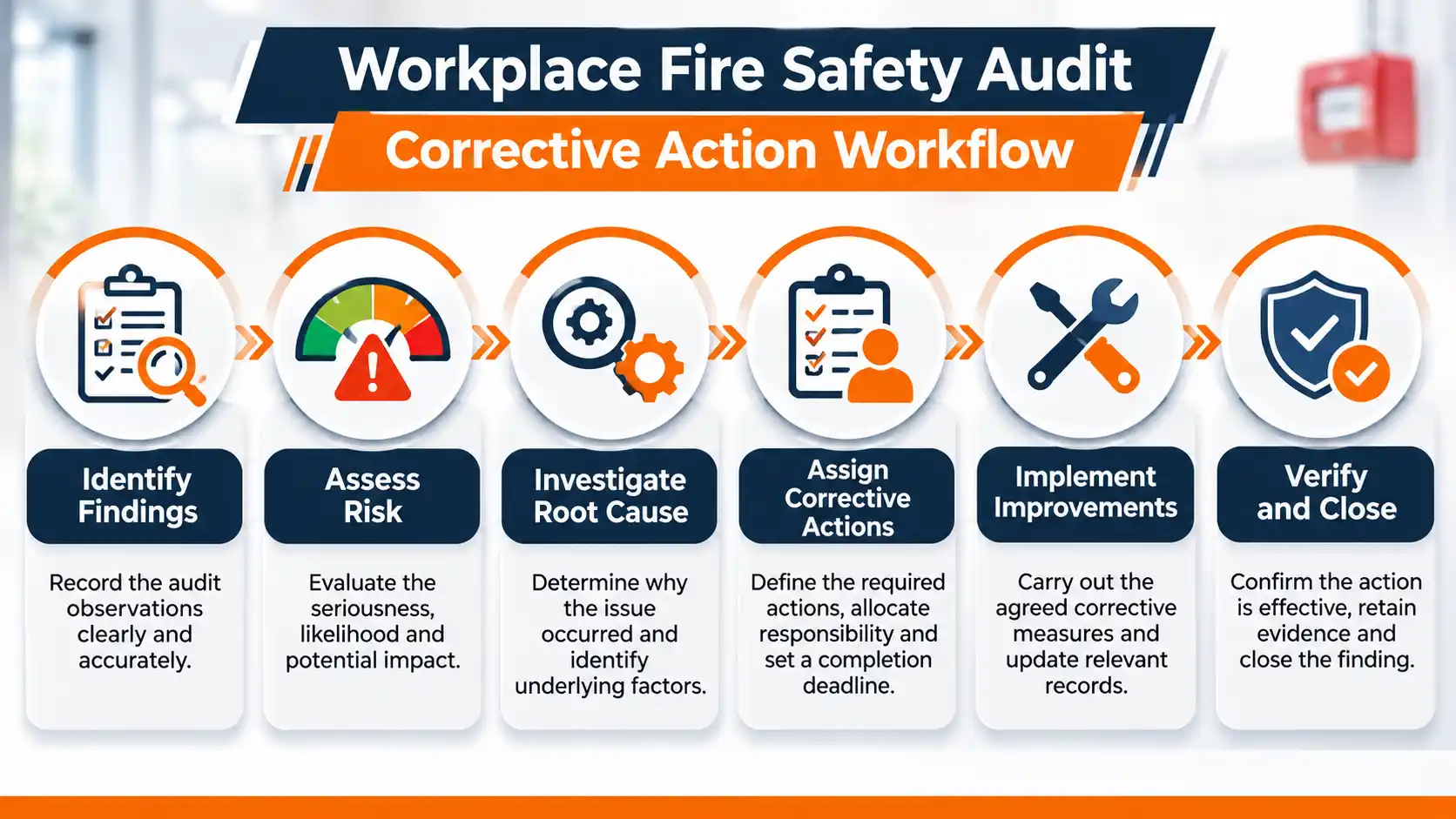
Developing a Workplace Fire Safety Corrective Action Plan
A corrective action plan provides a documented method for managing issues identified during workplace fire safety audits. It explains what needs to be improved, who is responsible, when the work should be completed and how the organisation will verify the outcome.
Essential elements of a corrective action plan
A useful plan should include the following information:
- Finding reference: A unique identification number linked to the original audit report.
- Description: A clear explanation of the identified issue.
- Risk priority: An assessment of the urgency and potential consequences.
- Root cause: The reason the issue occurred, where established.
- Required action: The specific improvement needed.
- Action owner: The person responsible for coordinating completion.
- Target date: A deadline appropriate to the risk and work involved.
- Evidence: Records, photographs, service reports or other relevant documentation.
- Verification: Confirmation that the action has been implemented and is effective.
- Closure status: Whether the finding remains open or has been properly closed.
Example corrective action register
| Finding | Priority | Action | Responsible role | Evidence required |
|---|---|---|---|---|
| Blocked exit | Urgent | Clear route and introduce controls | Site Manager | Inspection record and photographs |
| Damaged fire door | Risk assessed | Competent inspection and repair | Facilities Manager | Specialist report and repair evidence |
| Training gap | Planned | Deliver suitable staff training | HR / Safety Manager | Training and attendance records |
| Missing records | Planned | Establish a controlled document register | Compliance Manager | Updated document register |
The priorities shown are illustrative rather than universal classifications. Actual urgency must be determined through a competent assessment of the circumstances. A critical fire safety deficiency must not be left unresolved simply because a standard administrative deadline has been assigned.
Setting measurable completion criteria
Corrective actions should be specific enough for management to determine whether they have been completed successfully. Vague statements such as “improve fire safety” or “review the procedures” do not establish a measurable outcome.
Instead, define what must change and what evidence will demonstrate completion. For example, a revised evacuation procedure should be approved, communicated to relevant employees and reflected in appropriate training arrangements.
Monitoring progress and overdue actions
Management should review open actions regularly and investigate delays. If an action cannot be completed by its original deadline, the responsible manager should reassess the risk, introduce suitable interim controls where necessary and agree a revised completion plan.
Overdue high-risk findings should be escalated to appropriate senior management. They should not remain hidden within an ordinary maintenance or administration backlog.
Verifying and closing actions
Action closure should be supported by objective evidence. Depending on the issue, this may involve inspection photographs, competent service reports, updated procedures, training records or documented verification checks.
Where the original action has not adequately resolved the problem, it should remain open or be replaced with a more effective corrective action.
For organisations developing specialist competence in fire safety risk assessment, the ICTQual AB Level 3 Award in Fire Safety Risk Assessment and Control is a relevant learning pathway to explore.
UK Fire Safety Regulations and Compliance Requirements
Workplace fire safety audits should be aligned with the legislation and guidance applicable to the premises. In the UK, fire safety requirements differ between England and Wales, Scotland and Northern Ireland. Organisations must identify the legal framework relevant to their location and activities.
Regulatory Reform (Fire Safety) Order 2005
The Regulatory Reform (Fire Safety) Order 2005 is the principal fire safety legislation applying to most non-domestic premises in England and Wales. It establishes duties for the responsible person, including employers, owners, occupiers and others who have control of relevant premises.
Article 8 addresses general fire precautions, while Article 9 requires a suitable and sufficient assessment of the risks to relevant persons. The assessment must be reviewed regularly and particularly when circumstances change or there is reason to believe it is no longer valid.
Organisations should use audit findings to identify weaknesses in their arrangements and determine whether additional precautions or reviews of the fire risk assessment are necessary.
Read the Regulatory Reform (Fire Safety) Order 2005.
Fire Safety Act 2021
The Fire Safety Act 2021 clarified the application of the Fire Safety Order to the structure, external walls and specified elements of multi-occupied residential buildings, including individual flat entrance doors between domestic premises and common parts.
Where these provisions are relevant to a building, responsible persons should ensure that their fire risk assessments and associated management arrangements consider the applicable requirements.
Read the official Fire Safety Act 2021 guidance.
Fire Safety (England) Regulations 2022
The Fire Safety (England) Regulations 2022 introduced additional requirements for responsible persons in relevant buildings in England. These include duties concerning information, building records and fire door checks in specified circumstances.
Organisations responsible for applicable multi-occupied residential buildings should consider these duties when planning inspections and reviewing corrective action arrangements.
Read the Fire Safety (England) Regulations 2022.
Building Safety Act 2022: Section 156
Section 156 of the Building Safety Act 2022 strengthened responsibilities under the Fire Safety Order. The relevant changes came into force on 1 October 2023 and include requirements for responsible persons to record their fire risk assessment in full and maintain records of their fire safety arrangements.
These requirements reinforce the importance of maintaining accurate documentation, recording findings and ensuring that corrective actions can be evidenced.
Read the official Section 156 guidance.
Scotland and Northern Ireland
Scotland and Northern Ireland have separate fire safety legislation and guidance. For example, relevant Scottish workplace fire safety requirements are established under the Fire (Scotland) Act 2005 and associated regulations. Northern Ireland has its own framework, including the Fire and Rescue Services (Northern Ireland) Order 2006 and associated fire safety regulations.
Employers and building managers should consult the relevant authorities and competent professionals rather than automatically applying England-specific regulations to premises elsewhere in the UK.
Using audit findings to support compliance
A well-managed corrective action process helps organisations demonstrate that fire safety concerns are identified, assessed and addressed. However, an audit report or completed action register does not automatically establish legal compliance.
Responsible persons must ensure that the actual fire safety arrangements meet the requirements applicable to their premises. They should also ensure that relevant maintenance, training, inspection and risk assessment records remain accurate and available.
For additional information, consult the UK Government workplace fire risk assessment guidance and the guidance on who is responsible for workplace fire safety.

Conclusion: Improving Workplace Fire Safety Through Effective Audits
Workplace fire safety audits are valuable tools for identifying weaknesses in fire prevention, protection, maintenance and emergency preparedness. However, their effectiveness depends on how organisations respond to the findings.
Turning workplace fire safety audit findings into corrective actions requires more than producing an inspection report. Organisations must assess risks, investigate underlying causes, define practical improvements, assign responsibilities and establish suitable completion deadlines.
Verification is equally important. Management should confirm that corrective measures have been implemented and that they have effectively addressed the identified problems. Recurring findings should be investigated to determine whether wider changes to workplace procedures or management systems are required.
By adopting a structured approach, employers, responsible persons, facilities managers and fire safety professionals can improve accountability, strengthen emergency preparedness and support ongoing compliance with applicable fire safety requirements.
Ultimately, the purpose of an effective workplace fire safety audit is not simply to identify what is wrong. It is to ensure that meaningful improvements are implemented, maintained and continuously reviewed to help protect everyone who may be affected by a workplace fire.
Develop Your Fire Safety Risk Assessment Knowledge
Build specialist knowledge of fire risk assessment, fire safety management and workplace fire prevention through relevant professional learning programmes.
Explore Fire Safety QualificationsFrequently Asked Questions About Workplace Fire Safety Audits
What are workplace fire safety audits?
Workplace fire safety audits are systematic reviews of an organisation’s fire safety arrangements, including fire prevention measures, protection systems, emergency procedures, maintenance records and employee awareness. They help identify weaknesses and opportunities for improvement.
What do workplace fire safety audits turn findings into?
Workplace fire safety audits turn findings into corrective actions, risk reduction measures, improved procedures and measurable safety improvements. These actions should have clear owners, suitable deadlines and evidence of successful completion.
How do you turn fire safety audit findings into corrective actions?
Document each finding, assess its risk, investigate the underlying cause, define an appropriate corrective action, assign responsibility, establish a deadline, implement the improvement and verify its effectiveness.
What are the most common workplace fire safety audit findings?
Common findings include blocked escape routes, damaged fire doors, inadequate housekeeping, defective fire safety equipment, missing maintenance records, insufficient staff training and weaknesses in emergency evacuation procedures.
Who is responsible for completing fire safety corrective actions?
Responsibility depends on the nature of the finding and the organisation’s management structure. Facilities managers, maintenance teams, health and safety professionals, departmental managers and senior management may each have specific responsibilities.
How should fire safety audit findings be prioritised?
Findings should be prioritised according to their potential consequences, likelihood, exposure and impact on existing safety arrangements. Issues that threaten safe evacuation or involve critical protective systems require urgent assessment and appropriate action.
How often should workplace fire safety audits be conducted?
There is no single audit frequency appropriate for every workplace. Organisations should establish a risk-based audit programme that considers premises, activities, previous findings, changes, applicable requirements and the condition of existing precautions. This is separate from the duty to review the fire risk assessment regularly.
What is the difference between a fire safety audit and a fire risk assessment?
A fire risk assessment evaluates fire hazards, people at risk and the precautions required to protect them. A fire safety audit reviews the effectiveness of fire safety arrangements, controls and management processes. An audit may support the review of a fire risk assessment but does not replace the statutory assessment.
What should a workplace fire safety corrective action plan include?
It should include the audit finding, risk priority, root cause, required corrective measure, responsible person, target completion date, supporting evidence, verification method and closure status.
Why is root cause analysis important in fire safety audits?
Root cause analysis helps identify why a deficiency occurred rather than simply correcting its visible symptoms. It supports sustainable improvements and helps prevent repeated problems involving maintenance, supervision, training or workplace procedures.
How can organisations verify completed fire safety corrective actions?
Verification can involve follow-up inspections, photographs, specialist service reports, updated procedures, training records and relevant testing evidence. The method should be appropriate to the issue and demonstrate that the required improvement has been achieved.
Does completing a fire safety audit guarantee legal compliance?
No. Completing an audit does not automatically guarantee compliance. The responsible person must ensure that the premises meet applicable legal requirements and that suitable fire precautions are implemented, maintained and reviewed.
Official UK Fire Safety Resources
Use the following authoritative resources for further information:
- Regulatory Reform (Fire Safety) Order 2005
- Fire Safety Act 2021
- Fire Safety (England) Regulations 2022
- GOV.UK: Workplace Fire Risk Assessments
- HSE: General Fire Safety
- Section 156 Fire Safety Responsibilities
This article provides general educational information. It does not replace a suitable and sufficient fire risk assessment, specialist professional advice or the legal duties applicable to individual premises.