
Fire Safety for Contractors: Site Rules, Inductions and Responsibilities
Discover practical construction fire safety procedures, contractor induction requirements, hot work precautions, site responsibilities and emergency planning measures that help protect workers, property and the public.

Fire safety is an essential part of managing construction sites, refurbishment projects, commercial maintenance and specialist contracting work. Contractors frequently work around combustible materials, temporary electrical installations, hot work equipment and incomplete fire protection systems. Without suitable controls, these conditions can expose workers, building occupants, neighbouring properties and the public to serious danger.
Fire safety for contractors requires clear site rules, effective inductions, suitable risk assessments, competent supervision and well-understood emergency procedures. Every worker must understand the hazards associated with their tasks, the precautions required before starting work and the actions to take if a fire occurs.
Construction sites change continuously. Work areas move, new subcontractors arrive, materials are delivered and temporary arrangements are modified. Consequently, fire safety measures must be reviewed as the project develops rather than treated as a one-time exercise.
This guide explains how to establish contractor fire safety rules, conduct effective site inductions, control hot work, allocate responsibilities and maintain safe working conditions. It also includes practical checklists for contractors and site managers.
Fire safety for contractors is the identification, prevention and control of fire hazards associated with construction, maintenance and refurbishment work. It includes site-specific rules, worker inductions, task risk assessments, safe material storage, ignition-source controls, emergency arrangements and regular monitoring.
Why Is Fire Safety Important for Contractors?
Construction activities can introduce ignition sources and combustible materials into environments where permanent fire protection may not yet be installed or operational. Contractors may also work in enclosed spaces, temporary structures and occupied buildings where smoke can affect people who are not directly involved in the work.
Effective fire prevention reduces foreseeable risks and supports safer project delivery. The UK Health and Safety Executive (HSE) provides specific guidance for managing fire risks throughout construction projects in its publication Fire Safety in Construction (HSG168).
Protecting workers and the public
Fire and smoke can spread beyond the immediate work area. Contractors need controls that protect operatives, subcontractors, visitors, building occupants and nearby members of the public.
Reducing property damage
A construction fire can damage structures, materials, equipment and neighbouring properties. Prevention helps reduce the likelihood of costly disruption and recovery work.
Coordinating different trades
Welding, electrical installation, painting and adhesive application may create interacting hazards. Coordination allows site managers to manage work sequences and shared risks.
Meeting applicable requirements
Site arrangements should reflect relevant legislation, contractual obligations, risk assessments and client requirements. Legal duties depend on the country, project and role.
Common Fire Hazards on Construction Sites
Construction fire hazards generally involve a source of ignition, combustible fuel and conditions that allow a fire to develop. Identifying how these factors interact is a fundamental part of prevention.
| Fire hazard | Potential concern | Practical control |
|---|---|---|
| Welding, cutting and grinding | Sparks and heat may ignite nearby or concealed combustibles. | Assess the work area, remove or protect combustibles and follow hot work authorisation procedures. |
| Temporary electrical equipment | Damaged equipment, unsuitable connections or electrical faults may create ignition risks. | Use suitable, maintained equipment and report faults promptly. |
| Flammable liquids and gases | Incorrect storage or handling can increase fire and explosion risks. | Follow applicable storage requirements, product instructions and safety data sheets. |
| Combustible packaging and waste | Accumulated materials provide fuel and may obstruct escape routes. | Store materials appropriately and remove waste regularly. |
| Temporary heaters and open flames | Heat sources may ignite nearby materials. | Use only authorised equipment and maintain the required separation and safeguards. |
| Incomplete fire protection | Missing fire separation or unavailable warning systems can affect escape and fire spread. | Provide suitable temporary precautions and manage any impairment formally. |
For further guidance, consult the HSE’s construction fire safety questions and answers, which discusses common hazards, prevention and emergency precautions.
Essential Fire Safety Site Rules for Contractors
Site fire safety rules establish the minimum standards expected from everyone working on a project. They should be clear, relevant to the work and communicated before contractors begin their activities.
Control smoking and ignition sources
Smoking and other ignition sources must be managed according to site rules and the risk assessment. Where smoking is permitted, designated areas and suitable disposal arrangements should be provided. Unauthorised open flames, portable heaters and other ignition sources must not be introduced into restricted areas.
Follow hot work authorisation procedures
Welding, flame cutting, grinding, brazing and similar activities may produce sparks or heat capable of igniting combustible materials. Contractors must follow the site’s permit-to-work procedure whenever a permit is required. Required precautions should be checked before work begins.
Store materials safely
Timber, packaging, insulation, solvents, paints, adhesives, fuels and other potentially hazardous materials should be stored in suitable designated locations. Keep quantities in active work areas to a practical minimum and follow relevant product instructions.
Maintain electrical safety
Temporary supplies, extension leads, lighting and tools should be appropriate for their intended use and maintained in safe condition. Do not use damaged equipment, bypass protective devices or make unauthorised electrical connections. Report faults and remove unsafe equipment from service.
Keep the site tidy
Waste must be removed regularly, and combustible materials should not accumulate around ignition sources. Escape routes, stairways, emergency exits and access to fire equipment must remain clear throughout the working day.
Respect restricted areas and emergency arrangements
Contractors should follow site access controls and avoid obstructing fire points, alarms, emergency exits and emergency service access. Any necessary change to a safety arrangement must be authorised and managed before it takes effect.
The HSE’s guidance on construction site rules and inductions identifies fire prevention, hot work, permit-to-work systems and emergency arrangements among the matters that site rules should address.
Fire Safety Inductions for Contractors: What Should Be Included?
A contractor fire safety induction is a site-specific briefing explaining the hazards, preventive controls, emergency procedures and behavioural expectations relevant to the work. It should be delivered before workers begin activities that expose them to site hazards.
A general company induction may not explain the particular layout, changing conditions and emergency arrangements of a new construction project. The site induction should therefore communicate the information workers need to operate safely at that location.
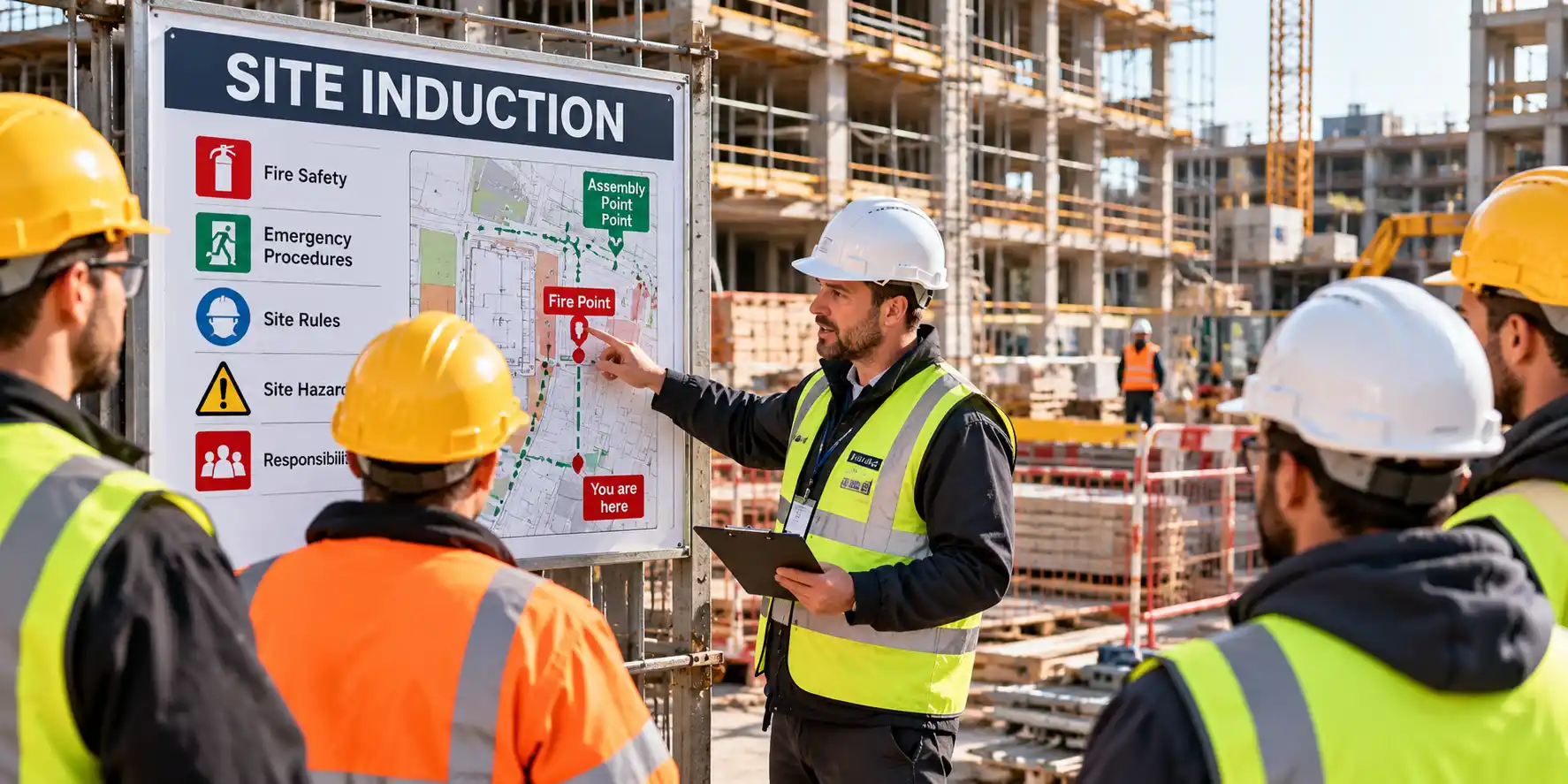
Explain the site layout and hazards
Identify the work areas, restricted locations, combustible storage areas, hot work zones and relevant temporary installations. Explain how nearby activities could affect the contractor’s work.
Explain alarms and emergency communication
Workers should know how a fire warning is given, how to raise the alarm, who should be notified and how emergency services are contacted through the site’s arrangements. The warning method must be suitable for the noise levels and layout.
Show escape routes and assembly points
Explain the relevant emergency exits, escape routes and assembly point. Workers must understand that routes must remain clear and that they should not return to the affected area until authorised to do so.
Explain fire points and equipment limitations
Identify relevant fire points and explain the site’s rules for firefighting equipment. Workers must not be expected to tackle a fire beyond their competence or place themselves at risk.
Explain reporting procedures
Contractors should know how to report blocked exits, damaged electrical equipment, missing fire protection, unsafe storage and other hazards. They should also understand how to report incidents and near misses.
Check understanding and accessibility
Provide additional explanation, translations or visual information where necessary. A signed induction register records attendance but does not, by itself, demonstrate that the worker understands the instructions.
Who Is Responsible for Fire Safety on a Construction Site?
Fire safety responsibilities are shared, but each role should be clearly defined. Legal duties vary according to jurisdiction, project arrangements and the degree of control an organisation has over the work.
| Role | Typical responsibilities |
|---|---|
| Client or project owner | Establish appropriate project arrangements and coordinate appointments and duties as required by applicable law. |
| Principal contractor or site management | Coordinate construction-phase arrangements, site rules, inductions, emergency procedures and monitoring within their responsibilities. |
| Individual contractor | Plan and supervise work safely, provide appropriate information and comply with site requirements. |
| Subcontractor supervisor | Brief the team, check task precautions, monitor work and report changing conditions. |
| Workers and operatives | Follow instructions, use equipment safely, maintain housekeeping and report hazards promptly. |
| Competent fire safety adviser | Provide specialist advice or assessment when appointed and suitably qualified for the work. |
Principal contractor responsibilities
On UK projects involving more than one contractor, the principal contractor has duties under the Construction (Design and Management) Regulations 2015 to plan, manage and monitor the construction phase. Relevant arrangements include site rules, inductions and coordination of health and safety.
Individual contractor responsibilities
Contractors must identify the risks created by their activities, provide appropriate information and supervision to workers under their control, use suitable equipment and comply with the site’s arrangements. Required permits and precautions must be in place before work begins.
Subcontractor and worker responsibilities
Subcontractors should explain both company procedures and site-specific rules. Workers should report unsafe conditions and follow applicable stop-work arrangements. If conditions change, the work should be reassessed before continuing.
Read the HSE’s guidance on contractor duties under CDM 2015 for further information about the UK framework.
How to Conduct a Fire Risk Assessment for Contractor Activities
A fire risk assessment identifies potential ignition sources, combustible materials, people who could be harmed and the controls needed to reduce the risk. It should consider both the overall site and the specific work being undertaken.
- Identify ignition sources and fuel. Consider hot work, temporary heaters, electrical equipment, flammable liquids, timber, packaging and waste.
- Identify people at risk. Consider contractors, employees, visitors, delivery drivers, building occupants and members of the public.
- Evaluate existing precautions. Check storage, permits, warning arrangements, firefighting equipment and escape routes.
- Specify corrective actions. Record the problem, required control, responsible person and target completion time.
- Review changing conditions. Reassess significant changes in work activities, materials, building layout or fire protection arrangements.
Do not assume that a control is effective simply because it appears in a written document. Confirm that it is available, accessible, understood and maintained.
The HSE’s HSG168 construction fire safety guidance explains why fire prevention and protection arrangements need to reflect changing construction conditions.
Hot Work Safety: Permits, Fire Watches and Post-Work Checks
Hot work requires particular attention because sparks, molten metal and conducted heat may ignite materials beyond the immediate work area. A fire can also develop after the activity ends, especially when combustible materials are concealed behind walls, ceilings or floor coverings.

Before hot work begins
- Consider whether the work can be avoided or completed in a safer location.
- Obtain the required permit and confirm the authorised work area.
- Remove combustible materials or protect them effectively.
- Check adjacent rooms, concealed spaces and other locations that sparks or heat could affect.
- Provide suitable firefighting equipment and fire watch arrangements where required.
- Confirm that escape routes and necessary warning systems remain effective.
During hot work
Workers must follow the authorised method and remain alert to changing conditions. Work should stop if required precautions are disturbed, combustible materials enter the area or another unsafe condition develops.
After hot work has finished
Follow the permit and risk assessment for post-work checks, monitoring periods and permit closure. The responsible person should inspect the relevant work area and any adjacent or concealed spaces that could have been affected.
Managing Flammable Materials and Combustible Waste
Effective material management reduces the fuel available to a fire and helps prevent ignition sources from coming into contact with hazardous substances.
Use designated storage areas
Storage should reflect the properties of the materials, manufacturer instructions, ventilation needs and applicable requirements. Fuels, gas cylinders, flammable liquids and chemical products may require different controls.
Limit materials in active work areas
Bring only the materials reasonably required for the immediate task into the work area wherever practicable. Avoid accumulating excess packaging, timber, adhesives or flammable products around equipment that generates heat or sparks.
Remove waste regularly
Establish who removes waste, where it is temporarily stored and how it is disposed of. Oily or solvent-contaminated rags may present additional hazards and should be handled according to their properties and applicable procedures.
Maintain site security
Outside working hours, secure materials and equipment according to the site security plan. Depending on the risk assessment, additional controls may include access control, lighting, alarms or security patrols.
Fire Protection, Escape Routes and Emergency Procedures
Preventing fires is the priority, but contractors must also know how to respond if prevention measures fail. Emergency arrangements should reflect the site layout, workforce, activities and changing construction conditions.
Keep escape routes available
Escape routes should remain usable, appropriately identified and suitable for the current site layout. Materials, cables and equipment must not obstruct emergency exits, stairways or corridors.
Provide effective warning arrangements
The alarm or warning method must be appropriate for the site’s size, noise levels and layout. Arrangements should account for enclosed work areas, shift work and locations where fewer supervisors may be present.
Maintain appropriate firefighting equipment
The type, location and quantity of equipment should be based on the risk assessment and applicable requirements. Equipment must be accessible, maintained and suitable for the hazards present.
Follow the evacuation procedure
If a fire is discovered, workers should raise the alarm, alert others where safe, evacuate by an appropriate route and report to the designated assembly point. They must not delay evacuation to collect tools or belongings.
Account for workers and visitors
Site arrangements should explain how people are accounted for after evacuation. Missing-person information should be passed to the emergency coordinator or responding emergency services. Nobody should re-enter an unsafe area without appropriate authorisation.
Fire Safety in Occupied Buildings and Refurbishment Projects
Refurbishment and maintenance projects can take place while offices, shops, residential areas or other parts of a building remain occupied. Contractors must therefore consider the risks to people who are not directly involved in the construction work.
Coordinate with building management
Before work begins, confirm access restrictions, alarm arrangements, evacuation routes, emergency contacts and procedures for modifying fire protection systems.
Control fire protection impairments
Fire alarms, sprinklers, smoke control systems and fire doors must not be disabled, obstructed or modified without appropriate authorisation and precautions. Any unavoidable impairment should be managed formally, with suitable temporary measures and arrangements for restoration and testing.
Protect fire separation and escape routes
Work that penetrates walls, floors, ceilings or service risers may compromise fire separation if openings are not properly managed and reinstated. Contractors should follow approved specifications for fire-stopping and ensure that escape routes remain available.
For further guidance, consult the HSE’s construction fire safety guidance.
Common Fire Safety Mistakes Contractors Should Avoid
Starting hot work without checking
Sparks and heat may affect nearby or concealed combustibles. Check the area, establish required controls and obtain authorisation before starting.
Allowing waste to accumulate
Combustible debris increases the available fuel and may obstruct evacuation. Assign housekeeping responsibilities and remove waste regularly.
Treating induction as paperwork
A signed register does not prove understanding. Explain actual site arrangements, check comprehension and provide additional instruction where needed.
Blocking escape routes
Deliveries and installation work can obstruct routes during the shift. Inspect exits and access routes regularly.
Ignoring changing conditions
New trades, materials and temporary shutdowns can introduce hazards. Review precautions when significant changes affect fire risk.
Failing to close corrective actions
Identifying a hazard is not enough. Assign responsibility, set a completion target and verify that the problem has been resolved.
Practical Fire Safety Checklists for Contractors
Checklists help translate written procedures into actions that workers and supervisors can verify. Adapt the following examples to the project, the task and applicable requirements.
Contractor induction checklist
Use this checklist when preparing or reviewing a site-specific fire safety induction.
Daily fire safety inspection checklist
Supervisors should check the conditions relevant to their site before work begins and throughout the shift.
Inspection records should identify the date, location, person completing the check, findings, action owner, target completion date and confirmation that corrective action has been completed.
How to Improve Fire Safety for Contractors Across a Project
Integrate fire safety into project planning
Review planned activities, temporary facilities, material deliveries and the status of permanent fire protection before work begins. Early planning makes it easier to identify conflicts between trades and introduce appropriate controls.
Coordinate contractors through regular briefings
Communicate changes to escape routes, work areas, material storage and fire protection arrangements. Short, focused briefings help workers understand what has changed and what action they need to take.
Monitor performance and correct problems
Review inspection findings, incidents and near misses to identify recurring problems. Repeated blocked exits or incomplete hot work checks may indicate that responsibilities, training or supervision need improvement.
Provide suitable training
Training should reflect the hazards and responsibilities of each role. General induction may need to be supplemented by task-specific instruction, permit procedures or competency assessment. Keep appropriate records and verify that workers can apply procedures in practice.
Review arrangements when work changes
Fire safety is a continuous management process. Revisit assessments and controls when the site layout changes, new materials are introduced, work activities are modified or an incident reveals a weakness in the existing arrangements.
Frequently Asked Questions About Fire Safety for Contractors
What are the essential fire safety rules for contractors?
Essential rules include controlling ignition sources, following required hot work procedures, storing combustible materials safely, maintaining housekeeping, keeping escape routes clear and following emergency arrangements. Contractors must also report hazards and comply with applicable risk assessments and site instructions.
What should a contractor fire safety induction include?
A site-specific induction should explain fire hazards, prevention rules, alarm signals, escape routes, assembly points, emergency contacts, fire points, hot work controls and reporting procedures. It should address the actual hazards and arrangements relevant to the work.
Who is responsible for fire safety on a construction site?
Responsibilities are shared between relevant project organisations and individuals, including clients, principal contractors, individual contractors, subcontractors and workers. The precise legal duties depend on the applicable legislation, project structure and the role of each party.
Is a hot work permit required for every construction task?
No. Formal permits are used for specified activities and circumstances according to the site’s procedures and risk assessment. Where a permit is required, authorisation and precautions must be in place before work begins.
How often should contractors receive fire safety inductions?
Contractors should receive appropriate site-specific induction before beginning work, according to applicable arrangements. Additional briefings or refresher instruction may be needed when site conditions change, new hazards arise or emergency procedures are revised.
What should a contractor do if a fire breaks out?
Follow the site’s emergency procedure, raise the alarm, alert others where safe, evacuate using an appropriate route and report to the designated assembly point. Follow the established arrangements for contacting emergency services and do not re-enter an unsafe area without authorisation.
What are common fire hazards for contractors?
Common hazards include hot work, faulty electrical equipment, temporary heaters, flammable liquids and gases, combustible packaging, waste accumulation and unauthorised ignition sources. The actual risk depends on the activity, materials and effectiveness of controls.
How can contractors improve fire safety in occupied buildings?
Coordinate with building management, protect escape routes, manage fire protection impairments, control hot work and ensure that occupants remain protected. Changes to alarms, sprinklers or other protective systems should be authorised and managed using suitable precautions.
Why is housekeeping important for construction fire safety?
Housekeeping limits combustible waste, reduces opportunities for ignition and helps maintain access to exits and firefighting equipment. Regular waste removal and suitable storage are essential parts of a contractor fire safety programme.
Which guidance should construction contractors consult?
Contractors should consult applicable legislation, site procedures and relevant industry guidance. In the UK, the HSE publication Fire Safety in Construction (HSG168) is an important reference for managing fire risks during construction projects.
Conclusion: Make Fire Safety Part of Every Contractor’s Work
Fire safety for contractors depends on more than written policies and emergency equipment. It requires practical site rules, effective inductions, clear responsibilities, suitable risk assessments and consistent supervision.
Every contractor should understand the hazards associated with their work, know which precautions must be in place before starting and be able to respond appropriately when conditions become unsafe.
For site managers, the priority is to keep arrangements relevant as construction progresses. Review changing hazards, coordinate subcontractors, control hot work, maintain escape routes and ensure that identified problems are corrected promptly.
The key principle is simple: every contractor should know the rules, understand the risks and take responsibility for working safely.
Authoritative Fire Safety References
Use recognised sources to verify requirements and develop site-specific procedures.
- HSE: Fire Safety in Construction (HSG168) — construction fire risk prevention and management.
- HSE: Site Rules and Induction — construction site rules and induction arrangements.
- HSE: Construction Fire Safety — common hazards, precautions and emergency arrangements.
- HSE: Contractors under CDM 2015 — contractor responsibilities in the UK construction framework.
This article provides general information, not a substitute for a suitable site-specific risk assessment, competent professional advice or applicable legal requirements. UK guidance should not be assumed to apply unchanged in other jurisdictions.